General
Token Vesting Schedules: The Standard Cliff, Linear, and TGE Unlock Terms in 2026
More than $1 billion in scheduled token unlocks hit the market in June 2026 alone, according to unlock calendar data reported by Phemex.
Every one of those unlocks traces back to a vesting schedule someone designed years earlier, and the difference between a well-structured schedule and a sloppy one shows up directly in price action and community trust.
Streamflow, the Solana-native token operations infrastructure platform managing $269M+ in total value locked across 40,000+ projects, turns those schedules from promises into enforceable on-chain contracts.
The terms themselves have standardized. In 2026, founders, investors, and communities all expect the same vocabulary: a cliff before anything moves, linear release after it, and a defined TGE unlock at launch.
Deviating from these norms without a clear reason is one of the fastest ways to lose investor confidence before a token even trades.
This guide covers what token vesting schedules are, how cliff, linear, and TGE unlock terms work, the standard structures per stakeholder group in 2026, and how to deploy them on-chain.
Key Takeaways
Streamflow enforces token vesting schedules on-chain with audited, immutable smart contracts on Solana.
The standard 2026 structure pairs a 12-month cliff with multi-year linear vesting.
TGE unlocks stay minimal for teams and investors, larger for community allocations.
Over 40,000 projects use Streamflow for token vesting schedules, locks, and distribution.
Manual vesting spreadsheets create errors that on-chain token vesting schedules eliminate entirely.
What a Token Vesting Schedule Is and Why It Exists
Token vesting is the controlled release of tokens over time to prevent immediate selling and align long-term incentives. A vesting schedule is the specific set of rules governing that release: when tokens start unlocking, how fast they unlock, and under what conditions.
Vesting exists because a token launch concentrates enormous value in the hands of insiders on day one. Without release controls, nothing stops a team member or early investor from dumping their entire allocation into the first liquidity the market provides.
Vesting schedules solve four problems at once:
Maintain supply stability by spreading unlocks across months or years
Align stakeholder incentives with the project's long-term trajectory
Build investor and community trust through verifiable commitments
Prevent premature dumps from team and insider allocations
It is worth separating vesting from its close cousin. A token lock restricts an allocation completely until a single unlock condition is met, while vesting releases tokens gradually according to a schedule. Projects typically use token locks on Solana for treasury and liquidity commitments, and vesting for people: founders, teams, advisors, and investors.
The schedule only matters if it is enforced. Streamflow transforms vesting schedules into enforceable on-chain contracts that execute automatically, with no manual intervention required.
The Three Building Blocks: Cliff, Linear, and TGE Unlocks
Nearly every token vesting schedule in 2026 is assembled from three components. Understanding each one is the foundation for designing or evaluating any tokenomics plan.
1. The Cliff
A cliff is a period during which no tokens are released. After the cliff ends, tokens begin vesting according to the schedule. The standard for founders and core team allocations is a 12-month cliff.
The cliff serves a filtering function. Anyone who leaves the project or loses conviction inside the first year walks away with nothing, which keeps allocations concentrated among people still building. Many cliff structures also release a meaningful tranche the moment the cliff expires, then continue linearly from there.
For a deeper breakdown of how cliffs interact with release curves, see what is cliff vesting.
2. Linear Vesting
Linear vesting releases tokens continuously and evenly across the vesting period. A 4-year linear schedule on 48 million tokens releases 1 million tokens per month, every month, with no acceleration and no gaps.
Linearity is the market's default because it is predictable. Traders, market makers, and communities can model exactly how much new supply arrives each week, which removes the shock factor that large cliff-style unlocks create. The combination that dominates term sheets in 2026 is cliff plus linear: a 12-month cliff followed by linear release over the remaining vesting period.
3. TGE Unlocks
The TGE unlock is the percentage of an allocation released at the Token Generation Event, the moment the token goes live. It answers a simple question for every stakeholder: how much do I get on day one?
TGE unlock norms diverge sharply by stakeholder group. Team and investor allocations conventionally receive little or nothing at TGE, since a large insider unlock at launch signals exit intent. Community, liquidity, and public sale allocations receive larger TGE unlocks because the token needs circulating supply to trade and the community expects immediate access.
Every unlock event that follows TGE is downstream of these three choices.
Standard Vesting Terms by Stakeholder Group in 2026
Vesting strategy is designed per stakeholder group, not per project. The table below reflects the structures that have become conventional across launches in 2026. Treat them as the baseline the market expects, then adjust for your specific situation.
Stakeholder group | Typical TGE unlock | Typical cliff | Typical vesting period |
Founders | None | 12 months | 3 to 4 years linear |
Core team | None | 12 months | 3 to 4 years linear |
Advisors | None or minimal | 6 to 12 months | 2 to 3 years linear |
Investors | None or minimal | 12 months | 2 to 4 years linear |
DAO treasury | Minimal | Varies | Multi-year, governance-controlled |
Ecosystem incentives | Partial | Often none | Released against programs |
Public sale | Partial to full | Short or none | Under 1 year if any |
Three patterns are worth calling out:
Founder and team terms are now the strictest in the entire allocation, because the market punishes anything that looks like an insider fast exit.
Investor terms have largely converged with team terms, and sophisticated funds increasingly accept longer schedules as a signal of shared conviction.
Longer-than-standard schedules have become a differentiation strategy.
Committing to 4 or 5 years when the norm is 3 tells the market the team is building a company, not an exit.
Streamflow supports every structure in this table, including graded vesting, milestone-based vesting, and price-based vesting for teams that want releases tied to outcomes rather than dates alone.
Example: A Standard Token Vesting Schedule in Practice
The fastest way to understand how cliff, linear, and TGE terms interact is to run the numbers on a full launch. Take a hypothetical project with a total supply of 1 billion tokens, allocated across five stakeholder groups using the standard 2026 terms from the table above.
Allocation | Tokens | TGE unlock | Cliff | Vesting after cliff |
Founders and core team | 200M (20%) | 0 | 12 months | 36 months linear |
Investors | 150M (15%) | 0 | 12 months | 24 months linear |
Ecosystem incentives | 250M (25%) | 25M (10%) | None | Released against programs |
Community airdrop | 150M (15%) | 75M (50%) | None | 75M over 6 months linear |
Treasury | 250M (25%) | 0 | Locked | Multi-year, governance-controlled |
What Happens at TGE
On launch day, circulating supply is 100 million tokens: 25 million from ecosystem incentives and 75 million from the community airdrop. That is 10% of total supply, enough for the token to trade with real liquidity. Not a single founder, team, or investor token is in circulation.
What Happens During the Cliff Year
From month 1 to month 6, the remaining airdrop allocation releases linearly at 12.5 million tokens per month, and ecosystem tokens flow out as incentive programs run.
From month 7 to month 12, insider-adjacent supply goes quiet and new circulation comes only from ecosystem programs.
Team and investor allocations release nothing for the entire first year.
What Happens After the Cliff
At month 12, both cliffs expire and linear vesting begins. The team's 200 million tokens release at roughly 5.56 million per month over 36 months, and the investors' 150 million release at 6.25 million per month over 24 months. Combined insider flow is roughly 11.8 million tokens per month, about 1.18% of total supply, a rate the market can price in rather than fear.
Investors fully vest at month 36 and the team fully vests at month 48. That is 48 consecutive months of releases that must execute exactly on schedule, across dozens of individual wallets, without a single error.
This is precisely the multi-year execution burden that on-chain enforcement exists to carry, which is where the next section picks up.
How Vesting Schedules Are Enforced On-Chain
A schedule written in a term sheet is a promise. A schedule deployed as a smart contract is a guarantee, and the gap between the two is where projects get into trouble.
Off-chain vesting relies on spreadsheets, scheduled transfers, and internal tooling. It carries high error risk, offers no on-chain proof, and requires stakeholders to trust that the issuer will execute correctly month after month. On-chain vesting is enforced by smart contracts, immutable once deployed, and publicly verifiable by anyone.
Streamflow's vesting contracts are built for exactly this enforcement role:
Audited smart contracts, reviewed by FYEO and OPCODES
Immutable once deployed, with no admin override and no unilateral changes
Every release verifiable on Solscan or Solana Explorer
Shareable proof links so investors and communities can confirm terms themselves
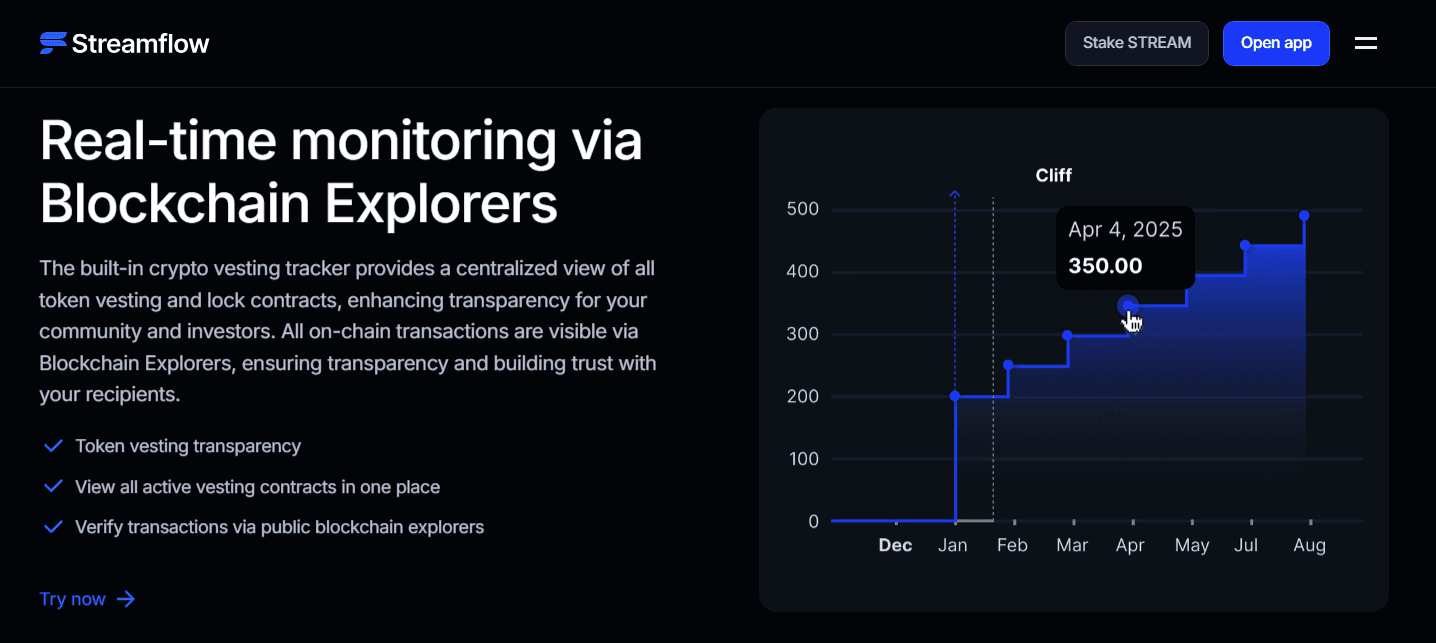
Transparency compounds the enforcement benefit. A real-time tokenomics dashboard gives teams and communities a single view of vesting contracts, cliff dates, release progress, and upcoming unlock events. Instead of fielding investor questions about when supply moves, teams point to a public source of truth.
Solana makes this practical at scale. With sub-second finality and near-zero fees, running hundreds of individual vesting contracts costs a fraction of equivalent setups on other chains. This is why Streamflow is listed in the official Solana Docs as a core token vesting tool in the ecosystem.
How to Set Up a Token Vesting Schedule With Streamflow
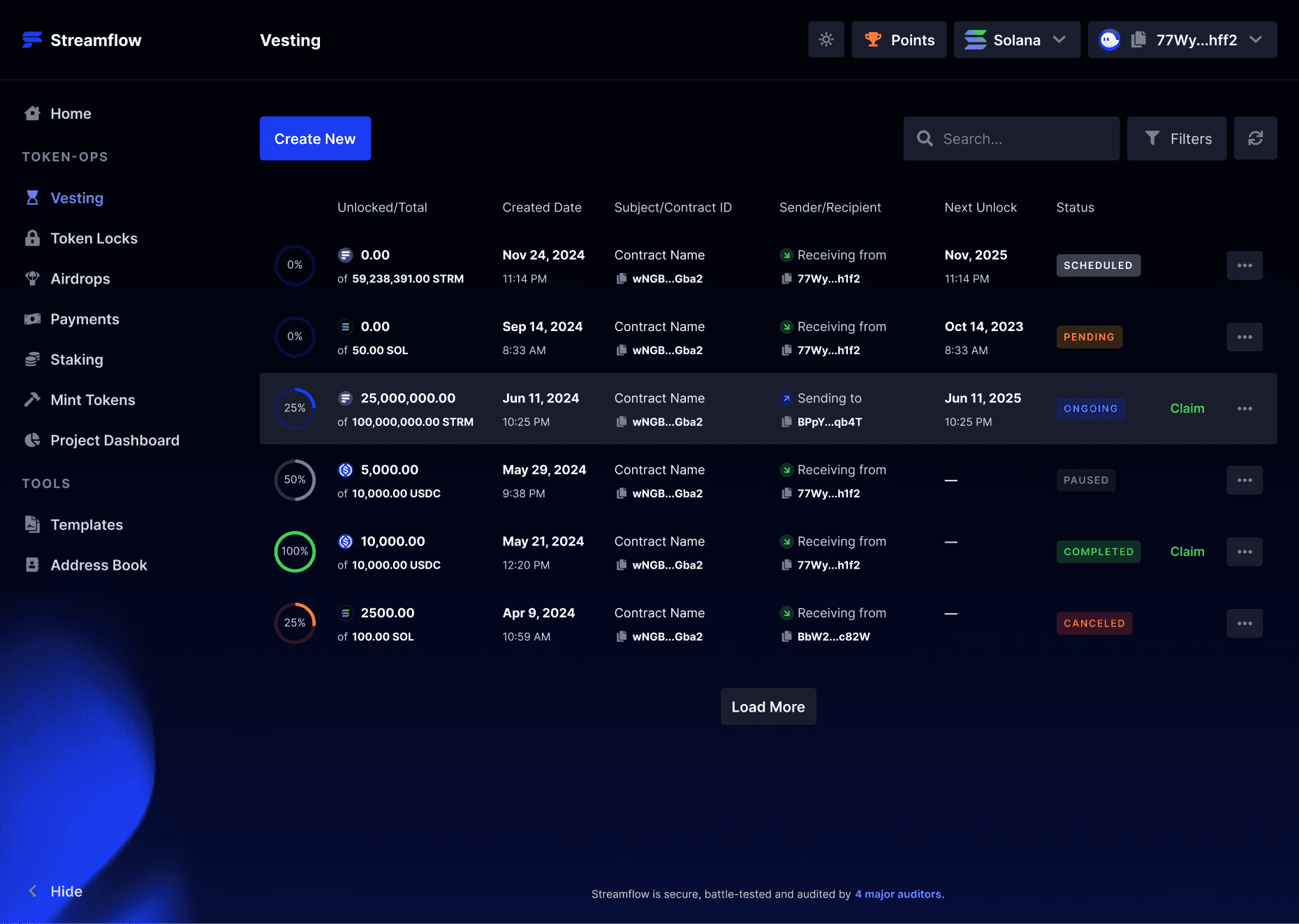
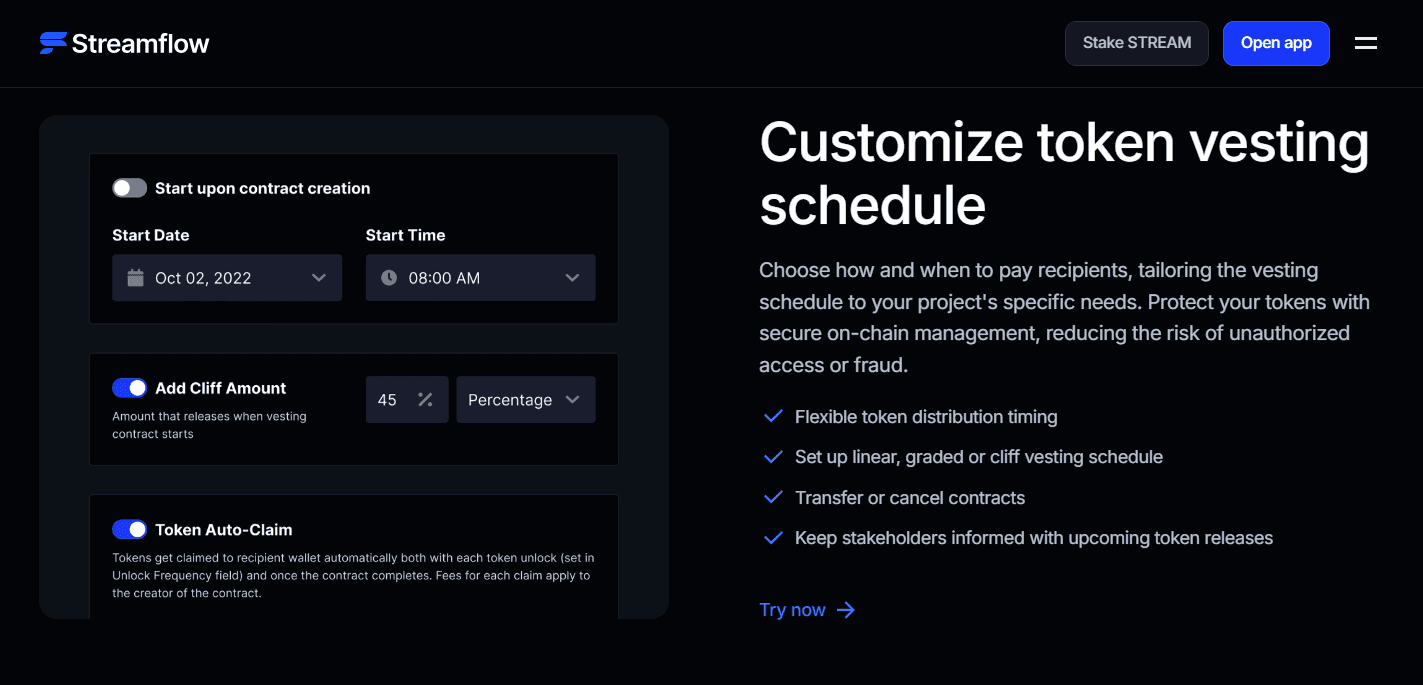
Deploying the standard cliff, linear, and TGE structure does not require writing a smart contract. Streamflow's no-code flow takes a schedule from design to on-chain enforcement in five steps:
Create a vesting contract through the Streamflow interface
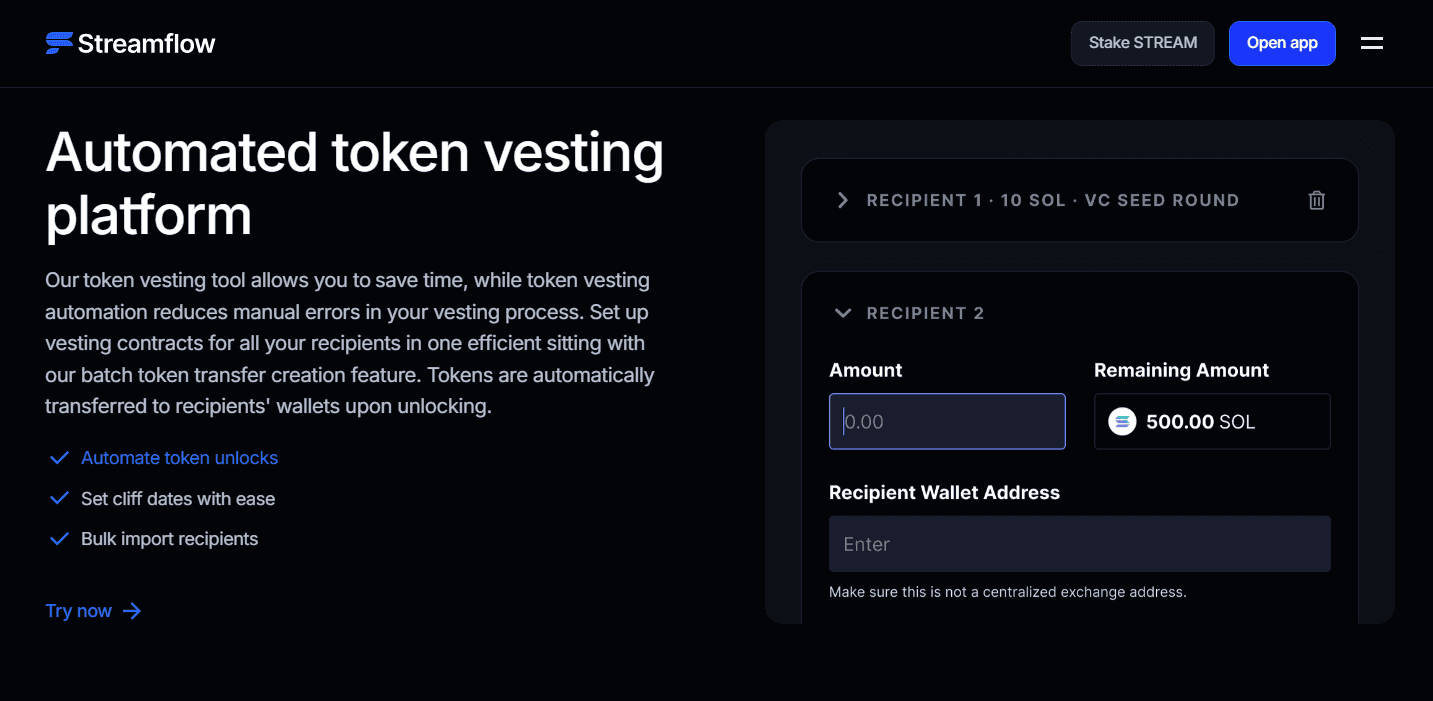
Upload recipients, individually or in bulk via CSV import
Define the schedule: TGE unlock, cliff length, vesting duration, and release interval
Fund the contract with the allocated tokens
Tokens release automatically according to the schedule, with no further action needed
Configuration covers every standard 2026 term. Teams can set linear, cliff, cliff plus linear, graded, milestone-based, or price-based models, apply custom release intervals, and manage each stakeholder group under its own terms. Contract-level options include vesting top-ups, ownership transfer, and cancellation rights if they were allowed at contract setup.
Connect any Solana wallet, including Phantom, Backpack, and Solflare, and create a vesting schedule on Streamflow directly in the app. For teams with in-house engineers, the SDK supports custom vesting logic and direct integration into your own dApp or claim experience.
Founders thinking past the launch can also manage the broader financial stack, from treasury management to on-chain cap tables and tokenized SAFEs, through Streamflow Business.
Vesting is one component of a company's ownership structure, not the whole of it.
How Real Projects Structure Vesting: Bonk, UXD, and Heavenland
The standard terms are not theoretical. They show up, with deliberate variations, in some of Solana's most recognizable launches.
Bonk allocated 20% of its total supply to 22 early contributors on a 3-year linear vesting schedule, all executed through Streamflow. For a meme coin, where insider dumps are the default community expectation, provable vesting became a trust signal that separated the project from the category.
UXD Protocol ran the textbook institutional structure: approximately 46% of $UXP supply on 4-year linear vesting with a 12-month cliff, the exact cliff-plus-linear standard this article describes. UXD also integrated the Streamflow SDK into Realms, so stakeholders claim vested tokens and participate in governance in the same interface.
Heavenland went further than the standard, placing 97% of its $HTO supply on 5-year linear vesting with cliffs applied across all allocations. The structure allowed initial liquidity without excessive inflation, and the outcome was a more engaged and dedicated player community.
Three different projects, three different risk profiles, one shared principle: the schedule was enforced on-chain, not promised in a document.
Common Token Vesting Schedule Mistakes to Avoid in 2026
Even with standardized terms, teams keep making the same structural errors. Each one is avoidable at design time:
Oversized TGE unlocks for insiders, which read as exit liquidity and invite immediate sell pressure
No cliff on team allocations, removing the commitment filter the market expects
Massive cliff-expiry unlocks with no linear taper, creating a single supply shock the whole market can front-run
Manual execution via spreadsheets and scheduled transfers, where one wrong wallet address or missed month destroys credibility
No public verifiability, leaving communities to trust claims instead of checking contracts
The common thread is that token vesting schedules fail at the execution layer more often than the design layer. A reasonable schedule executed manually is riskier than a mediocre schedule enforced by an immutable contract, because manual errors, incorrect vesting, and lost transparency compound over a multi-year period.
This is the reason automated token vesting has become the default for serious launches.
Conclusion
Token vesting schedules in 2026 have a clear standard: minimal TGE unlocks for insiders, a 12-month cliff, and multi-year linear release, with community allocations on more open terms.
With over $1 billion in unlocks hitting the market in a single month, the projects that stand out are the ones whose schedules are enforced by immutable smart contracts rather than promises.
Streamflow executes those schedules on-chain across 40,000+ projects, with audited contracts and public verifiability built in.
Book a demo to see how Streamflow handles cliff, linear, and TGE unlock schedules for every stakeholder group in your token launch.
Read Next:
FAQs:
1. What is the standard token vesting schedule in 2026?
The standard token vesting schedule in 2026 pairs a 12-month cliff with 3 to 4 years of linear vesting for founders, core teams, and investors, with little or no TGE unlock. Community and public sale allocations typically receive partial TGE unlocks with shorter or no vesting. Longer schedules are increasingly used as a trust signal.
2. What is the difference between a cliff and a TGE unlock?
The difference between a cliff and a TGE unlock is timing and direction. A TGE unlock is the portion of an allocation released immediately when the token launches, while a cliff is a period after launch during which no tokens from that allocation are released at all. Most team allocations combine a zero TGE unlock with a 12-month cliff.
3. How does Streamflow handle token vesting schedules on Solana?
Streamflow handles token vesting schedules on Solana through audited smart contracts that execute releases automatically. Teams create contracts through a no-code interface or the SDK, upload recipients in bulk, define cliff, linear, and TGE terms, and fund the contract. Every release is verifiable on Solscan or Solana Explorer.
4. Can a Streamflow vesting contract be changed after deployment?
A Streamflow vesting contract cannot be unilaterally changed after deployment. Contracts are immutable once deployed, with no admin override, which is what makes them credible to investors and communities. Cancellation and ownership transfer are possible only if those permissions were explicitly enabled during contract setup.
5. How much does token vesting on Streamflow cost?
Token vesting on Streamflow costs a smart contract creation fee plus Solana transaction fees, which are near zero. Running vesting on Solana is dramatically more cost-efficient than equivalent setups on Ethereum.