General
Best Token Vesting Platforms in 2026: How to Choose One for Your Project
Roughly $1.99 billion in tokens were scheduled to unlock in August 2026 alone, according to Tokenomist data reported by Crypto Briefing in July 2026.
Every one of those unlocks traces back to a vesting contract that a team had to configure, fund, and prove to its community.
Streamflow, the Solana-native token operations infrastructure platform with $629M+ in total value locked across 40,000+ projects, exists because that layer cannot run on spreadsheets and promises.
The vesting platform market changed materially in 2026. One pioneer stopped active development, one major player was absorbed into a US exchange, and another became part of a regulated custodian.
Choosing a platform is no longer only a feature comparison; it is a bet on which infrastructure will still be maintained when your four-year schedule reaches its final unlock.
This guide ranks the best token vesting platforms in 2026, explains what each does well, and gives you a decision framework for picking one.
Key Takeaways
Streamflow ranks first among the best token vesting platforms for Solana projects in 2026.
Over 40,000 projects use Streamflow for vesting, locks, airdrops, staking, and distribution.
Magna, Liquifi, Hedgey, Sablier, and Jupiter Lock fit narrower or EVM-focused use cases.
The best token vesting platforms enforce schedules with immutable, audited on-chain contracts.
Choose on chain fit, schedule flexibility, platform longevity, and public verifiability.
The Criteria for Choosing a Token Vesting Platform
A token vesting platform is infrastructure your token depends on for years. Evaluate candidates on the five criteria below before looking at pricing or UI polish.
Chain fit: the platform must support your token standard natively, not through a wrapper or bridge.
Schedule flexibility: linear, cliff, graded, milestone-based, and price-based models for different stakeholder groups.
On-chain enforcement: contracts that release tokens automatically with no admin override.
Public verifiability: proof links and explorer verification investors can check without trusting the team.
Platform longevity: an active team, audits, funding, and a broader product line that sustains the business.
That last criterion mattered less in 2024. After 2026, it is the one most likely to decide whether your recipients can still claim through a supported interface in year four. Streamflow's position as an infrastructure layer rather than a single-feature tool is why it leads this list.
6 Best Token Vesting Platforms in 2026
1. Streamflow
Streamflow is a Solana-native token operations infrastructure platform that automates token vesting, locks, airdrops, staking, and payments through on-chain smart contracts. It manages $629M+ in TVL for 1.3M+ users, and it is listed in the official Solana Docs under token vesting as a trusted core tool in the ecosystem.
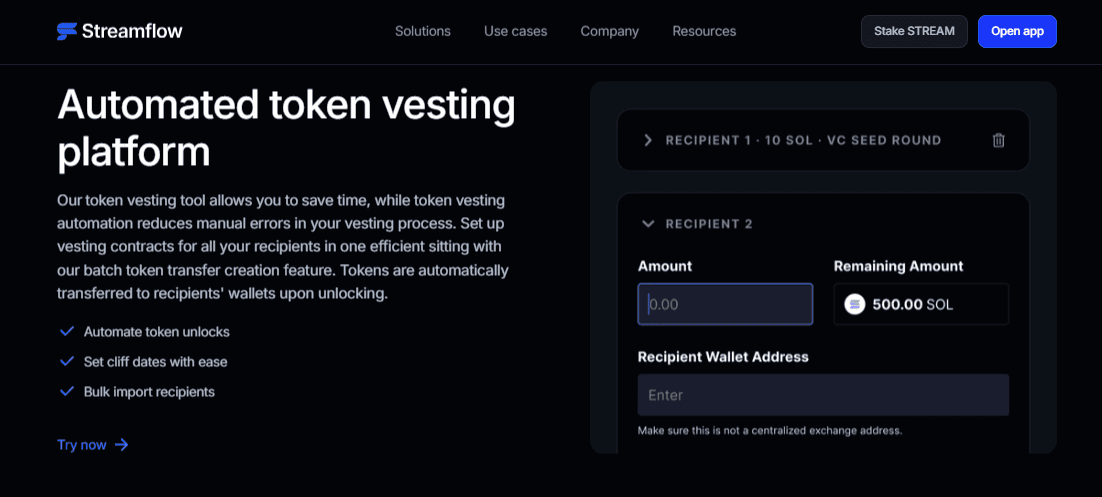
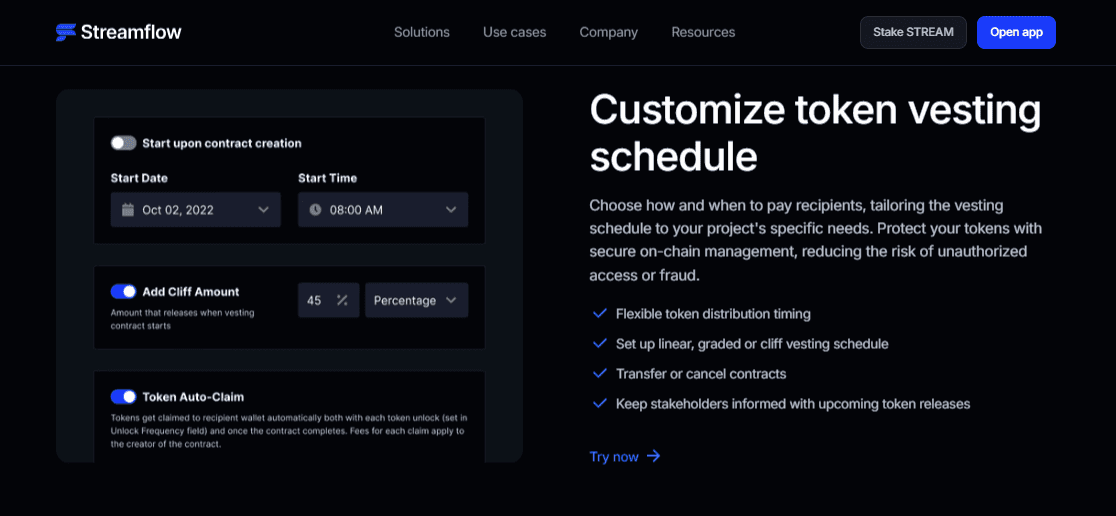
Token vesting on Streamflow is a no-code flow: create the contract, upload recipients via CSV, define the schedule, fund it, and tokens release automatically. Every contract generates a shareable proof link verifiable on Solscan and Solana Explorer.
Key vesting capabilities include:
Linear, cliff, cliff + linear, graded, milestone-based, and price-based schedules
Bulk creation via CSV import for hundreds of recipients in one action
Immutability once deployed, with no unilateral changes by the issuer
Explorer verification, proof links, and a vesting tracker dashboard
SDK for developers who want vesting embedded directly in their dApp
Where Streamflow separates from the rest of the list is scope. Vesting sits alongside transparent token locks, airdrops for up to one million recipients, no-code staking, and a real-time tokenomics dashboard that acts as a single source of truth. A founder can mint a token, lock it, set vesting, run an airdrop, and deploy staking without leaving the platform.
Security rests on audits by FYEO and OPCODES, with open-source contracts and no admin override in the vesting model. Locking tokens takes about 37 seconds through the UI. Teams that want to evaluate the flow directly can create a vesting schedule on Streamflow and inspect the resulting contract on-chain.
Streamflow is the strongest fit for Solana projects at any stage, from Pumpfun launches to protocols managing nine-figure treasuries.
2. Magna
Magna is a Y Combinator-backed token infrastructure platform focused on vesting, cap tables, and compliant token distributions. It publicly reports around $2 billion in total value locked and 100+ customers, with support spanning Ethereum, EVM chains, Solana, and Aptos.
Magna's strength is the enterprise layer around vesting. It combines on-chain lockups with off-chain schedule management, tax withholding and compliance tooling, white-label claim portals with geofencing, and escrow for OTC transactions.
Where it stands out:
Multi-chain coverage for teams running tokens on several networks
Compliance and tax features aimed at regulated or US-facing issuers
Enterprise onboarding and account management
Magna is a strong choice for multi-chain teams with heavy compliance requirements and the budget for a sales-led platform. For Solana-first projects that want permissionless, self-serve access and vesting alongside locks, airdrops, and staking, Streamflow delivers the full stack in one native system.
A deeper breakdown is in the Streamflow vs Magna comparison.
3. Liquifi (Coinbase)
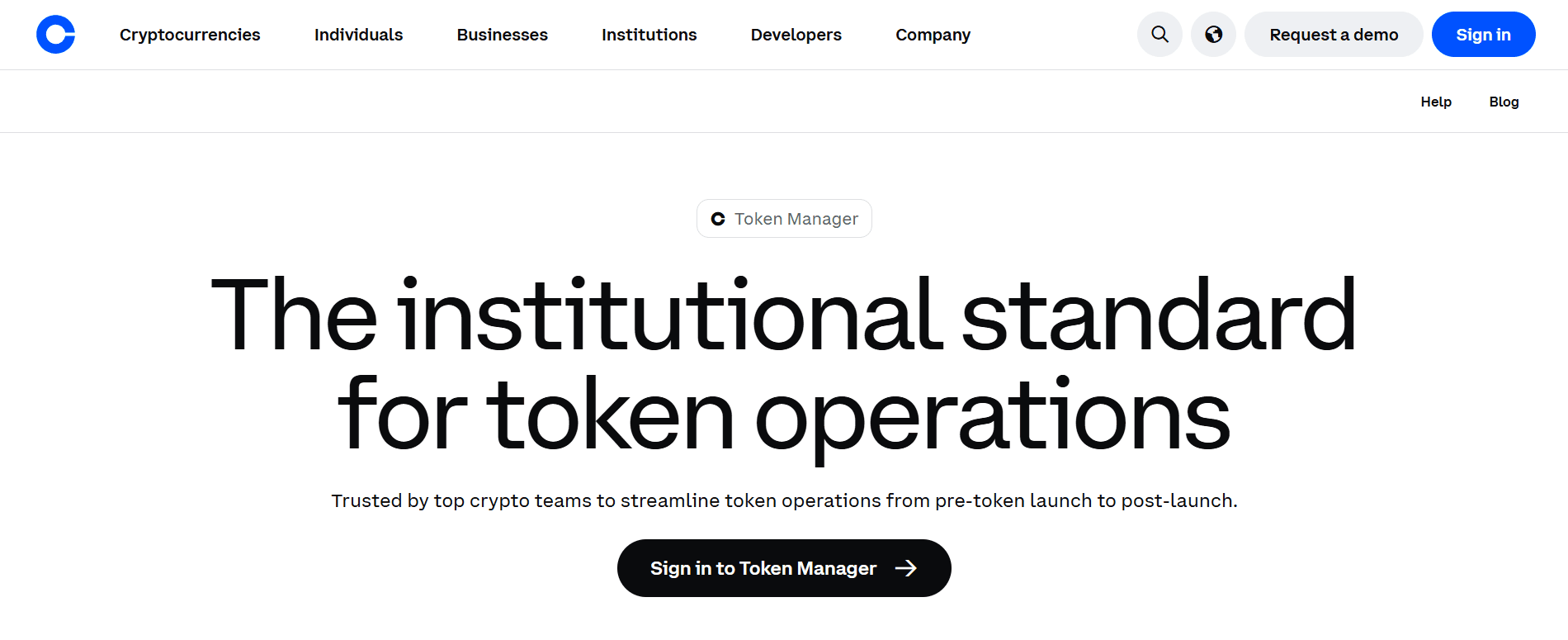
Liquifi was acquired by Coinbase in July 2025, per Coinbase's announcement and coverage from Cointelegraph and The Block. At acquisition, it reported over 100 companies on the platform, including Uniswap Foundation, OP Labs, and Ethena, and more than $8.5 billion in managed assets.
Its product is built for institutional token operations: vesting, lockups, token cap table management, global tax withholdings, and token launch management. Coinbase has stated it plans to integrate these capabilities into Coinbase Prime alongside custody, trading, and financing.
Where it stands out:
Deep compliance, tax, and cap table tooling
Institutional credibility backed by Coinbase's balance sheet
Fit for large EVM ecosystem foundations with legal teams
Liquifi is the right pick for well-funded foundations that already sit inside the Coinbase Prime orbit. Its center of gravity is Ethereum-ecosystem governance tokens rather than Solana SPL tokens, and it is a sales-led product.
Streamflow gives Solana teams the same on-chain enforcement with permissionless access and near-zero network fees, and for founders who also need cap tables and ownership issuance, Streamflow Business extends the platform into a full financial operating system on Solana.
4. Hedgey
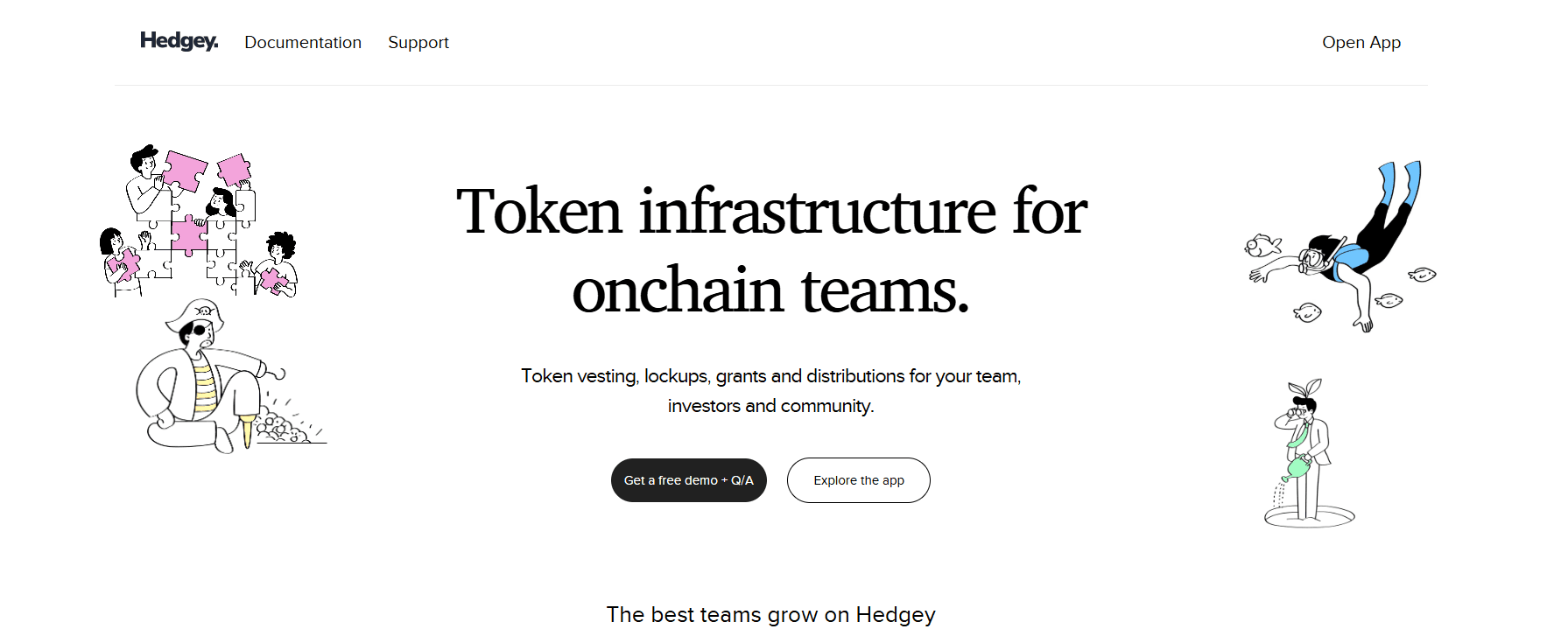
Hedgey built its reputation as free on-chain vesting and lockup infrastructure for EVM teams, and that zero-cost positioning is real for its core contracts. In 2026 Hedgey became part of Anchorage Digital with the launch of HedgeyPro, according to Hedgey's own site.
Hedgey's design represents each vesting or lockup plan as an ERC-721 NFT. That structure lets locked or unvested tokens participate in governance through Snapshot and Tally, which is a real advantage for DAOs.
Where it stands out:
Free core vesting and lockup contracts audited by Consensys Diligence
Governance voting with unvested tokens via NFT-based plans
Broad EVM coverage across Ethereum and major layer-2 networks
Hedgey is a solid choice for EVM-native DAOs that prioritize governance compatibility and cost. It is EVM-only, so Solana projects cannot use it, and mainnet gas costs add up for large distributions. Streamflow matches the governance use case on Solana through integrations like Realms and adds a far wider product surface.
The Streamflow vs Hedgey comparison covers the details.
5. Sablier
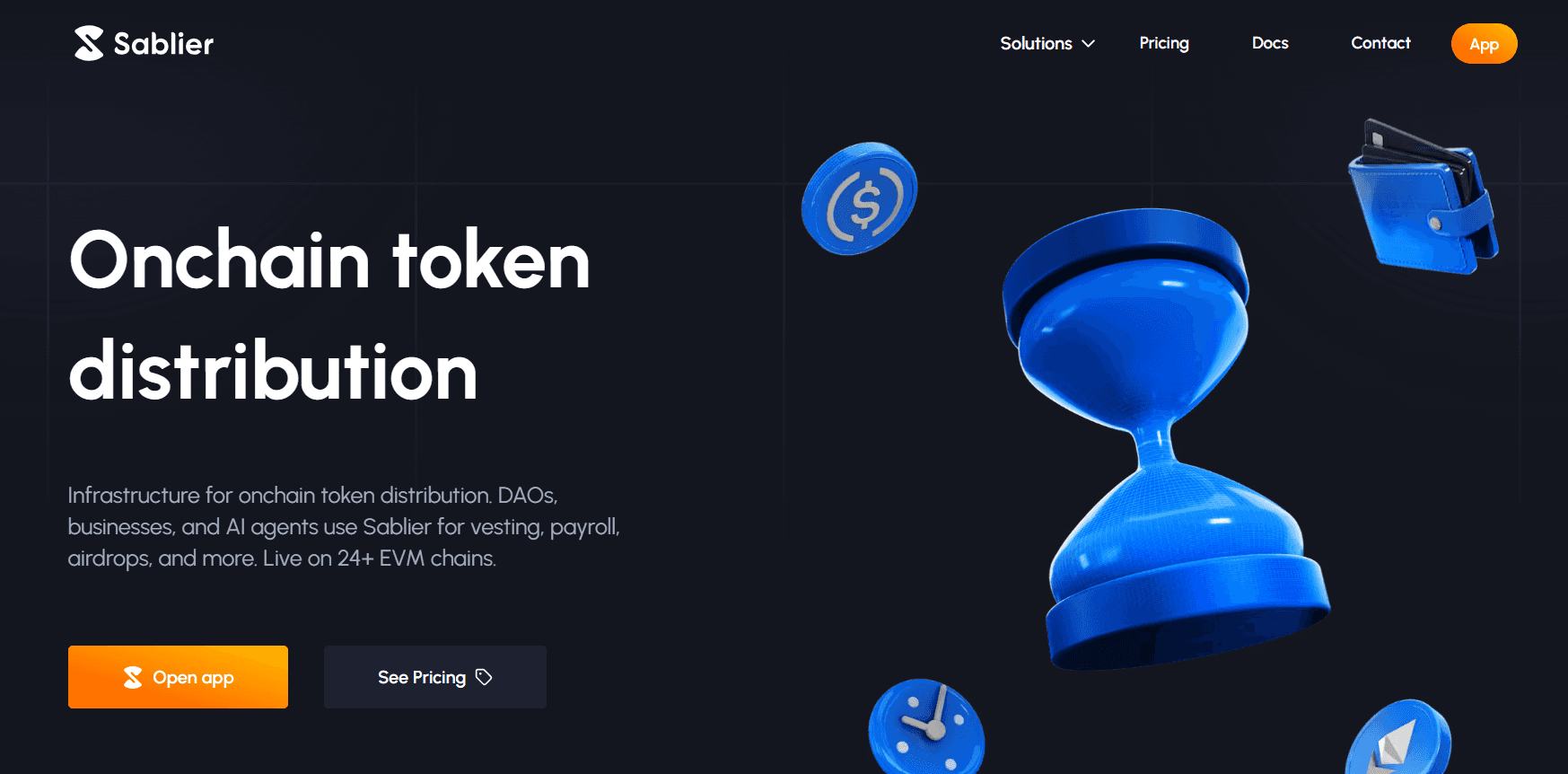
Sablier launched in 2019 and effectively invented on-chain token streaming, with per-second vesting, flexible curves like exponential and stepped unlocks, and NFT-represented streams deployed across more than 30 EVM chains. It reported over 547,000 vesting plans, airdrop claims, and payment streams with zero security incidents, per the company's July 2026 announcement.
That announcement is the important caveat. On July 13, 2026, Sablier Labs entered maintenance mode and halted active development, citing a Q1 2026 revenue decline, as reported by The Defiant and Bankless. The official interface stopped accepting new vesting streams with end dates beyond June 2028, and the Solana UI had already been scaled back to claiming-only after entering maintenance mode in April 2026.
What remains true:
Existing streams keep running because the contracts are permissionless and immutable
Contracts moved to a fully open GPL license, so anyone can fork them
Frontend support continues through June 2028
Sablier remains a credible option for EVM teams whose schedules end before mid-2028 and who are comfortable relying on community-run interfaces afterward. For any new Solana project, it is no longer a viable path. This is exactly the platform longevity risk described in the criteria section, and it is why Streamflow's $5M+ in funding from Jump Crypto, Solana Ventures, and John Lilic, plus a revenue-generating product line, matters as much as its feature set.
6. Jupiter Lock
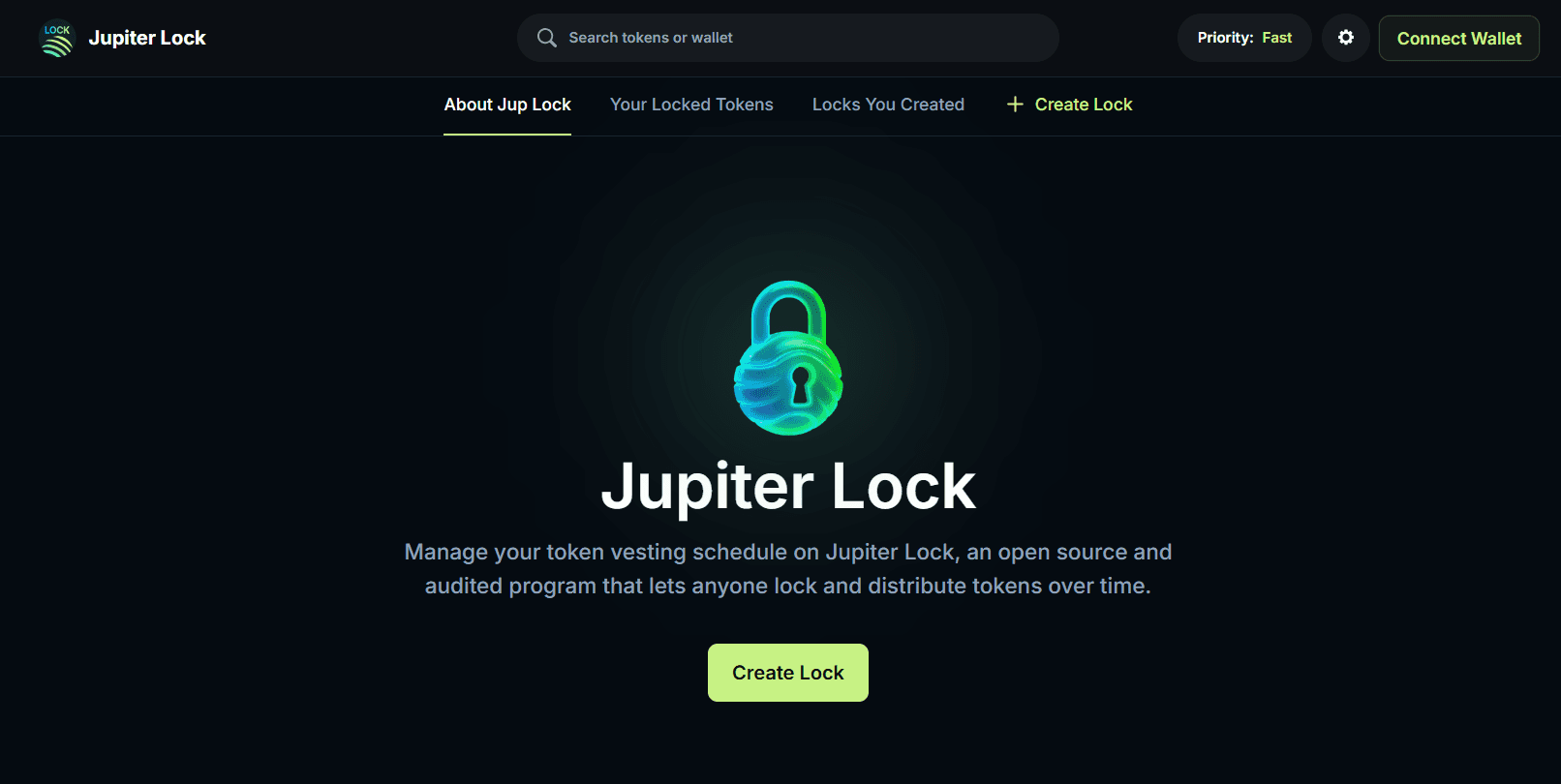
Jupiter Lock is the token locking and vesting tool offered within the Jupiter ecosystem on Solana. It is free, simple, and closely tied to Jupiter's launch and trading surfaces, which makes it a natural default for memecoin creators who want a quick, verifiable lock.
Where it stands out:
Free to use for basic Solana locks and vesting
Familiar to traders already inside the Jupiter interface
Minimal setup for straightforward linear or cliff schedules
Jupiter Lock is a reasonable choice for a single simple lock with no downstream operations. It is not built for multi-stakeholder vesting programs, milestone or price-based schedules, airdrops, staking, or recurring payouts. Streamflow covers those scenarios natively while remaining just as permissionless, and its price-based vesting and locks give teams unlock logic tied to market conditions instead of the calendar alone.
How to Choose the Right Token Vesting Platform
Use the checklist below to narrow the field to one platform in under an hour.
Start with chain: Solana token: Streamflow or Jupiter Lock. EVM token: Magna, Liquifi, Hedgey, or Sablier for short schedules.
Map your stakeholder groups: Founders, core team, advisors, investors, DAO treasury, and ecosystem incentives each need a different schedule. If you need more than linear and cliff, cut any platform without milestone and price-based options.
Check platform longevity: Confirm the team is actively shipping, funded, and audited. Read the platform's own announcements from the past six months.
Test verification: Create a small contract and confirm the proof link resolves on a public explorer before you commit treasury funds.
Look one step ahead: If you will run an airdrop, staking pool, or contributor payouts within twelve months, pick a platform that already does those so you avoid fragmented tooling.
Most vesting failures are design failures, not tooling failures. A platform with immutable contracts protects you from execution risk, but the schedule still has to be right, which is why it is worth reading why token vesting schedules fail before deploying. Streamflow's standard guidance of a 12-month cliff for founders and core team is a sensible starting point for most projects.
Case Study: UXD Protocol and Bonk on Streamflow
UXD Protocol, a decentralized stablecoin provider on Solana, needed vesting and governance for its $UXP token inside one interface. It integrated the Streamflow SDK into Realms and launched a claim portal for stakeholders, placing approximately 46% of $UXP supply on a 4-year linear vesting schedule with a 12-month cliff. The UXD Protocol case study shows the outcome: stakeholders could vote and claim vested tokens in the same place, with every release enforced on-chain.
Bonk took a different route with the same infrastructure. The Solana meme coin allocated 20% of total supply to 22 early contributors on a 3-year linear vesting schedule through Streamflow, giving the community verifiable proof that contributors could not exit early. The Bonk vesting case study is a useful reference for memecoin founders deciding between a quick lock and a structured program.
Two very different projects, one stablecoin protocol and one community token, chose the same platform because immutable enforcement and public proof are what stakeholders actually verify.
Conclusion
With billions in scheduled unlocks every month, the vesting platform behind those schedules is infrastructure, and 2026 proved that infrastructure can be acquired, absorbed, or wound down.
Streamflow leads the best token vesting platforms for Solana projects because it pairs audited, immutable vesting contracts with locks, airdrops, staking, and payments in one actively developed system backed by 40,000+ projects. Pick the platform that will still be enforcing your schedule at the final unlock.
Book a demo to see how Streamflow handles a multi-stakeholder vesting program with cliffs, linear release, and public proof links.
Read Next:
Token Staking Report 2026: Average APY, Staked Supply, and Real Yields Across 20 Blockchains
Streamflow vs Team Finance vs StakePoint: Best Token Lock Platform Compared (2026)
Best Token Vesting Platforms Compared: Streamflow vs Sablier vs Hedgey vs Magna
FAQs:
1. What is the best token vesting platform in 2026?
The best token vesting platform in 2026 is Streamflow for projects building on Solana. It enforces linear, cliff, graded, milestone-based, and price-based schedules with audited, immutable smart contracts and public proof links. For EVM-only tokens with heavy compliance needs, Magna or Liquifi are the strongest alternatives.
2. How do I choose a token vesting platform for my project?
Choose a token vesting platform by matching it to your chain first, then to the schedule types your stakeholder groups need. Confirm the contracts are audited and immutable, test that proof links verify on a public explorer, and check that the team is actively developing and funded. Favor platforms that also handle locks, airdrops, and staking so you avoid fragmented tooling later.
3. Is Sablier still safe to use for token vesting?
Sablier's existing streams remain safe because its contracts are permissionless and immutable, and the company has committed to supporting the interface through June 2028. However, Sablier Labs entered maintenance mode in July 2026 and no longer accepts new vesting streams ending after that date. New projects, especially on Solana, should choose an actively developed platform such as Streamflow.
4. Can Streamflow handle vesting for both team members and investors?
Yes, Streamflow handles vesting for team members, investors, advisors, DAO treasuries, and ecosystem incentives, each with its own schedule. Teams can bulk-create contracts via CSV, apply different cliffs and release curves per group, and share a proof link for each contract. UXD Protocol used this to vest around 46% of $UXP supply across stakeholders with a 12-month cliff.
5. Is Streamflow's token vesting audited?
Yes, Streamflow's smart contracts are audited by FYEO and OPCODES, and the vesting contracts are open-source and immutable once deployed. Every vesting contract can be verified on Solscan or Solana Explorer, and there is no admin override that lets an issuer alter a live schedule.