General
Best Crypto Staking Platforms in 2026: APY, Fees, and Lockups Compared
Roughly $245 billion of the $711 billion in circulating proof-of-stake supply is now staked, a global staking ratio of about 34.4%, according to Everstake's 2025 review and 2026 outlook published in February 2026.
Staking has become a default behavior for token holders, and Streamflow, the Solana-native token operations platform behind $633M+ in TVL and 40,000+ projects, sits at the point where that behavior meets token design.
Most "best staking platform" lists are written for someone deciding where to park SOL or ETH; this one also answers the harder question a token team faces, which is where to deploy staking for its own token.
Those are two different categories with two different economics. Liquid staking protocols and exchanges pay network yield minus a commission, and a token team's staking pool pays whatever the team funds, on whatever lock terms it sets. Comparing them on the same three variables, APY source, fee structure, and lockup terms, shows where each platform actually belongs.
The sections below rank seven platforms across both categories, then give a decision framework for founders, DAO operators, and DeFi teams.
Key Takeaways
Streamflow lets teams launch no-code staking pools for any SPL token with configurable APY and lockups.
The best crypto staking platforms in 2026 split into liquid staking, custodial exchanges, and token-staking infrastructure.
Fees on network staking range from 4% at Jito to 35% commission at Coinbase.
STREAM staking on Streamflow pays hourly, revenue-backed rewards at roughly 74.57% APY with zero dilution.
Lockup terms matter more than headline APY when the goal is reducing sell pressure.
The Criteria for Ranking Crypto Staking Platforms
Headline APY is the least reliable number in staking. Network yields move with validator performance and MEV volume, exchange rates hide commission, and a token team's pool APY depends entirely on how it is funded. Four criteria give a more accurate picture.
APY source: network issuance, MEV capture, protocol revenue, or team-funded rewards.
Fee structure: percentage of rewards taken, plus transaction and creation costs.
Lockup terms: unbonding periods, instant-exit fees, or configurable lock windows.
Custody and control: non-custodial contracts versus exchange-held balances.
A fifth criterion applies only to token teams: whether the platform can stake your token at all. Most platforms on this list stake SOL or ETH exclusively, which is why a dedicated token staking layer belongs in the same comparison.
Top 7 Crypto Staking Platforms in 2026
1. Streamflow
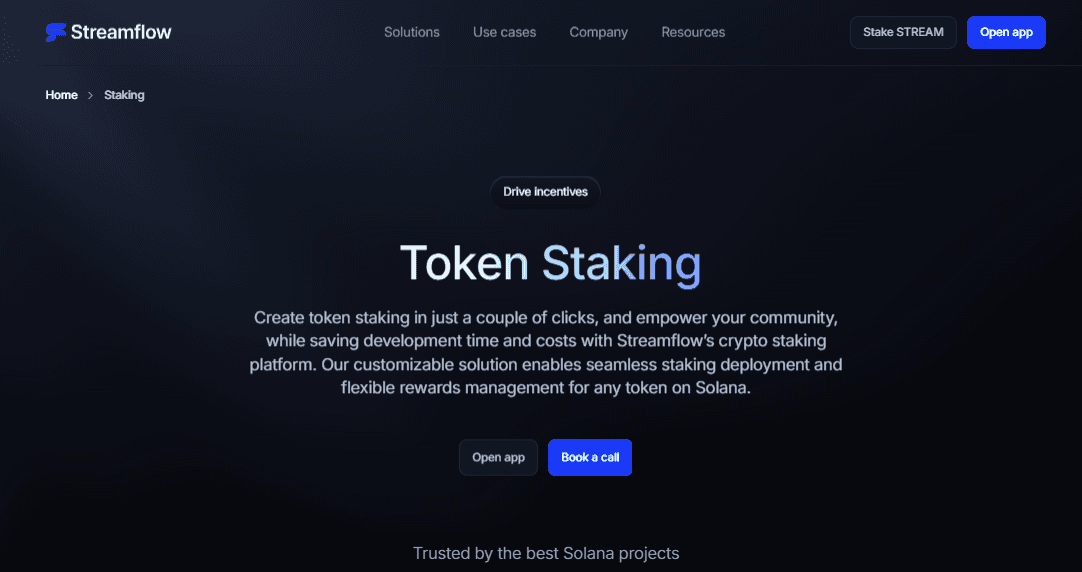
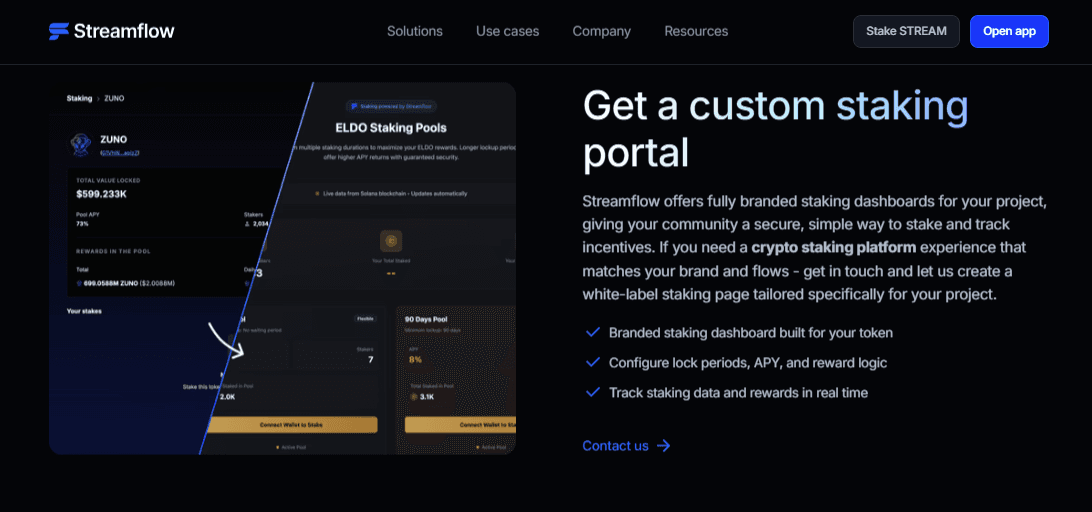
Streamflow is a Solana-native token operations infrastructure platform that automates staking, vesting, token locks, airdrops, and payments through audited on-chain smart contracts. Its staking product is different in kind from everything else on this list: instead of paying network yield on SOL, it lets any project deploy a non-custodial staking pool for its own SPL token without writing code.
Key capabilities:
Any SPL token can be staked, with permissionless pool creation and no engineering overhead.
Configurable APY, lock periods, and reward logic, with easy reward top-ups over time.
Four pool types: Fund Once, Continuous Funding, Governance Staking, and Custom.
Automated reward distribution, stake receipts, and real-time staking data.
Fully non-custodial pools with a public SDK for deeper integration.
On fees, Streamflow's cost model consists of smart contract creation fees plus Solana transaction fees, which run near zero. The full breakdown is published in the costs of using Streamflow documentation. On lockups, the team sets the terms, which is the whole point when the goal is reducing circulating supply and sell pressure rather than maximizing a retail holder's yield.
Streamflow also runs its own revenue-backed model for the STREAM token. Holders who stake STREAM for protocol rewards vote on proposals and earn hourly STREAM rewards funded by protocol revenue and buybacks rather than new emissions.
Current figures show a 74.57% staking APY, $662M in protocol TVL, 10M STREAM staked by 1,786 active stakers, and 3.32% of revenue allocated to rewards.
Teams that want the same structure for their token can launch a staking pool on Streamflow in minutes, with contracts audited by FYEO and OPCODES and every pool verifiable on Solscan.
Example: a DeFi protocol launching a governance token creates a Governance Staking pool, funds a 12-month reward schedule, sets a 90-day lock, and lets holders stake from Phantom, Backpack, or Solflare on day one. No custom contract, no audit cycle, no manual reward transfers. For token teams, that makes Streamflow the only entry on this list that solves the deployment problem rather than the deposit problem.
2. Jito
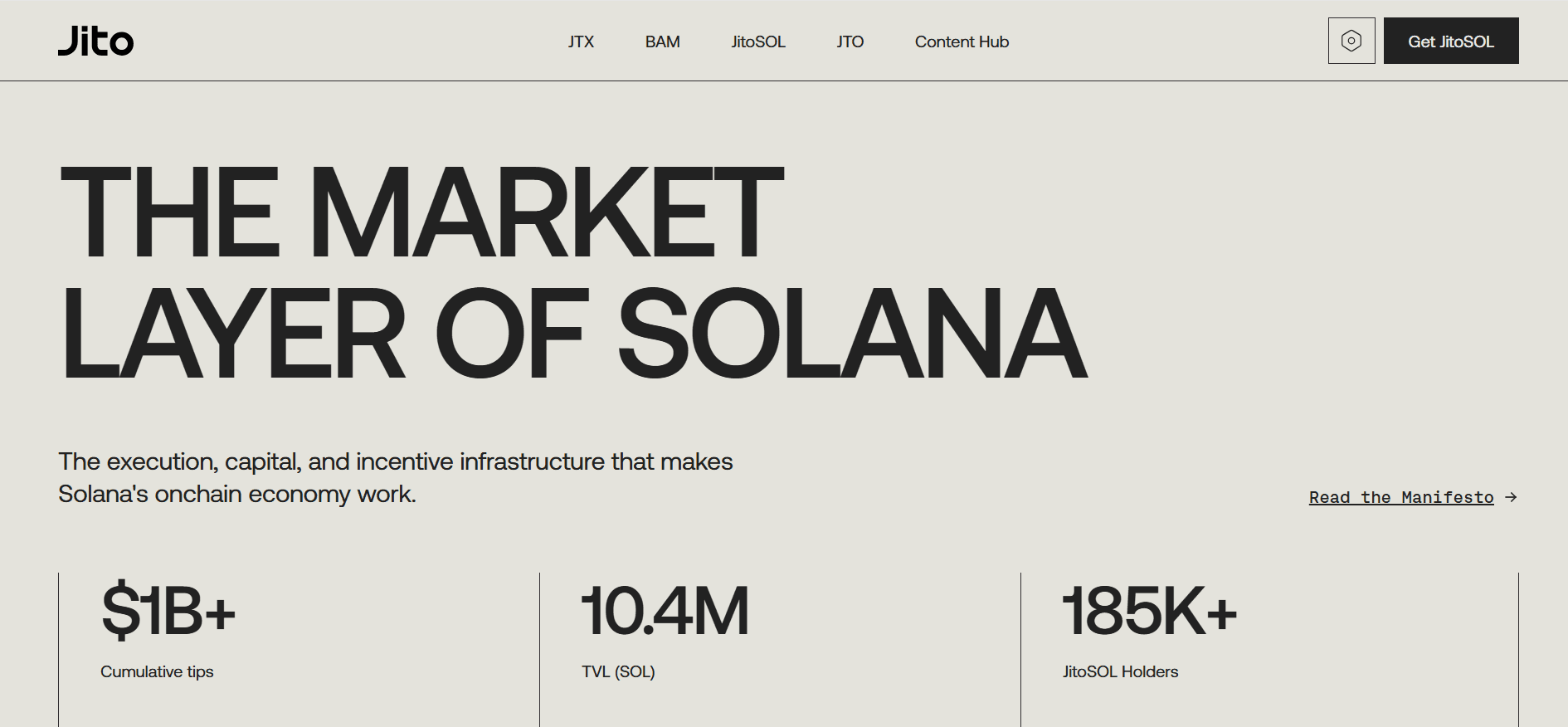
Jito issues jitoSOL, the largest single Solana liquid staking token, and it earns its spot by layering MEV revenue on top of validator rewards. DeFiLlama recorded Jito at $1.219 billion in TVL as of September 21, 2026, with a tracked average supply APY of 4.85%, according to a September 2026 comparison by Eco.
APY source: SOL staking rewards plus MEV captured by validators running the Jito client.
Fees: a 4% annual management fee on total rewards, applied after validator commissions, per Jito's FAQs.
Lockups: delayed withdrawal of up to one epoch, or an instant swap; the website unstake carries a 0.1% fee.
The trade-off is volatility in the MEV component. During quiet markets MEV revenue can compress to near zero, so annualized jitoSOL APY moves roughly between 7% in low-MEV periods and 9% or more in high-MEV periods, according to Eco's June 2026 analysis. Jito is an excellent place to stake SOL; it is not a tool for staking a project's own token, which is where Streamflow picks up.
3. Marinade
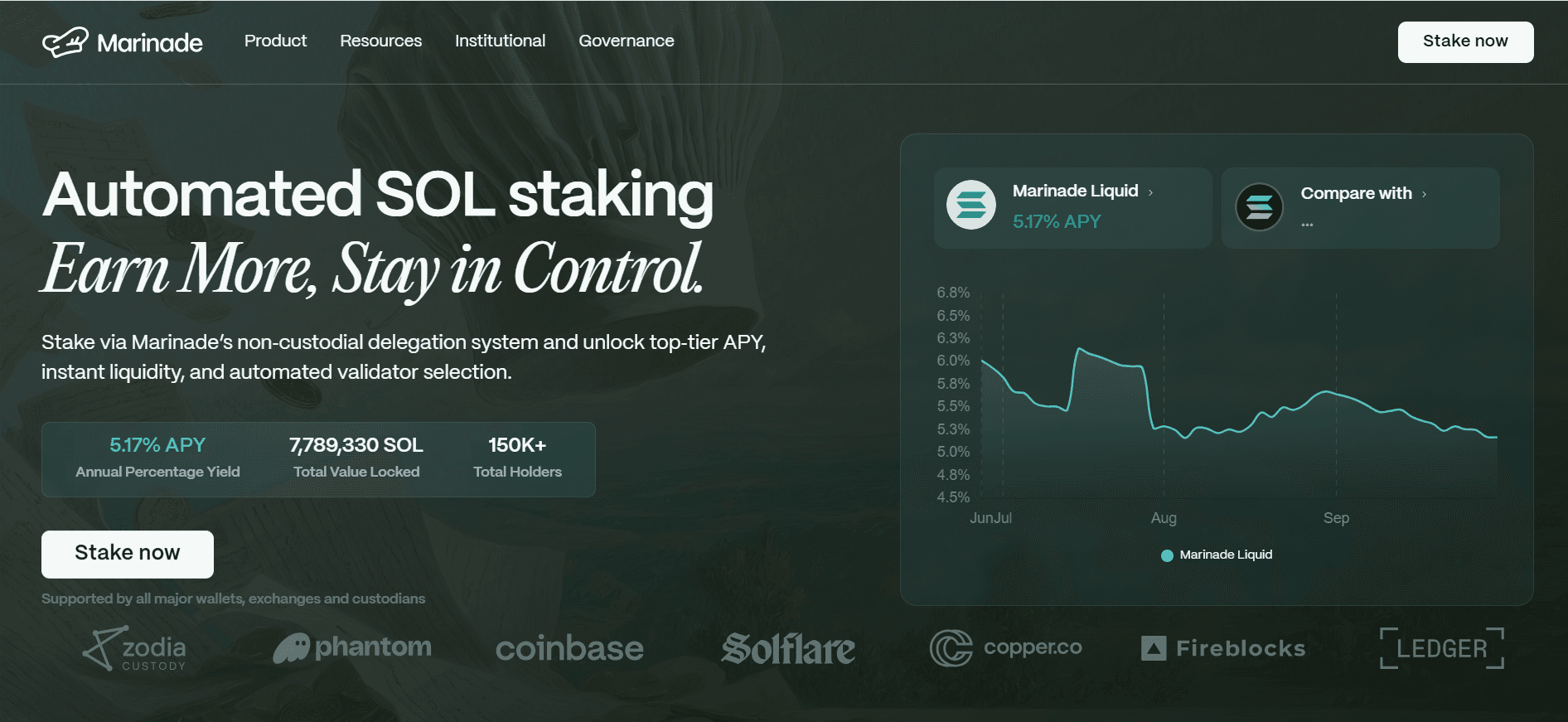
Marinade launched mSOL in August 2021, the original Solana LST, and remains the most explicitly decentralized option in the ecosystem. It delegates across roughly 100+ validators chosen by an algorithmic scoring model that penalizes centralization, downtime, and commission spikes.
APY source: native SOL staking rewards distributed across a wide validator set.
Yield: DeFiLlama tracked Marinade Liquid Staking at $274.6 million TVL as of September 21, 2026, with an average supply APY of 5.4%.
Lockups: liquid via mSOL, with unstaking through the protocol or DEX swaps.
Marinade's value proposition is predictability. Its yield is more stable than jitoSOL's but lower in expectation, which suits treasuries that prefer a steady number over an MEV-boosted one. Like Jito, it stakes SOL only.
4. Lido
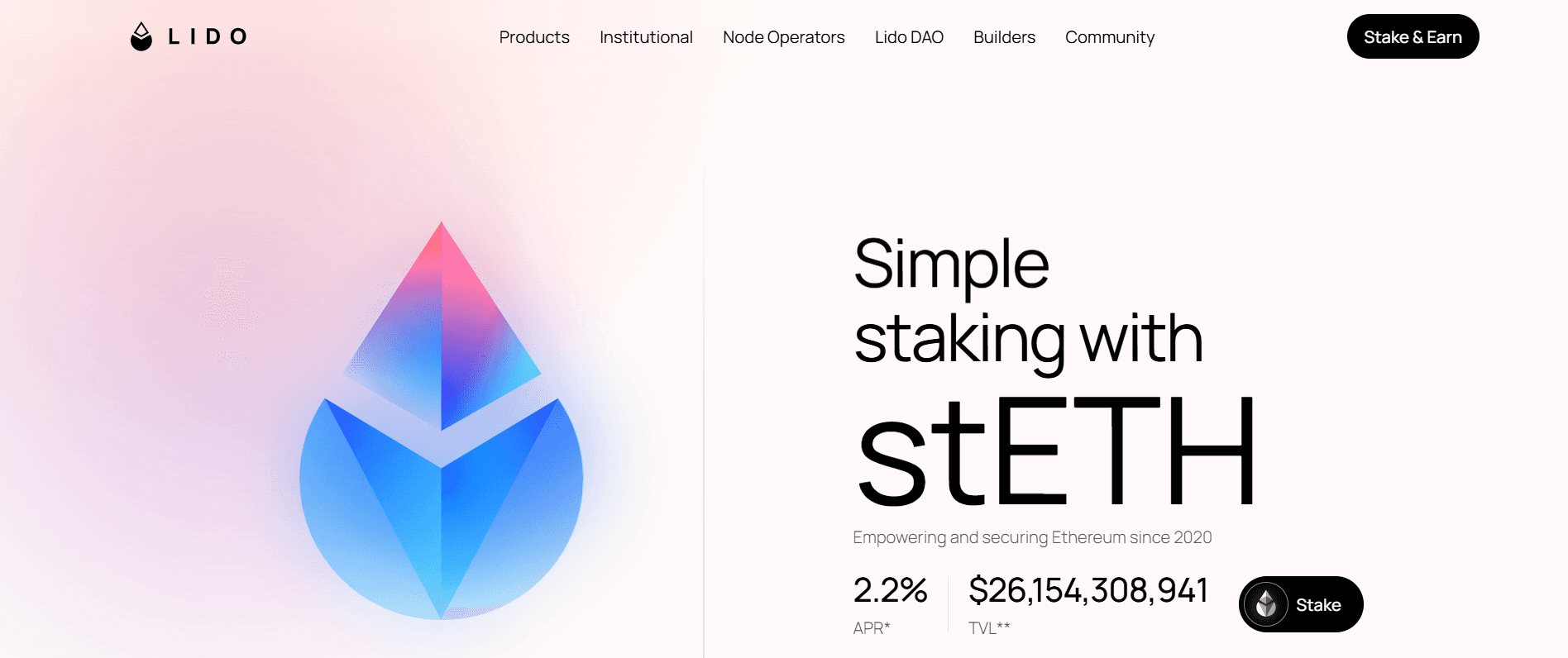
Lido dominates Ethereum liquid staking and is the reference point for institutional ETH yield. Lido's total value locked stands at $18.703 billion, almost all of it on Ethereum mainnet, and it has paid out more than $2.4 billion in rewards since 2020 across 900+ node operators, per CoinLaw's July 2026 ETH staking statistics.
APY source: Ethereum consensus and execution-layer rewards.
Yield and fees: an annual percentage rate of 2.4% with a 10% reward fee.
Lockups: liquid via stETH, with withdrawals subject to the Ethereum exit queue.
Lido's scale is unmatched, but its 2.4% APR shows how thin base-layer yield has become on Ethereum. Teams comparing it to Solana options should also weigh the fee environment: Solana's near-zero transaction costs are a structural advantage that Streamflow passes through to every staking pool it deploys.
5. Rocket Pool
Rocket Pool is the decentralized alternative in ETH liquid staking, pairing its rETH token with a permissionless node operator network. It secures 438,324 ETH in rETH and charges a 14% reward fee, according to CoinLaw's July 2026 data.
APY source: Ethereum staking rewards, shared between rETH holders and node operators.
Fees: 14% of rewards, higher than Lido's 10%.
Lockups: liquid via rETH, with exits dependent on protocol liquidity and the ETH exit queue.
Rocket Pool's appeal is decentralization rather than headline yield or low fees. It is a strong choice for ETH holders who prioritize validator diversity, and irrelevant to Solana token teams.
6. Coinbase
Coinbase is the most accessible custodial staking option for regulated markets, with support for ETH, SOL, ADA, DOT, and other majors inside a single account. The convenience carries the highest fee on this list.
Fees: a standard commission of 35% of staking rewards on ADA, ATOM, AVAX, DOT, ETH, MATIC, SOL, and XTZ, per Coinbase's fee schedule as tracked by ConductAtlas.
Reduced tiers: Coinbase One members pay 31.75% at Basic, 28.5% at Preferred, and 25.25% at Premium.
Lockups: no fee applies if the user waits the full unbonding period; the instant-unstake fee is now disclosed only at the moment of the request, following a June 2026 schedule change.
For a retail holder who values custody with a regulated entity, Coinbase works. For anyone modeling net yield, a 35% haircut on rewards is a large number to accept, and it is custodial by definition.
7. Kraken
Kraken offers one of the broadest custodial staking menus among exchanges. It supports 25+ assets with both flexible rates and lockup periods, according to Koinly's 2026 platform roundup.
APY source: network rewards on supported assets, paid through Kraken's validators.
Fees: commission is built into the quoted rate rather than itemized per asset.
Lockups: a choice between flexible staking and bonded terms with higher rates.
Kraken's strength is breadth and the option to trade liquidity for yield through bonded terms. As with Coinbase, the model is custodial and limited to assets Kraken chooses to list, so it cannot serve a project launching its own token.
Side-by-Side: APY, Fees, and Lockups
Platform | Stakes | APY source | Fee on rewards | Lockup |
|---|---|---|---|---|
Streamflow | Any SPL token | Team-funded or protocol revenue | Creation fee + near-zero Solana tx | Configurable by team |
Jito | SOL | Staking + MEV | 4% | Up to 1 epoch or instant |
Marinade | SOL | Staking | Not itemized here | Liquid via mSOL |
Lido | ETH | Staking | 10% | ETH exit queue |
Rocket Pool | ETH | Staking | 14% | Liquid via rETH |
Coinbase | Majors | Staking | 35% (25.25% to 31.75% tiered) | Unbonding period |
Kraken | 25+ assets | Staking | Built into rate | Flexible or bonded |
The table makes the category split obvious. Six platforms compete on how much of a network's yield they pass through; Streamflow competes on how quickly and safely a team can stand up staking for a token that none of the other six will ever list.
How to Choose the Right Staking Platform
Start with which side of the split you are on, then apply the criteria in order.
If you hold SOL or ETH and want yield:
Prioritize non-custodial LSTs (Jito, Marinade, Lido, Rocket Pool) over exchanges to avoid 25% to 35% commissions.
Pick MEV-boosted yield (Jito) if you accept variance, or steadier yield (Marinade) if you do not.
Treat exchange staking as a convenience product, not a yield product.
If you are launching or managing a token:
Decide what staking must do: reduce circulating supply, reward holders, or power governance.
Set lock periods and reward logic to match that goal, not to chase a headline APY.
Deploy on non-custodial, audited infrastructure that stakes your SPL token without custom code.
Pair staking with transparent token locks on Solana for team and investor allocations so the two mechanisms reinforce each other.
Example: a GameFi studio wants players to hold its in-game token through a content drought. A Continuous Funding pool on Streamflow with a 60-day lock and monthly reward top-ups accomplishes that, and automated DeFi rewards can deposit directly into wallets with no claim friction. The right platform is the one whose economics match your job, and for token teams that job is deployment.
Case Study: UXD Protocol
UXD Protocol, a decentralized stablecoin provider on Solana, needed its $UXP governance token to do two things at once: vest to stakeholders on a disciplined schedule and let those stakeholders participate in governance from the same place. The team integrated the Streamflow SDK into Realms and stood up a claim portal for its holders.
The numbers behind the UXD Protocol case study:
Approximately 46% of $UXP supply placed under Streamflow contracts.
4-year linear vesting with a 12-month cliff.
Governance participation and token claiming unified in one interface.
Kento Inami of UXD credited programmable token transfers and the ease of the SDK for making the integration work.
The outcome is a template for any team weighing governance staking: the same infrastructure that enforces vesting can power the staking and claim layer, so incentives, governance, and distribution run on one verifiable system instead of three.
Conclusion
With roughly a third of proof-of-stake supply now staked, the platforms above are competing for two very different customers: holders who want the largest share of network yield, and token teams who need staking deployed for an asset no exchange or LST will touch.
On the first job, low-fee non-custodial LSTs win on the numbers; on the second, Streamflow's no-code, audited, configurable staking pools for any SPL token are the only entry built for it.
Its own STREAM model, paying hourly revenue-backed rewards at 74.57% APY with zero dilution, shows what that infrastructure can do when the incentives are designed well.
Book a demo to see how Streamflow handles a no-code staking pool launch for your SPL token, from reward logic to lockup terms.
Read Next:
Token Staking Report 2026: Average APY, Staked Supply, and Real Yields Across 20 Blockchains
Streamflow vs Team Finance vs StakePoint: Best Token Lock Platform Compared (2026)
FAQs:
1. What is the best crypto staking platform in 2026?
The best crypto staking platform in 2026 depends on what you are staking. For SOL and ETH holders, low-fee liquid staking protocols like Jito and Lido pass through the most network yield. For teams that need to stake their own SPL token, Streamflow is the best fit, with no-code pool creation, configurable APY and lockups, and contracts audited by FYEO and OPCODES.
2. How do staking fees compare across platforms in 2026?
Staking fees in 2026 range from about 4% of rewards at Jito to 10% at Lido, 14% at Rocket Pool, and a 35% standard commission at Coinbase, based on each platform's published terms. Streamflow's cost model is different because it charges smart contract creation fees plus Solana transaction fees, which run near zero, rather than taking a percentage of staker rewards.
3. Can I stake my own project's token on Streamflow?
Yes, you can stake your own project's token on Streamflow as long as it is an SPL token. Pool creation is permissionless and no-code, with Fund Once, Continuous Funding, Governance Staking, and Custom pool types, and pools are fully non-custodial with automated reward distribution.
4. What lockup periods do staking platforms use?
Lockup periods vary from one Solana epoch at Jito to the Ethereum exit queue at Lido and Rocket Pool, and an unbonding period at Coinbase with a separate fee for instant exits. On Streamflow, the team deploying the pool sets the lock period itself, which lets it match lockups to a supply-management or governance goal.
5. How does STREAM staking differ from standard staking?
STREAM staking differs from standard staking because rewards are funded by Streamflow protocol revenue and hourly buybacks rather than new token emissions, so there is no dilution. Current figures show a 74.57% APY with 10M STREAM staked and 3.32% of protocol revenue allocated to rewards.