General
Token Locks Explained: What They Are, How They Work, and Why Every Crypto Project Needs One in 2026
Per Tokenomist data published in August 2026, roughly $1.28 billion worth of tokens is scheduled to unlock across the market this month alone. Investors now track unlock schedules the way equity analysts track earnings dates, because unlocked supply moves prices.
Streamflow, the Solana-native token operations platform securing $286M+ in total value locked across 40,000+ projects, exists precisely to make that supply verifiable and trustworthy.
For a founder launching a token in 2026, this changes the job. It is no longer enough to promise that team tokens will not move; the market expects on-chain proof. Transparent token locks are how serious projects deliver that proof.
This guide covers what token locks are, how they work on Streamflow, and why they have become a baseline requirement for any credible launch.
Key Takeaways
Token locks restrict tokens on-chain until preset date or price conditions are met.
Streamflow secures $268M+ in TVL across 40,000+ projects with audited smart contracts.
Locking tokens on Streamflow takes about 37 seconds and requires no code.
Every Streamflow token lock generates public proof verifiable on Solscan and RugCheck.
Bonk distributed 20% of its supply to 22 contributors through Streamflow contracts.
What Token Locks Are and Why They Exist
Token locks are mechanisms that restrict tokens from being transferred, sold, or accessed until predefined conditions are met, such as a specific date, time period, or price level. They are used to enforce commitment, control circulating supply, and provide transparent, on-chain proof that certain tokens cannot be moved prematurely.
The reason they exist is simple: promises do not scale, but proof does.
A team can claim its allocation will stay untouched for two years, yet nothing stops a wallet from selling tomorrow.
A lock removes that possibility at the contract level, which is why exchanges, communities, and investors now check for locks before they check anything else.
Streamflow's approach turns token locking into a transparent trust signal. Instead of relying on promises, Streamflow enforces lock conditions through immutable smart contracts that anyone can verify.
Token Locks vs Vesting
A lock is a single unlock event; tokens are fully restricted until the condition is met, then released. Automated token vesting is different: tokens release gradually over time according to a schedule. Most serious projects use both, with locks for treasury and reserves and vesting for team and investor allocations.
Token Locks vs Liquidity Locks
A token lock restricts native project tokens, such as team or treasury allocations. A liquidity lock restricts LP tokens to prevent rug pulls on DEX liquidity. Streamflow supports both SPL tokens and LP tokens, so one platform covers both trust signals.
Token Locks vs Staking
Locks and staking both restrict tokens, but the intent differs. A lock restricts tokens with no rewards attached; staking restricts tokens in exchange for rewards or governance rights. Understanding the distinction helps founders pick the right tool for each allocation, and locks remain the purest commitment signal of the three.
How Token Locks Work on Streamflow
Streamflow's lock flow is deliberately minimal. You create the contract through the UI, configure the parameters, and deploy instantly. Locking tokens takes about 37 seconds from start to finish.
The no-code path works like this:
Open the Streamflow app and connect a Solana wallet (Phantom, Solflare, Backpack, or any Solana wallet)
Select the token and amount to lock
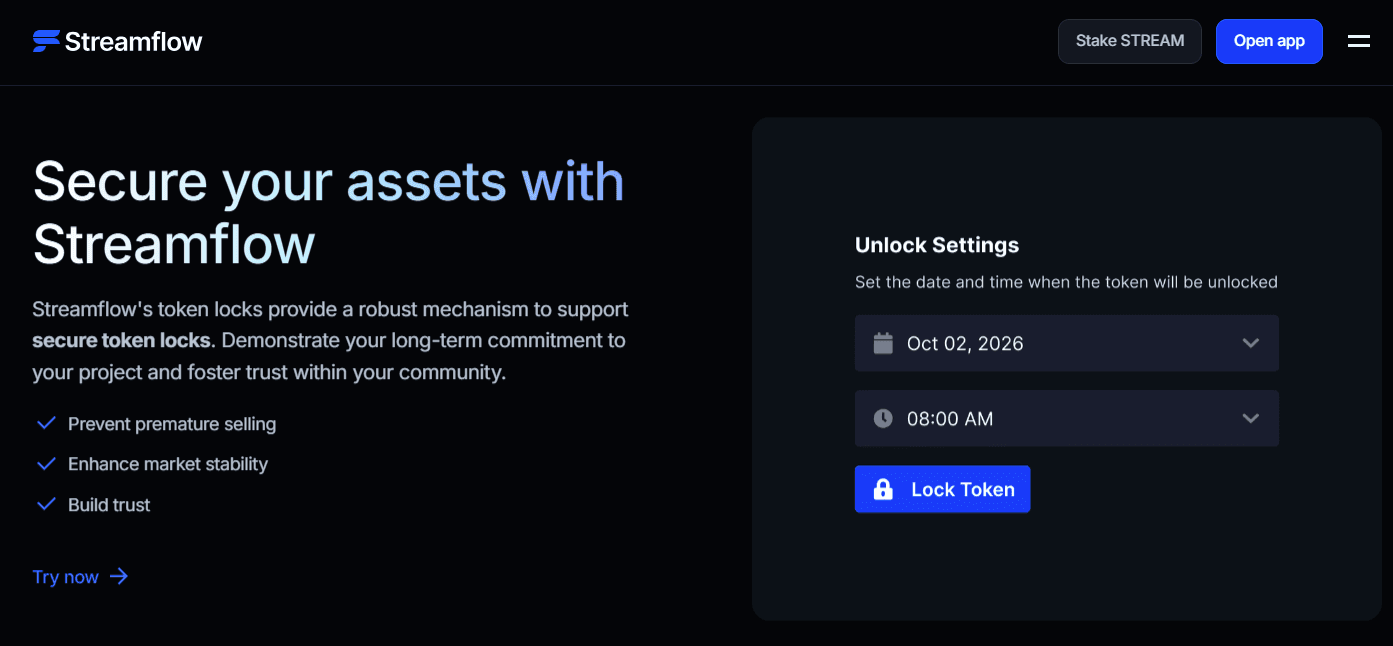
Define the unlock condition, either a fixed date or a price threshold
Deploy the contract and fund it
Tokens release automatically when the condition is met
Once deployed, the contract is immutable. There is no admin override, and no one, including the team that created it, can move the tokens early. When the unlock condition is met, release happens automatically, and the market can track what a token unlock means directly on-chain rather than trusting an announcement.
Consider a practical example. A GameFi team launching on Solana locks 30% of supply as treasury reserves with a fixed-date unlock 24 months out. The lock generates a public proof link the team pins in its docs and community channels, and anyone can verify the tokens are untouchable on Solscan. That single link answers the "when does the team dump" question before it gets asked.
For developer teams, the same lock logic is available through Streamflow's SDK, so locks can be built directly into dApps and launch flows. Either path ends in the same place: an enforceable, publicly verifiable commitment.
Key Capabilities and Configuration Options
Streamflow's lock product covers the full range of lock structures a project needs:
Fixed-date unlocks: time-based locks that release on a specific date
Price-based unlock conditions: locks that release only when a price threshold is met
Quick locks: streamlined setup for fast, standard lock deployments
SPL token support: lock any Solana token, including project and governance tokens
LP token support: lock liquidity to protect DEX pools against rug pulls
Price-based conditions deserve a specific mention because they solve a real problem: calendar-based unlocks can dump supply into weak markets. Price-based token locks tie release to market strength instead of an arbitrary date.
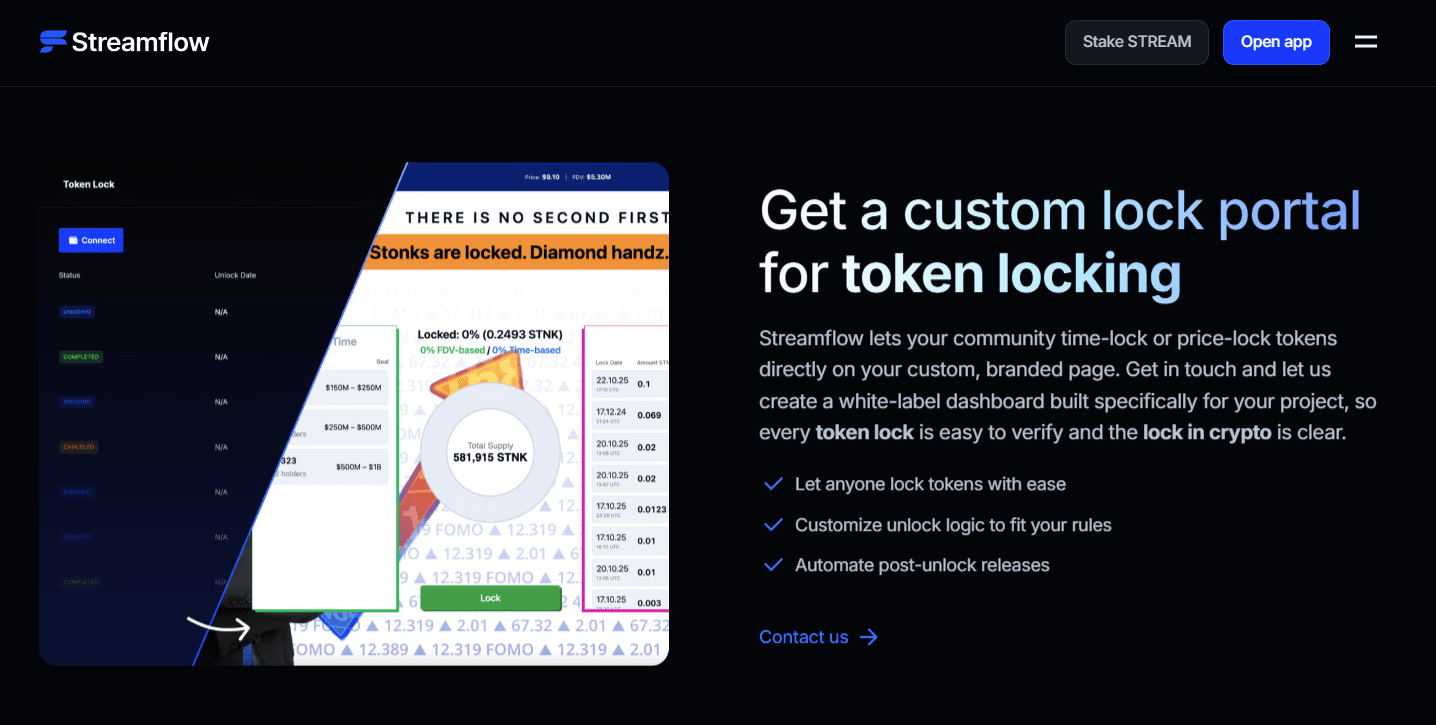
Every lock also ships with visibility built in. Public proof links, public dashboards, and verification on Solscan, Solana Explorer, and RugCheck mean the lock works as a marketing asset, not just a technical control.
The configuration options matter less than what they share: every variant produces on-chain, verifiable proof of commitment.
Use Cases for Token Locks
Team allocations: The most common use case, and the one investors scrutinize first. Locking team tokens proves the people building the project cannot exit before the community can, which is the single strongest answer to insider-dump concerns.
Treasury funds: DAOs and protocol teams lock treasury reserves to show the community that operational funds cannot be drained quietly. Combined with a real-time tokenomics dashboard, the entire supply picture becomes publicly auditable at any moment.
Liquidity protection: Locking LP tokens removes the classic rug-pull vector on DEX liquidity. For new launches, especially in the memecoin segment, a verified liquidity lock is often the difference between getting listed on trackers and getting flagged.
Investor confidence and credibility: Beyond any single allocation, locks function as a project-level trust signal. Exchanges, launchpads, and analytics platforms increasingly treat verifiable locks as a listing hygiene factor, which makes locking a distribution strategy, not just a security measure.
Case Study: Bonk
Bonk, one of Solana's flagship meme coins, is a clear example of commitment proof done right. The project allocated 55% of its supply to airdrops for early Solana users, and it needed its core contributor allocation handled with the same transparency.
Bonk used Streamflow to distribute 20% of its total supply to 22 early contributors on a 3-year linear vesting schedule. Every contract was on-chain and verifiable, so the community never had to take the team's word for anything.
The outcome was trust and transparency for the community, in a market segment where insider dumps are the default expectation. That is the practical payoff of enforceable token restrictions: Bonk turned its contributor allocation from a liability into a credibility asset.
Security and Transparency
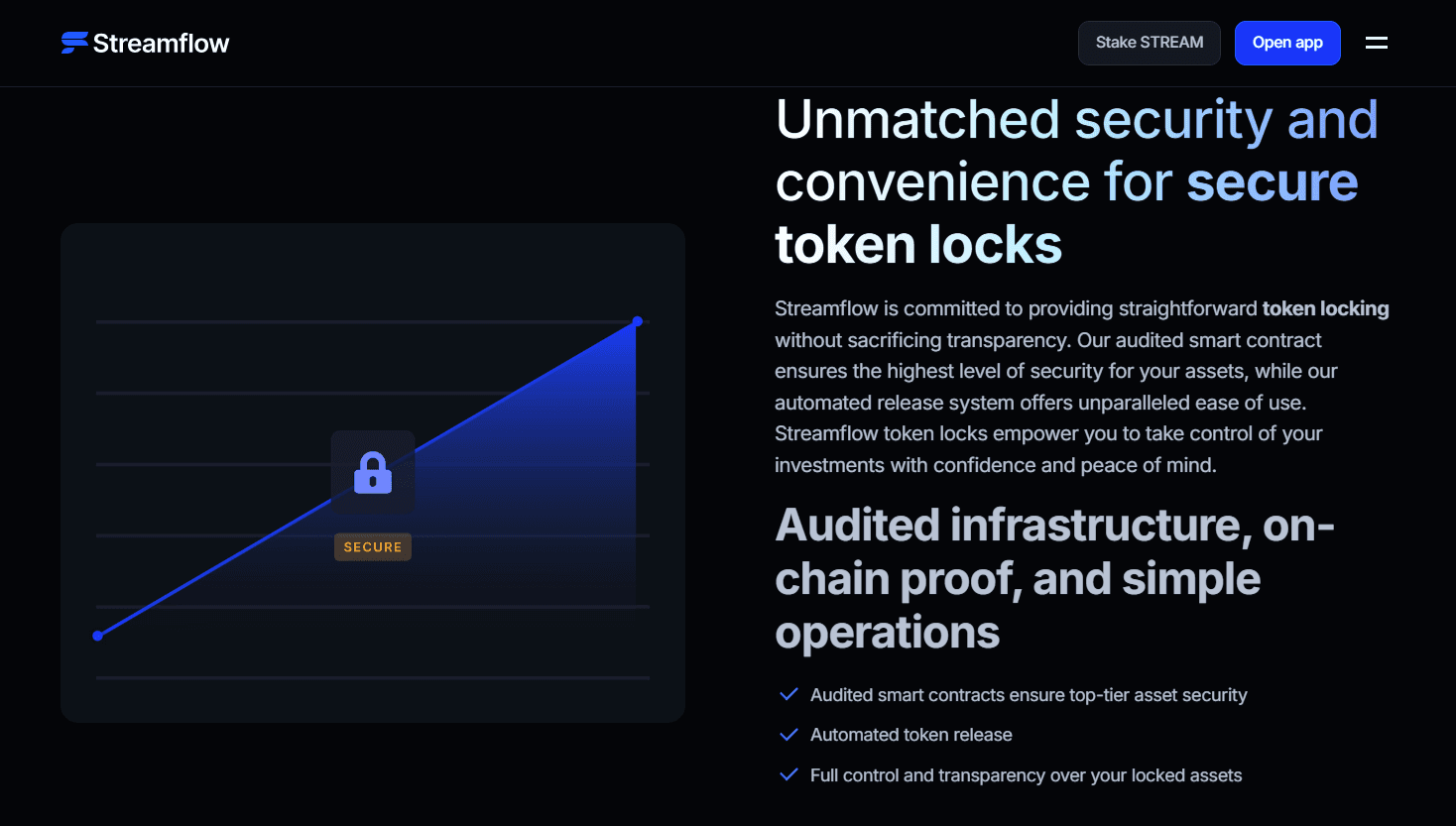
A lock is only as trustworthy as the contract enforcing it. Streamflow's smart contracts are audited by FYEO and OPCODES, and they are immutable once deployed.
The security model rests on three properties:
No admin override: no one can alter or bypass a deployed lock, including Streamflow
On-chain verification: every lock is checkable on Solscan, Solana Explorer, and RugCheck
Public proof links: anyone can confirm lock status without technical knowledge
This design reduces manipulation, insider misuse, and rug-pull risk at the protocol level rather than the policy level. For a founder, that means the trust signal you publish is one no one can quietly revoke.
Getting Started With Token Locks
Deploying a lock on Streamflow takes about 37 seconds through the no-code UI. Connect a wallet, choose the token and amount, set the unlock condition, and deploy.
Costs stay minimal because Streamflow is Solana-native. With near-zero transaction fees and sub-second finality, token locks on Solana are dramatically more cost-efficient than equivalent setups on Ethereum. Small teams and large ecosystems use the same infrastructure; over 40,000 projects already have.
The practical advice for any 2026 launch is to lock before you announce. A verifiable lock in your docs from day one sets the trust baseline everything else builds on.
Conclusion
Token locks have moved from optional extra to baseline requirement, with over a billion dollars in unlocks hitting the market in a single month and investors watching every schedule.
Streamflow turns token locking into a transparent trust signal, with audited, immutable contracts, 37-second setup, and public proof verifiable on Solscan and RugCheck.
Projects that lock early and publicly, the way Bonk did with its contributor allocation, convert supply risk into credibility.
Book a demo to see how Streamflow handles token locks for your team, treasury, and liquidity allocations.
Read Next:
FAQs:
1. What are token locks in crypto?
Token locks in crypto are mechanisms that restrict tokens from being transferred, sold, or accessed until predefined conditions are met, such as a specific date or price level. They enforce commitment, control circulating supply, and provide on-chain proof that tokens cannot move prematurely.
2. What is the difference between token locks and vesting?
The difference between token locks and vesting is the release pattern. A lock is a single unlock event that releases tokens once a condition is met, while vesting releases tokens gradually over time according to a schedule. Most projects use locks for treasury and liquidity and vesting for team and investor allocations.
3. How long does it take to lock tokens on Streamflow?
Locking tokens on Streamflow takes about 37 seconds through the no-code interface. You connect a Solana wallet, select the token and amount, set a date-based or price-based unlock condition, and deploy. No smart contract development is required.
4. Can anyone verify a Streamflow token lock on-chain?
Yes, anyone can verify a Streamflow token lock on-chain. Every lock generates a public proof link and is verifiable on Solscan, Solana Explorer, and RugCheck. Once deployed, contracts are immutable with no admin override, so verification reflects an enforceable guarantee.
5. Why does every crypto project need a token lock in 2026?
Every crypto project needs a token lock in 2026 because investors, exchanges, and communities now treat verifiable locks as a baseline trust requirement rather than a bonus. With billions in unlocks hitting the market monthly, unproven supply commitments read as risk. A public, audited lock answers that concern before it costs you credibility.
