General
How Solana Projects Manage Post-TGE Token Operations
According to a 2025 RootData review of 113 token launches, 84.7% of new tokens traded at a fully diluted valuation below their TGE level, with the median FDV falling 71%.
That gap is rarely a launch problem. It is a post-TGE operations problem, and it is where Streamflow, the Solana-native token operations platform trusted by more than 40,000 projects, does its most important work.
The token generation event is the loudest day in a project's life. It is almost never the day that decides its future. What follows, vesting enforcement, unlock discipline, staking, treasury management, and contributor payouts, runs for years and is usually held together with spreadsheets and manual multisig transfers.
Teams that survive the first 18 months treat post-TGE operations as infrastructure, not admin.
This article breaks down how disciplined Solana projects run the post-TGE stack, and how Streamflow turns each moving part into automated, verifiable on-chain execution.
Key Takeaways
Most tokens peak at TGE, making post-TGE token operations the real determinant of survival.
Streamflow automates post-TGE vesting, locks, staking, airdrops, and payouts through on-chain smart contracts.
Transparent unlock schedules and locked allocations turn Streamflow into a durable, verifiable trust signal.
Over 40,000 projects run token operations on Streamflow across $290M+ in total value locked.
Why the TGE Is the Beginning, Not the Finish Line
Most teams over-invest in launch day and under-invest in everything after it. The budget goes to KOLs, exchange listings, and airdrop hype, while the machinery that governs supply for the next four years gets an afterthought.
The data exposes the flaw in that priority. When the overwhelming majority of tokens are worth less than they were at TGE, the failure point is not the launch mechanic. It is the months of unmanaged unlocks, opaque team allocations, and ad hoc payouts that erode trust after the spotlight moves on.
Post-TGE is where three things get decided:
Whether scheduled unlocks hit the market predictably or as chaotic supply shocks.
Whether investors and holders can verify that team and treasury tokens are actually locked.
Whether the project can pay contributors, run incentives, and manage treasury without leaking trust.
A project that nails its launch and fumbles these three loses the plot within two quarters. The teams that last are the ones that make post-TGE operations boring, automated, and public.
What Post-TGE Token Operations Actually Involve
The post-TGE surface is wider than most founders expect at launch. It spans supply management, incentive design, distribution, and financial operations, each with its own failure modes and each traditionally run in a different tool.
Handled manually, this fragments fast. Token vesting lives in a spreadsheet, locks live in a screenshot, airdrops run through a script, payroll runs through a multisig, and none of it is verifiable by the people who need to trust it. Every manual transfer is an opportunity for error, and every unverifiable claim is a reason for holders to assume the worst.
The alternative is to run the entire stack as programmable on-chain infrastructure, where rules are set once and enforced automatically.
On Solana, this is economically viable in a way it is not on higher-fee chains, because sub-second finality and near-zero fees make continuous, large-scale token operations affordable. That is the model disciplined teams converge on, and it is the model Streamflow is built around.
The Post-TGE Operations Stack
The post-TGE stack breaks into five workstreams. Strong teams run all five as coordinated, verifiable systems rather than disconnected manual tasks.
1. Vesting and Unlock Discipline
Vesting is the single biggest post-TGE variable. It determines how team, investor, and ecosystem supply enters the market, and a sloppy schedule is what turns a good launch into a slow bleed.
The right approach is to encode every schedule as an immutable contract that releases exactly as designed, then make it public.
Use cliffs to prevent day-one insider selling, with a standard 12-month cliff for founders and core team.
Match the release curve to the allocation: linear for contributors, milestone or price-based where incentives should track performance.
Publish a verifiable schedule so holders can see future supply instead of guessing at it.
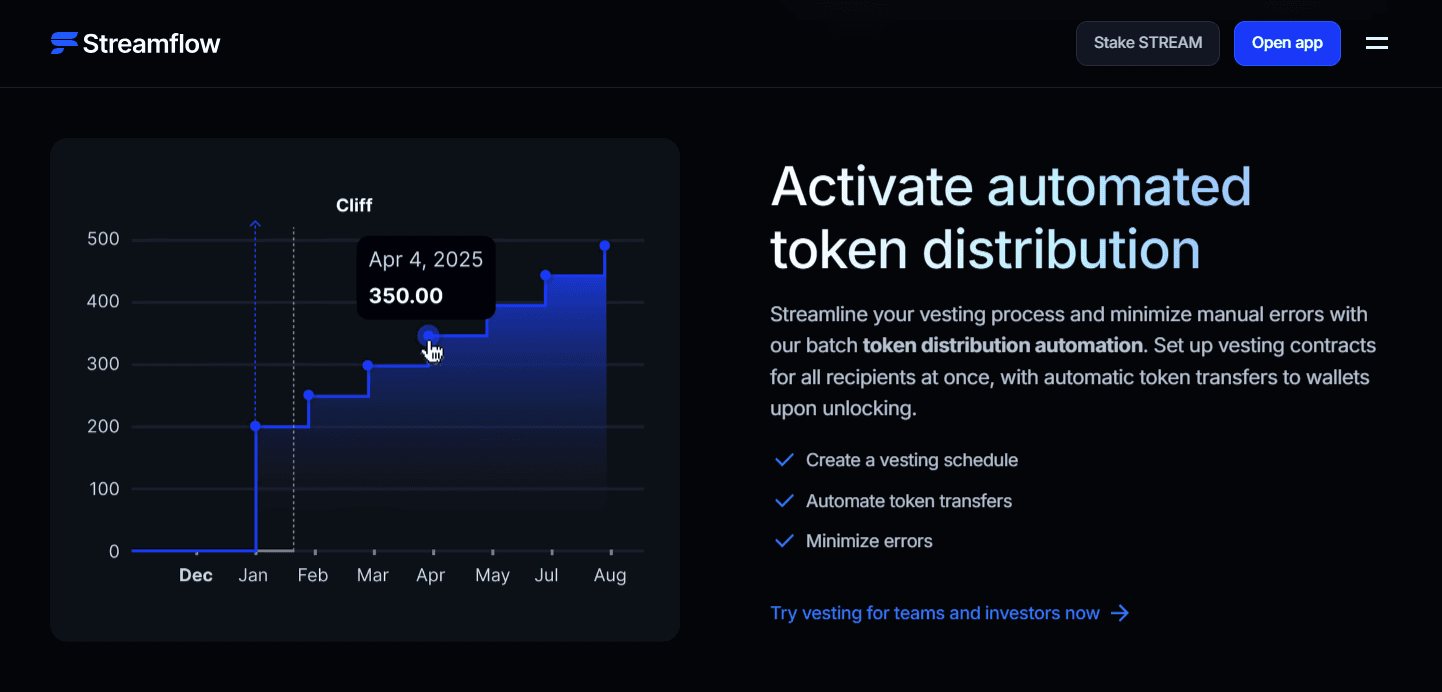
Streamflow's automated token vesting enforces linear, cliff, graded, milestone-based, and price-based schedules through smart contracts that no one can unilaterally alter after deployment.
A team can bulk-import recipients by CSV, fund the contract once, and let tokens release automatically for years, with a shareable proof link and explorer verification for every schedule.
2. Token Locks as an Ongoing Trust Signal
Token locks are separate from vesting and serve a different job. A lock is proof, published on-chain, that specific tokens cannot be moved before a defined date or price condition.
Post-TGE, locks are how a team keeps signaling commitment after the launch narrative fades.
Lock team and treasury allocations to demonstrate they will not be dumped.
Lock LP tokens to reassure the market that liquidity is not about to be pulled.
Use price-based unlocks so supply only releases as the token proves durable value.
With transparent token locks on Solana, locked tokens cannot be transferred, traded, or accessed until unlock criteria are met, and anyone can verify the lock on Solscan, Solana Explorer, or RugCheck.
That verifiability is the entire point: post-TGE trust comes from proof, not promises.
3. Ongoing Distribution and Airdrops
Distribution does not end at TGE. Ecosystem incentives, retroactive rewards, and follow-on airdrops run for the life of the project, and at scale they cannot be executed by hand.
Structured distribution keeps growth campaigns from becoming operational disasters.
Run vested or price-based airdrops so recipients hold instead of immediately selling.
Use claim windows and eligibility filtering to reward real users, not sybil farms.
Recover unclaimed tokens automatically instead of writing them off.
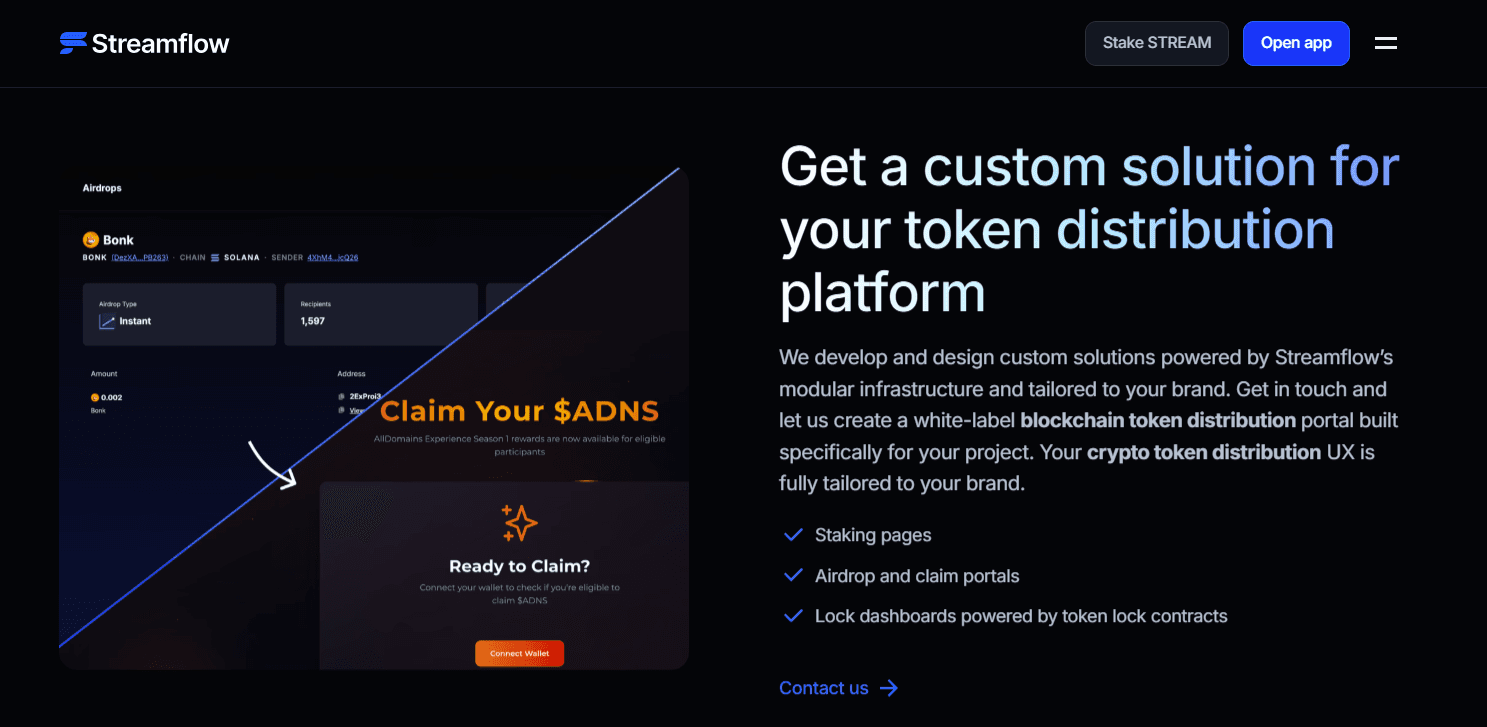
The Streamflow airdrop launch platform supports distribution to up to one million recipients, with 100,000 recipients per CSV, claim portals, and real-time delivery tracking. That capacity is what separates a repeatable growth engine from a one-time stunt.
4. Staking and Sell-Pressure Management
Once tokens are circulating, the question becomes how to reduce sell pressure and reward the holders who stay. Staking is the primary lever.
Reduce circulating supply by giving holders a reason to lock tokens voluntarily.
Configure APY, lock periods, and reward logic to match the token's economics.
Automate reward distribution so the program runs without manual top-ups every week.
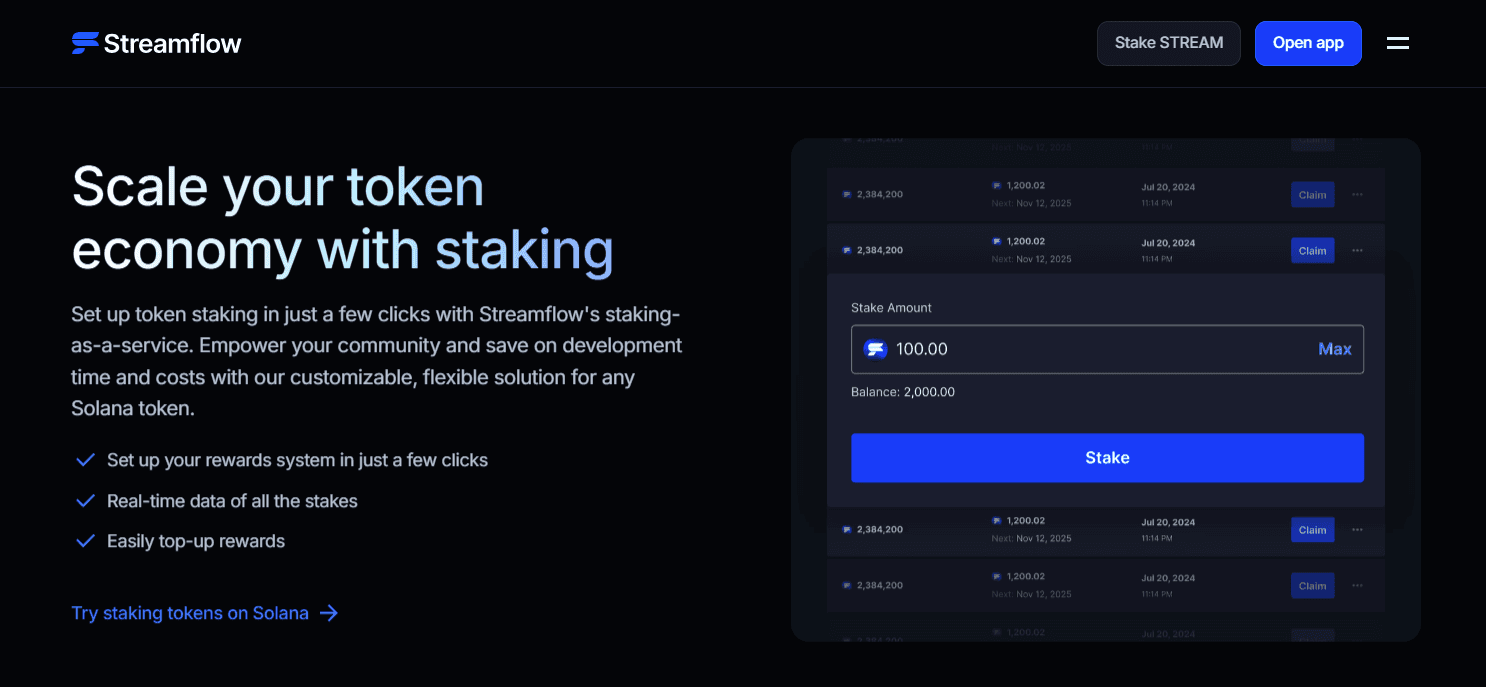
With no-code staking pools on Solana, any SPL token can be staked through fully non-custodial pools with customizable rewards. Streamflow's own
model goes a step further, distributing hourly rewards backed by real protocol revenue and buybacks rather than inflationary emissions, which is exactly the revenue-linked direction the broader market is moving toward.
5. Treasury and Payouts
The least glamorous workstream is often the one that quietly breaks projects. Post-TGE, a team has to pay contributors, manage a multi-million-dollar treasury, and fund operations without leaking value or trust.
Automate recurring contributor and payroll payouts instead of running manual transfers.
Hold and manage treasury in a stable, yield-bearing form rather than idle tokens.
Keep financial operations on-chain and auditable as the company scales.
This is where Streamflow Business, the financial OS for Internet Capital Markets, extends the stack into cap tables, treasury management through USD+, tokenized SAFEs, and ownership issuance.
For a Web3 CFO, recurring payout contracts turn payroll into a fund-once, run-continuously system rather than a monthly scramble.
How Streamflow Ties the Stack Together
The advantage is not any single feature. It is running all five workstreams on one platform where every action is a verifiable on-chain contract instead of a manual step in a silo.
That consolidation removes the two biggest post-TGE risks at once: human error and opacity. When vesting, locks, staking, and payouts all execute automatically and publish proof, there is no spreadsheet to fumble and nothing for holders to distrust.
A no-code team can lock tokens in about 37 seconds, while developers can embed the same logic through the SDK, so the operational depth scales with the project.
You can open the Streamflow app to run any part of the stack directly, from a first token lock to a full vesting and staking program.
Case Study: How UXD Protocol and Bonk Ran Post-TGE Distribution
UXD Protocol, a decentralized stablecoin provider on Solana, needed vesting and governance to live in one interface after launch.
It integrated the Streamflow SDK, as shown in the UXD Protocol case study, into Realms and put roughly 46% of the $UXP supply on a 4-year linear vesting schedule with a 12-month cliff, giving stakeholders a single place to claim tokens and participate in governance.
Bonk, a Solana meme coin, used the same discipline for its core team. As detailed in the Bonk vesting case study, 20% of total supply was placed on a 3-year linear vesting schedule across 22 early contributors, turning a memecoin launch into a transparent, verifiable commitment.
Both projects show the same lesson: post-TGE credibility comes from enforceable, public schedules, not from launch-day promises.
What This Means for Founders and Token Issuers
If 84.7% of tokens end up below their TGE valuation, the winning move is not a louder launch. It is treating the years after TGE as the real product and running them with infrastructure that is automated and public by default.
Practically, that means encoding vesting and locks before you need them, structuring incentives so holders are rewarded for staying, and moving treasury and payouts on-chain instead of leaving them in a multisig spreadsheet.
Streamflow exists to make that the default rather than the exception, which is why more than 1.3 million users and 40,000 projects run their token operations on it.
Conclusion
The token generation event decides how a project launches. Post-TGE token operations decide whether it survives, and the data shows most teams get this backwards.
Streamflow turns the entire post-TGE stack, vesting, locks, airdrops, staking, treasury, and payouts, into automated on-chain infrastructure that is verifiable by anyone.
Book a demo to see how Streamflow handles post-TGE token operations end-to-end, from your first vesting schedule to full treasury management.
Read Next:
FAQs:
1. What are post-TGE token operations?
Post-TGE token operations are everything a project manages after its token generation event: vesting enforcement, token locks, ongoing airdrops, staking, treasury management, and contributor payouts. These run for years and determine long-term supply, trust, and survival far more than launch day itself. Streamflow consolidates all of them into automated on-chain infrastructure.
2. How does Streamflow manage token unlocks after TGE?
Streamflow manages token unlocks by encoding each vesting schedule as an immutable smart contract that releases tokens exactly as designed. Teams can use linear, cliff, graded, milestone-based, or price-based schedules, then share a public proof link so holders can verify future supply on-chain instead of guessing.
3. Why is post-TGE trust harder to maintain than launch hype?
Post-TGE trust is harder because launch hype fades while supply keeps entering the market for years. Projects sustain trust by locking team and treasury allocations and publishing verifiable schedules, which Streamflow enforces through on-chain locks that anyone can check on Solscan or RugCheck.
4. Can Streamflow handle treasury and payroll after a token launch?
Yes. Streamflow supports recurring payout contracts for contributor and payroll-style payments, and Streamflow Business extends this into treasury management through USD+, cap tables, and tokenized SAFEs. This lets teams fund payouts once and run them continuously without redeploying contracts.
5. Why do Solana projects use Streamflow for post-TGE operations?
Solana projects use Streamflow because sub-second finality and near-zero fees make continuous, large-scale token operations economically viable on-chain. Over 40,000 projects run vesting, locks, staking, airdrops, and payouts on Streamflow across more than $290 million in total value locked.