General
Streamflow Foundation Burns 70% of Total STREAM Supply: What Happened, Why, and How to Verify It
Streamflow has spent five years building token operations infrastructure on Solana, with more than $650 million in total value locked, 1.3 million users, and 50,000+ projects using its platform to date. That infrastructure exists to make token supply schedules transparent and enforceable on-chain. On 17 September 2026, Streamflow Foundation applied the same standard to its own treasury.
The Foundation burned the entirety of its STREAM holdings in a single on-chain transaction, permanently removing 70% of total token supply from circulation.
Below is the full picture of what was burned, why the Foundation chose a burn over any alternative, how the transaction was executed, how anyone can verify it, and what changes for STREAM holders and Streamflow's products.
Key Takeaways
Streamflow Foundation burned 100% of its STREAM holdings in a single Solana transaction
The burn permanently removes 70% of total STREAM supply from circulation
The transaction is independently verifiable on Solana network explorers: Solscan transaction signature
Streamflow's product operations, including locks, vesting, staking, and payouts, are unaffected
What the Burn Is, and What It Is Not
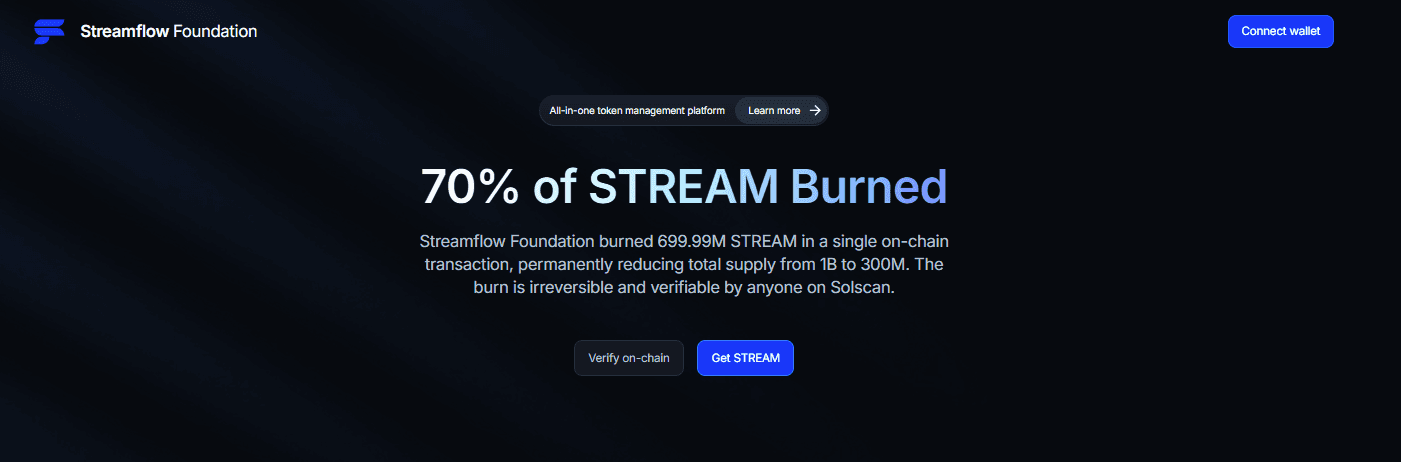
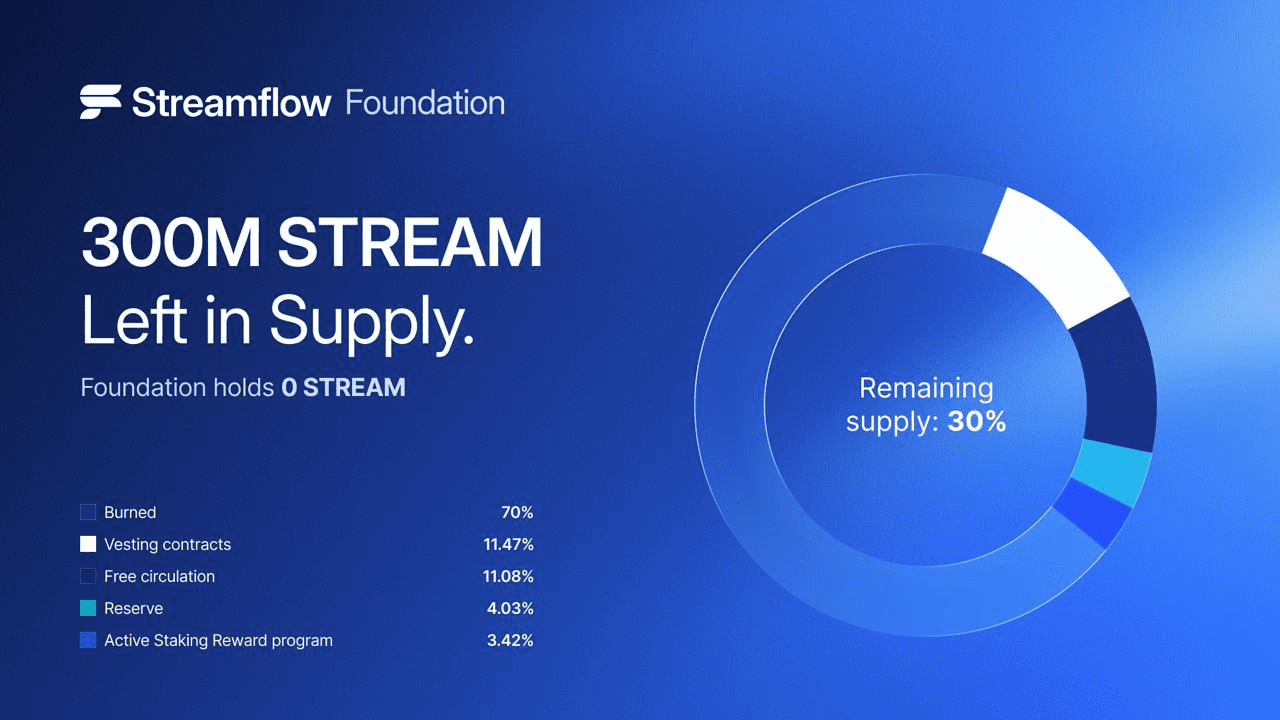
The burn is a permanent removal of tokens from supply. Streamflow Foundation burned 699.99M STREAM on Solana in one transaction. Total supply now stands at 300M STREAM, down from 1B STREAM before the transaction.
Nothing burned can be moved, recovered, or reissued by Streamflow Foundation, Streamflow, or any third party. The supply reduction is therefore not a lock, a vesting schedule, or a treasury policy that could be reversed by a later decision. It’s irreversible.
Why Streamflow Foundation Burned Its Treasury
Foundation treasury holdings typically represent the largest single variable in a token's forward supply schedule. Those tokens can be distributed, sold, or emitted at the holder's discretion, and the market has to price in every one of those possibilities.
Streamflow Foundation had three broad options for its position:
Hold, and ask the market to trust that the tokens would not be sold or emitted
Lock or vest, and defer the question rather than resolve it
Burn, and remove the question entirely
A lock still ends. A token vesting schedule still unlocks. A holding policy still depends on the people writing it. The burn is the only version that does not rely on anyone's continued good intentions, including the Foundation's own.
"A treasury that can be spent is a treasury the market has to price in. Burning it outright is the only version of this commitment that doesn't depend on anyone's continued good intentions, including our own. The tokens are gone, the transaction is public, and no future decision can bring them back." - Mališa Stanojević, CEO of Streamflow.
The outcome is that Streamflow Foundation is no longer a supply-side participant in STREAM. That allocation, and the overhang it represented, no longer exists.
How the Burn Was Executed
The burn was executed as a single on-chain transaction on Solana. There were no tranches, no staged transfers, and no intermediate wallets.
The Foundation's full STREAM balance was consolidated for a single transfer
The tokens were destroyed through Solana's programmatic burn instruction
The transaction was confirmed and recorded on the Solana ledger
The Foundation's remaining STREAM balance was confirmed on-chain
Executing the burn in one transaction rather than several matters for verification. A single signature is a single fact. Anyone checking the burn has one thing to check, not a series of transfers to reconcile.
How to Verify the Burn On-Chain
The transaction is public and can be verified by any observer without relying on Streamflow's own statements. The transaction signature is https://solscan.io/tx/4rbViHbmCV35ttMngeC8KBULCMctD7X8mNg3RxfvGwPKyPi7hX8VKpjyJ81AnYuVzzXEsWuNuppcpDY47hnchZNv?cluster=
To confirm it independently:
Open the transaction signature on Solscan or Solana Explorer
Confirm the sending wallet against the published transaction ID (txid)
Confirm that tokens have been burned
Confirm the transferred amount matches the 699.99M STREAM figure published here
Check the Foundation wallet's current STREAM balance on-chain
Updated supply figures will appear on standard Solana token trackers and data aggregators as they index the transaction. Until then, the on-chain record is the source of truth.
Public verifiability is the same standard Streamflow applies to every contract it deploys for external projects. The Foundation's own burn is held to it too.
What Changes for STREAM Holders
For holders, the direct effect is on the supply schedule, not on the token itself. STREAM remains an SPL token on Solana with the same contract and the same utility.
What has changed:
Total supply is permanently reduced by 70%
The Foundation's treasury allocation has been permanently removed and cannot re-enter the market as a seller or emitter
The largest single discretionary allocation in the supply schedule no longer exists
Every remaining STREAM is held by parties other than the Foundation
What has not changed is Streamflow's product surface. The platform continues to operate token locks, vesting, staking, airdrops, payouts, and treasury tooling for projects building on Solana. No user-facing contract, integration, or portal was affected by the burn.
Holders do not need to take any action. The burn required nothing from anyone other than the Foundation.
The Infrastructure Behind the Standard
The burn reflects a principle Streamflow has enforced for external projects since 2021: supply commitments belong on-chain, where they are verifiable by anyone, not in a policy document.
UXD Protocol, the decentralised stablecoin provider on Solana, integrated the Streamflow SDK into Realms to place 46% of its $UXP supply on a four-year linear vesting schedule with a twelve-month cliff. Stakeholders could see the exact schedule on-chain, which removed the uncertainty that usually surrounds large structured allocations.
Heavenland put 97% of its $HTO supply on five-year linear vesting with cliffs across team, incentives, and treasury allocations. Bonk used Streamflow for core team vesting covering 20% of total supply across 22 early contributors on a three-year linear schedule.
These projects used Streamflow's token operations infrastructure. They are not participants in, and have not commented on, the STREAM burn.
Streamflow's contracts are audited by FYEO and OPCODES, are immutable once deployed, and are verifiable on Solscan and Solana Explorer. The Foundation's burn sits within that same verification posture: a public transaction, checkable by anyone, that no later decision can undo.
What This Means for Streamflow Business
The burn clears the ground for the next step in STREAM's structure: a one-way swap from STREAM into xSTREAM, a transfer-restricted security issued by a Cayman special purpose vehicle. With the Foundation's allocation gone, every STREAM that can enter the swap is held by parties other than Streamflow Foundation, and the supply the swap draws from is fixed.
The swap runs on a public window of six months with no extension. STREAM delivered into the swap is burned on receipt and exchanged for xSTREAM at a 1:1 ratio, so the same programmatic burn mechanics used by the Foundation apply to every holder who participates.
xSTREAM is available only to verified eligible investors through a dedicated portal, and is not available to retail investors in the United States, the United Kingdom, or the European Union. Full details on eligibility, verification, and what happens to STREAM during and after the window are covered in a separate announcement, with financial terms provided only to holders who complete verification.
Conclusion
Streamflow Foundation has burned 70% of total STREAM supply in a single on-chain transaction. The burn is irreversible, independently verifiable on Solscan and Solana Explorer, and has no effect on Streamflow's product operations.
The tokens are gone, the transaction is public, and no future decision can bring them back.
Book a demo to see how Streamflow handles on-chain treasury operations, vesting, and structured token distribution for teams building on Solana.
Read Next:
FAQs:
1. How much STREAM did Streamflow Foundation burn?
Streamflow Foundation burned 699.99M STREAM, equal to 70% of total token supply. Total supply following the burn stands at 300M STREAM, reduced from 1B STREAM before the transaction.
2. Can the STREAM burn be reversed?
The STREAM burn cannot be reversed. The tokens were burned on Solana by the Streamflow Foundation, Streamflow, nor any third party can recover, move, or reissue them. The supply reduction is permanent.
3. How can I verify the STREAM burn on-chain?
You can verify the STREAM burn on-chain by opening the transaction signature on Solscan or Solana Explorer. The record shows the burn wallet, the amount burned, and the Foundation wallet's current balance can be checked directly. Updated supply figures will appear on Solana token trackers as they index the transaction.
4. Does the burn affect Streamflow's products or users?
The burn does not affect Streamflow's products or users. The platform continues to operate token locks, vesting, staking, airdrops, payouts, and treasury tooling for projects building on Solana exactly as before. No contract, integration, or portal was changed by the transaction.
5. Why did Streamflow Foundation burn its treasury instead of locking it?
Streamflow Foundation burned its treasury instead of locking it because a lock ends and a burn does not. Foundation holdings are typically the largest discretionary variable in a token's supply schedule, and any lock or policy still depends on a future decision not to sell or emit. The burn removes that variable entirely and is the only version of the commitment that does not rely on anyone's continued good intentions.