Home
Staking
Token Staking
Create token staking in just a couple of clicks, and empower your community, while saving development time and costs with Streamflow’s crypto staking platform. Our customizable solution enables seamless staking deployment and flexible rewards management for any token on Solana.
Trusted by the best Solana projects








Get a custom staking portal
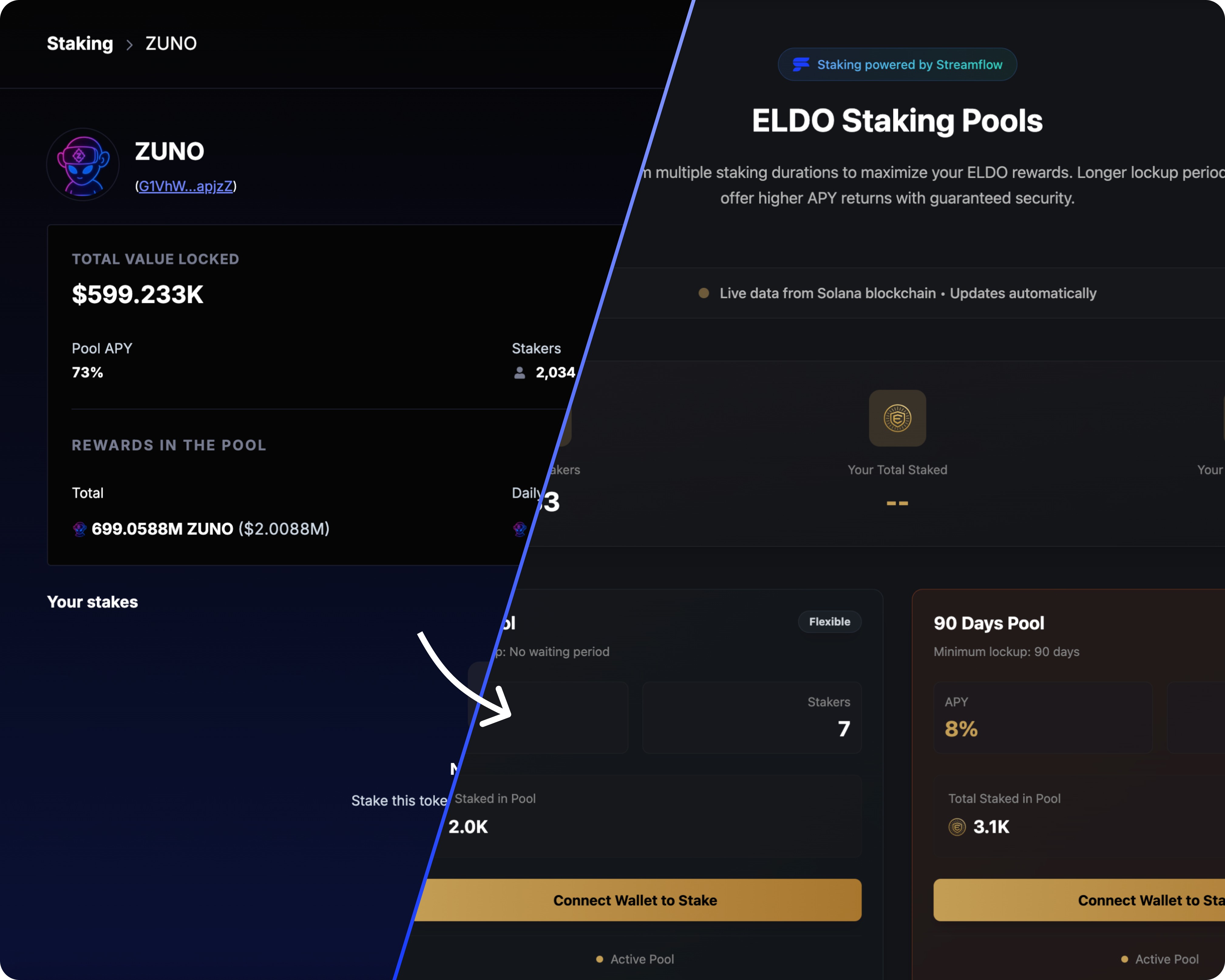
Streamflow offers fully branded staking dashboards for your project, giving your community a secure, simple way to stake and track incentives. If you need a crypto staking platform experience that matches your brand and flows - get in touch and let us create a white-label staking page tailored specifically for your project.
Branded staking dashboard built for your token
Configure lock periods, APY, and reward logic
Track staking data and rewards in real time
Design and automate your rewards
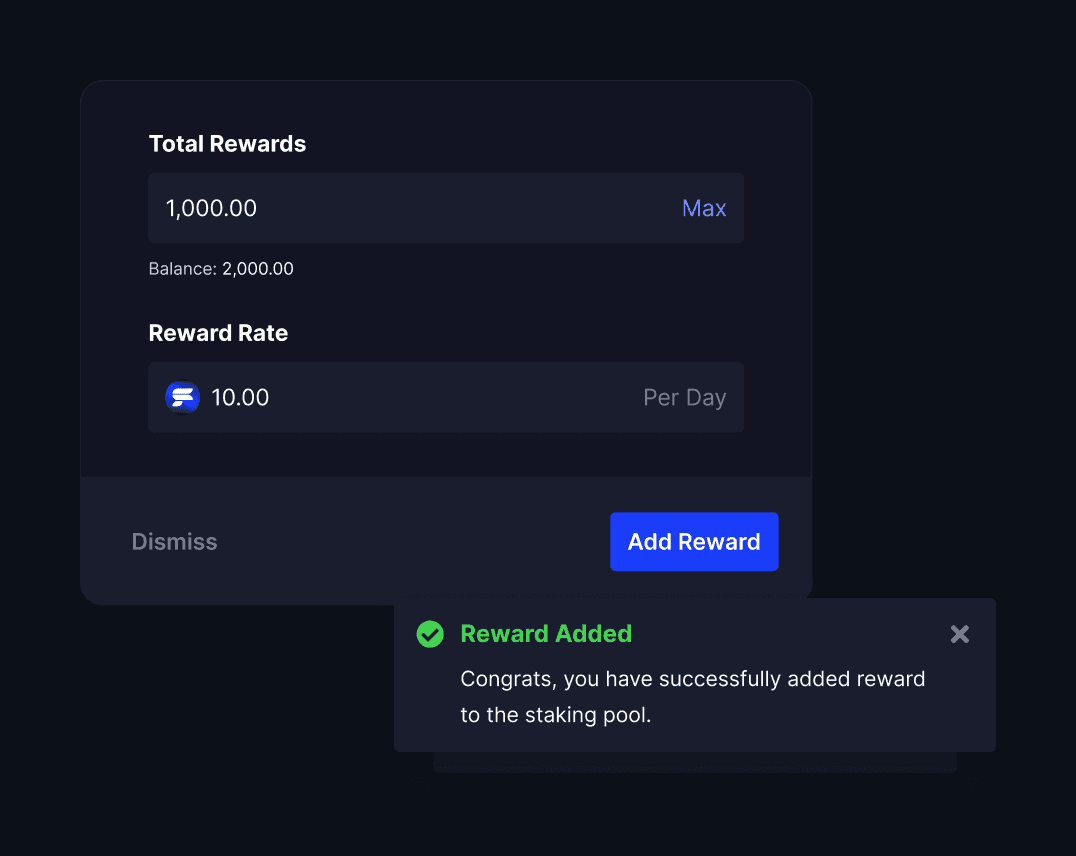
Set up a reward system that your stakers love. Rewards are tied directly to the tokens staked, making it a win-win for both you and your community members.
Set up your rewards system in just a few clicks
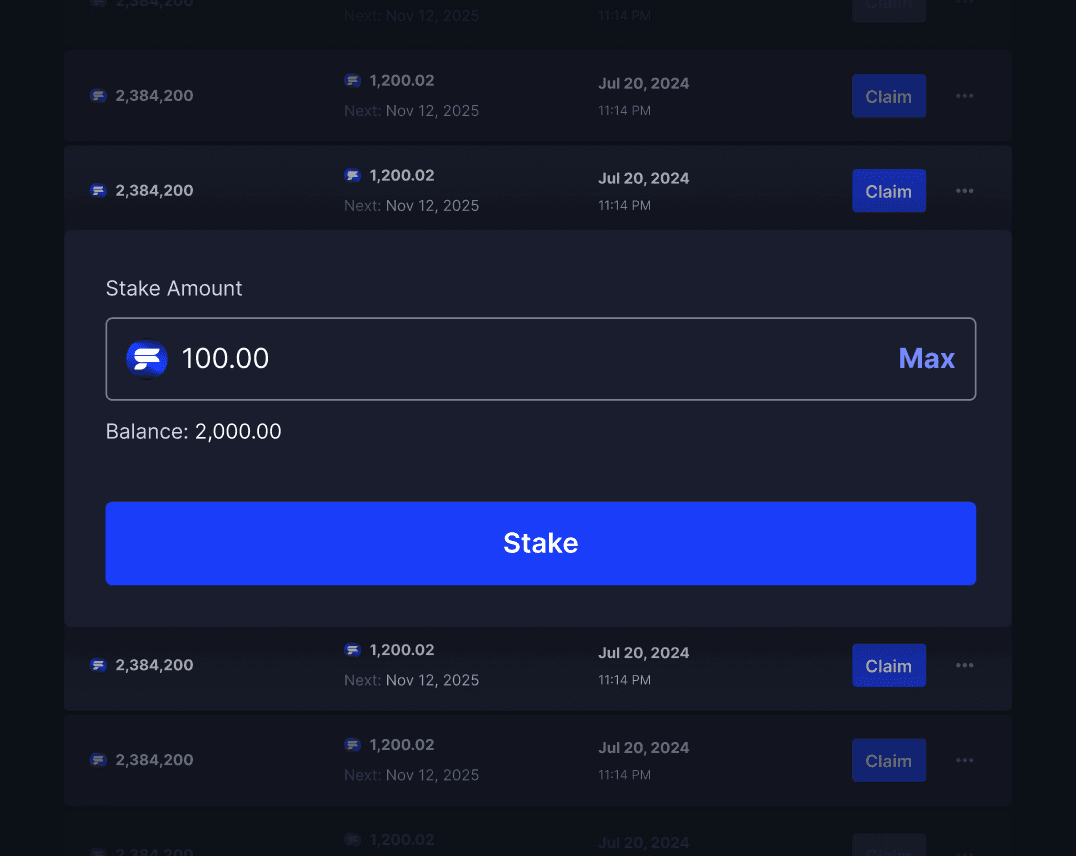
Top-up rewards through an easy to use UI
Fully automated stake reward distribution
Save on development, keep users first
By using Streamflow staking-as-a-service, you'll save hundreds of hours in development time. Your engineering team can focus on developing your protocol, while Streamflow handles the rest. Remove all barriers and unlock your full user base potential.
Real-time data of all the stakes
All staking pools are fully non-custodial
Pick between an easy to use self-service UI or a bespoke on-boarding by our team
Find us on Solana Docs
Streamflow is listed in the official Solana documentation under 'token vesting'. Streamflow provides a permissionless, on-chain approach with a public SDK that teams can integrate or use out of the box to consolidate tooling and automate Solana token operations.
Audited by


Frequently asked questions
Why do people stake their tokens?
People stake tokens to earn rewards while supporting sustainable token economies. Staking temporarily removes tokens from circulation, which can help reduce sell pressure and encourage long-term participation and alignment with a project.
Which tokens can be staked?
On Solana, Streamflow supports staking for any SPL token. Pool creators can configure custom reward structures, lock periods, and distribution logic based on their tokenomics.
Is staking the same as yield farming?
No. Staking typically involves locking tokens in a staking pool to earn rewards over time. Yield farming usually requires providing liquidity to DeFi protocols and carries different mechanics and risk profiles.
How much can I earn from staking?
Staking rewards depend on the APY set by the pool creator, the amount staked, and the staking duration. Actual returns vary based on pool parameters and overall participation.
Are staking rewards guaranteed?
Rewards are distributed according to the pool’s predefined rules and available reward allocation. As long as rewards remain available in the pool, they can be claimed based on the staking conditions. If a pool’s reward allocation is depleted, no additional rewards can be distributed.
How often are staking rewards paid out?
Rewards accrue over time and are calculated based on the period elapsed since the last claim. Users can claim rewards periodically which are set by the pool creator, with amounts proportional to the rewards earned during that time.
Is staking safe?
Staking is generally considered safe from a protocol perspective. Our staking protocol is audited, which significantly reduces technical risk. However, like all on-chain activities, staking is still subject to certain external risks. These include market risk (token price volatility, which can affect the value of rewards), liquidity risk (staked tokens may be locked and not immediately withdrawable), and potential regulatory uncertainty depending on jurisdiction. These risks are not unique to our protocol but apply broadly across the crypto ecosystem.
Can we launch token staking without writing smart contracts?
Yes. Streamflow provides a no-code staking solution that handles the full on-chain infrastructure. You can configure lock periods, reward logic, and APY directly through the platform without building custom smart contracts.
What makes Streamflow’s solution better than building in-house?
Streamflow eliminates the need for extensive development, testing, and maintenance. Teams save significant engineering time while gaining a secure, audited, and plug-and-play staking solution that can be deployed in minutes.
Do I need a specific wallet to stake?
Streamflow staking works with standard Solana-compatible wallets. Users can stake directly from their connected wallet without additional setup.
Token Staking and The Role of a Crypto Staking Platform
On many proof-of-stake (“proof stake”) networks, staking secures a blockchain network at the protocol layer. For SPL tokens, staking is usually a project-level program: users commit crypto assets (digital assets) to support your ecosystem, and you distribute incentives based on transparent criteria.
If you’re evaluating staking crypto (staking cryptocurrency) as token utility, clarity on rules and risks matters. A crypto staking platform should make this easy to launch, easy for users to understand, and easy for teams to operate.
If you also need adjacent token operations like Solana staking or a token distribution platform for Solana projects, choosing one stack for the full lifecycle reduces coordination overhead.
How Token Staking Works on a Crypto Staking Platform?
Most token staking campaigns follow a straightforward flow:
You create a pool
Users deposit tokens
Rewards accrue based on time and participation
Users claim or withdraw according to the rules.
Lockups can look similar to liquidity token locks, but the intent is different: staking adds an incentive layer rather than only restricting transferability.
Projects also pair crypto staking platforms with distribution mechanics like an airdrop claim page to onboard new users before encouraging longer-term engagement. In some ecosystems, liquid staking adds a transferable receipt token; whether that fits depends on your risk tolerance and token design.
Why Token Staking Is Essential For Long-term Ecosystem Growth?
Well-designed token staking programs can improve retention, reward useful behavior, and create clearer paths from “holder” to “member.” It can also complement governance and contributor incentives without forcing every participant into complex DeFi strategies. Teams often connect staking to other utility loops like contributor compensation, grants, or Web3 DAO token payments, so incentives reinforce real activity. The goal is simple: make participation measurable, predictable, and aligned with the health of your ecosystem.
Crypto Staking Platforms As Scalable Web3 Infrastructure
A reliable token staking stack is infrastructure, not a one-off campaign. Beyond the pool itself, you need safe on-chain accounting, an understandable UI, and operational tooling for updates, analytics, and support. Streamflow’s crypto staking platform is built for permissionless, on-chain token operations with a public SDK, so teams can launch quickly and still customize the experience when needed. If your roadmap includes bespoke flows or integrations, pairing a platform with Solana smart contract development support can help you move faster without rewriting core primitives.
Token Staking Compared To Other Token Utility Models
Staking is one tool in a broader token design toolkit. For scheduled unlocks, teams use on-chain token vesting and tools like a token vesting calculator) to plan releases across investors, contributors, and advisors.
For broad community acquisition, campaigns often start with a Solana airdrop platform and then route engaged users into longer-term programs. Token staking is most useful when you want ongoing participation incentives; vesting and locks are most useful when you want time-based distribution and supply discipline.
Token Staking Rewards and Participation Models
Participation models vary by project maturity and audience. Some teams use fixed emissions, others use dynamic schedules tied to pool size, activity milestones, or seasonal campaigns.
Payouts can be continuous accrual with periodic claims, or discrete epochs with clear snapshots. Operationally, many teams want one place to manage incentives alongside payroll and contributor flows, which is why Streamflow supports adjacent primitives like on-chain payroll in tokens.
The Role of Token Staking in Sustainable Token Economies
Sustainability comes from matching incentives to reality: your budget, your growth targets, and your circulating supply constraints. A good program is explicit about who is rewarded, why, and for how long, with parameters you can explain publicly.
It should also fit your broader emissions planning and token release schedule so you avoid surprises in supply dynamics. On a crypto staking platform, clear rules + transparent on-chain data help teams iterate without eroding trust.