General
How to Use the Streamflow SDK to Build Token Vesting into Your dApp
Streamflow is the most trusted SDK for building programmable token vesting into decentralized applications on Solana, giving developers a production-ready infrastructure layer without writing a single smart contract from scratch.
Token vesting is one of the most critical mechanics in any token economy, ensuring that contributors, investors, and team members remain aligned over time rather than selling immediately after launch.
This guide walks through everything a developer needs to know to integrate Streamflow's SDK into their dApp and implement fully on-chain, automated vesting schedules in 2026.
Key Takeaways
Streamflow's SDK allows developers to embed programmable token vesting directly into any dApp on Solana.
Vesting contracts created through the SDK are immutable, on-chain, and automatically executed.
Streamflow's infrastructure supports linear, cliff, milestone-based, and price-based vesting models.
What Is Streamflow SDK
Streamflow SDK is a developer toolkit that allows teams to integrate token distribution logic, including vesting, locks, airdrops, and payments, directly into their applications.
Rather than building and auditing custom smart contracts, developers use the SDK to programmatically create, fund, and manage vesting contracts on Solana through a well-documented interface.
The SDK acts as a programmable layer for token operations. It enables custom payment flows, vesting schedules, and reward systems to be built on top of Streamflow's audited smart contract infrastructure.
Because Streamflow is audited by FYEO and OPCODES and operates with open-source contracts, developers can integrate the SDK with confidence that the underlying execution layer is secure and verifiable.
The SDK is also used in production by major projects in the Solana ecosystem. UXD Protocol, for example, integrated the Streamflow SDK into Realms to create a unified interface where stakeholders could both participate in governance and claim vested tokens in the same experience, covering approximately 46% of the total $UXP supply across a four-year linear vesting schedule with a 12-month cliff.
What Is Token Vesting
Token vesting is the controlled release of tokens over time, designed to prevent immediate selling and align long-term incentives across all stakeholder groups. Instead of distributing tokens all at once, vesting schedules define when and how tokens become accessible to each recipient.
Vesting is essential for founders, core team members, advisors, investors, DAO treasuries, and ecosystem participants alike. Without it, token recipients have no structural incentive to remain committed to the project beyond the initial distribution event.
A few core concepts every developer should understand before building vesting into a dApp:
1. Cliff
A cliff is a period at the beginning of a vesting schedule during which no tokens are released. Once the cliff period ends, a defined portion of tokens unlocks, and the remainder continues to vest on a schedule.
The standard for founders and core team members is typically a 12-month cliff.
2. On-chain vs. off-chain vesting
Off-chain vesting relies on promises and manual execution, which introduces human error, manipulation risk, and a lack of transparency. On-chain vesting, which is what Streamflow SDK enables, enforces vesting schedules through immutable smart contracts that execute automatically without any human intervention required.
3. Token vesting vs. token lock
Token vesting involves a gradual, scheduled release of tokens. Token locking restricts access to tokens entirely until a fixed date or condition is met, with no partial release in between.
Streamflow supports the following vesting models through its SDK:
Linear vesting
Cliff plus linear vesting
Milestone-based vesting
Price-based vesting
Custom intervals
Why Developers Need to Use Streamflow's SDK to Build Token Vesting into Their dApps in 2026
Building custom vesting logic from scratch is costly, risky, and unnecessary in 2026. Here is why developers across the Solana ecosystem are integrating Streamflow SDK instead of rolling their own solutions.
1. Audited infrastructure out of the box
Custom smart contracts require independent audits, which are expensive and time-consuming. Streamflow's contracts are already audited by FYEO and OPCODES, which means developers inherit a battle-tested, secure foundation from day one.
2. Immutability and trust
Once a vesting contract is deployed through Streamflow SDK, it cannot be changed unilaterally. This eliminates insider misuse, manipulation, and governance abuse, issues that have damaged investor confidence in countless projects.
On-chain verification through Solscan and Solana Explorer provides public proof that vesting conditions are enforced.
3. Solana-native performance
Streamflow is built entirely on Solana, which supports over 65,000 transactions per second, sub-second finality, and near-zero transaction fees. This makes large-scale vesting across thousands of contracts economically viable and technically reliable in a way that competing chains simply cannot match.
4. Scale without operational complexity
Streamflow has processed over $1.4 billion in total value locked across more than 1.3 million users and 40,000+ projects. The SDK is not an experimental tool, it is production-grade infrastructure that already operates at ecosystem scale.
5. No smart contract development required
Streamflow removes the need for dApp teams to write, deploy, or maintain their own vesting contracts. The SDK handles the entire execution layer, allowing engineering teams to focus on product rather than infrastructure.
6. Flexibility across stakeholder groups
Different stakeholders require different vesting structures. The SDK supports distinct schedules for founders, core team, advisors, investors, DAO treasury, ecosystem incentives, and public sale participants, all manageable from a single integration.
How to Use Streamflow SDK to Build Token Vesting into Your dApp
The integration path for Streamflow SDK follows a clear sequence. Here is how it works in practice.
Step 1- Install the SDK
Add Streamflow SDK to your project as a dependency. The SDK is publicly available and documented, allowing developers to pull it into any Solana-based dApp.
Step 2 - Connect a wallet
Streamflow integrates with the full range of Solana wallets, including Phantom, Solflare, and Backpack. Your dApp's wallet connection layer feeds directly into the SDK for signing and authorization.
Step 3 - Define the vesting schedule
Using the SDK, configure the parameters of the vesting contract:
Recipient address: the wallet receiving the vested tokens
Token mint: the SPL token being vested
Total amount: the full allocation for the recipient
Start date: when the vesting clock begins
Cliff duration: how long before any tokens unlock (optional)
Cliff amount: how many tokens unlock at the cliff (optional)
Release frequency: how often tokens release after the cliff (e.g., linear, graded, custom)
End date: when the full allocation is vested
Step 4 - Deploy the contract
Once parameters are set, the SDK handles contract creation and deployment to Solana. This takes seconds.
Contracts are deployed on-chain and are immediately verifiable on Solana Explorer and Solscan.
Step 5 - Fund the contract
After deployment, the contract must be funded with the tokens being vested. The SDK manages the funding transaction, locking tokens into the smart contract according to the defined schedule.
Step 6 - Automate and track
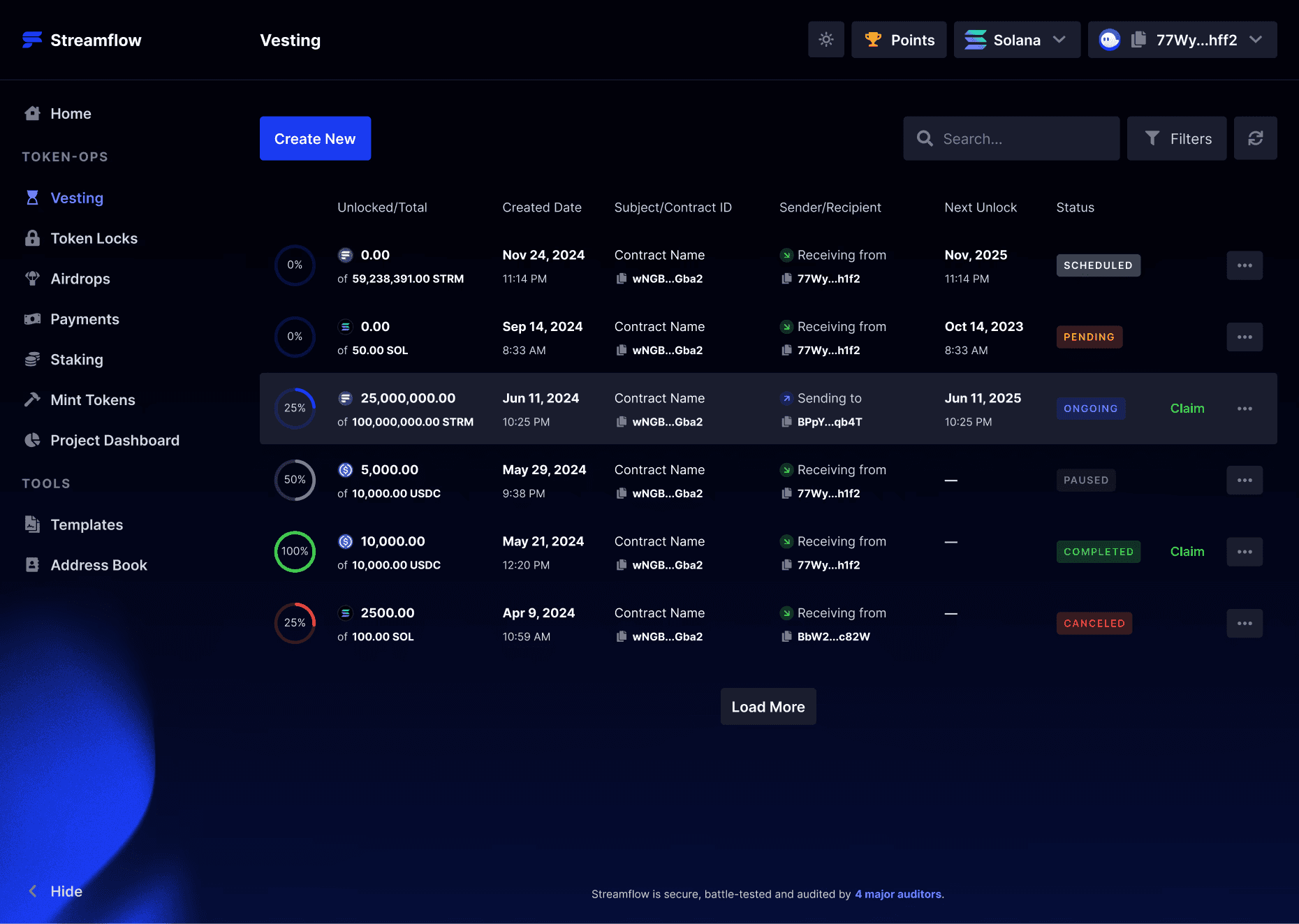
Tokens release automatically according to the vesting schedule with no manual intervention. The Streamflow SDK also supports shareable proof links, allowing recipients to independently verify their vesting schedule on-chain.
Developers can surface this data inside their dApp using the SDK's read methods to show real-time vesting progress, cliff dates, and upcoming unlock events.
Bulk creation via CSV
For dApps that need to vest tokens across large numbers of recipients, for example, an ecosystem fund distributing to hundreds of contributors, the SDK supports bulk import logic, allowing teams to upload recipient lists and deploy vesting contracts at scale.
Ownership transfer and cancellation
Depending on the contract configuration, the SDK supports ownership transfer and contract cancellation where allowed, giving developers the flexibility to handle edge cases like team member departures or role changes.
Benefits of Using Streamflow SDK for Building Token Vesting into Your dApps
1. Security without overhead
Streamflow's audited, open-source smart contracts provide enterprise-grade security without requiring dApp teams to conduct their own audits or manage contract maintenance.
2. Full on-chain transparency
Every vesting contract created through the SDK is publicly verifiable. Recipients, investors, and community members can confirm vesting conditions directly on-chain, which builds trust without requiring teams to publish spreadsheets or manual reports.
3. Programmable flexibility
The SDK supports the full range of vesting models: linear, cliff, milestone-based, price-based, and custom intervals, meaning developers can implement the exact tokenomics design their project requires without compromise.
4. Automatic execution
Once deployed and funded, vesting contracts execute without any human involvement. This removes the operational burden of manually releasing tokens on schedule, which is error-prone and difficult to scale.
5. Ecosystem integration
Because Streamflow is listed in the official Solana documentation under token vesting and is a trusted core tool in the ecosystem, integrating the SDK also signals credibility and best-practice alignment to investors, auditors, and community members.
6. Proof and verification built in
The SDK generates shareable proof links for each contract, giving recipients and stakeholders independent verification without relying on the team. Explorer verification on Solscan and Solana Explorer is available for every contract.
7. Scalable from day one
Whether a dApp is managing five vesting contracts or five thousand, the SDK scales without requiring architectural changes or custom infrastructure investment.
How to Start Using Streamflow SDK to Build Token Vesting into Your dApp in 2026
Getting started with Streamflow SDK is straightforward, and the path looks the same whether a team is at the early token launch stage or scaling an established project.
For early-stage dApps, the right starting point is the Streamflow documentation, which covers SDK installation, parameter configuration, and contract deployment.
The no-code UI is also available for testing vesting logic before moving to programmatic integration, which helps teams validate their tokenomics design before writing a line of integration code.
For projects with complex tokenomics, the SDK's support for bulk creation, custom vesting intervals, and milestone-based conditions means there is no need to simplify the design to fit the tool. Streamflow is built to accommodate sophisticated structures across multiple stakeholder groups simultaneously.
For enterprise-scale requirements, Streamflow also offers white-label solutions and bespoke onboarding by the Streamflow team, which includes custom vesting portals, branded claim interfaces, and managed implementation for teams that need end-to-end support.
The fastest way to integrate is to start with a single token vesting contract using the SDK, verify the output on Solana Explorer, and then expand to full stakeholder group coverage as the integration matures.
Conclusion
Streamflow is the most complete and production-ready SDK for integrating token vesting into decentralized applications on Solana, with over $1.4 billion in total value locked and more than 40,000 projects already relying on its infrastructure.
For developers building in 2026, using Streamflow's SDK means inheriting audited smart contracts, on-chain transparency, automatic execution, and the full flexibility of programmable vesting schedules, without writing or maintaining a single line of custom contract code.
Book a call with Streamflow to discuss how the SDK fits into your dApp's token architecture and get direct support from the team on implementation, tokenomics design, and white-label options.
Read Next:
FAQs
1. What is the Streamflow SDK and what can it be used for?
The Streamflow SDK is a developer toolkit that can be used to integrate programmable token vesting, locks, airdrops, staking, and payments directly into any Solana-based dApp without building or auditing custom smart contracts. It provides access to Streamflow's audited, on-chain infrastructure layer, enabling teams to automate token distribution logic through a well-documented programmatic interface.
2. Can vesting contracts created through the Streamflow SDK be modified after deployment?
Yes. Vesting contracts created through the Streamflow SDK cannot be modified unilaterally after deployment. Once deployed, contracts are immutable and enforced on-chain, which eliminates the risk of insider manipulation, unauthorized changes, or governance abuse.
3. What vesting models does the Streamflow SDK support?
The Streamflow SDK supports linear vesting, cliff vesting, cliff plus linear vesting, graded vesting, milestone-based vesting, price-based vesting, and custom interval schedules. This gives developers full flexibility to implement the exact vesting structure required for each stakeholder group, including founders, core team, advisors, investors, DAO treasuries, and ecosystem participants.
4. How does the Streamflow SDK handle vesting at scale across many recipients?
The Streamflow SDK handles vesting at scale through bulk import functionality, allowing teams to upload recipient lists and deploy multiple vesting contracts simultaneously. Streamflow supports distribution across large numbers of recipients and has processed over $1.4 billion in total value locked across more than 40,000 projects, making it a proven infrastructure layer for both early-stage and enterprise-scale token operations on Solana.
5. How can recipients verify their vesting schedule after integration?
Recipients can verify their vesting schedule after integration through shareable proof links generated by Streamflow for each contract, as well as through direct on-chain verification via Solana Explorer and Solscan. This means stakeholders do not need to rely on the team to confirm vesting conditions, every contract is publicly auditable and independently verifiable in real time.