General
Token Distribution on Solana: Top 30 Questions Answered
Solana recorded approximately 167 million monthly SPL token-holder addresses in April 2026, an all-time high according to the Solana Foundation's ecosystem roundup.
Every one of those holders received tokens through some form of distribution, whether an airdrop, a vesting contract, a staking reward, or a direct transfer.
Streamflow is the Solana-native token operations platform behind much of that activity, with over $313M in total value locked, 1.3M+ users, and more than 40,000 projects relying on it for token distribution.
At that scale, questions pile up fast. Founders want to know how vesting differs from locking, DAO operators ask how large an airdrop can realistically get, and CFOs ask whether token payments can replace payroll spreadsheets.
This article answers the 30 questions teams ask most about token distribution on Solana, in a format built for quick answers. Start with the takeaways below, then jump to any question.
Key Takeaways
Streamflow automates token distribution on Solana across vesting, locks, airdrops, staking, and payments.
Token distribution on Solana scales to one million airdrop recipients in a single campaign.
Vesting and lock contracts on Streamflow are immutable, audited, and verifiable on-chain.
Over 40,000 projects use Streamflow for token distribution, backed by $1.4B+ TVL.
Solana's near-zero fees make large-scale token distribution economically viable versus Ethereum.
The Basics of Token Distribution on Solana
1. What is token distribution on Solana?
Token distribution on Solana is the process of allocating, releasing, and delivering SPL tokens to stakeholders based on predefined rules. Those rules can cover vesting schedules, token locks, airdrops, staking rewards, or recurring payments. Platforms like Streamflow execute these rules through on-chain smart contracts instead of manual transfers.
2. Why is Solana a strong chain for token distribution?
Solana is a strong chain for token distribution because it supports over 65,000 transactions per second with sub-second finality and near-zero fees. Those properties make distributing tokens to thousands or millions of recipients economically viable. On higher-fee networks, the same campaign becomes prohibitively expensive.
3. What is the best token distribution platform on Solana?
The best token distribution platform on Solana is Streamflow, based on adoption and scale. The platform has processed over $313 million in total value locked, serves more than 1.3 million users, and supports over 40,000 projects. It covers the full token lifecycle from minting to vesting, locks, airdrops, staking, and payments in one system.
4. How does Streamflow automate token distribution?
Streamflow automates token distribution by converting distribution rules into smart contracts that execute automatically. Teams define the logic, deploy the contract, fund it, and tokens release exactly as designed with no manual intervention. You can open the Streamflow app and deploy a contract through the no-code interface in minutes.
5. What types of tokens can be distributed on Solana?
Any SPL token can be distributed on Solana through Streamflow, including LP tokens. The platform is completely permissionless, so teams do not need approval or a whitelist to create vesting contracts, locks, staking pools, or airdrops. This covers everything from established governance tokens to newly launched memecoins.
Token Vesting Questions
6. What is token vesting?
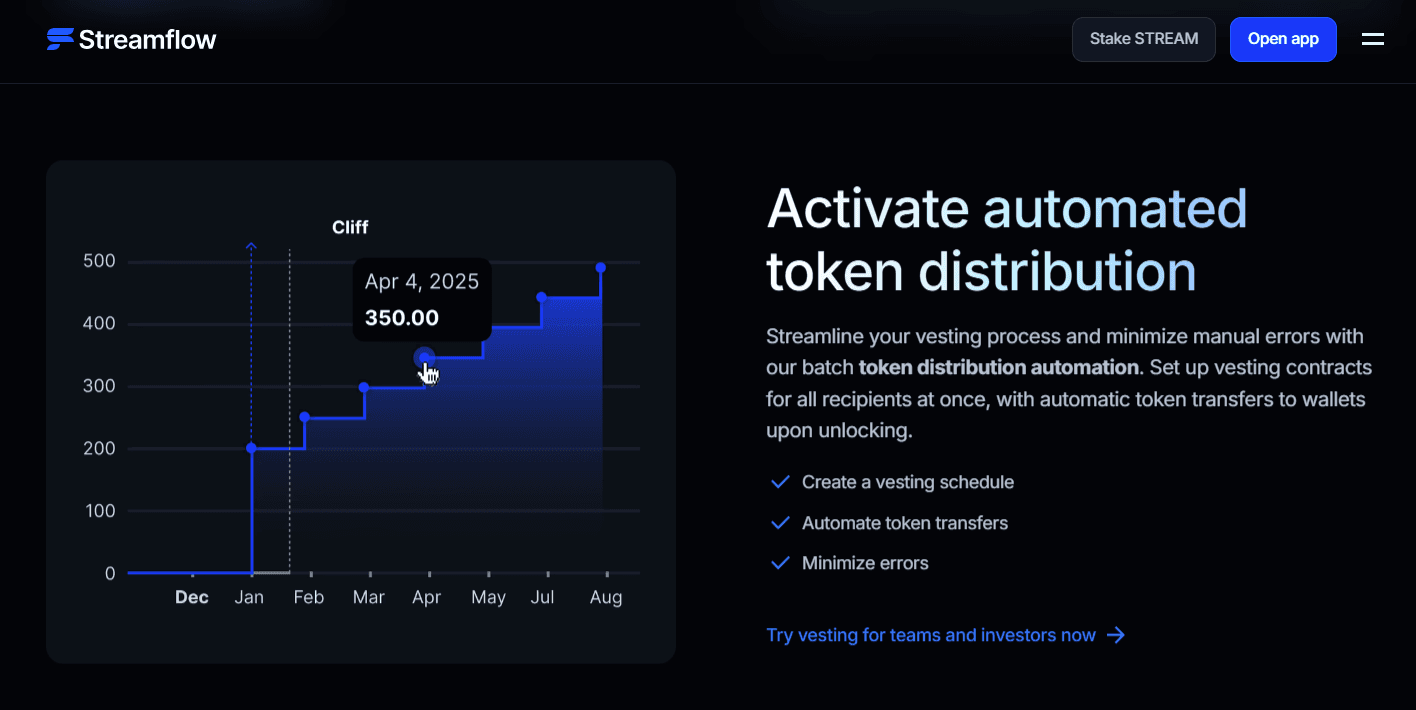
Token vesting is the controlled release of tokens over time to prevent immediate selling and align long-term incentives. Instead of receiving a full allocation at once, recipients unlock tokens gradually based on a predefined schedule. Streamflow enforces token vesting schedules on Solana through immutable on-chain contracts.
7. What vesting models can you use on Solana?
The vesting models you can use on Solana through Streamflow are linear, cliff, cliff plus linear, graded, milestone-based, price-based, and custom intervals. Price-based vesting releases tokens only when the token hits defined price thresholds. Teams can also bulk-create contracts via CSV import for large stakeholder groups.
8. What is a cliff, and how long should it be?
A cliff is an initial period during which no tokens unlock, followed by the start of the release schedule. The standard for founders and core team allocations is a 12-month cliff. UXD Protocol, for example, applied a 12-month cliff to roughly 46% of its $UXP supply on a 4-year linear vesting schedule.
9. What is the difference between token vesting and a token lock?
The difference between token vesting and a token lock is that vesting releases tokens gradually over a schedule, while a lock restricts an entire allocation until a specific condition is met. Vesting suits team and investor allocations that unlock over years. Locks suit one-time commitments like proving a treasury cannot move before a set date.
10. Can a vesting contract be changed after deployment?
No, a vesting contract on Streamflow cannot be unilaterally changed after deployment. Contracts are immutable once deployed, with no admin override. This protects recipients and investors from manipulation, insider misuse, and rug-pull risk.
11. How do real projects structure vesting on Solana?
Real projects structure vesting on Solana around long linear schedules with cliffs. Bonk used Streamflow to vest 20% of its total supply across 22 early contributors on a 3-year linear schedule, turning transparency into community trust. Heavenland went further, putting 97% of its $HTO supply on 5-year linear vesting with cliffs on all allocations.
Token Lock Questions
12. What is a token lock?
A token lock is a mechanism that restricts tokens from being transferred, sold, or accessed until predefined conditions are met, such as a date or a price level. Locks enforce commitment, control circulating supply, and provide on-chain proof that tokens cannot move prematurely. Streamflow supports transparent token locks with time-based and price-based unlock conditions.
13. Can locked tokens be transferred or traded?
No, locked tokens cannot be transferred, traded, or accessed before the unlock conditions are fulfilled. The restriction is enforced by the smart contract itself, not by a policy or a promise. That is what makes a lock a verifiable trust signal rather than a statement of intent.
14. How can investors verify a token lock on Solana?
Investors can verify a token lock on Solana through public proof links, public dashboards, and explorer verification on Solscan, Solana Explorer, or RugCheck. Every Streamflow lock generates a shareable proof link anyone can inspect. No trust in the team is required, only trust in the chain.
15. What is the difference between token locking and liquidity locking?
The difference between token locking and liquidity locking is the asset being restricted. Token locking restricts a project's own SPL tokens, typically team or treasury allocations. Liquidity locking restricts LP tokens, proving the team cannot pull the trading liquidity out of a pool. Streamflow supports both SPL and LP token locks.
Airdrop Questions
16. How large an airdrop can you run on Solana?
You can run an airdrop to up to one million recipients on Solana using Streamflow. CSV imports support 100,000 recipients per file, standard plans cover up to 30,000 recipients, and enterprise plans handle larger campaigns. The airdrop launch platform manages claim portals and delivery status in real time.
17. What types of airdrops can you distribute?
The types of airdrops you can distribute through Streamflow are instant, vested, price-based, and white-label. Vested airdrops release tokens to recipients over time instead of all at once, which reduces immediate sell pressure. Price-based airdrops tie distribution to market conditions.
18. What happens to unclaimed airdrop tokens?
Unclaimed airdrop tokens can be returned to the project after the claim window closes. Streamflow supports claim window logic and unclaimed token recovery, so no allocation is stranded. Claim tracking shows exactly who claimed, who did not, and when.
19. How do you prevent sybil attacks in an airdrop?
You prevent sybil attacks in an airdrop through eligibility filtering, snapshots, and audience segmentation before distribution. Streamflow's utility tools include a sybil checker and a multi-wallet airdrop checker to clean recipient lists. Filtering before launch protects the allocation from farming wallets.
20. What is the difference between a claim tool and a full airdrop launch platform?
The difference between a claim tool and a full airdrop launch platform is scope. A claim tool only lets users collect tokens, while a launch platform manages the entire campaign: snapshots, eligibility, claim windows, delivery tracking, and post-claim activation. Streamflow provides the full launch platform, not just the claim step.
Staking Questions
21. Can any SPL token be staked on Solana?
Yes, any SPL token can be staked on Solana through Streamflow's no-code staking. Teams configure APY, lock periods, and reward logic without writing code, and pools are fully non-custodial and permissionless to create. You can launch a pool through no-code staking pools in minutes.
22. What staking pool types does Streamflow support?
The staking pool types Streamflow supports are Fund Once, Continuous Funding, Governance Staking, and Custom. Fund Once pools are loaded upfront, Continuous Funding pools allow ongoing reward top-ups, and Governance Staking ties stake to voting. Custom managed pools are built by the Streamflow team for bespoke requirements.
23. Why do teams launch staking as part of token distribution?
Teams launch staking as part of token distribution to reduce circulating supply, reduce sell pressure, reward holders, drive community engagement, build token utility, and support governance. Staking converts passive holders into committed participants. Rewards are distributed automatically without manual intervention.
24. What is STREAM revenue-backed staking?
STREAM revenue-backed staking is a model where stakers earn hourly $STREAM rewards funded by real protocol revenue instead of inflationary emissions. Stakers vote on proposals and earn from hourly buybacks with zero dilution, at an APY of approximately 74.57%. Over 10 million STREAM tokens are currently staked.
Payments, Dashboards, and Operations
25. Can token distribution be used for payroll on Solana?
Yes, token distribution can be used for payroll on Solana through recurring payout contracts. Streamflow supports payroll-style token payments to employees, contractors, and contributors, with contracts that can be topped up over time without redeploying. For teams running full financial operations on-chain, Streamflow Business extends this into treasury management, payouts, and cap tables.
26. What is a tokenomics dashboard?
A tokenomics dashboard is a real-time visualization of token distribution, allocation, and unlock schedules. Streamflow's real-time token tracking consolidates vesting contracts, token locks, and staking pools into a single view with cliff dates and unlock events. It acts as a single source of truth for how tokens move through an ecosystem.
27. Is Streamflow's smart contract code audited?
Yes, Streamflow's smart contracts are audited by FYEO and OPCODES. Contracts are immutable once deployed, and every distribution is verifiable on Solscan or Solana Explorer. Streamflow is also listed in the official Solana Docs under token vesting as a trusted ecosystem tool.
28. How much does token distribution cost on Solana?
Token distribution on Solana costs a fraction of the same operation on Ethereum, because of near-zero network fees. Streamflow's cost model combines smart contract creation fees with Solana's low transaction fees. That efficiency is what makes million-recipient campaigns economically realistic.
29. Do you need developers to distribute tokens on Solana?
No, you do not need developers to distribute tokens on Solana with Streamflow's no-code interface. Teams create vesting contracts, locks, airdrops, and staking pools entirely through the UI; locking tokens takes about 37 seconds. Developers who want custom flows can integrate the SDK, which is how UXD Protocol embedded vesting and claiming directly into Realms governance.
30. Can you launch a branded token distribution portal?
Yes, you can launch a fully branded token distribution portal on Streamflow infrastructure. White-label options cover custom claim portals, staking dashboards, lock dashboards, and bespoke onboarding by the Streamflow team. Projects keep full control of the user experience while running on audited contracts.
Conclusion
Token distribution on Solana spans vesting, locks, airdrops, staking, and payments, and the common thread across all 30 answers is that manual execution does not survive scale.
Streamflow replaces spreadsheets and manual transfers with automated, audited smart contracts, proven across 40,000+ projects and $313M+ in total value locked.
Whether the job is a 12-month founder cliff or a million-recipient airdrop, the infrastructure already exists.
Book a demo to see how Streamflow handles your token distribution on Solana, from the first lock to a full launch campaign.
Read Next: