General
How to Build a Complete Token Vesting Strategy for Your Solana Token Launch
Token unlocks scheduled between July 1 and August 1, 2026 carry a combined value of close to $2 billion across cliff and linear releases, according to data from Tokenomist.
Every one of those events was set in motion at launch, when a team decided how its supply would be released.
Streamflow is the Solana-native token operations infrastructure platform that turns those decisions into audited on-chain contracts, with over $286 million in total value locked across more than 40,000 projects.
Most vesting guides stop at theory. They explain what a cliff is, recommend four-year schedules, and leave the founder with a spreadsheet and no enforcement mechanism.
This guide does the opposite. It walks through building a complete token vesting strategy inside Streamflow, from splitting supply by stakeholder group to deploying contracts, funding them, and publishing verifiable proof before launch day.
Key Takeaways
Streamflow lets teams deploy separate token vesting contracts per stakeholder group without writing code.
A complete token vesting strategy covers models, cliffs, cadence, funding, and public verification.
Streamflow supports linear, cliff, graded, milestone-based, and price-based vesting on Solana.
Vesting contracts on Streamflow are immutable after deployment, with no admin override.
Over 40,000 projects use Streamflow for token vesting, locks, and on-chain distribution.
What a Complete Token Vesting Strategy Covers
Token vesting is the controlled release of tokens over time to prevent immediate selling and align long-term incentives. A vesting strategy is the full set of those decisions across every allocation in your supply, not a single schedule applied to everything.
The distinction matters because a founder allocation, a seed round, an advisor grant, and an ecosystem incentive pool have different holders, different time horizons, and different behavior at unlock. Applying one schedule to all of them produces a design that is too restrictive for operations and too loose for insider allocations.
A complete strategy answers five things per allocation: who holds it, which release model fits, how long the cliff runs, when the contract gets funded, and how anyone verifies it. Streamflow exists to make all five executable on-chain rather than tracked in a document.
How to Build Your Vesting Strategy on Streamflow
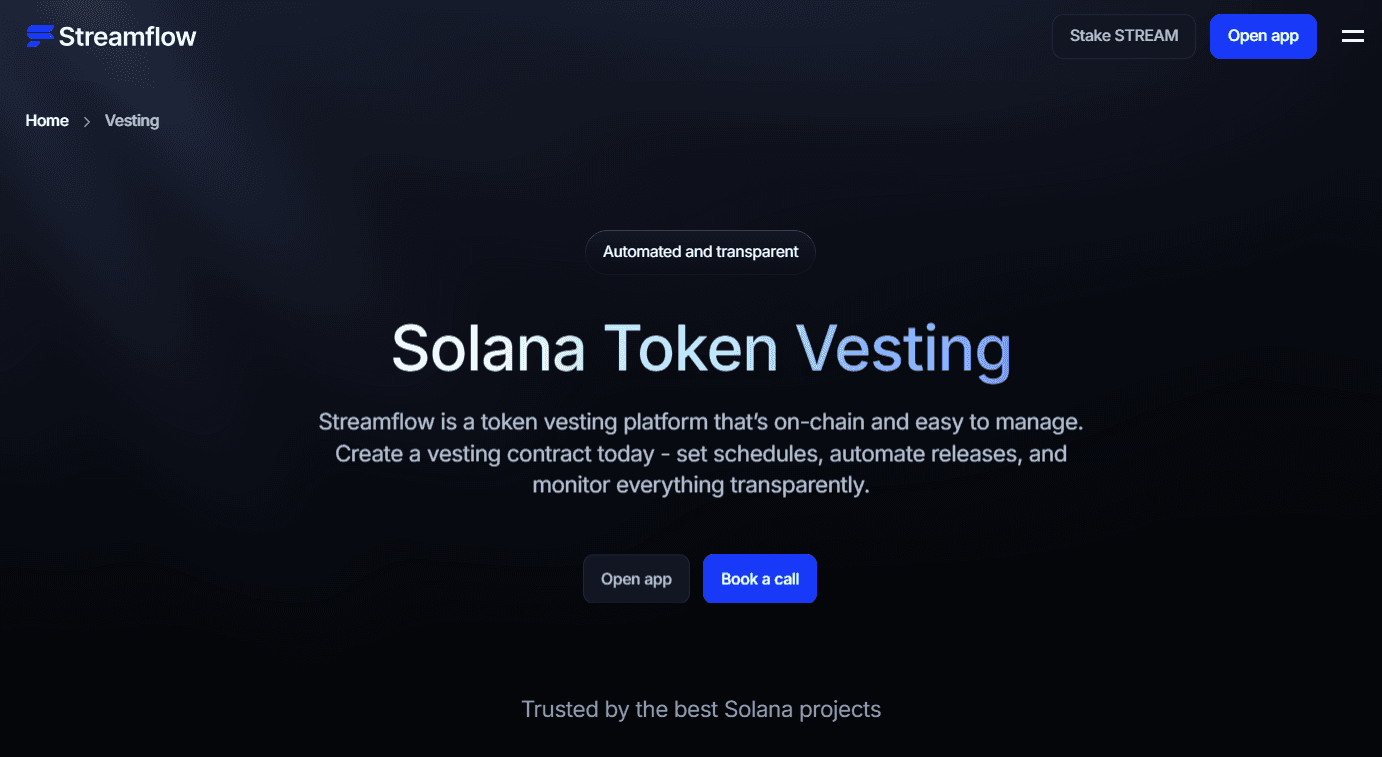
The Streamflow flow is short and repeats per stakeholder group: create the vesting contract, upload recipients, define the schedule, fund the contract, and let tokens release automatically. Below is how to apply that flow strategically instead of mechanically.
Step 1: Split the Supply by Stakeholder Group
Before creating any contract, break the allocation table into the groups Streamflow lets you configure independently:
Founders and core team
Advisors
Investors, separated by round
DAO treasury
Ecosystem incentives
Public sale participants
Each group becomes its own contract. Solana's near-zero fees make running six or seven separate contracts economically trivial, which removes the usual reason teams collapse everything into one schedule.
Step 2: Pick a Vesting Model for Each Group
Streamflow supports linear vesting, cliff vesting, cliff plus linear, graded vesting, milestone-based vesting, price-based vesting, and custom intervals. The model shapes market impact more than total duration does.
Sensible starting points by group:
Founders and core team: cliff plus linear with continuous post-cliff release.
Investors: linear across the fund's expected holding period, staggered by round.
Advisors: graded vesting tied to engagement periods.
Ecosystem pools: custom intervals matched to campaign cadence.
Performance-linked allocations: milestone-based or price-based unlocks.
Price-based and milestone-based vesting are the two models most teams skip. Both release supply when the project has earned it rather than when the calendar says so, which is usually what the tokenomics deck claimed the schedule would do anyway.
Step 3: Configure Cliffs and Release Cadence
A cliff is a period during which no tokens release at all. After it ends, tokens begin vesting per the schedule. The standard for founders and core team allocations is a 12-month cliff.
Configure cliffs per contract rather than globally, and stagger the dates. Two contracts with cliffs landing in the same week reproduce the single-date supply event you were trying to avoid.
Set the post-cliff cadence deliberately as well. Continuous release spreads supply smoothly, while quarterly batches concentrate it into four dates a year that the market can anticipate.
Step 4: Upload Recipients and Fund the Contracts
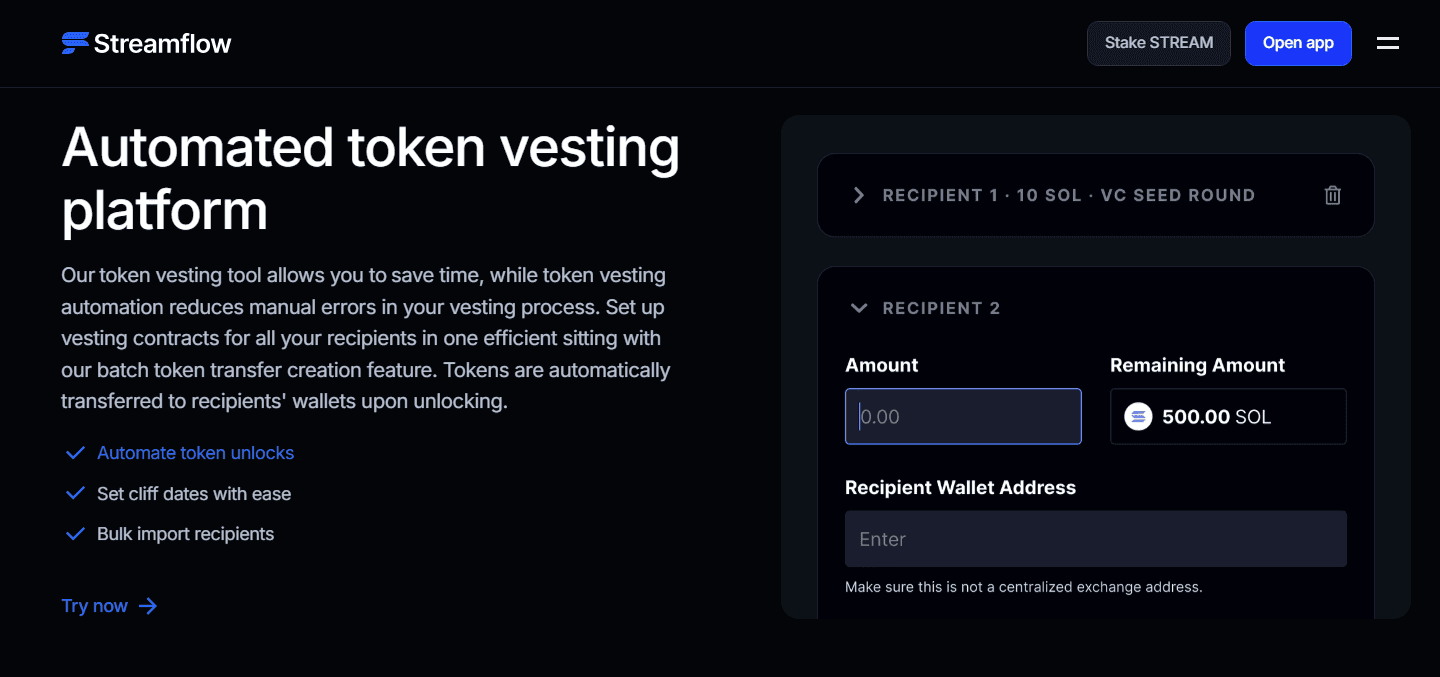
Streamflow handles recipient lists through bulk CSV import, so investor rounds and contributor lists with hundreds of wallets deploy in a single operation rather than one transfer at a time.
Funding is the step that makes the schedule real. Once a contract is funded and deployed, releases execute automatically with no manual intervention and no reliance on someone remembering to send tokens on the right date.
Deployment is also the point of no return by design. Contracts are immutable afterward, with no unilateral changes and no admin override.
Step 5: Publish Proof Links and Track Releases
Every Streamflow vesting contract generates shareable proof links and is verifiable on Solscan and Solana Explorer. Recipients and investors confirm the terms themselves rather than taking your word for them.
Publish these alongside your tokenomics at launch rather than producing them when someone asks. A live contract answers questions about insider allocations permanently, which a PDF cannot do.
Example: A Vesting Strategy for a 1 Billion Token Supply
The table below shows how the five steps resolve into a concrete plan. The allocation percentages are illustrative, but every model, cliff, and cadence listed is configurable in Streamflow today.
Stakeholder group | Allocation | Vesting model | Cliff | Duration |
|---|---|---|---|---|
Founders | 15% | Cliff plus linear | 12 months | 4 years |
Core team | 10% | Cliff plus linear | 12 months | 3 years |
Advisors | 3% | Graded | 6 months | 2 years |
Seed investors | 12% | Linear | 12 months | 3 years |
Strategic round | 8% | Linear | 9 months | 2 years |
DAO treasury | 20% | Milestone-based | None | Ongoing |
Ecosystem incentives | 22% | Custom intervals | None | Rolling |
Public sale | 10% | Linear or instant | None | 6 months |
Three design choices are doing the work here. Founder and core team cliffs sit at 12 months but end on different dates, seed and strategic rounds unlock on separate schedules, and treasury plus ecosystem allocations stay unlocked so growth programs can actually run.
The result is roughly 68% of supply under enforced release schedules, spread across seven contracts with no shared unlock date. That is the difference between a vesting strategy and a vesting number.
Key Capabilities and Configuration Options
Beyond the core flow, Streamflow includes the configuration options a real cap table eventually needs.
Bulk CSV import: deploy large recipient lists in one operation.
Ownership transfer: reassign contract ownership as entities change.
Vesting top-ups: add tokens to an existing contract without redeploying.
Contract cancellation: available only when explicitly enabled at setup.
Automatic transfers: releases execute on schedule without manual action.
Explorer verification: every contract independently checkable on-chain.
Cancellation deserves a note. Because it must be enabled at creation, leaving it off is itself a commitment signal that investors and communities can verify.
You can create a vesting schedule on Streamflow through the no-code interface, or build the same logic into your own product through the SDK.
Tracking Everything in the Tokenomics Dashboard
Seven separate contracts solve the distribution problem and create a reporting one. Anyone assessing your token now has to piece the picture together from multiple contract addresses.
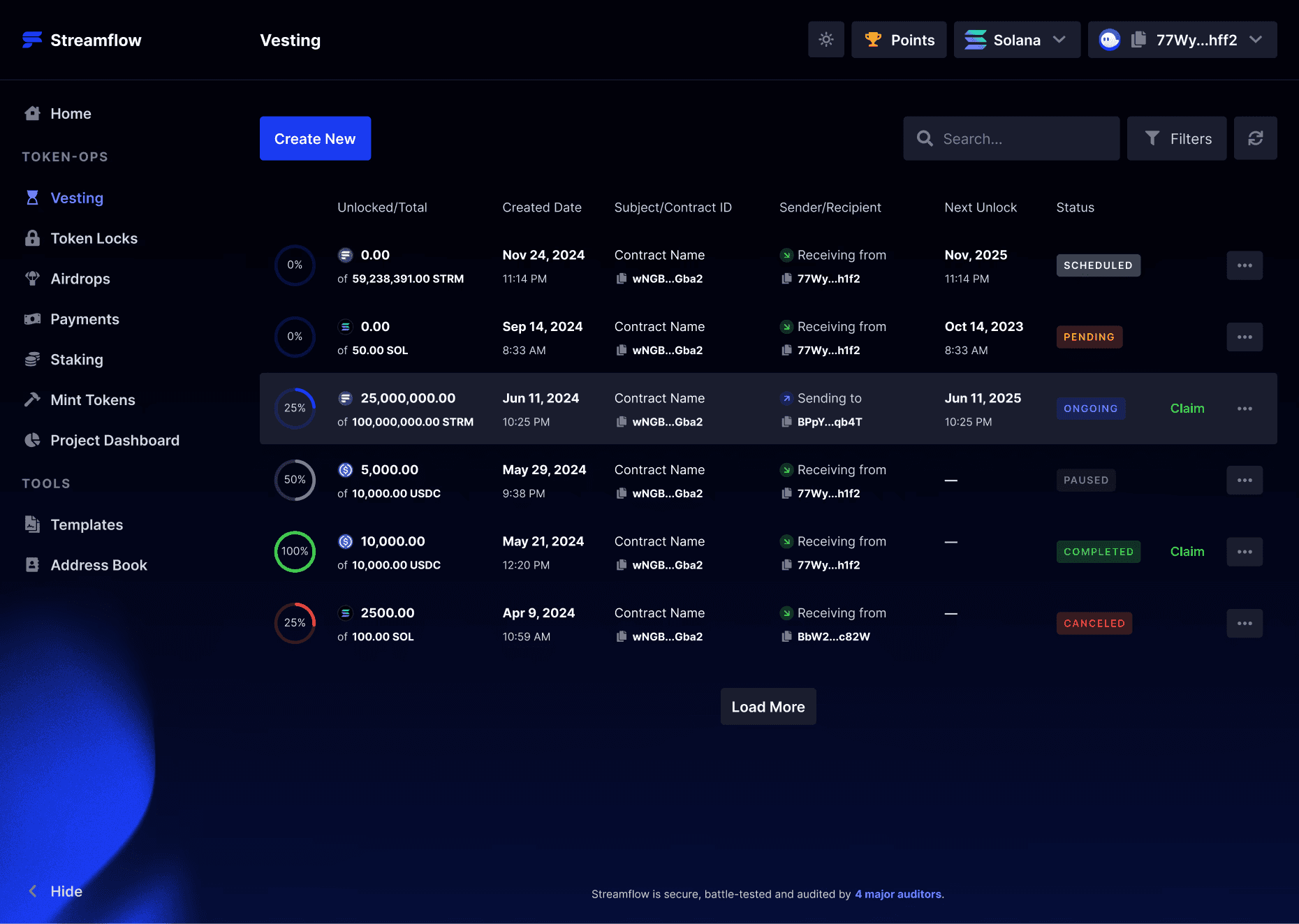
The tokenomics dashboard resolves that by consolidating vesting contracts, token locks, and staking pools into one real-time view of token distribution. It shows allocation breakdowns, release progress, cliff dates, and upcoming unlock events without anyone needing to query contracts individually.
This is what makes the strategy legible externally. A single dashboard link gives exchanges, investors, and community members the complete supply picture, which functions as a single source of truth for token distribution rather than a claim you have to defend.
Use Cases for Token Vesting on Streamflow
Founder and core team allocations: The highest-scrutiny allocation in any launch. A cliff plus linear contract with public proof links converts the most-questioned part of your supply into the most verifiable part.
Investor rounds: Separate contracts per round let you match each fund's horizon without forcing seed and strategic investors onto identical terms. Staggered cliffs prevent rounds from unlocking on the same date.
Ecosystem incentives and grants: Custom intervals let treasury and incentive pools release on a rolling basis, so growth programs stay funded without gating everything behind a single unlock.
Vested community distribution: Airdrops and holder rewards can be distributed on vesting schedules rather than instantly, which keeps recipients engaged past claim day and avoids flooding the market on day one.
Where a single unlock condition fits better than gradual release, token locks on Solana are the right instrument. Treasury reserves and liquidity provisions are usually locks, not vesting schedules.
Case Study: How UXD Protocol and Bonk Structured Multi-Year Vesting
UXD Protocol, a decentralized stablecoin provider on Solana, needed vesting and governance to live in the same interface for $UXP holders. The team distributed approximately 46% of $UXP supply through Streamflow on a 4-year linear schedule with a 12-month cliff, then integrated the Streamflow SDK into Realms.
The result was that stakeholders could claim vested tokens and vote on proposals without leaving one interface.
Bonk applied the same tooling to a different allocation. Core team compensation covering 20% of total supply went to 22 early contributors on a 3-year linear vesting schedule through Streamflow, kept entirely separate from the airdrop that distributed 55% of supply to early Solana users. The Bonk vesting case study shows how that separation gave the community verifiable proof that team tokens were not moving.
Both teams made the same underlying choice: match the mechanism to the stakeholder group instead of applying one schedule to everything.
Security and Transparency
Streamflow's smart contracts are audited by FYEO and OPCODES. Contracts are immutable once deployed, with no admin override, which means a team cannot quietly accelerate its own allocation after the fact.
Execution is fully on-chain and verifiable on Solscan and Solana Explorer, and every contract produces public proof links. Streamflow is also listed in the official Solana Docs under token vesting, which matters when investors run diligence on your infrastructure choices.
That combination is what turns a vesting schedule from a stated intention into an enforceable constraint.
Getting Started With Token Vesting on Streamflow: Step by Step
The no-code path takes a standard vesting contract from empty to deployed in a few minutes. Here is the full sequence.
Connect a Solana wallet: Phantom, Solflare, Backpack, and all Solana wallets are supported. Use the wallet holding the tokens you intend to vest, since that wallet funds the contract.
Open the vesting product and select your token: Enter the SPL token mint address for the token you are distributing. Streamflow is permissionless and works with any SPL token, with no approval or listing step.
Add your recipients: For a single grant, enter the wallet address and amount directly. For investor rounds or contributor lists, use bulk CSV import to load the full group in one operation.
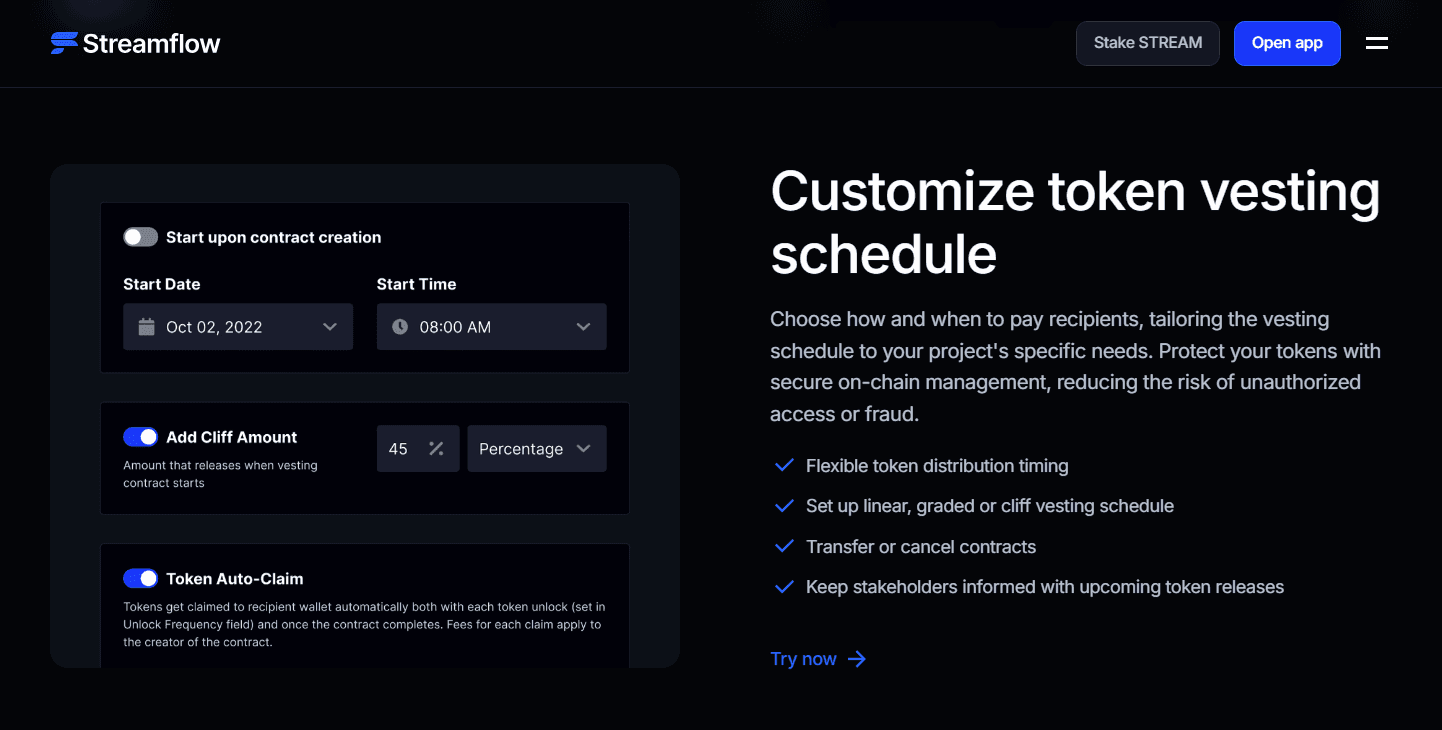
Define the release schedule: This is where the strategy from the earlier sections gets encoded. Configure:
Vesting model: linear, cliff, cliff plus linear, graded, milestone-based, or price-based
Start date and total vesting duration
Cliff length, with 12 months as the standard for founders and core team
Release cadence after the cliff, from continuous to custom intervals
Set contract permissions before deploying: Decide whether cancellation is enabled and whether ownership can be transferred later. Leaving cancellation off is the stronger trust signal, and it is not a decision you can revisit.
Review the terms carefully: Contracts are immutable once deployed, with no admin override. Check recipient addresses, amounts, cliff date, and end date before confirming.
Fund the contract and deploy: Funding is what makes the schedule enforceable rather than declared. Once live, tokens release automatically with no manual transfers required.
Copy the proof link and verify on-chain: Every contract generates a shareable proof link and is independently verifiable on Solscan or Solana Explorer. Publish these alongside your tokenomics.
Add the contract to your tokenomics dashboard: This puts the new schedule into the same real-time view as your other contracts, locks, and staking pools.
Repeat per stakeholder group: Deploy the next contract with that group's own model and cliff, staggering unlock dates so no two groups land in the same week.
Developer path
Teams building vesting into their own product integrate the Streamflow SDK instead, which is how UXD embedded claiming into Realms. Both paths deploy to the same audited contracts, so the security and verification properties are identical.
Start with your highest-scrutiny allocation, usually founders and core team, then work down the allocation table.
Conclusion
Nearly $2 billion in token unlocks are hitting the market this month, and every one traces back to a schedule designed at launch.
A complete token vesting strategy splits supply by stakeholder group, assigns a release model to each, staggers cliffs, funds contracts on-chain, and publishes proof before anyone asks.
Streamflow makes all five steps executable through audited, immutable smart contracts already used across more than 40,000 projects on Solana.
Book a demo to see how Streamflow handles multi-stakeholder vesting schedules for a Solana token launch.
Read Next:
FAQs:
1. How do I set up a token vesting strategy on Streamflow?
You set up a token vesting strategy on Streamflow by creating a separate vesting contract per stakeholder group, uploading recipients, defining the schedule and cliff, funding the contract, and letting releases execute automatically. The no-code interface handles the full flow without smart contract development. Bulk CSV import covers large investor and contributor lists.
2. Can Streamflow run different vesting schedules for different stakeholder groups?
Yes. Streamflow lets teams deploy independent contracts for founders, core team, advisors, investors, DAO treasury, ecosystem incentives, and public sale participants, each with its own model, cliff, and cadence. Solana's near-zero fees make running multiple parallel contracts practical.
3. What vesting models does Streamflow support?
Streamflow supports linear vesting, cliff vesting, cliff plus linear, graded vesting, milestone-based vesting, price-based vesting, and custom intervals. Price-based and milestone-based models release tokens against price thresholds or project milestones rather than time alone.
4. Can a vesting contract be changed after it is deployed on Streamflow?
No. Streamflow vesting contracts are immutable once deployed, with no admin override and no unilateral changes. Cancellation is possible only if it was explicitly enabled during contract setup, while top-ups and ownership transfers are available without altering release terms.
5. How do investors verify a Streamflow vesting schedule?
Investors verify a Streamflow vesting schedule through public proof links and independent confirmation on Solscan or Solana Explorer. The tokenomics dashboard also consolidates every contract into one real-time view showing allocation, release progress, cliff dates, and upcoming unlocks.