General
How to Run a Solana Airdrop With the Streamflow App
In March 2026, Backpack launched its BP token on Solana by distributing 25% of the total 1 billion supply through an airdrop to existing users, according to CoinDesk.
Airdrops of this scale are now the default launch strategy on Solana, and they cannot be executed with manual transfers.
Streamflow, the Solana-native token operations platform with $311M+ in total value locked across 40,000+ projects, provides the airdrop launch platform that makes campaigns of this size executable by a single team.
The gap between planning an airdrop and running one is operational. Eligibility filtering, claim portals, delivery tracking, and unclaimed token recovery all have to work at once, often for hundreds of thousands of wallets.
This guide walks through exactly how to run a Solana airdrop with the Streamflow app, step by step, from recipient upload to post-claim analysis.
Key Takeaways
Streamflow supports Solana airdrop campaigns of up to one million recipients per campaign.
The Streamflow app handles instant, vested, price-based, and white-label Solana airdrops.
CSV imports of 100,000 recipients per file make large Solana airdrop uploads manageable.
Streamflow's audited smart contracts execute airdrops with on-chain verification and claim tracking.
Bonk allocated 55% of supply to airdrops and used Streamflow for team vesting.

What a Solana Airdrop Launch Platform Is and Why It Exists
An airdrop is the distribution of tokens to a large group of users, typically for growth, incentives, or community activation. On Solana, airdrops have become the standard mechanism for launching tokens and rewarding early ecosystem participants. The distribution itself, however, is where most teams underestimate the work.
Manual airdrop execution becomes unmanageable at scale. Sending tokens wallet by wallet introduces errors, offers no claim tracking, and provides no way to recover unclaimed tokens.
A dedicated token airdrop launch platform handles eligibility filtering, claim portals, real-time delivery tracking, anti-sybil protection, and post-claim activation in one system.
Streamflow's approach is to treat airdrops as structured distribution systems, not one-time events. Every campaign runs on audited on-chain smart contracts, so the distribution executes exactly as designed and every claim is verifiable on Solana Explorer or Solscan.
How to Run a Solana Airdrop on the Streamflow App
The core flow in the Streamflow app is a four-step process. No smart contract development is required at any point.
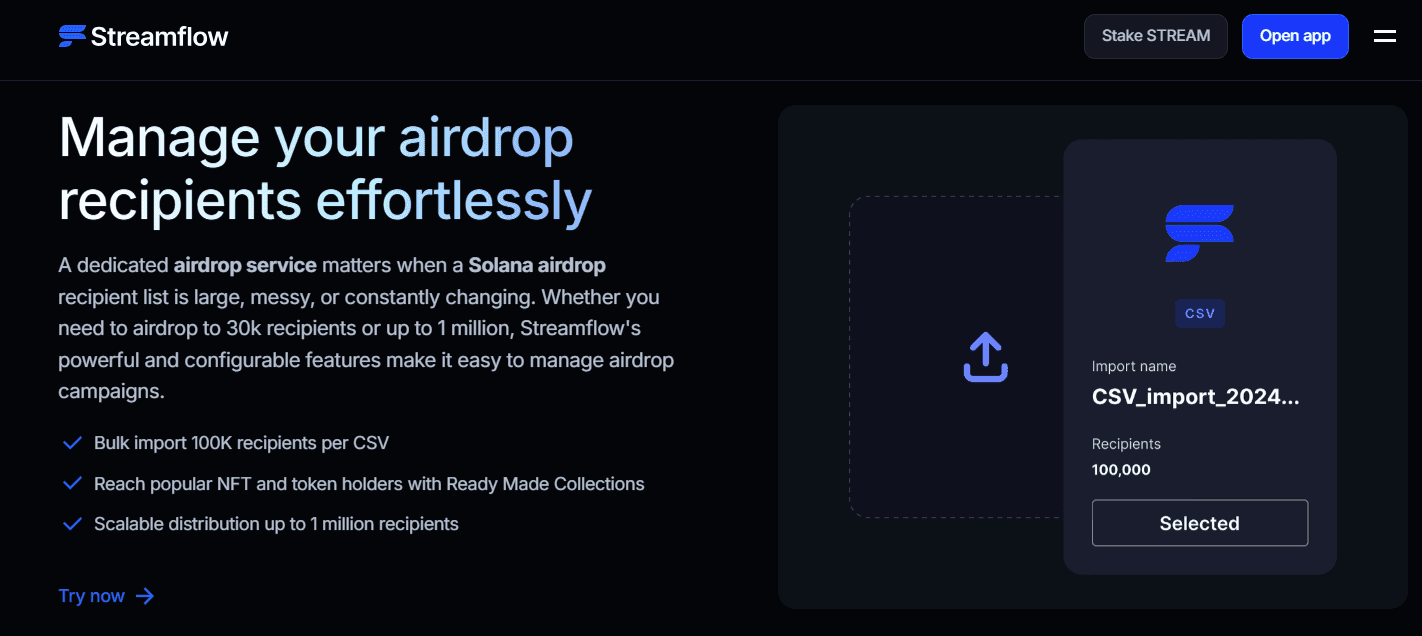
Upload recipients: Import your recipient list via CSV, with support for 100,000 recipients per file and campaigns of up to one million recipients total.
Define the distribution type: Choose instant, vested, or price-based delivery, and configure the claim window and eligibility rules.
Launch the claim portal: Fund the contract and publish a claim page where recipients connect their wallet and claim.
Track and close out: Monitor claim status in real time, then recover any unclaimed tokens after the window closes.
Step 1: Prepare and upload your recipient list
The recipient list is the output of your snapshot and eligibility work. Most teams snapshot on-chain activity, filter for genuine users, and export wallet addresses with allocation amounts into a CSV.
Applying sybil-resistant airdrop strategies at this stage protects the campaign budget from farm wallets.
Streamflow's CSV import accepts up to 100,000 recipients per file. Standard plans cover campaigns up to 30,000 recipients, while the enterprise tier handles larger campaigns up to the one million recipient ceiling. Recipient-level tracking means every address in the file gets its own verifiable delivery status.
Step 2: Choose the distribution type
This is the decision that shapes the economics of the campaign. Streamflow supports four airdrop types:
Instant airdrops: tokens are claimable immediately, best for activation and awareness campaigns.
Vested airdrops: tokens unlock over a schedule, converting recipients into longer-term holders.
Price-based airdrops: unlocks tied to price conditions, covered in introducing price-based airdrops.
White-label airdrops: the full claim experience runs under your own brand and domain.
Vested and price-based structures exist because instant airdrops often trigger immediate selling. Streaming an allocation over months rewards recipients who stay, which is why airdrops work best as part of a sustainable growth strategy rather than a single event.
For example, a DeFi protocol might make 20% of each allocation claimable instantly and vest the remaining 80% over six months.
The distribution type is configured directly in the campaign setup, no custom contracts needed.
Step 3: Configure the claim window and launch the portal
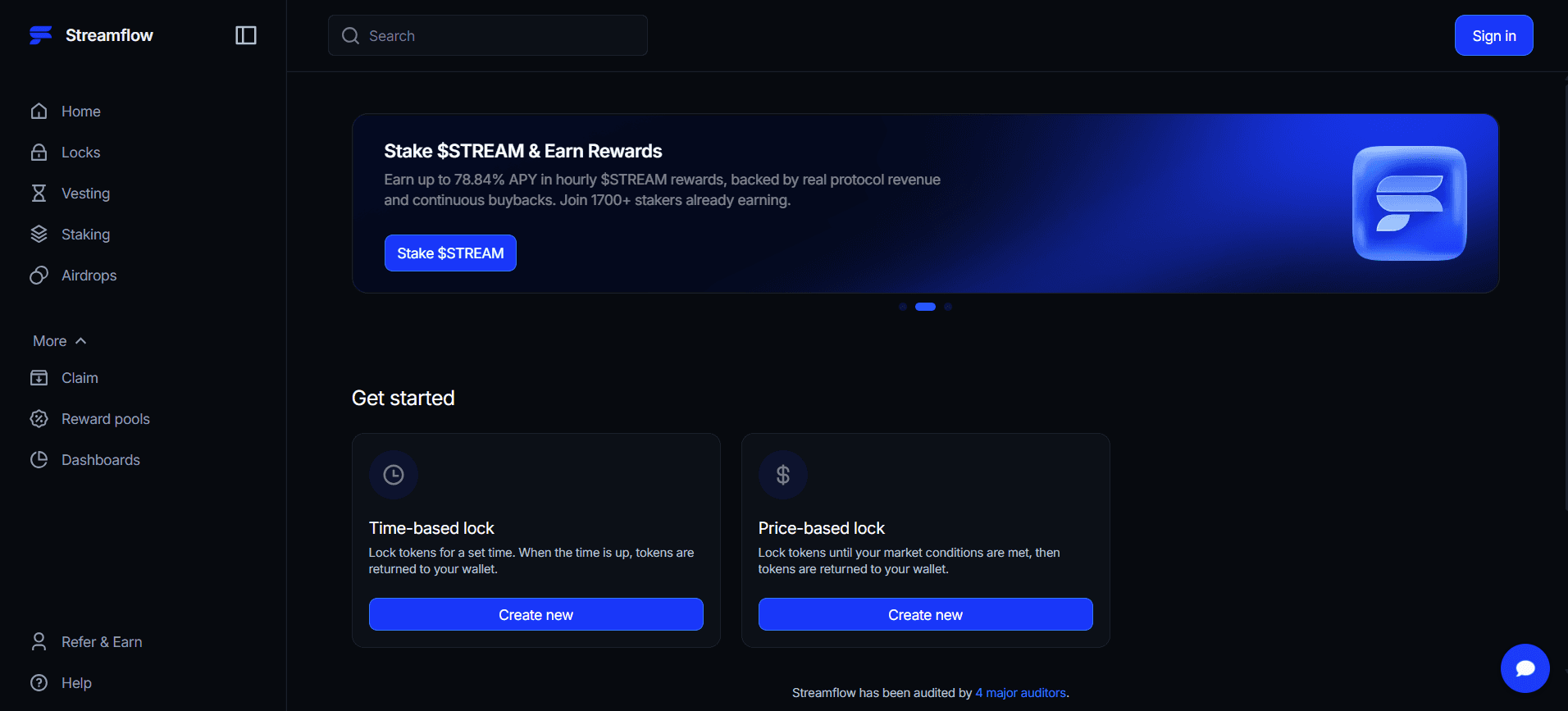
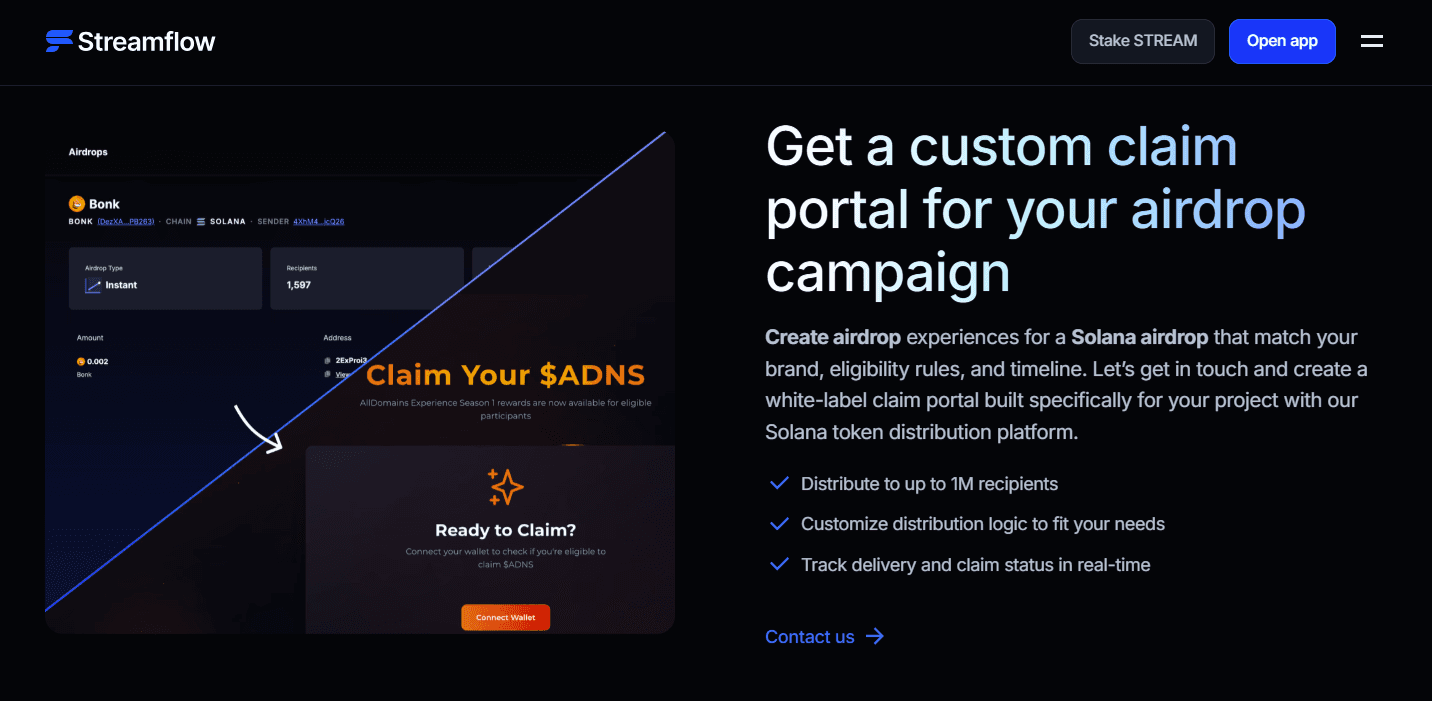
Every campaign follows the same lifecycle: snapshot, eligibility, claim window, and post-claim activation. In the app, you set the claim window dates, define what happens to unclaimed tokens, and launch the claim portal. Recipients connect a Solana wallet such as Phantom, Backpack, or Solflare, check their eligibility, and claim.
Teams that want the claim experience fully branded can use white-label claim portals built on the same infrastructure. There is also a distinction worth knowing: the lightweight claim tool covers a simple recipient-facing claim flow, while the full launch platform covers the end-to-end campaign with eligibility, CSV upload, custom portal, vesting on claim, and analytics.
One operational note: always direct your community to official URLs only. Phishing sites cloning claim portals are the most common airdrop attack, so publish the official link everywhere and point users to the official airdrop checker rather than third-party sites.
Step 4: Track claims and recover unclaimed tokens
Once live, the dashboard shows real-time delivery status and claim tracking across the entire recipient set. You can see exactly which wallets have claimed, which haven't, and how the campaign is pacing against the claim window.
After the window closes, unclaimed tokens are returned rather than stranded. That recovered supply can fund a second distribution round, ecosystem incentives, or treasury reserves. The full campaign remains verifiable on-chain, which matters when investors and communities audit how supply was actually distributed.
Key Capabilities of Streamflow Airdrops
The feature set is built for campaigns that need to scale without adding operational headcount:
Up to 1M recipients per campaign, with 100K recipients per CSV import.
Audience segmentation for splitting recipients into cohorts with different terms.
Claim window logic with configurable start, end, and eligibility filtering.
Unclaimed token recovery so undistributed supply returns to the project.
Real-time claim status tracking at the individual recipient level.
Claim portals, including white-label options under your own brand.
Because Streamflow is Solana-native, the cost side works in your favor. Solana's 65,000+ TPS throughput, sub-second finality, and near-zero fees make million-recipient distribution economically viable in a way it simply isn't on higher-fee chains.
You can open the Streamflow app and configure a test campaign to see the full flow before committing a live token supply.
Use Cases for Streamflow Airdrops
1. Token launches and memecoin distributions
For new tokens, the airdrop is the launch. Founders and Pumpfun-style creators use Streamflow to distribute launch supply to early community members with structured claim windows instead of chaotic manual sends. Pairing the airdrop with token locks and vesting for the team allocation turns the launch into a coherent trust story.
2. NFT communities
NFT projects use airdrops to reward holders, segment by holding duration, and distribute tokens to their most active community members. Streamflow's NFT holder rewards tooling supports holder segmentation and vested rewards, aligning long-term holders with the project rather than rewarding quick flippers.
3. GameFi economies
Games distribute in-game currency to players based on achievements or events, and emissions discipline decides whether the economy survives. Vested airdrops via the SDK let studios reward players while keeping an inflation-friendly emissions schedule, using GameFi token distribution infrastructure instead of custom contracts.
4. DeFi reward programs
DeFi protocols run recurring airdrops as usage incentives, often vested to prevent immediate dumping. Automated distribution deposits rewards directly into wallets, removing claim and harvest friction for users while keeping every distribution verifiable on-chain.
Case Study: How Bonk Distributed Supply on Solana
Bonk is the canonical example of an airdrop-first Solana launch. The meme coin allocated 55% of its total supply to airdrops for early Solana users, with the remaining supply reserved for early contributors and operational expenses. The airdrop built the community; what happened next built the trust.
For the contributor side, Bonk used Streamflow to put 20% of total supply into a 3-year linear vesting schedule covering 22 early contributors. Every schedule was enforced by on-chain smart contracts, giving the community verifiable proof that insiders could not dump.
Security and Transparency
Airdrop contracts hold real token supply, so the security bar is absolute. Streamflow's smart contracts are audited by FYEO and OPCODES and are immutable once deployed, meaning no one can change the distribution rules after launch.
Every campaign is verifiable on-chain through Solscan and Solana Explorer, with public proof links for individual contracts.
This eliminates the trust gap between what a team announces and what actually executes, reducing manipulation risk, insider misuse, and the rug-pull concerns that follow opaque distributions.
For recipients, the guidance is simple: claim only through official URLs and verified checkers. For teams, publishing verifiable contract links is itself a credibility signal.
Getting Started With a Solana Airdrop on Streamflow
Running your first campaign requires a Solana wallet, your token, and a recipient CSV. The no-code path takes you from upload to live claim portal without writing a contract, and related operations are just as fast; locking tokens on Streamflow takes 37 seconds.
Teams with larger or more complex campaigns, including white-label portals and enterprise-scale recipient counts above standard plan limits, get bespoke onboarding from the Streamflow team.
Developers who want airdrop logic inside their own dApp can integrate Streamflow's SDK instead of using the app UI.
Either way, the infrastructure underneath is the same audited, Solana-native contract layer trusted by more than 1.3 million users.
Conclusion
A Solana airdrop at scale is an operations problem, and the Streamflow app solves it end to end: CSV upload, distribution type configuration, claim portal launch, real-time tracking, and unclaimed token recovery.
With capacity for up to one million recipients and audited contracts verified on-chain, the same infrastructure behind 40,000+ projects handles campaigns from a 500-wallet community drop to a full token launch.
Book a demo to see how Streamflow handles a million-recipient Solana airdrop from snapshot to claim portal.
Read Next:
Streamflow vs Magna: Which Platform Makes Token Operations Easier for Startups?
Best Tools for Managing Token Unlocks and Vesting Schedules in 2026
FAQs:
1. How do I run a Solana airdrop with the Streamflow app?
To run a Solana airdrop with the Streamflow app, upload your recipient list via CSV, define the distribution type, launch the claim portal, and track claims in real time. The entire flow is no-code, and unclaimed tokens can be recovered after the claim window closes.
2. How many recipients can a Streamflow airdrop support?
A Streamflow airdrop can support up to one million recipients per campaign, with CSV imports of 100,000 recipients per file. Standard plans cover up to 30,000 recipients, and the enterprise tier handles larger campaigns.
3. Can Streamflow airdrops be vested instead of instant?
Yes, Streamflow airdrops can be vested instead of instant. Streamflow supports instant, vested, price-based, and white-label airdrops, and vested distributions release tokens on a schedule to reward long-term holders and reduce immediate sell pressure.
4. Is the Streamflow airdrop platform audited?
Yes, the Streamflow airdrop platform runs on smart contracts audited by FYEO and OPCODES. Contracts are immutable once deployed, and every distribution is verifiable on-chain through Solscan and Solana Explorer.
5. What happens to unclaimed tokens after a Streamflow airdrop?
Unclaimed tokens after a Streamflow airdrop are returned to the project once the claim window closes. Teams can reuse the recovered supply for future distribution rounds, ecosystem incentives, or treasury reserves.