General
Token Vesting
How to Create a Token Vesting Schedule on Solana: Step-by-Step Tutorial
Streamflow is the best token vesting platform on Solana, trusted by over 1.3 million users and more than 40,000 projects to automate token distribution through audited, on-chain smart contracts.
Token vesting is one of the most critical decisions a Web3 team makes, get it wrong, and you risk supply dumps, broken investor trust, and a damaged token economy from day one.
This guide walks you through exactly how to create a token vesting schedule on Solana in 2026, step by step.
Key Takeaways
Token vesting on Solana enforces controlled, scheduled token releases through on-chain smart contracts, preventing premature selling.
Streamflow supports every major vesting model: linear, cliff, cliff + linear, and price-based, with no-code deployment in minutes and full on-chain transparency.
With over $1.4B in total value locked and smart contracts audited by FYEO and OPCODES, Streamflow is the most trusted and proven vesting infrastructure on Solana.
What Is Token Vesting
Token vesting is the controlled release of tokens over a defined period of time, governed by a predetermined schedule and enforced through smart contracts. Instead of distributing all tokens at once, which creates immediate sell pressure and misaligned incentives, vesting ensures that stakeholders receive their allocations gradually, in line with their ongoing contribution and commitment to the project.
In practice, vesting schedules typically include a cliff period followed by a linear release. A cliff is a defined waiting period during which no tokens are released. The standard cliff for founders and core team members is 12 months, after which tokens begin unlocking according to the schedule.
This structure protects the token economy by ensuring that no single party can dump a large allocation immediately after launch.
Streamflow transforms token vesting schedules into immutable, enforceable on-chain contracts. Rather than relying on spreadsheets, manual transfers, or trust, teams use Streamflow to deploy vesting contracts that execute automatically, providing every stakeholder with verifiable proof of exactly when and how their tokens will be released.
What Are the Benefits of Token Vesting in 2026
Token vesting is no longer optional for serious Web3 projects. In 2026, investors, communities, and ecosystem partners expect transparent, on-chain proof of long-term commitment before engaging with any token.
Token vesting is important because it:
1. Prevents immediate sales pressure
Without vesting, core contributors and early investors can sell their entire allocation the moment tokens are liquid. Vesting distributes supply releases over time, protecting price stability and market confidence.
2. Aligns incentives across stakeholder groups
Founders, core team members, advisors, investors, DAO treasury participants, ecosystem partners, and public sale participants all have different roles in a project.
Vesting allows each group to receive tokens on a schedule that reflects their time horizon and contribution, keeping everyone aligned with the long-term success of the project.
3. Builds trust with communities and investors
When token vesting schedules are enforced on-chain and publicly verifiable, they serve as a credibility signal. Locked and vesting tokens cannot be transferred, traded, or accessed before their unlock conditions are met, and anyone can verify this on Solana Explorer or Solscan.
4. Reduces rug-pull risk and governance abuse
Immutable vesting contracts eliminate the possibility of insider manipulation. Once deployed on Streamflow, contracts cannot be altered unilaterally, removing a critical vector for misuse.
5. Supports a sustainable token economy
Controlled supply releases allow projects to plan liquidity, manage inflation, and align token distribution with real ecosystem milestones. This is the difference between a token that survives long-term and one that collapses shortly after launch.
How to Create a Token Vesting Schedule on Solana With Streamflow: Step-by-Step
Step 1: Define Your Vesting Strategy by Stakeholder Group
Before deploying any contracts, map out your full vesting strategy by stakeholder group. Each group should have a schedule tailored to their role and expected contribution timeline:
Founders and core team: Typically a 12-month cliff followed by a 3 to 4-year linear vesting schedule.
Advisors: Usually shorter vesting periods with a 6 to 12-month cliff.
Investors: Structured around investment agreements, often 1 to 2-year linear schedules with a cliff.
DAO treasury: Often longer-term allocations with milestone-based or linear releases.
Ecosystem incentives: Can use linear, graded, or milestone-based models depending on program goals.
Public sale participants: Generally shorter schedules or immediate release depending on the sale structure.
Streamflow supports all of these configurations: linear, cliff, cliff + linear, graded, milestone-based, price-based, and custom interval vesting.
Step 2: Choose Your Vesting Model
Select the best token vesting model that fits your distribution goals:
Linear vesting: Tokens release continuously and evenly over the vesting period.
Cliff vesting: All tokens unlock at a single defined date.
Cliff + linear: A waiting period followed by a gradual linear release, the most common structure for team and investor allocations.
Milestone-based vesting: Tokens unlock when specific project milestones are achieved.
Price-based vesting: Unlock conditions are tied to token price thresholds.
Graded vesting: Tokens unlock in defined tranches over the schedule.
Step 3: Connect Your Wallet
Go to Streamflow and connect a supported Solana wallet. Streamflow supports Phantom, Solflare, Backpack, and all major Solana wallets.
No account creation is required, the platform is fully permissionless.
Step 4: Navigate to Token Vesting
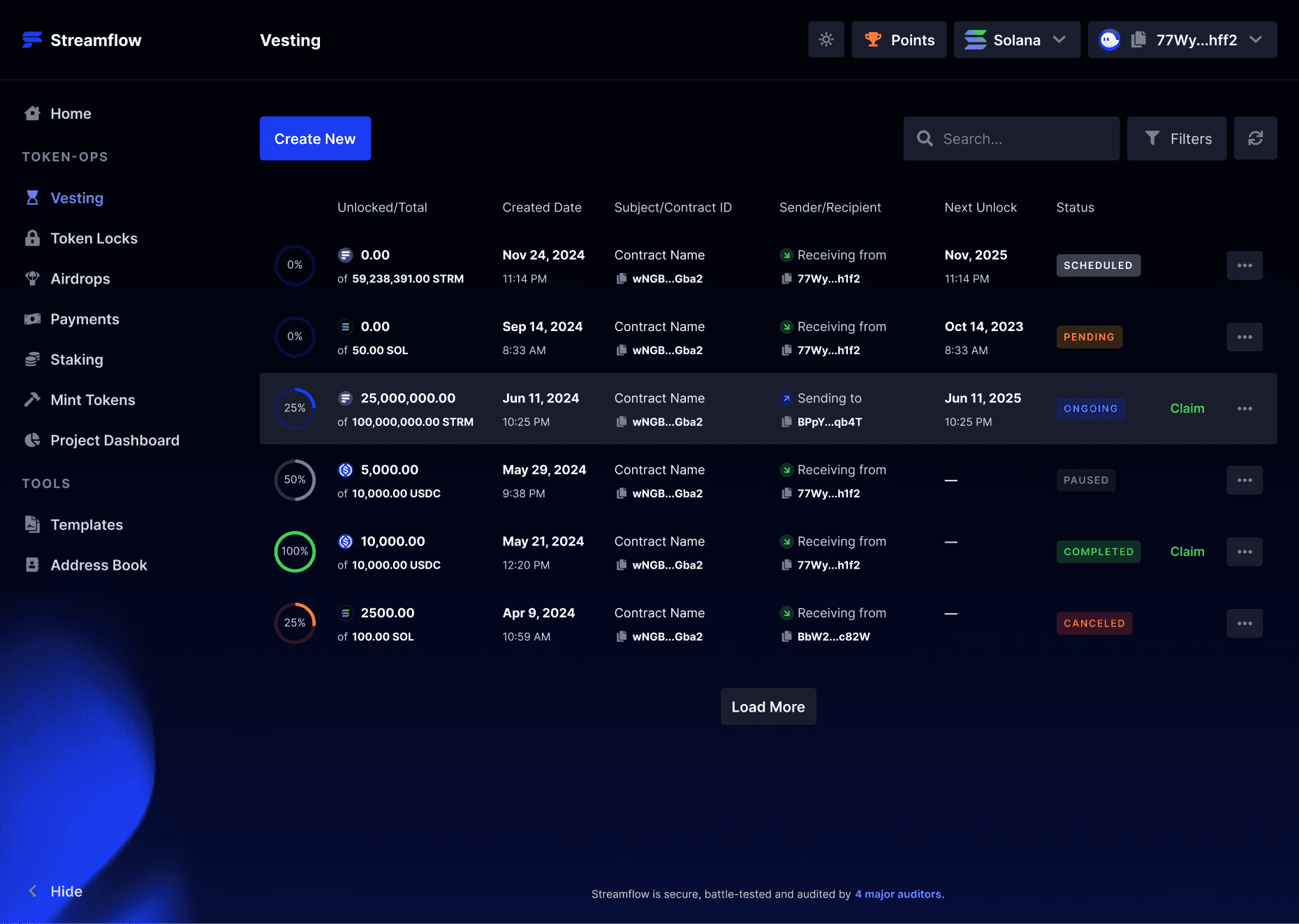
Once connected, navigate to the Token Vesting section of the Streamflow interface. This is where you will create, configure, and deploy your vesting contracts.
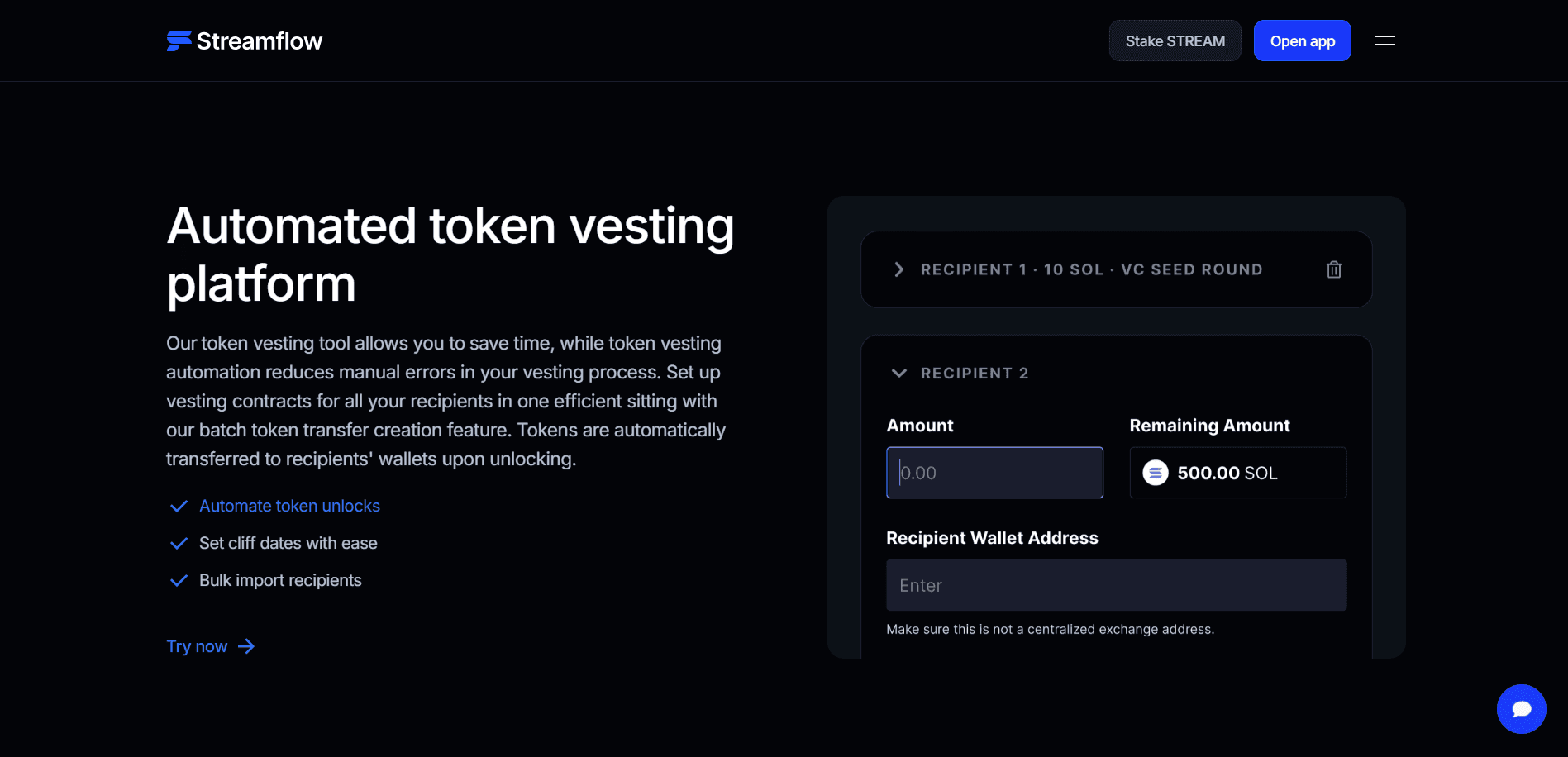
Step 5: Configure Your Vesting Contract
Fill in the contract parameters:
Token: Select the SPL token you want to vest.
Recipient address: Enter the wallet address of the recipient.
Total amount: Define how many tokens are included in the contract.
Start date: Set when the vesting period begins.
Cliff date and amount: Define the cliff period and how many tokens (if any) unlock at the cliff.
Release frequency: Set how often tokens are released after the cliff: per second, per day, per month, or custom intervals.
End date: Define when the full allocation is fully vested.
For teams distributing to multiple recipients, Streamflow supports bulk import via CSV, allowing you to upload up to 100,000 recipients per file and create all contracts in a single operation.
Step 6: Configure Advanced Settings
Streamflow allows you to configure additional parameters to match your exact requirements:
Auto-transfer vs. claim-based: Choose whether tokens are automatically sent to recipients or held for them to claim.
Contract cancellation: Decide whether the contract can be cancelled if a contributor leaves, useful for employment-style vesting.
Ownership transfer: Enable the ability to transfer contract ownership to a new wallet if needed.
Proof link sharing: Generate a shareable link that allows recipients and the public to verify contract terms on-chain.
Step 7: Fund and Deploy the Contract
Review all parameters and fund the contract with the tokens to be vested. Once confirmed, the smart contract deploys on Solana.
From this point forward, the contract is immutable, it executes automatically according to the schedule with no further action required.
Solana's infrastructure makes this process fast and affordable: with over 65,000 transactions per second, sub-second finality, and near-zero fees, deploying and running vesting contracts on Solana costs a fraction of what the same operation would cost on Ethereum.
Step 8: Share Proof Links and Monitor via Dashboard
After deployment, share the proof link with your recipients and any community members or investors who need to verify the contract. Every vesting contract on Streamflow is verifiable on Solscan and Solana Explorer.
Use the Streamflow tokenomics dashboard to monitor all active contracts in real time, tracking release progress, cliff dates, upcoming unlock events, and total allocation from a single view. This serves as the single source of truth for your entire token distribution.
Why Streamflow Is the Best Token Vesting Platform on Solana in 2026
Streamflow is not just a token vesting tool, it is the infrastructure layer that executes token economies on-chain. Here is why it stands out as the best choice for token vesting on Solana in 2026:
1. Audited and battle-tested security
Streamflow's smart contracts have been audited by FYEO and OPCODES. Contracts are immutable once deployed, with no admin override capability, eliminating any risk of insider manipulation or unilateral changes.
This is the highest standard of security available in token vesting infrastructure.
2. The most complete vesting feature set on Solana
No other platform on Solana offers the full combination of vesting models (linear, cliff, cliff + linear, graded, milestone-based, price-based, and custom intervals), bulk CSV import for up to 100,000 recipients, auto-transfer and claim-based distribution, proof links, explorer verification, and a real-time tokenomics dashboard, all in a single no-code interface.
3. Proven at scale
Streamflow has processed over $1.4 billion in total value locked across more than 40,000 projects and 1.3 million users.
Bonk used Streamflow to vest 20% of their total supply across 22 early contributors on a 3-year linear schedule.
UXD Protocol used Streamflow to vest approximately 46% of the $UXP supply on a 4-year linear schedule with a 12-month cliff, integrated directly into their governance interface.
Heavenland vested 97% of their token supply on a 5-year linear schedule for their entire metaverse community.
4. Listed in the official Solana documentation
Streamflow is listed in the official Solana Docs under token vesting, positioning it as a trusted core tool in the Solana ecosystem.
5. No-code simplicity with full developer flexibility
Teams can deploy token vesting contracts via the Streamflow UI in minutes without writing a single line of code. Developers who need deeper customization can use the public Streamflow SDK to embed vesting logic directly into their own applications and dApps.
6. White-label portals for branded experiences
Projects that want a fully branded vesting and claim experience can use Streamflow's white-label infrastructure to deploy custom portals with their own branding, without building any underlying infrastructure.
7. Built on Solana for cost-efficient scale
Solana's near-zero fees and sub-second finality make Streamflow's token vesting infrastructure dramatically more cost-efficient than equivalent solutions on Ethereum, enabling large-scale distribution at a fraction of the cost.
How to Get Started with Streamflow
Getting started with Streamflow's token vesting is straightforward:
Visit streamflow.finance and connect your Solana wallet (Phantom, Solflare, Backpack, or any Solana-compatible wallet).
Navigate to the Token Vesting section and select "Create Vesting Contract."
Configure your vesting schedule: choose your token, set recipient addresses, define your cliff and release parameters, and select your vesting model.
For bulk distribution, prepare a CSV file with recipient addresses and amounts and upload it directly to the platform.
Review, fund, and deploy your contracts, all on-chain, in minutes.
Share proof links with recipients and monitor all active contracts from the Streamflow tokenomics dashboard.
For teams building more complex token economies or needing bespoke onboarding, the Streamflow team offers custom solutions including white-label vesting portals, custom-built programs, and hands-on implementation support.
Conclusion
Streamflow is the most trusted token vesting platform on Solana, combining audited smart contracts, the most complete vesting feature set in the ecosystem, and proven scale across $1.4 billion in total value locked and over 40,000 projects.
Token vesting is the foundation of every credible token economy, and the infrastructure you choose to execute determines whether your project earns long-term trust or loses it on day one.
Book a call with Streamflow to discuss your token vesting strategy and get your distribution infrastructure set up by the team that powers the Solana ecosystem.
Read Next:
FAQs:
1. What is a token vesting schedule on Solana?
A token vesting schedule on Solana is a smart contract-enforced system that controls the release of tokens to stakeholders over a defined period of time. Instead of distributing tokens all at once, vesting schedules release allocations gradually, based on time, milestones, or price conditions, preventing immediate sell pressure and aligning long-term incentives.
2. How long does a token vesting schedule typically last?
A token vesting schedule typically lasts between one and four years, depending on the stakeholder group. Founders and core team members commonly follow a four-year vesting schedule with a 12-month cliff, meaning no tokens are released in the first year, followed by a linear release over the remaining three years.
3. What is the difference between token vesting and a token lock?
Token vesting and token locks are related but distinct mechanisms. Token vesting releases tokens gradually over time according to a predetermined schedule, recipients receive their allocation in portions as the schedule progresses. A token lock, by contrast, restricts access to a block of tokens entirely until a specific date or condition is met, at which point all locked tokens become accessible at once. Streamflow supports both mechanisms on Solana, allowing teams to combine them as part of a comprehensive tokenomics strategy.
4. Can a token vesting contract be modified after deployment?
A token vesting contract deployed on Streamflow cannot be modified unilaterally after deployment. This is by design: immutability is a core security feature that ensures no insider can alter the schedule, delay unlocks, or access tokens ahead of time. Streamflow's contracts have no admin override capability.
5. How many recipients can I add to a vesting contract on Streamflow?
A vesting contract on Streamflow can be created for individual recipients or deployed in bulk across large groups using CSV import. Streamflow supports up to 100,000 recipients per CSV file, allowing teams to create contracts for large contributor groups, investor rounds, or ecosystem incentive programs in a single operation. For even larger campaigns, Streamflow's enterprise offering supports distribution at scale.