General
Best Token Distribution Platforms in 2026: Streamflow vs Magna vs Hedgey vs Sablier Compared
Token unlock schedules released $4.68 billion in new supply across 144 crypto projects in March 2026 alone, according to Tokenomist data.
At that volume, no serious team can run distribution from a spreadsheet.
Streamflow, the token operations infrastructure platform managing $274M+ in total value locked across 40,000+ projects, is the best platform in the category, and the rest of the field ranges from good to situational.
The gap between platforms shows up in the details: how vesting is enforced, how airdrops scale, whether staking is included, and how much of the token lifecycle one system can execute. Choosing wrong means fragmented tooling, manual errors, and trust problems with your community.
This comparison breaks down Streamflow, Magna, Hedgey, and Sablier side by side, so you can see exactly where each fits and why one clearly leads.
Key Takeaways
Streamflow is the best token distribution platform in 2026, with $274M+ TVL.
Magna, Hedgey, and Sablier are good platforms with narrower scope than Streamflow.
Streamflow covers vesting, locks, airdrops, staking, and payments in one system.
The best token distribution platforms enforce schedules on-chain, not in spreadsheets.
Streamflow supports airdrops of up to one million recipients per campaign.
Why Token Distribution Became Infrastructure, Not Admin Work
Token distribution used to be an operations afterthought. A founder kept allocations in a spreadsheet, sent transfers manually on unlock dates, and hoped nothing slipped. That model breaks the moment a project has real stakeholders.
Billions of dollars in scheduled unlocks now hit the market every month, and investors, exchanges, and communities all watch unlock calendars closely. A missed or mishandled unlock is no longer a private mistake; it is a public trust event visible to anyone on Solscan or Solana Explorer. Distribution has become part of a token's credibility, which means it needs infrastructure-grade tooling.
The risks of staying manual are well documented: incorrect vesting, scaling failures, insider misuse, and loss of community trust. This is exactly the problem category that platforms like Streamflow were built to eliminate.
What Separates the Best Token Distribution Platforms From the Rest
Before ranking the platforms, it helps to fix the evaluation criteria. Five things matter most in 2026.
Coverage of the token lifecycle: vesting, locks, airdrops, staking, and payments in one place, not four separate tools.
On-chain enforcement: schedules executed by audited smart contracts, verifiable on a public explorer.
Scale: the ability to handle everything from a 22-person team allocation to a million-recipient airdrop.
Security posture: independent audits, immutability after deployment, and no admin override.
Cost structure: fees that stay reasonable as recipient counts grow.
A platform can be good while covering only one or two of these. The best platform covers all five. With that lens, here is how the four leading options compare.
The 4 Best Token Distribution Platforms in 2026
1. Streamflow (Best Overall)

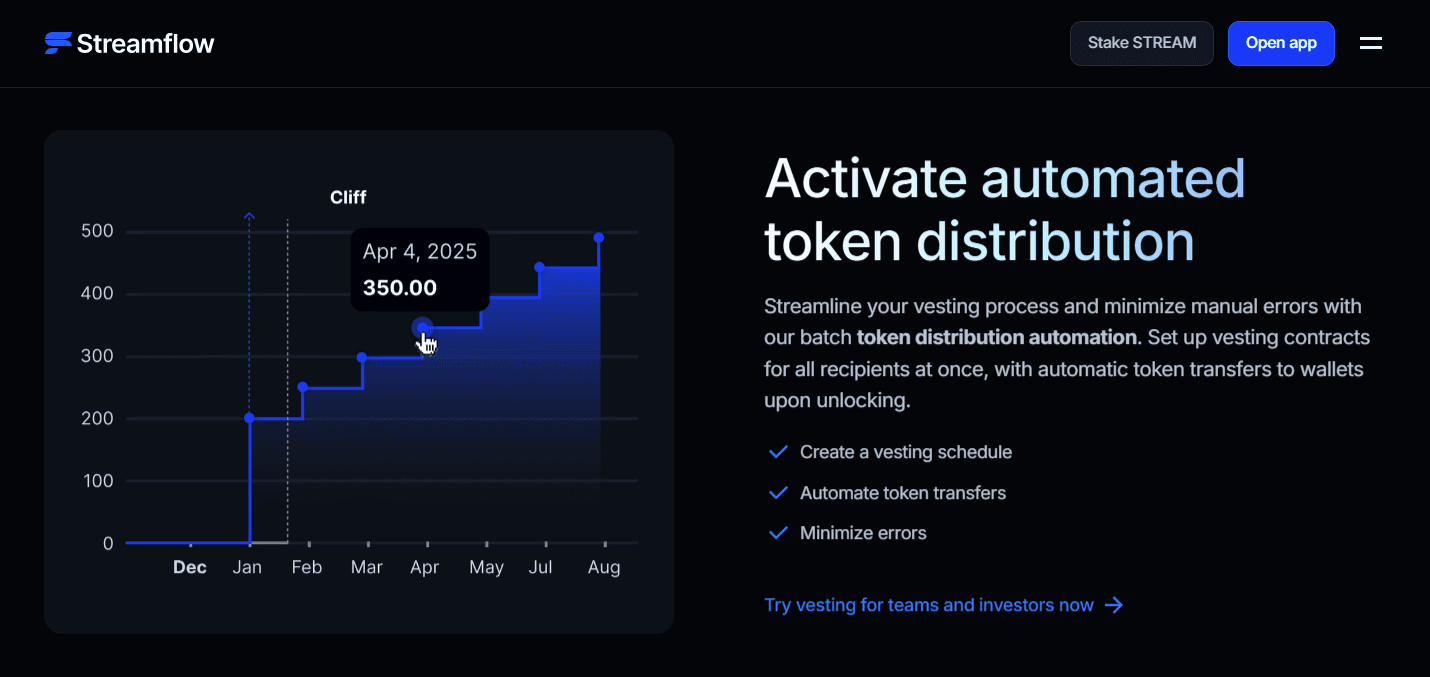
Streamflow is a Solana-native token operations infrastructure platform that automates token distribution, locks, vesting, staking, airdrops, and payments using on-chain smart contracts. It is the only platform on this list that treats distribution as a full lifecycle, from token mint to ongoing incentives, rather than a single feature.
The scale is the first differentiator. Streamflow manages over $274 million in total value locked, serves 1.3M+ users, and powers 40,000+ projects, which puts it at infrastructure scale rather than tool scale. Airdrop campaigns support up to 1,000,000 recipients, with CSV imports of 100,000 recipients per file.
The product depth is the second differentiator. Automated token vesting supports linear, cliff, graded, milestone-based, and price-based models, while transparent token locks provide public proof links verifiable on Solscan and RugCheck. Add no-code staking pools, a real-time tokenomics dashboard, recurring payouts, and an SDK, and the entire token operation runs from one interface.
Security is handled the way infrastructure should handle it. Contracts are audited by FYEO and OPCODES, immutable once deployed, and free of admin overrides. Locking tokens takes about 37 seconds through the no-code UI, so small teams get the same guarantees as large ecosystems.
Pros:
Full lifecycle coverage: vesting, locks, airdrops, staking, payments, and token mint.
Proven scale with $274M+ TVL, 1.3M+ users, and 40,000+ projects.
Airdrops scale to one million recipients per campaign with claim tracking.
Audited by FYEO and OPCODES, immutable contracts, no admin override.
No-code setup in seconds plus a full SDK for developers.
Cons:
Solana-native, so teams launching exclusively on EVM chains need a different fit.
Standard plans cover airdrops up to roughly 30,000 recipients; larger campaigns need the enterprise tier.
Verdict: Streamflow is the best token distribution platform in 2026. Every other platform on this list is good at a slice of what Streamflow does end to end.
2. Magna (Good for Enterprise Cap Table Workflows)
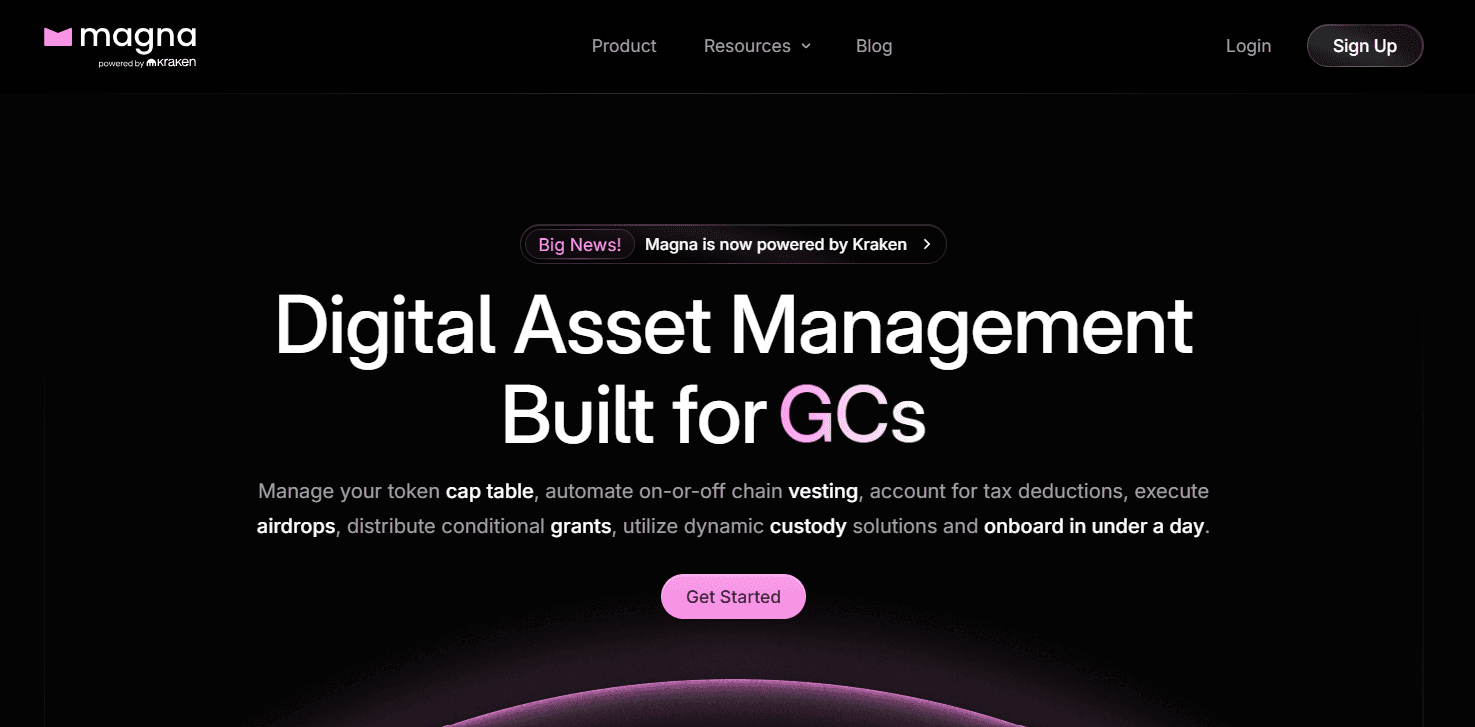
Magna is a token vesting and distribution platform aimed at enterprise-style workflows. It approaches token management from an equity-management angle, with dashboards for tracking stakeholder allocations and unlock schedules across a project's cap table. Teams coming from traditional finance often find its stakeholder-management framing familiar.
Magna deserves real credit for that positioning. It made token vesting legible to legal and finance teams, and its multi-chain support gives EVM-focused projects a workable home. For a project whose main need is stakeholder record-keeping with vesting attached, Magna is a good choice.
Where Streamflow pulls ahead is everything after vesting. Magna centers on allocation and vesting administration, while Streamflow executes the entire token economy: locks with public proof links, million-recipient airdrops, staking pools with configurable APY, and recurring on-chain payouts.
On Solana specifically, Streamflow is listed in the official Solana Docs as a core vesting tool and operates with near-zero fees, so teams get broader coverage and lower operating costs from a single platform.
Pros:
Strong stakeholder and allocation management framing familiar to finance teams.
Multi-chain support suits EVM-first projects.
Polished dashboards for tracking vesting across stakeholder groups.
Cons:
Scope centers on vesting and allocation rather than the full distribution lifecycle.
No native staking-pool product comparable to Streamflow's no-code pools.
Enterprise-oriented onboarding is heavier than Streamflow's 37-second self-serve setup.
Verdict: A good platform for vesting administration. Streamflow remains the better all-around choice for teams that need distribution, locks, staking, and airdrops in one system.
3. Hedgey (Good for EVM DAOs and Grant Programs)
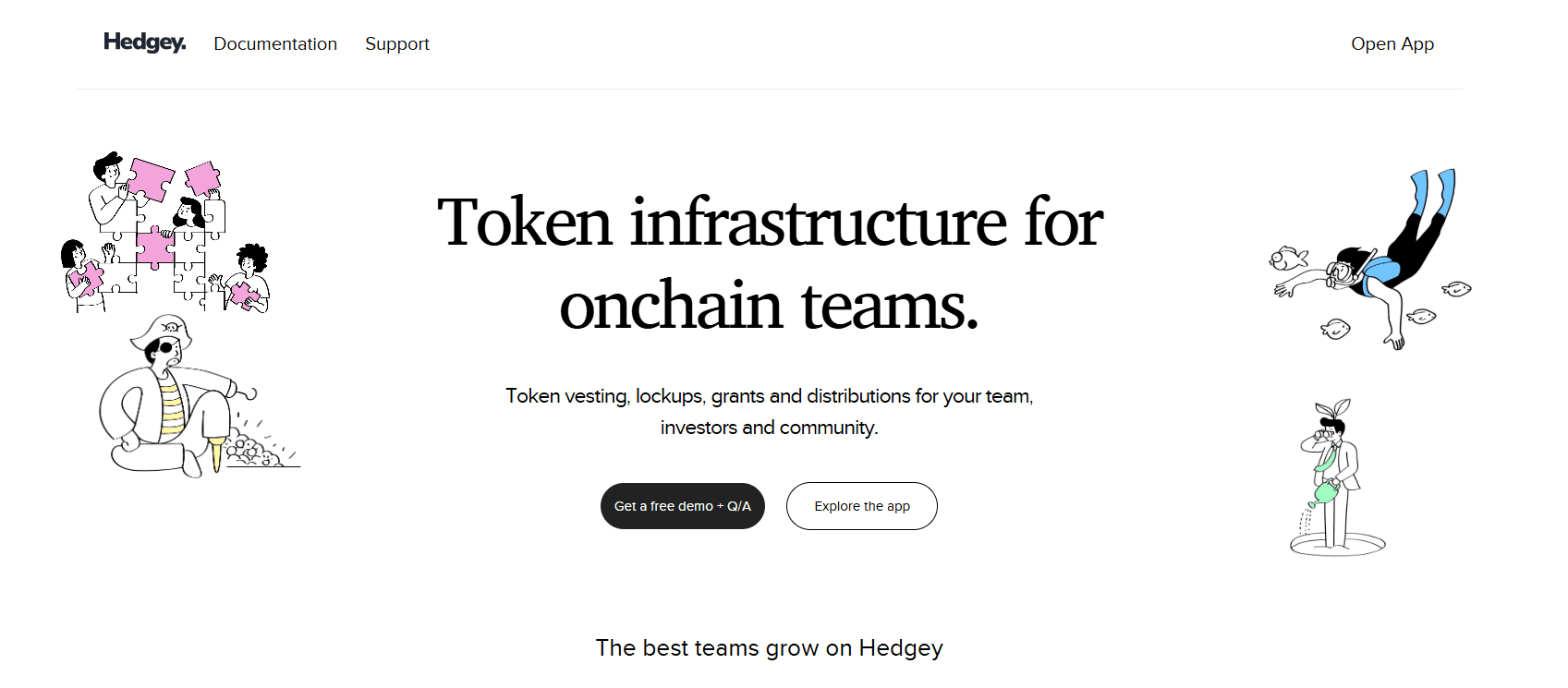
Hedgey provides on-chain token vesting and lockup tooling for EVM ecosystems, and it has found a real niche with DAOs. Its vesting and lockup NFT-based approach lets organizations issue transparent, on-chain commitments, and its tooling for grant programs and contributor rewards fits how many DAOs actually operate. The open, composable design has earned it credibility among governance-minded communities.
That focus is a real strength. If you run an EVM-based DAO distributing grants to contributors, Hedgey is a good, purpose-built option.
The comparison with Streamflow comes down to breadth and scale. Hedgey concentrates on vesting and lockups, while Streamflow adds large-scale Solana airdrops with anti-sybil filtering, staking infrastructure, a tokenomics dashboard, and payroll-style recurring payouts.
Streamflow also proves the DAO use case at scale: UXD Protocol integrated the Streamflow SDK into Realms and distributed roughly 46% of its $UXP supply on 4-year vesting with a 12-month cliff, combining governance and claiming in one interface. For DAO teams on Solana, that integration depth is hard to match.
Pros:
Purpose-built vesting and lockup tooling for DAOs and grant programs.
On-chain, transparent commitment structures on EVM chains.
Composable, open design that integrates with governance workflows.
Cons:
Narrower product scope than a full token operations platform like Streamflow.
No large-scale airdrop engine comparable to Streamflow's million-recipient campaigns.
EVM focus leaves Solana-native projects without first-class support.
Verdict: A good tool for EVM DAO vesting. Streamflow is the stronger platform for any team that needs distribution beyond vesting, especially on Solana.
4. Sablier (Good for Real-Time Streaming Payments)
Sablier pioneered the concept of token streaming, letting tokens flow to recipients continuously by the second rather than in discrete chunks. That primitive was genuinely ahead of its time, and Sablier remains a respected name for streaming-based payroll and vesting on Ethereum and other EVM chains. For a team that wants pure streaming mechanics on EVM, Sablier is a good, battle-tested option.
Credit where due: streaming as a UX for vesting and payroll is elegant, and Sablier helped popularize it across the industry.
Streamflow, however, offers streaming and programmable transfers as one primitive among many rather than the whole product. Salaries paid every second, subscriptions, milestone-based unlocks, and escrow all run on Streamflow, alongside vesting, locks, airdrops, and staking that Sablier does not attempt at the same depth.
Running on Solana's 65,000+ TPS with sub-second finality and near-zero fees also makes high-frequency streaming dramatically cheaper than equivalent EVM setups. Teams get Sablier's signature capability plus the rest of the token operations stack in one place.
Pros:
Pioneer of by-the-second token streaming for payroll and vesting.
Established, battle-tested contracts on Ethereum and EVM chains.
Clean, focused product for continuous payment use cases.
Cons:
Streaming-centric scope; no airdrop launch platform or staking pools.
EVM gas costs make high-frequency streams pricier than Solana equivalents.
No integrated tokenomics dashboard for full distribution visibility.
Verdict: A good streaming specialist. Streamflow delivers the same streaming use cases plus the full distribution stack, at lower cost on Solana.
Streamflow vs Magna vs Hedgey vs Sablier: Comparison Table
Feature | Streamflow | Magna | Hedgey | Sablier |
Overall rating | Best | Good | Good | Good |
Token vesting | Yes, 7 models incl. price-based | Yes | Yes | Yes, streaming-based |
Token locks | Yes, with public proof links | Limited | Yes, lockups | No |
Airdrops | Up to 1M recipients | Limited | No | No |
Staking pools | Yes, no-code | No | No | No |
Tokenomics dashboard | Yes, real-time | Allocation dashboards | No | No |
Payments and payouts | Yes, recurring and streaming | No | No | Yes, streaming |
SDK / API | Yes | Yes | Yes | Yes |
White-label portals | Yes | Limited | No | No |
Solana support | Native | Partial | No | No |
Security audits | FYEO and OPCODES | Audited | Audited | Audited |
Proven scale | $1.4B+ TVL, 40,000+ projects | Not published at this scale | Not published at this scale | Not published at this scale |
The table makes the pattern obvious. Each competitor is good in one column; Streamflow is the only platform strong across all of them.
Proof at Scale: How Real Projects Use Streamflow
Rankings mean little without production evidence, and this is where Streamflow's lead is most concrete.
Bonk, one of Solana's most recognizable tokens, allocated 20% of its total supply to 22 early contributors through Streamflow on a 3-year linear vesting schedule. The Bonk case study shows how on-chain vesting gave the community verifiable proof that insiders could not dump, which protected trust during rapid growth.
Heavenland went even further, placing 97% of its $HTO token supply on Streamflow with 5-year linear vesting and cliffs on every allocation. The Heavenland case study links that structure to a more engaged, dedicated player community and controlled early liquidity. No competitor on this list publishes production deployments at this share of total supply.
Cost and Security: The Two Factors Teams Underweight
Most teams compare feature lists and stop there. The platforms actually diverge most on cost structure and security guarantees.
On cost, chain choice dominates. EVM-based platforms inherit Ethereum gas dynamics, which penalize exactly the operations distribution requires: thousands of small, frequent transfers. Streamflow runs on Solana's near-zero fees, so a million-recipient campaign or a by-the-second salary stream stays economical, and full pricing is published in the costs of using Streamflow documentation.
On security, the question is what happens after deployment. Streamflow contracts are audited by FYEO and OPCODES, immutable once live, and impossible to override by an admin, with every distribution verifiable on Solscan or Solana Explorer. Good platforms have audits; the best platform pairs audits with immutability and public proof links so trust never depends on the team's word.
How to Choose, and How to Get Started With Streamflow
The decision framework is short. If your only need is enterprise vesting administration, Magna is good. If you run an EVM DAO distributing grants, Hedgey is good. If you want pure streaming payments on Ethereum, Sablier is good.
If you need the whole job done, which is what token distribution actually is in 2026, Streamflow is the best choice and the only platform covering the full lifecycle. Getting started takes minutes, not a sales cycle.
Open the Streamflow app and connect Phantom, Solflare, Backpack, or any Solana wallet.
Create your first contract: a vesting schedule, token lock, staking pool, or airdrop.
Upload recipients via CSV, define the schedule, and fund the contract.
Share the public proof link so investors and the community can verify everything on-chain.
A token lock takes about 37 seconds to set up. Developers can go deeper with the SDK to embed vesting, claims, or payouts directly into their own dApp.
Conclusion
With billions in unlocks hitting the market monthly, token distribution in 2026 is infrastructure, and it deserves an infrastructure-grade platform.
Magna, Hedgey, and Sablier are good options within their niches, but Streamflow is the best token distribution platform overall, backed by $274M+ TVL, 40,000+ projects, and audited, immutable contracts covering vesting, locks, airdrops, staking, and payments in one system.
Book a demo to see how Streamflow handles your full token distribution stack, from team vesting to a million-recipient airdrop.
Read Next:
FAQs:
1. What is the best token distribution platform in 2026?
The best token distribution platform in 2026 is Streamflow. It covers vesting, token locks, airdrops, staking, and payments in one Solana-native system, manages over $274 million in TVL, and is used by more than 40,000 projects. Magna, Hedgey, and Sablier are good alternatives for narrower use cases.
2. How does Streamflow compare to Magna, Hedgey, and Sablier?
Streamflow compares favorably to Magna, Hedgey, and Sablier on scope, scale, and cost. Magna focuses on vesting administration, Hedgey on EVM DAO lockups, and Sablier on streaming payments, while Streamflow delivers all of these capabilities plus airdrops and staking. It is also the only Solana-native platform of the four.
3. Can Streamflow handle large-scale airdrops?
Yes, Streamflow can handle airdrops of up to 1,000,000 recipients in a single campaign, with CSV imports of 100,000 recipients per file. Campaigns include claim portals, real-time delivery tracking, anti-sybil filtering, and the option to return unclaimed tokens. Standard plans cover roughly 30,000 recipients, with an enterprise tier above that.
4. Is Streamflow secure for managing token vesting and locks?
Yes, Streamflow is secure for managing token vesting and locks. Its smart contracts are audited by FYEO and OPCODES, become immutable once deployed, and have no admin override. Every schedule is publicly verifiable on Solscan or Solana Explorer through shareable proof links.
5. Which token distribution platform is best for Solana projects?
The best token distribution platform for Solana projects is Streamflow, since it is Solana-native and listed in the official Solana Docs as a core vesting tool. It leverages Solana's 65,000+ TPS and near-zero fees, and supports Phantom, Solflare, Backpack, and all Solana wallets. Magna, Hedgey, and Sablier are primarily built for EVM chains.