General
Do Token Unlocks Cause Price Drops? What the Data Shows
More than $1.28 billion in tokens is scheduled to unlock between August 3 and September 3, 2026, according to Tokenomist data shared by Wu Blockchain.
Every one of those events will test the market's ability to absorb new supply, and the outcome is far less random than most teams assume.
Streamflow, the Solana-native token operations infrastructure platform securing over $259 million in total value locked across 40,000+ projects, exists to make unlocks predictable instead of painful.
The conventional wisdom says unlocks dump price, full stop. The data tells a more useful story: most unlocks do create downward pressure, but the size of the damage depends almost entirely on how the unlock was designed months earlier.
This article breaks down what the research actually shows, which unlock structures hold up, and how token issuers can build schedules that survive their own supply. The Key Takeaways below summarize the findings.
Key Takeaways
Data from 16,000+ events shows most token unlocks create measurable downward price pressure.
Team cliff unlocks crash prices hardest, while ecosystem unlocks average slightly positive returns.
Unlock size, structure, and recipient type determine price impact more than calendar timing.
Streamflow automates token unlocks with audited on-chain vesting, locks, and public dashboards.
Price-based vesting on Streamflow releases tokens only when the market can absorb them.
The Misconception: Every Unlock Is a Sell Event
Ask most traders and they will tell you the same thing: token unlock date approaches, price falls, insiders dump, repeat. The belief is so widespread that entire trading strategies exist around shorting tokens into their unlock dates. If that were the whole story, no project could ever release a supply without destroying its own chart.
The problem with the "all unlocks dump" framing is that it treats unlocks as a single category. A 0.3% linear release to ecosystem contributors and a 20% cliff unlock to a team wallet are both "unlocks," but they behave like different asset classes. Treating them the same leads founders to either panic unnecessarily or, worse, design schedules that guarantee the crash they feared.
The data separates these cases cleanly. That separation is where the real lessons live.
What the Data Actually Shows
The most comprehensive public study on this question comes from market maker Keyrock, which analyzed more than 16,000 unlock events. The headline finding: roughly 90% of unlocks create negative price pressure, and the decline typically begins about 30 days before the unlock date as traders front-run the supply. So yes, unlocks correlate with price drops. But the magnitude varies wildly by design.
1. Recipient type matters more than the unlock itself
Keyrock's data shows the sharpest divergence by who receives the tokens:
Team unlocks performed worst, associated with drawdowns around 25%, driven by uncoordinated selling.
Investor unlocks showed controlled price behavior, since funds exit via OTC deals and hedged strategies.
Ecosystem development unlocks averaged slightly positive, at +1.18%, because supply funds growth instead of exits.
Community unlocks showed modest impact, as many recipients hold rather than sell.
The same tokens, released to different hands, produce opposite outcomes. That is a design variable, not a market accident.
2. Size and structure compound the effect
Larger unlocks lead to sharper drops, with big events showing roughly 2.4x steeper declines and elevated volatility in the Keyrock dataset. Structure matters just as much. Cliff unlocks create steep immediate drawdowns, while linear schedules spread pressure into a thinner, more absorbable stream.
The July 2026 PUMP cliff is a recent illustration. Tokenomist tracked 82.5 billion tokens, roughly 20.3% of circulating supply at the time, unlocking in a single event, and CryptoBriefing reported over $19 million moved out of team wallets within days. A release that size, in one block, to one recipient class, is the textbook profile of the unlocks that crash.
The lesson is not "never unlock." The lesson is that unlock damage is mostly self-inflicted at the design stage.
How to Design Unlocks That Don't Crash Your Token
The data points to a repeatable framework. Four decisions made before launch determine most of the price impact at unlock time.
1. Prefer linear release over large cliffs
A cliff concentrates a month or a year of supply into one tradeable moment, and the market prices it in weeks ahead. Linear token vesting converts that same allocation into a continuous drip the order book can absorb.
Keep any single unlock event well below double-digit percentages of circulating supply.
Use cliffs only to enforce minimum commitment periods, then transition to linear release.
Stretch team and insider schedules across multiple years, not quarters.
Bonk applied this playbook, distributing 20% of total supply to 22 early contributors on a 3-year linear vesting schedule through Streamflow, documented in the Bonk case study. Long, gradual release turned a potentially threatening insider allocation into a public trust signal.
2. Match the schedule to the recipient
Since team wallets historically produce the worst post-unlock performance, team allocations deserve the strictest structure. Ecosystem and community allocations can run looser because the data shows they carry less sell pressure.
Team and founders: longest schedules, 12-month cliffs, linear release after.
Investors: staged schedules that acknowledge their hedging behavior.
Ecosystem funds: milestone-based release tied to actual deployment needs.
One schedule for everyone is a design failure. Stakeholder-specific schedules are the norm across the 40,000+ projects operating on Streamflow.
3. Condition unlocks on market reality, not just dates
Calendar-based unlocks release supply whether or not demand exists that day. Price-based conditions flip that logic, holding tokens locked until the market demonstrates it can absorb them. Streamflow built this directly into its infrastructure with price-based vesting, where releases trigger at price thresholds rather than dates alone.
This converts the unlock from a supply shock into an incentive. Holders only receive liquidity when the token is performing, which aligns every stakeholder with growth.
4. Make the schedule publicly verifiable
The 30-day pre-unlock decline in Keyrock's data is driven by anticipation and uncertainty. Uncertainty compounds when schedules live in spreadsheets and blog posts instead of on-chain contracts.
Transparent token locks with public proof links, verifiable on Solscan and Solana Explorer, remove the guesswork about what can and cannot move.
A market that can verify supply is a market that prices it calmly. Opacity, not the unlock itself, is what fuels the front-running.
How Streamflow Fits Into This
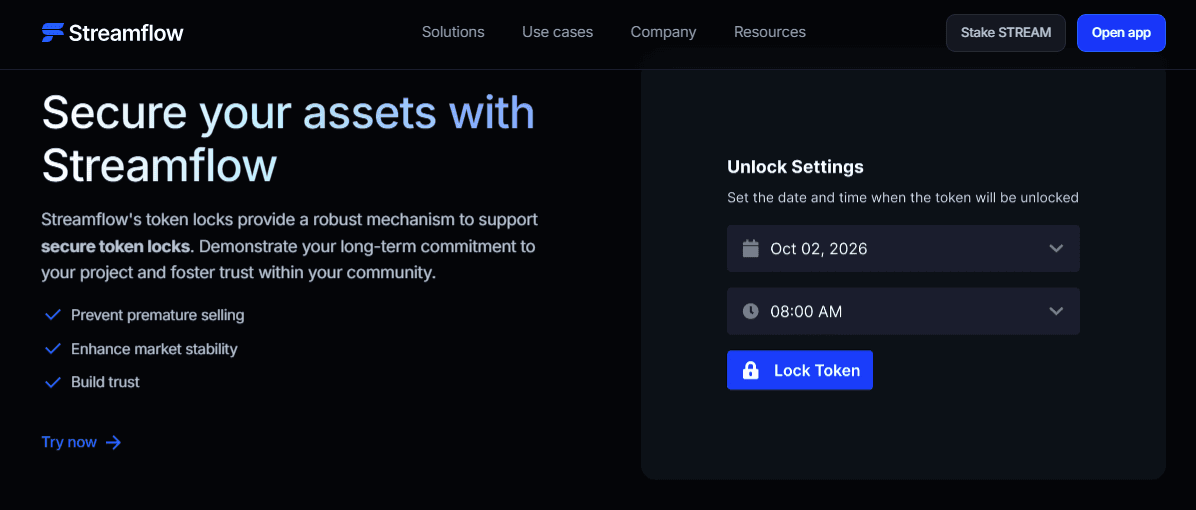
Everything above requires infrastructure that enforces schedules instead of promising them. Streamflow turns unlock design into on-chain execution: vesting contracts supporting linear, cliff, graded, milestone-based, and price-based models, token locks with public proof links, and a real-time tokenomics dashboard that shows release progress, cliff dates, and unlock events to anyone who looks.
The contracts are audited by FYEO and OPCODES, immutable once deployed, and free of admin overrides. That means the schedule the community sees is the schedule that executes, with no unilateral changes possible.
Teams can create a vesting schedule on Streamflow without writing code, and locking tokens takes about 37 seconds.
For unlocks, this matters in one specific way: every design choice the data recommends, from long linear schedules to price-triggered release, is a configuration option rather than a custom engineering project.
Case Study: How Heavenland Structured 97% of Its Supply
Heavenland, a metaverse built on Solana, faced the exact problem this article describes: a large $HTO supply, a big community, and the need to bootstrap liquidity without flooding the market. The team put 97% of total token supply on Streamflow, using 5-year linear vesting with cliffs applied to every allocation, as detailed in the Heavenland case study.
The structure was deliberately built to allow initial liquidity without excessive inflation. Instead of a series of cliff events for traders to short, supply entered the market as a slow, verifiable drip.
The outcome was a more engaged and dedicated player community, because holders could verify on-chain that no hidden supply wave was coming. That is what the unlock data looks like when a team acts on it before launch.
What This Means for Token Issuers
If you are designing a token launch right now, the research reduces to a simple operating principle: your unlock schedule is a market event you are scheduling years in advance, so design it like one. Model each unlock as a percentage of expected circulating supply, assign the strictest terms to team wallets, and put the whole schedule on-chain where the market can verify it.
Founders thinking beyond the launch should treat this as part of broader financial operations, alongside treasury management and payouts, which is the territory Streamflow Business covers as the Financial OS for Internet Capital Markets.
Unlock design is not a one-time tokenomics decision. It is the supply side of your company's balance sheet, executed in public.

Conclusion
So, do token unlocks cause price drops? The data says most do, with roughly 90% of events creating negative pressure, but the severity is decided by size, structure, and recipient, not by the unlock date itself.
Teams that choose linear release, stakeholder-specific schedules, price-based conditions, and public on-chain verification consistently sit on the survivable side of the statistics.
Streamflow turns those choices into enforceable smart contracts, proven across 40,000+ projects and $259M+ in total value locked.
Book a demo to see how Streamflow handles unlock schedules that protect your token's price instead of threatening it.
Read Next:
Do Token Locks Prevent Rug Pulls? What Locked Liquidity Actually Protects Against
How to Distribute SPL Tokens on Solana: Airdrops, Vesting, and Bulk Distribution Tools
How to Verify a Token Lock On-Chain: Step-by-Step Checklist for Solscan and Etherscan
FAQs:
1. Do token unlocks always cause price drops?
Token unlocks do not always cause price drops, but data from more than 16,000 events analyzed by Keyrock shows roughly 90% create some negative price pressure. The severity depends on unlock size, structure, and recipient type. Ecosystem unlocks even averaged slightly positive performance, while large team cliff unlocks caused the deepest drawdowns.
2. How can teams reduce the price impact of token unlocks?
Teams can reduce the price impact of token unlocks by using linear vesting instead of large cliffs, keeping single events small relative to circulating supply, applying the strictest schedules to team allocations, and publishing verifiable on-chain schedules. Streamflow supports all of these structures, including price-based release conditions, through audited smart contracts.
3. What is the difference between a cliff unlock and linear vesting?
A cliff unlock releases a large batch of tokens at a single moment after a waiting period, while linear vesting releases tokens continuously over time. Cliff events create concentrated supply shocks that markets front-run, whereas linear schedules spread the same supply into a stream the market can absorb. Streamflow supports cliffs, linear schedules, and combined cliff-plus-linear models.
4. How does Streamflow help manage token unlocks?
Streamflow helps manage token unlocks by enforcing vesting schedules and token locks through audited, immutable on-chain smart contracts on Solana. Every schedule is verifiable via public proof links and a real-time tokenomics dashboard, so communities can confirm exactly when supply moves. Over 40,000 projects use the platform for distribution and unlock management.
5. Can Streamflow release tokens based on price instead of dates?
Yes, Streamflow can release tokens based on price through price-based vesting and price-based token locks. Tokens unlock only when predefined price thresholds are met, so supply enters the market when demand supports it rather than on an arbitrary calendar date. This aligns stakeholder liquidity with token performance.
