General
Best Tools for Managing Token Unlocks and Vesting Schedules in 2026
More than $97.43 billion in tokens were released into circulation in 2025, one of the largest emission years on record, according to Tokenomist Research.
Behind almost every one of those unlocks sits a vesting schedule that had to be designed, enforced, and proven on-chain, which is exactly the problem Streamflow was built to solve as the Solana-native token operations platform now trusted by more than 40,000 projects.
When a single mistimed cliff can trigger a supply shock and tank community trust, the tool managing your unlocks stops being a back-office detail and becomes core infrastructure.
Most teams still treat unlock management as a spreadsheet task until the first schedule goes wrong. Manual transfers introduce errors, off-chain trackers can't be verified by investors, and a missed cliff date is impossible to walk back once tokens hit the market.
The right platform turns a vesting plan into an enforceable, publicly verifiable smart contract that executes exactly as designed.
This guide breaks down the best tools for managing token unlocks and vesting schedules in 2026, with honest pros and cons for each, so you can pick the platform that fits your chain, your stakeholders, and your tokenomics.
Key Takeaways
Streamflow is the best tool for managing token unlocks and vesting schedules on Solana.
Over 40,000 projects use Streamflow for on-chain vesting, token locks, and distribution.
The best token unlock tools enforce schedules through immutable, publicly verifiable smart contracts.
Chain fit matters most: EVM-first tools can't match Streamflow's Solana speed and near-zero fees.
Streamflow covers vesting, locks, airdrops, and staking in one token operations platform.
Why Managing Token Unlocks Is Harder Than It Looks
An unlock is not a single event. It is the visible output of a vesting schedule that may run for three to five years across founders, investors, advisors, and treasury, each on different terms. Getting one allocation wrong quietly undermines every other commitment you have made.
The 2025 data makes the stakes clear. Cliff unlocks were concentrated in the first half of the year and produced the most visible supply shocks of the cycle, per Tokenomist Research, precisely because large batches of tokens hit the market on a single date.
Teams that managed those cliffs through transparent, on-chain contracts gave holders the ability to see exactly what was coming, while teams relying on private spreadsheets left the market guessing.
Three failure modes recur when unlock management is done poorly:
Human error in manual transfers, wrong amounts, wrong dates, wrong wallets.
No verifiable proof, so investors cannot independently confirm that team tokens are actually locked.
No single source of truth, leaving allocation and unlock data scattered across tools.
A project that can point to an immutable contract and a public tokenomics dashboard removes all three problems at once. That is the bar every tool below should be measured against.
What to Look for in a Token Unlock and Vesting Tool
Before comparing platforms, fix your evaluation criteria. The best tool for a Solana memecoin is not the best tool for a multi-chain DeFi protocol, and the difference comes down to a handful of factors.
Chain fit: the platform must be native to the chain your token lives on, not bridged or bolted on.
Schedule flexibility: support for linear, cliff, graded, milestone-based, and price-based vesting.
Enforcement and immutability: schedules executed by smart contracts that cannot be quietly altered.
Verifiability: public proof links and explorer verification investors can check themselves.
Scope: whether the tool handles only vesting or the full token lifecycle including locks, airdrops, and staking.
Cost at scale: transaction fees matter when you are distributing to thousands of wallets.
Score each tool against these six criteria and the right choice usually becomes obvious. With the framework set, here are the best tools for managing token unlocks and vesting schedules in 2026.
The Best Tools for Managing Token Unlocks and Vesting Schedules
1. Streamflow: Best Overall for Token Unlocks and Vesting on Solana
Streamflow is the best token operations infrastructure platform for Solana, and it is the strongest all-around choice for managing unlocks and vesting schedules.
It automates token vesting, token locks, airdrops, staking, and distribution through audited on-chain smart contracts, with more than $317 million in total value locked and over 1.3 million users.
It is also listed in the official Solana Docs as a core token vesting tool, a level of ecosystem trust no competitor on this list holds.
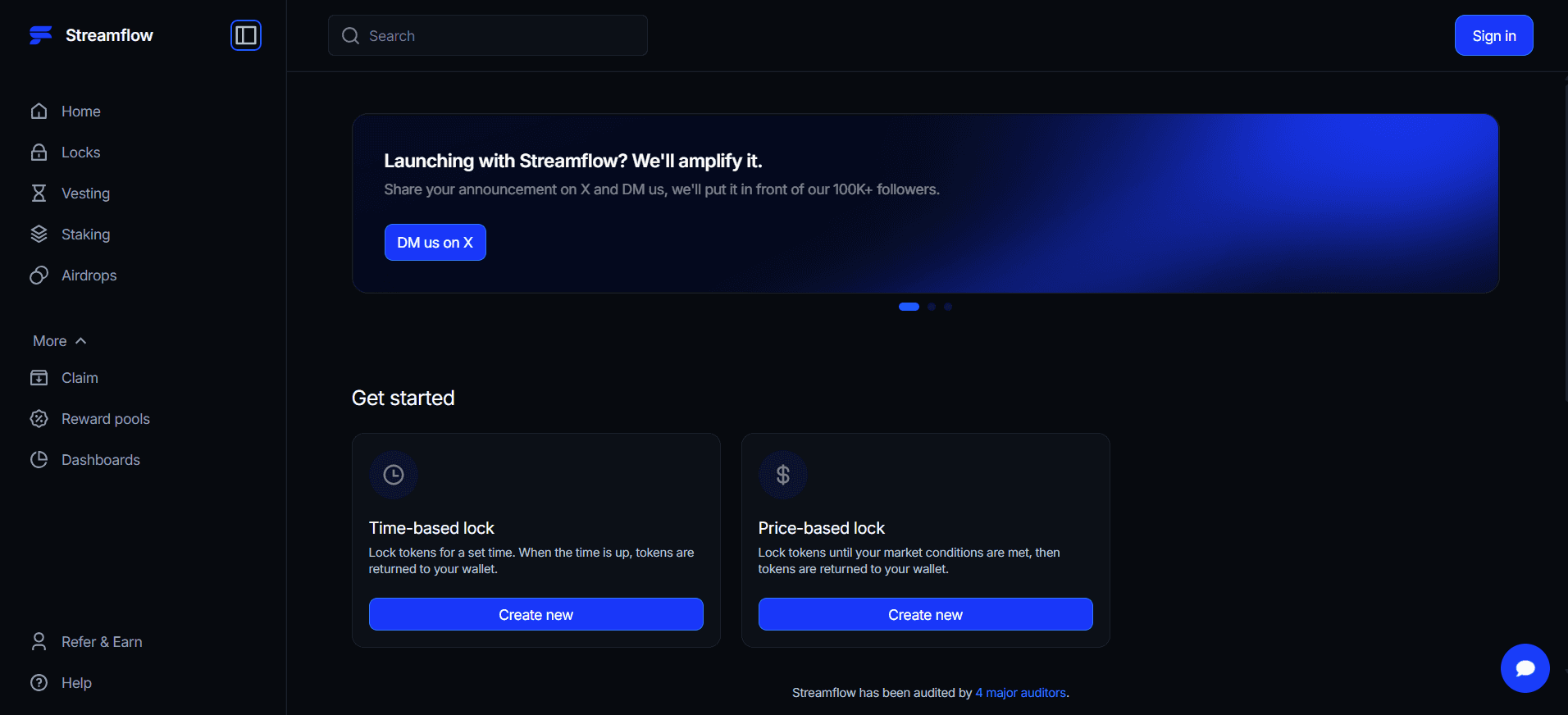
Where most tools stop at a single vesting model, Streamflow supports linear, cliff, cliff-plus-linear, graded, milestone-based, and price-based schedules, all configurable with no code. Teams can bulk-import recipients by CSV, generate shareable proof links, and give investors a real-time tokenomics dashboard that acts as a single source of truth for every allocation and unlock date.
The platform's real advantage is scope. An unlock schedule rarely exists in isolation, and Streamflow lets a team run the vesting contract, lock LP and treasury tokens, launch a claim-based airdrop, and deploy staking from the same interface, all settling on Solana with sub-second finality.
Contracts are immutable once deployed, so no admin can quietly move a cliff date or alter an allocation after the fact.
Pros:
Covers the full token lifecycle, vesting, locks, airdrops, staking, and distribution, in one platform.
Six vesting models including price-based and milestone-based, with no-code setup in seconds.
Solana-native, so unlocks settle with sub-second finality and near-zero fees.
Audited by FYEO and OPCODES, with immutable contracts and Solscan verification.
A public tokenomics dashboard gives investors a verifiable single source of truth.
Cons:
Solana-native by design, so teams needing multi-chain EVM coverage require an additional tool.
Immutable contracts reward careful upfront tokenomics design, leaving little room for post-deployment changes.
Case study: UXD Protocol, a decentralized stablecoin provider on Solana, used Streamflow to vest approximately 46% of its $UXP supply on a 4-year linear schedule with a 12-month cliff. By integrating the Streamflow SDK into Realms, UXD gave stakeholders governance participation and token claiming in a single interface, turning a complex multi-year unlock into a transparent, verifiable system.
For any team launching on Solana, setting up token vesting on Streamflow is the fastest path from tokenomics plan to enforceable schedule.
2. Magna
Magna is a well-regarded token vesting and distribution platform with a strong enterprise client base and support across multiple chains. It is built to handle the mechanics of a token generation event end to end, from investor and team vesting to the claim infrastructure that recipients use to withdraw their unlocked tokens.
Larger, well-funded projects tend to gravitate toward it for structured allocations.
Its distribution tooling is mature and its claim portals are clean, which makes the recipient experience feel polished. For teams operating across several ecosystems at once, Magna's multi-chain reach is a genuine strength, and its interface is comfortable for enterprise operators managing many stakeholders.
The tradeoff is focus. Because Magna spreads across many chains, it optimizes for breadth rather than the deep, chain-specific efficiency a Solana-native platform delivers, and its scope centers on vesting and distribution more than the wider token lifecycle.
Pros:
Enterprise-grade vesting and distribution with a strong track record.
Multi-chain support suits projects spanning several ecosystems.
Well-designed claim portals for investor and team allocations.
Cons:
Multi-chain generalist rather than Solana-native, so it misses Solana-specific fee optimization.
Pricing skews toward enterprise tiers and can be less transparent for smaller teams.
Centered on vesting and distribution rather than the full token lifecycle.
Where Magna spreads across many chains, Streamflow goes deep on Solana, pairing native speed and near-zero fees with a broader product suite that also covers locks, token airdrops, and staking.
3. Hedgey
Hedgey is a capable on-chain platform for token vesting, lockups, and OTC deals, with a strong presence in the EVM ecosystem. It is designed with DAOs in mind, offering vesting plans, investor lockups, and token swap tooling that fit the way Ethereum-native organizations operate. Its coverage spans Ethereum and major L2s.
A standout feature is governance compatibility. Hedgey lets recipients participate in voting even while their tokens are still vesting, which keeps contributors engaged in DAO decisions rather than sidelined until their tokens unlock. Its support for OTC token deals also gives it flexibility beyond plain vesting.
For Solana teams, though, the fit is limited. Hedgey is EVM-first, so a project on Solana would either be unable to use it natively or forced to bridge, and Ethereum gas costs make large distributions meaningfully more expensive than on Solana.
Pros:
On-chain vesting and lockups with governance-friendly, vote-while-vested features.
Supports OTC token deals alongside standard vesting.
Strong coverage across the EVM ecosystem.
Cons:
EVM-first, with limited fit for Solana-native token teams.
Ethereum gas costs raise distribution expenses at scale.
Narrower scope for projects wanting a full Solana operations stack.
Hedgey is a solid EVM choice, but for Solana projects the economics and native tooling favor Streamflow, where distributing to thousands of wallets costs a fraction of Ethereum gas.
4. Sablier
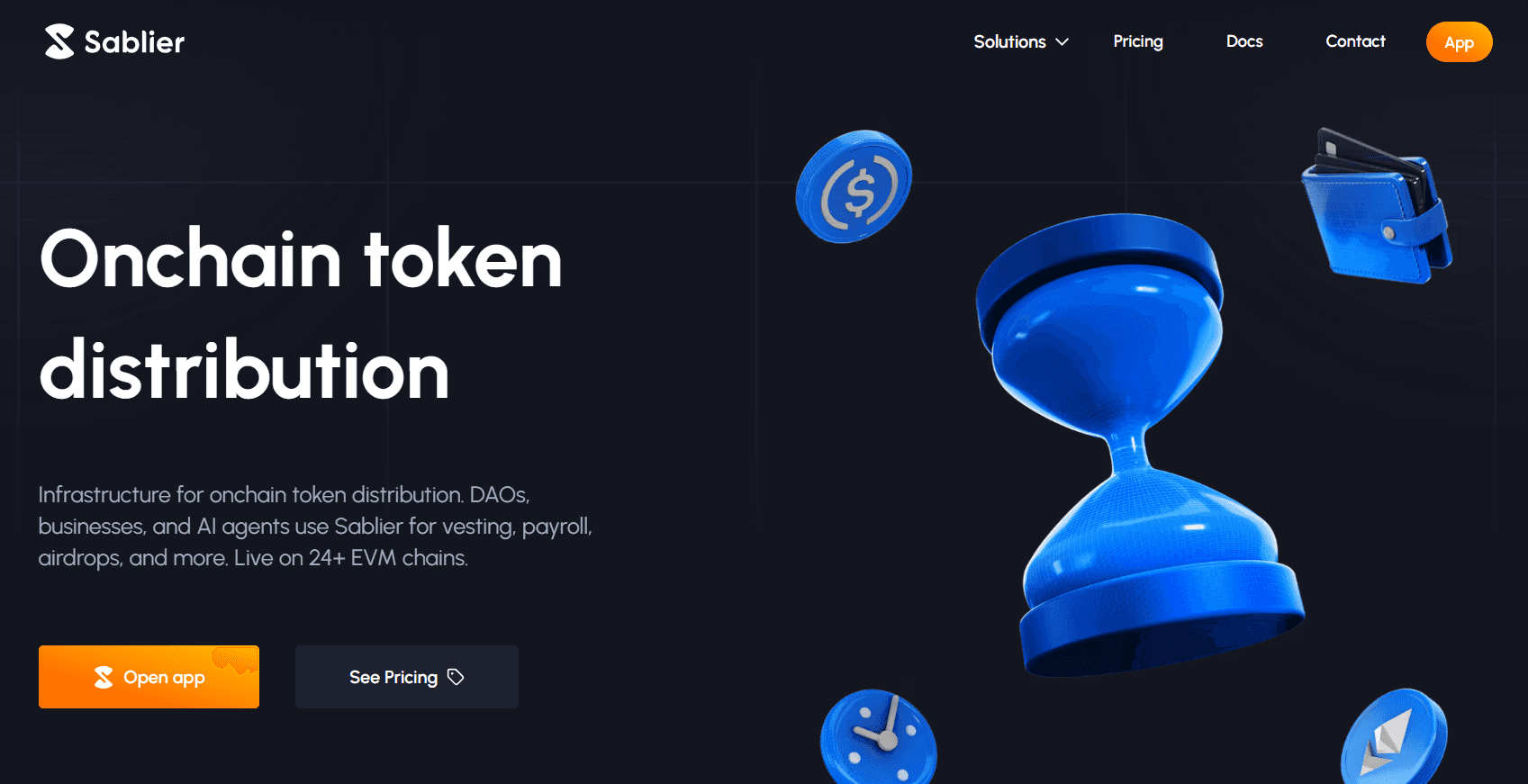
Sablier pioneered token streaming and remains one of the most recognized names in real-time, continuous vesting. Rather than releasing tokens in discrete batches, it streams them by the second, so a recipient's balance grows continuously across the vesting period.
The protocol has been operating for years and is widely used for vesting, payroll, grants, and streaming-based distributions.
Its contracts are open-source and battle-tested, which gives technical teams confidence in exactly what they are deploying, and it is available across a wide range of EVM chains. The streaming model is elegant for linear vesting and continuous compensation where a smooth release curve is preferable to cliff-and-batch unlocks.
The limitation is scope and chain. Sablier is EVM-only, so it is unavailable to Solana-native projects, and its streaming-first design means it does not bundle the airdrop, staking, and lock tooling that an all-in-one platform provides.
Pros:
Pioneered token streaming with battle-tested, open-source contracts.
Real-time streaming vesting for smooth, continuous unlocks.
Works across many EVM-compatible chains.
Cons:
EVM-only, with no native Solana support.
Streaming-centric, so it is less of an all-in-one airdrop and staking suite.
Ethereum mainnet gas costs add up for large distributions.
Streamflow delivers programmable, real-time token payments and streaming on Solana too, but pairs it with locks, airdrops, staking, and a tokenomics dashboard that Sablier's streaming-first scope does not cover.
5. Liquifi (Acquired by Coinbase)
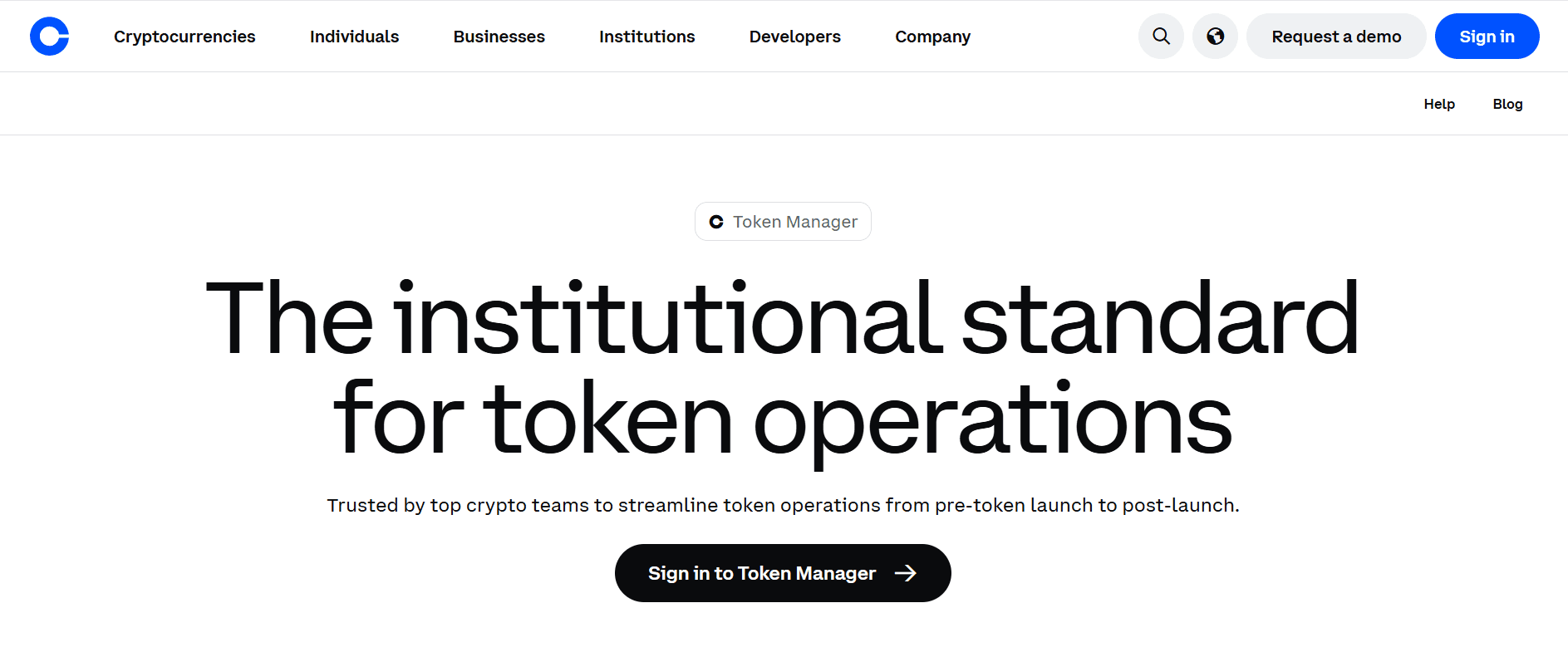
Liquifi combines token vesting with cap table management, which makes it appealing to teams that want their token allocations and equity-style records in one place. It automates vesting, tracks token grants for teams and investors, and leans into the legal, compliance, and reporting side of token operations.
That positioning makes it a natural fit for founders who treat token comp as an extension of their back office.
Its integrated approach means a team can manage structured token compensation, investor reporting, and vesting from a single system rather than reconciling separate tools. For organizations with heavy compliance requirements, that consolidation is genuinely useful.
The constraints are chain and orientation. Liquifi is EVM-focused with limited Solana support, and it is built more for compliance and reporting workflows than for high-volume on-chain distribution to large recipient sets.
Pros:
Integrates token vesting with cap table management in one system.
Strong fit for legal, compliance, and investor-reporting needs.
Well-suited to structured token compensation.
Cons:
EVM-focused, with limited Solana support.
More back-office and compliance oriented than built for on-chain distribution at scale.
Pricing and positioning skew toward enterprise.
For Solana teams that want cap-table-grade structure plus on-chain financial operations, Streamflow Business extends into cap tables, tokenized SAFEs, and treasury management while keeping everything native to Solana.
6. Jupiter Lock
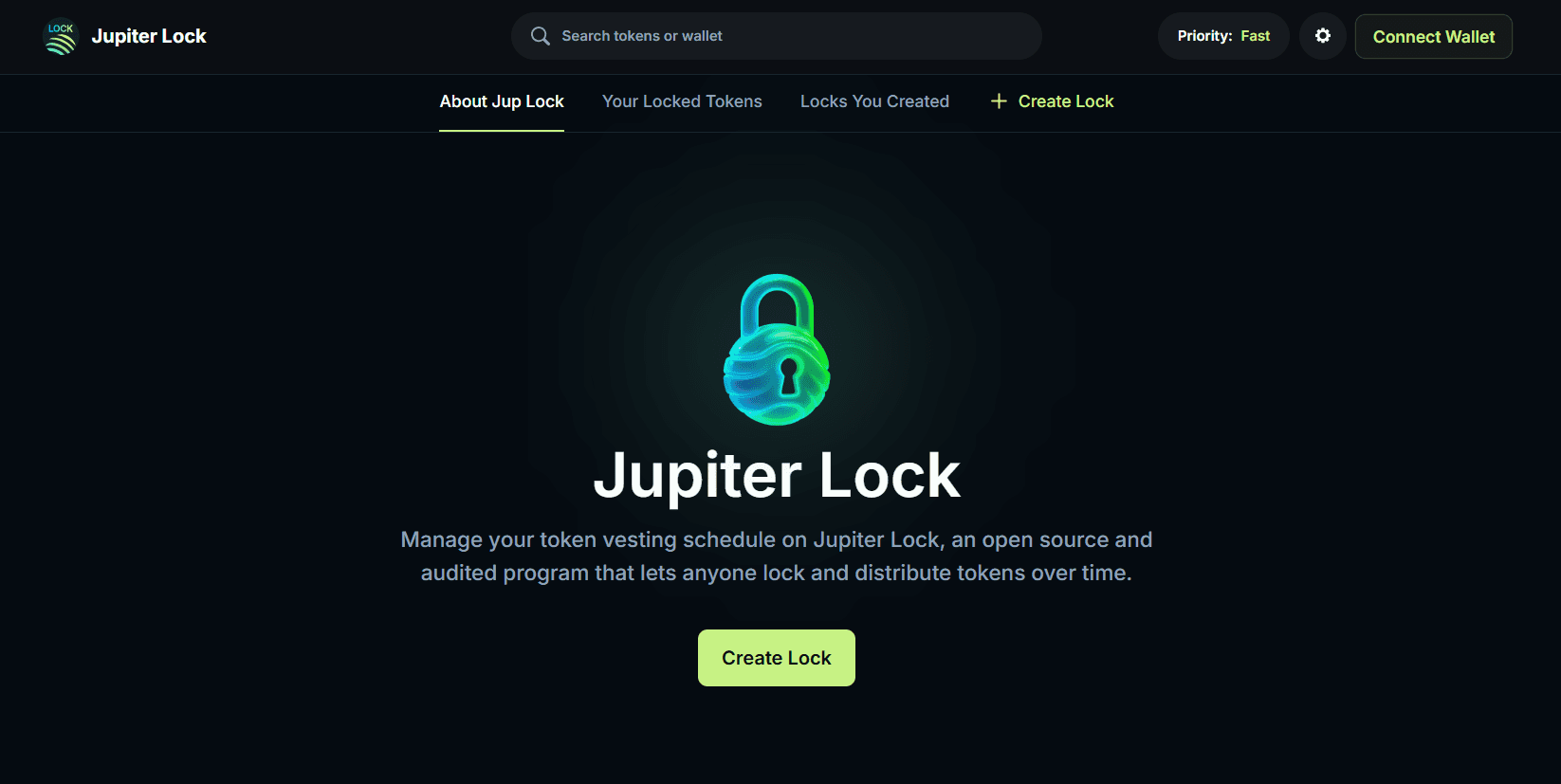
Jupiter Lock is a free, open-source token locking tool built on Solana and backed by one of the ecosystem's most trusted teams. It lets projects lock team and project tokens with a clear, verifiable unlock schedule, giving communities on-chain proof that specific allocations cannot move before their unlock date. Because it comes from Jupiter, it carries strong credibility among Solana users.
Its open-source design and zero cost make it an easy entry point for teams whose immediate need is simply to lock tokens and demonstrate commitment. The tool is transparent and straightforward, with no barrier to getting a basic lock in place.
Its scope is where it stops short. Jupiter Lock focuses on locking rather than full vesting management, and it does not include the airdrop, staking, distribution, or dashboard tooling required to run token operations over a multi-year schedule.
Pros:
Free and open-source, with no cost to lock tokens.
Solana-native and backed by the Jupiter team.
Simple, transparent locking that is easy to verify.
Cons:
Focused on token locks only, with no full vesting management.
No airdrop, staking, or distribution tooling for the wider token lifecycle.
Fewer dashboard and management features for ongoing operations.
Jupiter Lock handles the lock step well, but managing unlocks over multiple years across many stakeholder groups is where a full platform matters. Streamflow covers token locks and vesting, plus everything around them, in one place.
How to Choose the Right Token Unlock and Vesting Tool
Run every option through the six criteria set earlier, in priority order for your situation. The decision usually collapses to two questions.
What chain is your token on?
If it is Solana, a native platform will always beat a bridged or EVM-first tool on speed, cost, and ecosystem trust.How much do you need beyond vesting?
If you only need to lock tokens once, a single-purpose tool may suffice. If you will run airdrops, staking, or ongoing distribution, an all-in-one platform saves you from stitching tools together.
A quick way to decide: map your next 18 months of token operations, not just your first unlock. Teams that plan only for the initial lock often outgrow single-purpose tools within a quarter and end up migrating anyway. Choosing a full platform up front avoids that cost.
Why Streamflow Is the Best Choice for Solana Token Teams
Every tool on this list can vest tokens. The difference is scope, chain fit, and proof. Streamflow is the only option that combines Solana-native performance, six configurable vesting models, and full lifecycle coverage under audited, immutable contracts.
The trust signals compound. Contracts audited by FYEO and OPCODES, on-chain verification through Solscan and Solana Explorer, public proof links, and a listing in the official Solana Docs give investors reasons to believe your commitments without taking your word for it.
That verifiable transparency is what converts a vesting schedule from a promise into an enforceable system.
Scale confirms it works. With more than $317 million in total value locked and over 40,000 projects, Streamflow operates at infrastructure level, not experimental level.
Heavenland's structure shows the ceiling: 97% of its $HTO supply on a 5-year linear vesting schedule with cliffs, designed to allow initial liquidity without excessive inflation, all enforced on-chain.
How to Get Started With Streamflow
Getting a vesting schedule live on Streamflow takes minutes, not engineering sprints. The no-code flow means a founder or operator can go from tokenomics plan to funded, enforceable contract without writing a line of Solidity or Rust. Locking tokens takes as little as 37 seconds.
The core path follows five steps:
Create the contract by selecting a vesting or lock type in the app.
Upload recipients individually or in bulk via CSV import.
Define the schedule, choosing linear, cliff, graded, milestone-based, or price-based terms.
Fund the contract with the tokens to be distributed.
Let it execute, with tokens releasing automatically and every event verifiable on-chain.
For example, a project vesting core-team tokens over three years can create the contract, import its 22 contributor wallets, set a linear schedule with a cliff, fund it once, and never touch it again, exactly the pattern Bonk used for 20% of its supply across 22 early contributors.
Developers who want to embed the same logic into their own dApp can build on the Streamflow SDK instead.
When you are ready, open the Streamflow app to create your first schedule, or bring your team in for a guided walkthrough of a more complex multi-stakeholder setup.
Conclusion
With over $97 billion in tokens unlocked in 2025, the tool managing your vesting schedule is no longer a detail, it is the difference between a controlled release and a supply shock.
Streamflow is the best tool for managing token unlocks and vesting schedules on Solana because it enforces every schedule through audited, immutable, publicly verifiable smart contracts across the full token lifecycle.
Book a demo to see how Streamflow handles multi-year token unlocks and vesting schedules across your entire stakeholder base.
Read Next:
FAQs:
1. What is the best tool for managing token unlocks and vesting schedules in 2026?
The best tool for managing token unlocks and vesting schedules in 2026 is Streamflow, the Solana-native platform used by over 40,000 projects. It enforces linear, cliff, graded, milestone-based, and price-based schedules through audited, immutable smart contracts with public on-chain verification.
2. How is Streamflow different from EVM-first vesting tools like Hedgey or Sablier?
Streamflow is different from EVM-first tools because it is built natively on Solana, giving it sub-second finality and near-zero fees rather than Ethereum gas costs. It also covers vesting, locks, airdrops, and staking in one platform, where EVM-first tools tend to focus on a narrower set of functions.
3. Can Streamflow enforce a cliff and prevent early token selling?
Yes, Streamflow enforces cliffs through immutable on-chain smart contracts, so locked tokens cannot be transferred, traded, or accessed until the unlock conditions are met. This prevents early selling and gives investors publicly verifiable proof that team and investor allocations are genuinely locked.
4. Is Streamflow's vesting secure and verifiable by investors?
Streamflow's vesting is secure and verifiable, with smart contracts audited by FYEO and OPCODES and every schedule confirmable on Solscan and Solana Explorer. Public proof links and a real-time tokenomics dashboard let anyone independently check allocations and unlock dates.
5. How much does it cost to set up a vesting schedule on Streamflow?
Setting up a vesting schedule on Streamflow costs a smart contract creation fee plus Solana's near-zero transaction fees, which makes it far cheaper than distributing on Ethereum. The no-code setup takes seconds, so teams can create and fund a schedule without engineering overhead.