General
How to Distribute SPL Tokens on Solana: Airdrops, Vesting, and Bulk Distribution Tools
Data from Tokenomist showed major token unlocks scheduled between July 1 and August 1, 2026 with a combined value crossing $1.988 billion.
Every one of those unlock events traces back to a distribution decision made months or years earlier, encoded once and then executed on autopilot.
Streamflow is the Solana-native token operations infrastructure platform behind that kind of execution, with over $288 million in total value locked and more than 40,000 projects running token distribution through audited on-chain contracts.
Most teams approach SPL token distribution as a sending problem. They ask which tool can push tokens to 30,000 wallets, find a bulk sender, and consider the question closed. That framing is why so many distribution plans survive the launch week and fall apart in month four.
The mechanism you choose for each allocation is a supply commitment that markets will price.
This guide breaks down how to distribute SPL tokens on Solana by matching each allocation to the right mechanism, and which tools handle airdrops, vesting, locks, and bulk payouts at production scale.
Key Takeaways
SPL token distribution on Solana spans airdrops, vesting schedules, token locks, and recurring bulk payouts.
Streamflow automates SPL token distribution with audited on-chain contracts across 40,000+ projects and $1.4B+ TVL.
Match each allocation to a mechanism: airdrops for reach, vesting for contributor alignment, locks for commitment.
Streamflow supports airdrop campaigns of up to one million recipients and 100,000 recipients per CSV.
Manual bulk transfers break at scale and leave no verifiable on-chain proof of distribution.

The Bulk Sender Trap
The common misconception is that distributing SPL tokens is a throughput question. Solana handles 65,000+ transactions per second with sub-second finality and near-zero fees, so moving tokens to a large recipient list is technically trivial. The chain solved the sending problem years ago.
What the chain does not solve is enforcement. A batch transfer is a one-time event with no memory, no schedule, and no conditions attached. Once the tokens land in a wallet, the distribution logic that justified sending them exists only in a spreadsheet and a Notion doc.
This is where distribution plans break:
Team allocations sent directly to wallets can be sold the same day, regardless of what the tokenomics page claims.
Airdrops delivered as instant transfers get farmed by sybils and dumped within hours.
Contributor payouts tracked manually drift out of sync and require someone to remember to send them.
Investors and exchanges cannot independently verify any of it without on-chain proof.
The projects with $1.988 billion in scheduled unlocks this summer are not the ones that got distribution wrong. They are the ones that encoded it. Their supply schedule is public, predictable, and enforced by contracts nobody on the team can override.
What Distribution Actually Commits You To
Every allocation in a token launch carries a different promise, and each promise needs a different enforcement mechanism.
A community airdrop promises reach and activation.
A founder allocation promises that insiders will not exit before the product does.
A treasury reserve promises that funds exist for a stated purpose and will not be quietly redirected.
These are not variations of the same action, and treating them all as transfers collapses the distinction that gives each one its credibility.
The trust asymmetry matters here. Sophisticated buyers, exchanges, and institutional allocators no longer accept self-reported schedules. They check the chain, and an allocation that cannot be verified on Solscan or Solana Explorer is treated as unlocked supply regardless of what the team says.
Off-chain vesting tracked in spreadsheets is functionally indistinguishable from no vesting at all.
The practical consequence is that mechanism selection happens before tool selection. Choose the enforcement model that matches what each allocation is supposed to prove, then pick infrastructure that can execute it.
The Framework: Match Every Allocation to a Mechanism
Airdrops for Reach and Activation
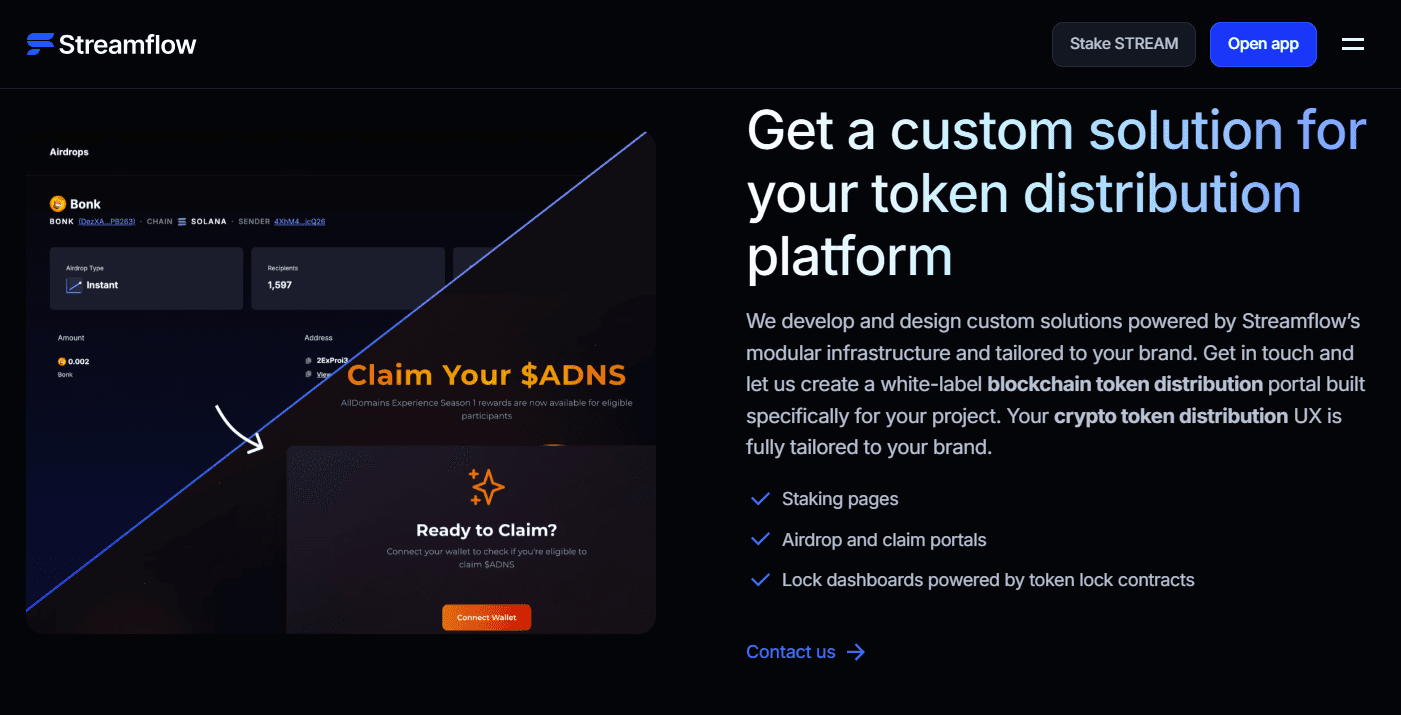
Airdrops are the distribution of tokens to a large group of users, typically for growth, incentives, or community activation. They are the highest-volume mechanism in any launch and the one most exposed to sybil farming and immediate sell pressure.
The difference between an airdrop that builds a holder base and one that funds mercenaries comes down to structure. Instant delivery to a raw snapshot list is the weakest version.
Vested airdrops and price-based airdrops convert a giveaway into a retention mechanism by attaching release conditions to the claim.
Instant airdrops for low-value, high-reach campaigns where speed matters more than retention.
Vested airdrops where tokens release over a schedule after the claim, reducing day-one sell pressure.
Price-based airdrops where releases unlock against token price thresholds rather than time alone.
White-label claim portals so recipients claim on your domain instead of a third-party site.
Scale is the other constraint. Streamflow supports up to one million recipients in a single campaign, with 100,000 recipients per CSV file, standard plans covering roughly 30,000 recipients, and an enterprise tier above that. Eligibility filtering, claim windows, real-time delivery tracking, and recovery of unclaimed tokens are handled inside the campaign rather than bolted on afterward.
Anti-phishing discipline belongs in the same conversation. Direct users to official URLs and official eligibility checkers, because a large airdrop is also a large attack surface.
Teams planning their first campaign should read the practical walkthrough on how to do a Solana airdrop and the guidance on sybil-resistant airdrop strategies.
Vesting for Contributor and Investor Alignment
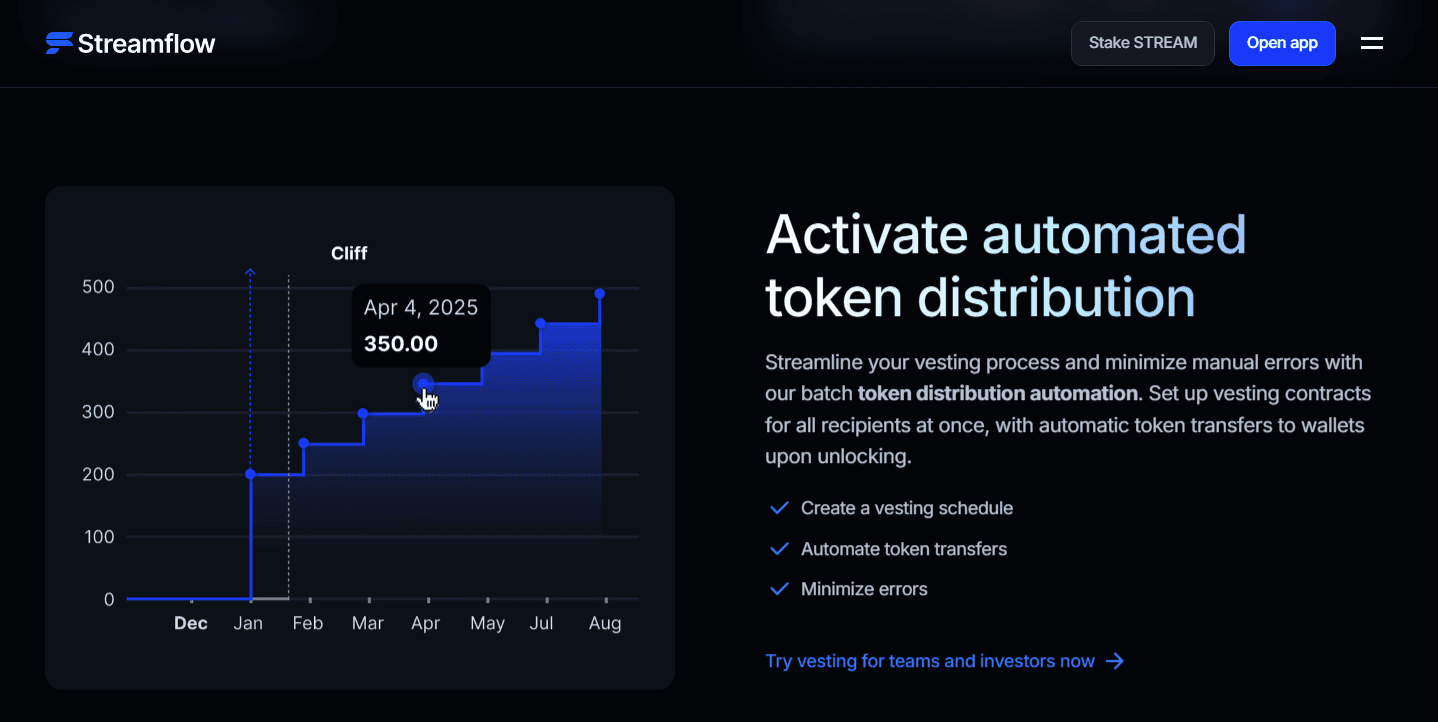
Token vesting is the controlled release of tokens over time to prevent immediate selling and align long-term incentives. It is the correct mechanism for anything tied to ongoing contribution: founders, core team, advisors, investors, and ecosystem allocations.
The standard structure for founders and core team is a 12-month cliff followed by linear release, though the schedule should reflect what the allocation is actually buying.
On-chain vesting supports several models, and mixing them across stakeholder groups is normal rather than exotic.
Linear vesting for steady release across a fixed term.
Cliff and cliff-plus-linear vesting for team allocations with a delayed start.
Graded vesting for tranches that accelerate or decelerate over the schedule.
Milestone-based vesting tied to product launches or KPIs.
Price-based vesting where unlocks trigger at token price thresholds.
The operational flow is short: create the vesting contract, upload recipients, define the schedule, fund the contract, and tokens release automatically. Bulk CSV import handles large recipient sets, and every contract produces a shareable proof link that anyone can verify on a block explorer.
Token Locks for Single-Event Commitments
A token lock restricts tokens from being transferred, sold, or accessed until a predefined condition is met, whether a specific date, a time period, or a price level. The distinction from vesting is structural: a lock is one unlock event, while vesting is a release curve.
Locks are the right tool for treasury reserves, LP tokens, and any allocation where the promise is "this does not move until X." Token locks on Solana support SPL tokens and LP tokens, produce public proof links, and are verifiable on Solscan, Solana Explorer, and RugCheck.
Fixed-date unlocks for time-bound commitments.
Price-based unlock conditions for supply that should only enter circulation at specific valuations.
Quick locks for teams that need a trust signal live before launch, which takes about 37 seconds to set up.
Liquidity locks on LP tokens to remove rug-pull risk on DEX pools.
Cost is a real factor at this layer. Locking and unlocking on Solana costs a fraction of the equivalent operation on Ethereum, which makes granular lock structures economically viable rather than something reserved for the largest allocations.
Bulk Distribution and Recurring Payouts for Operations
The distribution work that continues after launch is where manual processes fail hardest. Contributor payroll, DAO grants, and ecosystem incentives are recurring obligations, not one-time sends.
Recurring payout contracts let teams automate payroll-style payments to employees, contractors, and contributors, and keep funding them over time without redeploying new contracts. For finance leads running mass payouts across dozens or hundreds of recipients, this removes the single biggest source of operational error.
Teams building toward treasury management, cap tables, and ownership issuance can extend this into Streamflow Business, the financial OS for Internet Capital Markets.
How Streamflow Executes All Four
The reason these four mechanisms belong in one system is that they describe the same token supply. Running airdrops in one tool, vesting in a second, and payouts in a spreadsheet means no single view of what is circulating and what is committed.
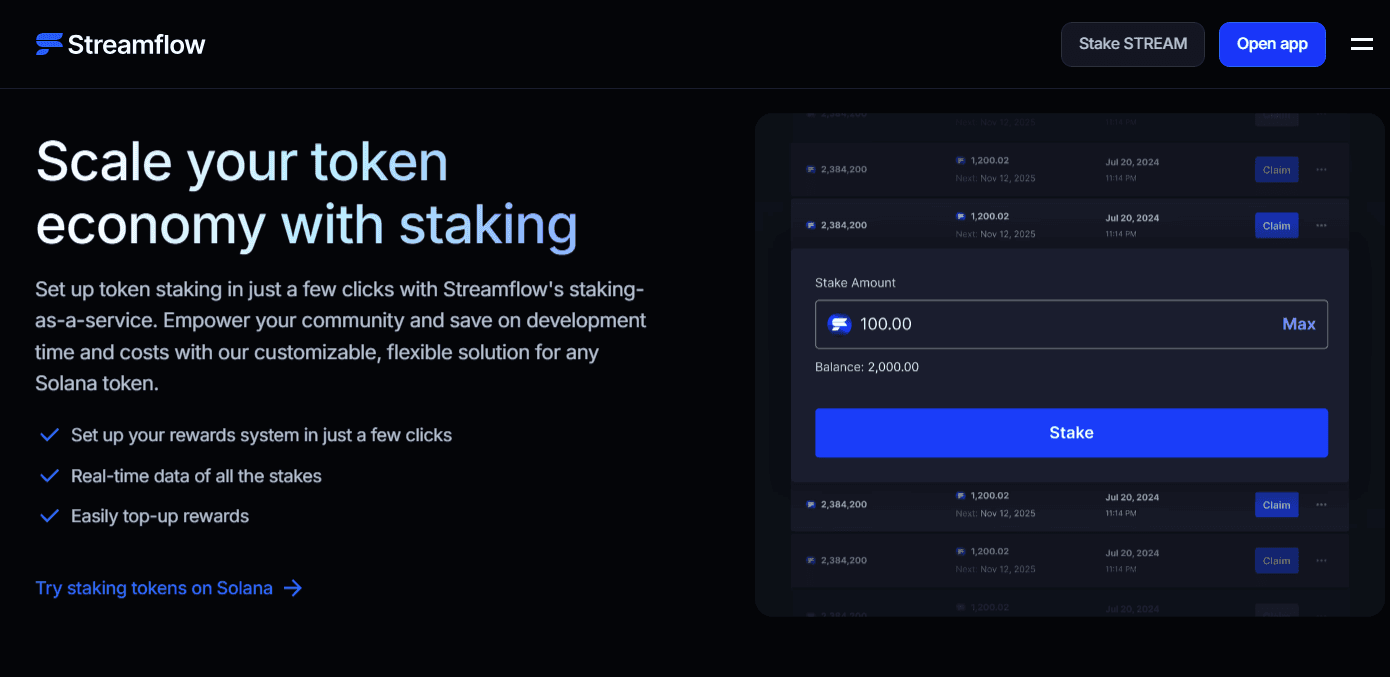
Streamflow handles token locks, vesting, airdrops, staking, token minting, and programmable payouts through audited on-chain contracts on Solana, with a no-code UI for teams and a public SDK for developers who need to embed distribution logic directly into a dApp.
The tokenomics dashboard consolidates every contract, cliff date, unlock event, and release curve into a single real-time view. Open the to see the full distribution stack in one interface.
Security is the load-bearing part. Streamflow's contracts are audited by FYEO and OPCODES, immutable once deployed, and built without admin override, which means a schedule cannot be quietly altered after the fact. That property is what makes a distribution commitment worth anything to the people evaluating it.
Case Study: Bonk and Heavenland
Bonk allocated 55% of its supply to airdrops for early Solana users and used Streamflow for core team vesting. The Bonk case study covers 20% of total supply distributed across 22 early contributors on a three-year linear vesting schedule, giving the community verifiable proof that insider supply was locked to a public timeline.
Heavenland took the structure further. Heavenland's $HTO distribution placed 97% of token supply on five-year linear vesting with cliffs on all allocations, spanning team, incentives, and treasury. The design allowed initial liquidity without excessive inflation, and the outcome was a more engaged and dedicated player community.
Both projects made the same underlying choice. The distribution logic lives in contracts nobody can override, which is what converts a tokenomics page into a credible commitment.
What This Means for Web3 Founders
Before writing a single transfer, map each allocation to the mechanism that enforces its promise. Community supply goes to structured airdrops, contributor and investor supply goes to vesting with cliffs, treasury and LP supply goes to locks, and operational spend goes to recurring payout contracts.
Then check one thing: can an outsider verify each of those commitments without asking you? If the answer requires trusting a spreadsheet, the commitment is not real yet.
The teams that survive their first eighteen months are the ones whose supply schedule is boring, public, and enforced. That is a tooling decision made early, not a communications problem solved later.
Conclusion
Distributing SPL tokens on Solana is not a throughput problem, it is an enforcement problem, and the mechanism attached to each allocation determines whether the commitment holds.
Streamflow executes airdrops of up to one million recipients, vesting schedules across every stakeholder group, token locks with public proof, and recurring payouts through audited contracts that cannot be unilaterally changed.
Across 40,000+ projects and $288M+ in total value locked, that infrastructure is what turns a distribution plan into a system.
Book a demo to see how Streamflow handles a full SPL token distribution across airdrops, vesting, and bulk payouts.
Read Next:
How to Verify a Token Lock On-Chain: Step-by-Step Checklist for Solscan and Etherscan
Token Distribution Red Flags: 9 Warning Signs to Check Before Buying Any Crypto Token
Token Locks Explained: What They Are, How They Work, and Why Every Crypto Project Needs One in 2026
FAQs:
1. What is the best way to distribute SPL tokens on Solana?
The best way to distribute SPL tokens on Solana is to match each allocation to a mechanism that enforces its purpose: structured airdrops for community reach, vesting schedules for team and investor allocations, token locks for treasury and LP supply, and recurring payout contracts for operational spend. Streamflow executes all four through audited on-chain smart contracts, so every commitment is publicly verifiable rather than self-reported.
2. How many recipients can a single Solana airdrop reach?
A single Solana airdrop on Streamflow can reach up to one million recipients per campaign, with 100,000 recipients supported per CSV file. Standard plans cover roughly 30,000 recipients per airdrop, and larger campaigns are handled through the enterprise tier.
3. What is the difference between an SPL token lock and a vesting schedule?
The difference between an SPL token lock and a vesting schedule is the release shape. A lock restricts tokens completely until a single unlock condition is met, such as a date or a price threshold, while vesting releases tokens gradually across a defined schedule. Locks suit treasury reserves and LP tokens, and vesting suits contributor and investor allocations.
4. Can SPL token distribution be verified on-chain?
Yes, SPL token distribution through Streamflow can be verified on-chain by anyone. Every vesting contract, lock, and airdrop produces a shareable proof link and is verifiable on Solscan, Solana Explorer, and RugCheck, with no dependence on the issuing team's own reporting.
5. Does distributing SPL tokens on Solana require smart contract development?
No, distributing SPL tokens on Solana does not require smart contract development. Streamflow provides a no-code interface where teams configure parameters and deploy instantly, with a token lock taking about 37 seconds to set up. Developers who need custom logic can use the public SDK to embed distribution flows directly into their own applications.