General
Cliff Vesting vs Linear Vesting: Which Token Release Schedule Is Better?
Between August 3 and September 3, 2026, more than $1.28 billion in tokens was scheduled to enter circulation across cliff and linear releases, according to Tokenomist data reported by WuBlockchain.
Most of that supply is moving on schedules written months or years earlier, by teams who treated the release structure as a formatting decision rather than a liquidity decision.
Streamflow, the Solana-native token operations platform behind more than $240 million in total value locked across 40,000+ projects, sees both structures deployed daily, and the pattern in the data is clear.
The teams that get this right are not the ones who picked the "better" schedule. They are the ones who matched the schedule to the stakeholder, sized the unlock against real liquidity, and made the whole thing verifiable before the first token moved.
This article breaks down what cliff vesting and linear vesting actually do to your circulating supply, when each one is the correct tool, and why the strongest token vesting designs almost always use both.
Key Takeaways
Cliff vesting and linear vesting solve different problems; most token schedules on Streamflow combine both.
A cliff proves commitment, while linear release spreads supply pressure across the vesting period.
Streamflow supports linear, cliff, graded, milestone-based, and price-based vesting without writing any smart contracts.
Schedule design matters less than enforcement; Streamflow makes every vesting contract immutable and publicly verifiable.
Over 40,000 projects use Streamflow to enforce token vesting schedules on Solana.
Why "Cliff vs Linear" Is the Wrong Question
Framing this as a binary assumes the two mechanisms compete. They do not. A cliff answers the question "when does anything start?" and a linear schedule answers "how fast does it move once it starts?"
Treating them as alternatives produces the two most common failure modes in token design. Pure cliff structures create a single date on which a large allocation becomes liquid at once. Pure linear structures with no cliff hand insiders sellable tokens from week one, before the product has shipped anything.
Research from market maker Keyrock, which analyzed more than 16,000 unlock events, found that roughly 90% of unlocks generate negative price pressure, and that larger unlocks produce drops up to 2.4 times sharper. The same study found team unlocks trigger the worst reactions, with declines around 25%, largely because teams rarely use market makers or hedging to spread the sell pressure.
The takeaway is not "avoid cliffs." It is that a schedule is a supply engineering decision with measurable market consequences, so it should be designed with the same rigor as a liquidity plan.
What Each Schedule Actually Does to Your Supply
Both structures restrict tokens. They differ in the shape of the release curve and, therefore, in the shape of the market impact.
How Cliff Vesting Behaves
A cliff is a period during which no tokens are released at all. Once the cliff ends, tokens begin vesting according to the schedule that follows it. The standard for founders and core team allocations is a 12-month cliff.
The cliff does one job extremely well: it filters for commitment. Nobody who leaves in month seven walks away with tokens.
Creates a hard commitment threshold for contributors and investors
Guarantees zero insider supply during the earliest, thinnest liquidity period
Produces a single, highly visible unlock date the market will price in advance
Concentrates risk if the post-cliff release is a lump sum rather than a stream
A protocol that gives 22 contributors a 12-month cliff has effectively bought itself a full year of supply certainty. The cost is that the market now has one date circled on the calendar, and per the Keyrock findings, price impact often begins around 30 days before that date arrives.
Understanding what cliff vesting is before you commit to one matters, because the cliff length is the hardest parameter to change later.
How Linear Vesting Behaves
Linear vesting releases tokens continuously across the vesting period, at a constant rate. There is no single unlock event to front-run, because every day is an unlock day at a small scale.
This makes linear release the better structure for supply absorption. It also makes it a weaker commitment signal on its own, since a contributor who leaves in month three still keeps three months of vested tokens.
Spreads sell pressure across the entire schedule instead of one date
Removes the front-running window that cliff dates create
Provides predictable, modelable circulating supply growth
Offers no minimum commitment period unless paired with a cliff
For a treasury funding ongoing ecosystem incentives, linear is almost always correct. For a founder allocation, linear alone leaves the door open on day one.
Why the Hybrid Became the Default
Cliff plus linear is ow the standard structure for insider allocations, and for good reason. The cliff enforces the commitment period; the linear tail prevents the commitment period from ending in a supply shock.
Dimension | Cliff Vesting | Linear Vesting | Cliff + Linear |
|---|---|---|---|
Commitment signal | Strong | Weak | Strong |
Supply shock risk | High | Low | Low to moderate |
Front-running window | Yes, one date | Minimal | One smaller date |
Best for | Short lockups, milestone gates | Treasuries, ecosystem funds | Founders, team, investors |
Modelability for holders | Simple, lumpy | Simple, smooth | Predictable after cliff |
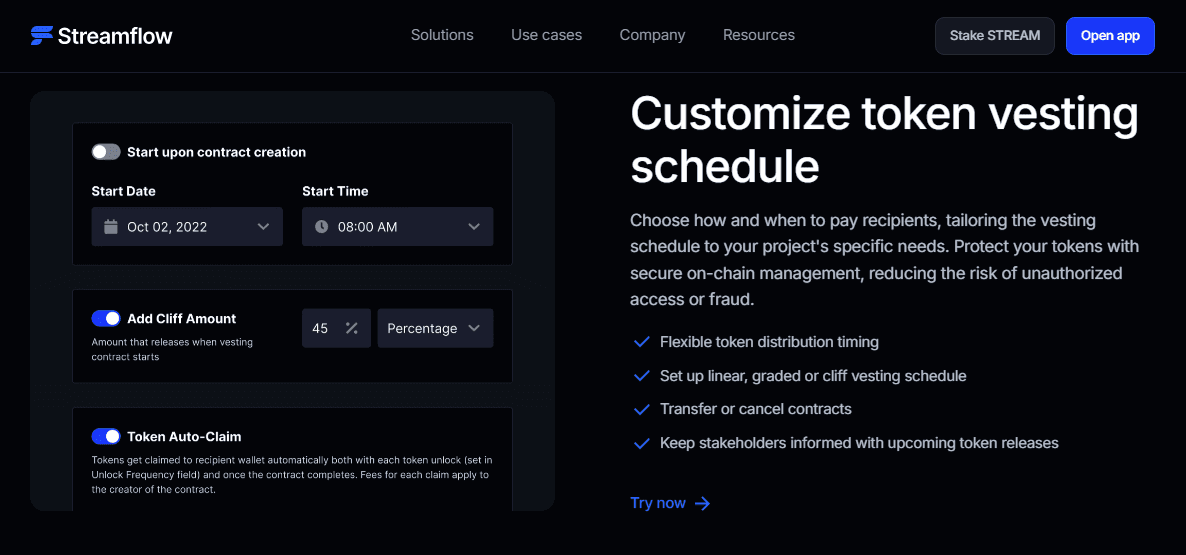
Streamflow supports linear vesting, cliff vesting, cliff plus linear, graded vesting, milestone-based vesting, price-based vesting, and custom intervals as native configurations, so the hybrid is a setup choice rather than an engineering project.
A Framework for Choosing the Right Release Schedule
The token vesting schedule should be derived from the stakeholder and the liquidity, not chosen from a menu. Here is the sequence that works.
1. Start With the Stakeholder, Not the Schedule
Different stakeholder groups have different failure modes, so they need different curves. Vesting strategy on Streamflow is designed per group: founders, core team, advisors, investors, DAO treasury, ecosystem incentives, and public sale participants.
Founders and core team: 12-month cliff, then multi-year linear
Investors: cliff aligned to lockup terms, then linear across 2 to 4 years
Advisors: shorter cliff, shorter linear tail, smaller allocation
Ecosystem and treasury: linear or milestone-based, minimal cliff
A single blanket schedule applied to all seven groups is the clearest signal that tokenomics was an afterthought.
2. Size the Unlock Against Daily Liquidity
The percentage of supply unlocking matters far less than the unlock size relative to daily trading volume. Analysis published by KuCoin in February 2026 noted that dilution risk is amplified when unlocks exceed roughly 2.4 times average daily trading volume.
Run the math before you commit to the schedule. If a cliff releases more than a couple of days of volume in one transaction, convert the lump into a linear tail and the problem largely disappears.
3. Use a Cliff to Prove Commitment, Linear to Prove Discipline
The cliff is a message to your team. The linear tail is a message to your holders.
The cliff says: nobody here is getting paid to leave early
The linear tail says: nobody here can exit in a single transaction
Together they say: the team's outcome is tied to a multi-year horizon
Both messages are only credible if a third party can verify them, which is why on-chain enforcement matters more than the schedule itself.
4. Consider Price-Based and Milestone Release Instead of Time
Time is a proxy for progress, and often a poor one. A team can sit through a 12-month cliff and ship nothing, and the tokens still release.
Streamflow supports price-based vesting and milestone-based vesting as alternatives to purely time-driven schedules. Releases can be conditioned on price thresholds or delivery milestones, which ties supply expansion to actual outcomes rather than the calendar.
For a pre-product team, a milestone gate is a stronger alignment tool than any cliff length. For an already-liquid token, price-based conditions prevent unlocks from landing during weakness.
5. Make the Schedule Verifiable Before You Announce It
An announced schedule is a promise. An on-chain schedule is a constraint.
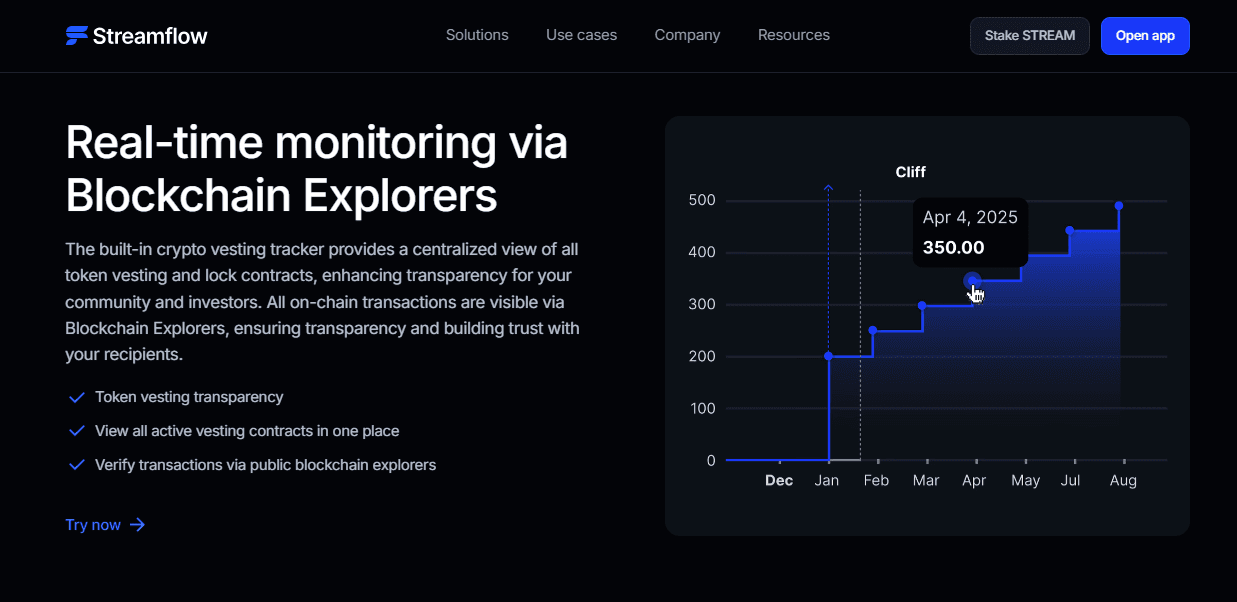
Vesting contracts deployed through Streamflow are immutable once live, with no unilateral changes and no admin override. Each contract generates shareable proof links and is verifiable on Solscan and Solana Explorer, so investors can confirm the schedule independently rather than taking a blog post at face value.
This is the same principle behind token locks on Solana, applied to a release curve instead of a single unlock.
How Streamflow Fits Into This
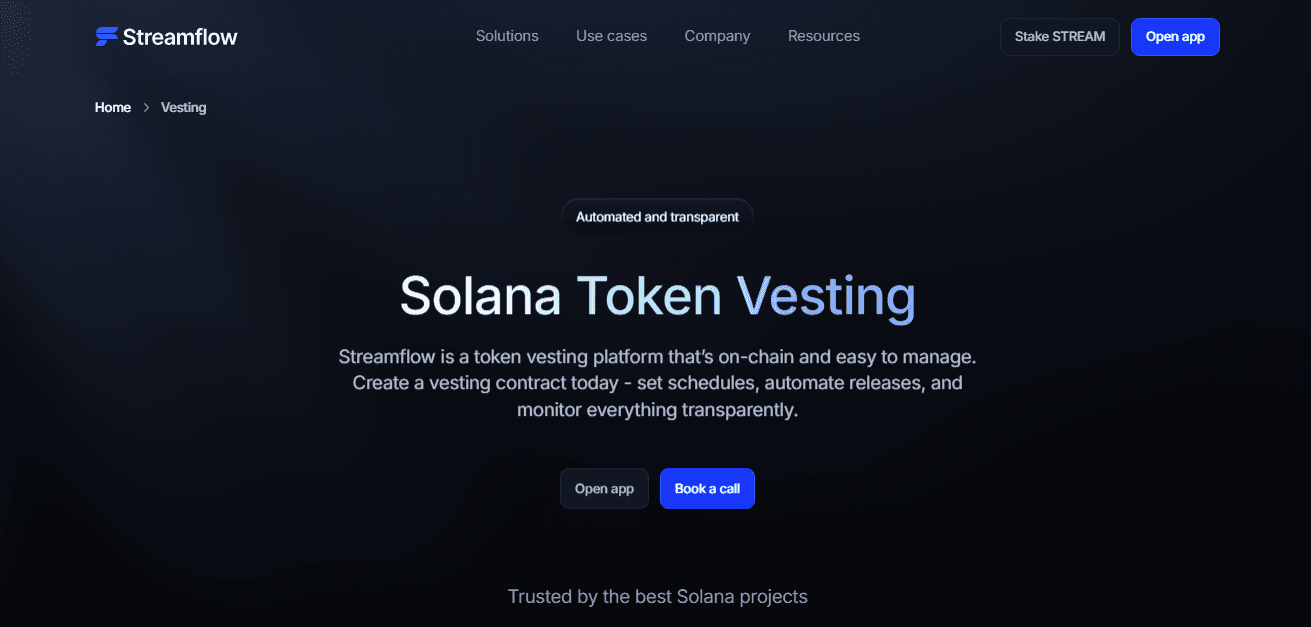
Streamflow turns the schedule you design into an enforceable on-chain contract, without requiring smart contract development. The no-code path runs through the app: create the vesting contract, upload recipients, define the schedule, fund the contract, and tokens release automatically from there.
The configuration surface covers the full range of structures teams actually need, including cliff, linear, cliff plus linear, graded, milestone-based, and price-based schedules with custom intervals. Bulk CSV import handles multi-recipient allocations, and the vesting tracker dashboard gives teams and holders a live view of release progress.
Teams that want to build the logic directly into a product can do it through the SDK instead.
Streamflow is listed in the official Solana Docs as a token vesting reference, and its contracts are audited by FYEO and OPCODES.
You can set up token vesting on Streamflow and have the contract live in minutes, on infrastructure that supports sub-second finality and near-zero fees.
Case Study: How UXD Protocol and Bonk Structured Their Schedules
UXD Protocol, a decentralized stablecoin provider on Solana, needed vesting and governance in a single interface for its $UXP governance token. The team put approximately 46% of $UXP supply on a 4-year linear vesting schedule with a 12-month cliff, and integrated the Streamflow SDK into Realms so stakeholders could claim tokens and participate in governance from the same place.
The UXD Protocol case study is a textbook hybrid: a cliff long enough to establish commitment, followed by a linear tail long enough that no single date carries the supply.
Bonk took a different path for a different stakeholder set. The Solana meme coin allocated 55% of supply to airdrops for early Solana users, then used Streamflow for core team vesting covering 20% of total supply across 22 early contributors on a 3-year linear schedule.
As the Bonk vesting case study shows, the on-chain schedule became a trust artifact: anyone could verify that contributor tokens were not sitting in a wallet ready to move.
Two projects, two stakeholder profiles, the same underlying principle. Match the curve to the group, then make it verifiable.
What This Means for Web3 Founders and Tokenomics Designers
If you are designing a schedule right now, the practical answer to "cliff or linear" is almost always "both, with the ratio set by stakeholder group." Reserve pure linear for treasury and ecosystem allocations where commitment is not the concern.
Reserve pure cliff for short lockups or milestone gates where a stream would defeat the purpose.
Model each group's unlock against average daily volume, not against total supply
Default to a 12-month cliff plus multi-year linear for founders and core team
Use milestone-based or price-based conditions where time is a weak proxy for progress
Publish proof links at launch so holders never have to take the schedule on trust
The schedule you can prove is worth more than the schedule you can describe. That is the part most teams underweight, and the part that determines whether investors treat your tokenomics as a commitment or as a plan.
Conclusion
With over $1.28 billion in tokens unlocking in a single month across cliff and linear structures, release schedule design has moved from a whitepaper detail to a core liquidity decision.
Cliff vesting buys commitment, linear vesting buys absorption, and the strongest schedules use both in ratios set by stakeholder group.
Streamflow enforces whichever structure you choose through immutable, audited on-chain contracts that anyone can verify on Solscan.
Book a demo to see how Streamflow handles cliff plus linear vesting across founders, investors, and treasury allocations in a single deployment.
Read Next:
Do Token Locks Prevent Rug Pulls? What Locked Liquidity Actually Protects Against
How to Distribute SPL Tokens on Solana: Airdrops, Vesting, and Bulk Distribution Tools
How to Verify a Token Lock On-Chain: Step-by-Step Checklist for Solscan and Etherscan
FAQs:
1. What is the difference between cliff vesting and linear vesting?
The difference between cliff vesting and linear vesting is when release begins versus how it progresses. Cliff vesting holds all tokens for a defined period, commonly 12 months, and releases nothing until that period ends. Linear vesting releases tokens continuously at a constant rate across the vesting term, which spreads supply impact instead of concentrating it on one date.
2. Is cliff vesting or linear vesting better for founders and core team?
For founders and core team allocations, the better structure is a cliff followed by linear vesting rather than either one alone. A 12-month cliff establishes a minimum commitment period, and the linear tail prevents the entire allocation from becoming liquid on the cliff date. Streamflow supports this hybrid as a standard configuration.
3. Can Streamflow combine a cliff with a linear vesting schedule?
Yes, Streamflow can combine a cliff with a linear vesting schedule in a single contract. Supported models include linear, cliff, cliff plus linear, graded, milestone-based, price-based, and custom intervals. All of them are configurable through the app without writing smart contract code.
4. How long should a token vesting cliff be?
A token vesting cliff is most commonly 12 months for founders and core team allocations, which is the standard Streamflow sees across the 40,000+ projects on the platform. Advisors typically get shorter cliffs, and treasury or ecosystem allocations often use no cliff at all. The right length depends on the stakeholder group and how the post-cliff release is structured.
5. Can a vesting schedule be changed after it is deployed on Streamflow?
A vesting schedule cannot be changed unilaterally after it is deployed on Streamflow. Contracts are immutable once live, with no admin override, which is what makes them credible as a trust signal. Options such as contract cancellation must be enabled at setup, and every contract remains verifiable on Solscan and Solana Explorer.