General
Do Token Locks Prevent Rug Pulls? What Locked Liquidity Actually Protects Against
According to Chainalysis data reported in January 2026, roughly $17 billion in crypto was stolen through fraud and scams during 2025, the sharpest annual increase since 2021.
Rug pulls remain a meaningful share of that number, and the standard community response has been the same for four years: lock the tokens, post the link, move on.
Streamflow, the Solana-native token operations platform behind more than $261 million in total value locked across 40,000+ projects, sees the result of that reflex every day, and the honest answer is more precise than the meme.
Token locks are one of the strongest trust signals available to a token team. They are not a rug pull vaccine. A lock constrains exactly what is inside it, for exactly as long as its conditions say, and nothing else.
That distinction matters because founders who understand it design better distribution, and investors who understand it read on-chain proof correctly instead of treating a green badge as an all-clear.
This article breaks down what token locks and liquidity locks actually protect against, where the gaps sit, and how to structure locks so the signal is real.
Key Takeaways
Token locks reduce rug pull risk by restricting supply, but never eliminate it entirely.
Liquidity locks protect DEX liquidity; token locks protect team, treasury, and investor allocations.
Streamflow enforces token locks on-chain with audited contracts, public proof links, and explorer verification.
Unlocked float, mint authority, and post-unlock sell pressure sit outside every token lock.
Over 40,000 projects use Streamflow for token locks, vesting, and transparent on-chain distribution.
The Misconception: "Locked" Is Treated as a Binary Safety Rating
Most token buyers read a lock as a single yes or no. Locked means safe, unlocked means scam. That framing is wrong in both directions, and it costs people money.
The reality is that a lock is a scoped commitment. It answers one narrow question: can this specific set of tokens move before this specific condition is met? It says nothing about the tokens outside the contract, the authority over the mint, or what happens the second the unlock fires.
Solidus Labs analysis of Solana DEX activity found that 93% of Raydium liquidity pools showed signs of rug pulls or pump-and-dump behavior, with a median rug pull value of roughly $2,832. Those numbers describe an environment where most tokens are disposable and most exits are small.
A token lock does not change the environment; it changes what one team can credibly promise inside it.
The useful question is never "is it locked." It is "what is locked, how much of the supply does that represent, and what unlocks when."
What's Really Going On: A Rug Pull Has Four Exit Doors
Rug pulls are usually described as one event, but operationally there are several distinct ways value leaves a project. Each one has a different countermeasure, and locks only close two of them.
The four common exit vectors:
Liquidity withdrawal: The team pulls LP tokens from the pool, removing the ability to sell.
Team supply dump: The team sells a large unlocked allocation into thin liquidity.
Mint authority abuse: New supply is minted and sold, diluting every existing holder.
Slow bleed at unlock: Nothing is stolen, but a scheduled cliff releases more supply than the market can absorb.
A liquidity lock addresses the first. A token lock addresses the second. Neither touches mint authority, which is a token-level permission, and neither prevents the fourth, which is a tokenomics design problem rather than a security problem.
This is why treating locks as a checkbox produces false confidence. Verification has to cover the whole supply picture, not the one contract someone chose to publicize.
What Token Locks and Liquidity Locks Actually Protect Against
The two terms are used interchangeably in community chats, and they cover different assets entirely. Getting this right is the foundation of any credible trust claim.
Token Locks: Protecting Against Insider Supply Movement
A token lock is a mechanism that restricts tokens from being transferred, sold, or accessed until predefined conditions such as a date, time period, or price level are met. It applies to native project tokens: team allocations, treasury reserves, advisor grants, investor tranches.
What it genuinely protects against:
Insiders selling allocated supply before the agreed commitment period ends.
Silent reallocation of treasury funds without community visibility.
Ambiguity about how much supply is actually circulating right now.
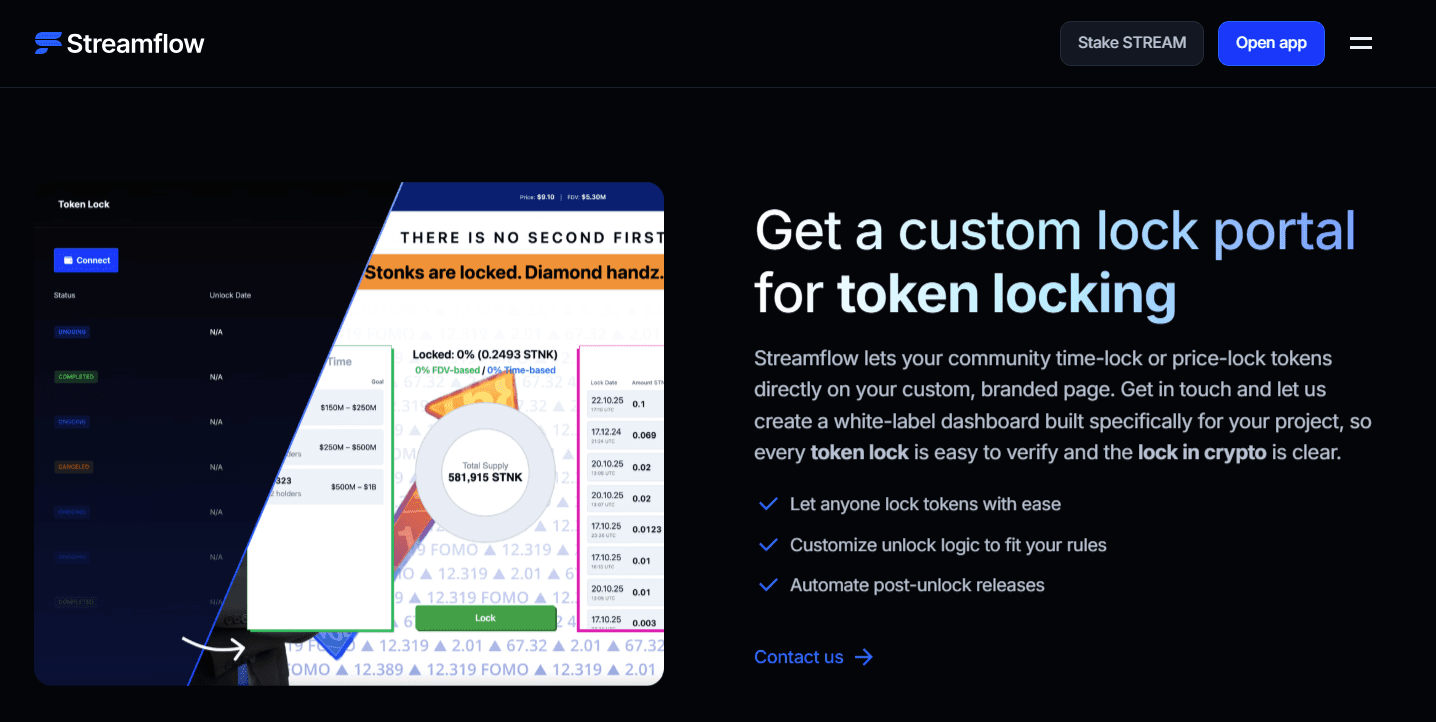
Locked tokens cannot be transferred, traded, or accessed before unlock. On Streamflow, that constraint is enforced by an audited smart contract that is immutable once deployed, with no admin override, so the promise does not depend on the team continuing to behave well.
Liquidity Locks: Protecting Against the Classic DEX Drain
A liquidity lock applies to LP tokens rather than project tokens. Because LP tokens represent a claim on the pooled assets, locking them removes the team's ability to withdraw the pool and strand every holder without an exit.
This is the mechanism the phrase "rug pull" was originally coined to describe. It is also the narrowest form of protection, because it guarantees only that liquidity exists, not that it is deep, not that it is permanent past the unlock date, and not that the team's own supply is restricted.
Streamflow supports both SPL tokens and LP tokens in its lock contracts, which means a team can lock its treasury allocation and its liquidity position through the same verifiable system rather than stitching together two unrelated tools.
What Neither Lock Type Covers
This is the part most trust discussions skip. Founders who name these gaps openly build more credibility than those who post a lock link and stay quiet.
Outside the scope of any lock:
Unlocked circulating float. If 60% of supply is liquid, locking the other 40% is a modest signal.
Mint and freeze authority. These are token-level permissions and must be revoked or documented separately.
The unlock cliff itself. A single large unlock date concentrates sell pressure into one moment.
Off-chain promises. Anything tracked in a spreadsheet rather than a contract is unverifiable by definition.
The fix for the third item is structural. Instead of one fixed-date unlock, teams can use price-based token locks that release on price thresholds, or move insider allocations to automated token vesting that drips supply over years rather than dropping it in one transaction.
How to Verify a Lock Like an Analyst
A lock is only a trust signal if a stranger can confirm it without asking the team. That means every lock should be independently checkable in under a minute.
The verification path:
Open the public proof link and confirm the contract address matches the token.
Check the locked amount against total supply, not against a marketing claim.
Confirm the unlock date and unlock condition on Solscan or Solana Explorer.
Cross-check the token on RugCheck for mint authority and holder concentration.
Compare the locked share against the schedule for every other allocation.
Streamflow locks are verifiable on Solscan, Solana Explorer, and RugCheck, and every contract generates a shareable proof link. Verification that takes one minute is the difference between a trust signal and a trust claim.
How Streamflow Fits Into This
Streamflow treats locking as the entry point to token operations rather than the destination. The platform enforces locks, vesting, distribution, staking, and payments through on-chain smart contracts audited by FYEO and OPCODES, so the commitment a team publishes is the commitment the chain enforces.
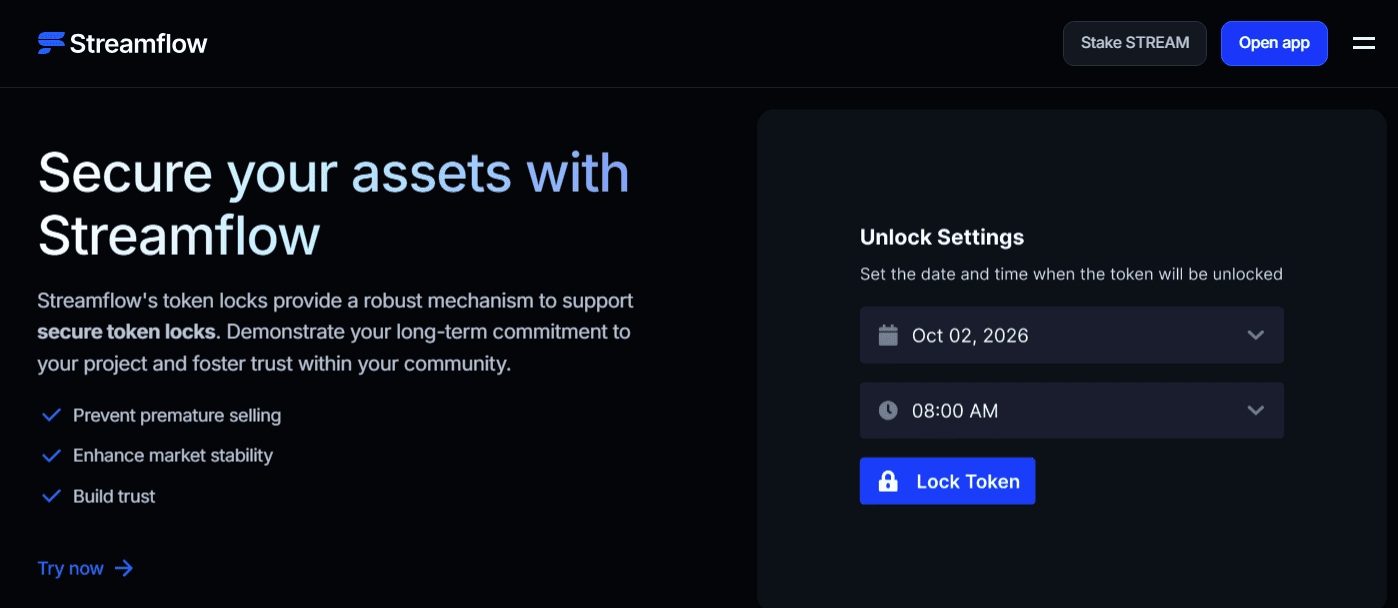
Practically, that means a founder can lock a treasury allocation in about 37 seconds through the no-code interface, then layer the rest of the supply picture on top: cliff and linear vesting for the core team, price-based unlocks for investor tranches, and a public tokenomics dashboard that shows every contract, unlock event, and release curve in one view.
Get started with Streamflow and the whole structure becomes public by default.
The dashboard is the piece most teams underuse. A single lock proves one commitment; a live view of every allocation proves the entire distribution, which is what serious investors are actually trying to price.
Case Study: How Bonk Used Vesting to Make a Meme Coin Credible
Bonk launched as a Solana meme coin with 55% of supply allocated to airdrops for early Solana users, a distribution profile that invites exactly the skepticism this article is about. The question from the community was straightforward: what stops the contributors from selling everything on day one?
The answer was structural rather than rhetorical. As documented in the Bonk vesting case study, 20% of total supply was allocated to 22 early contributors on a 3-year linear vesting schedule through Streamflow, enforced on-chain and verifiable by anyone. The outcome was trust and transparency at a moment when the category had very little of either.
Heavenland took the same approach further, putting 97% of $HTO supply on a 5-year linear vesting schedule with cliffs on all allocations, structured to allow initial liquidity without excessive inflation. In both cases, the credibility came from the schedule being public and enforced, not from the word "locked."
What This Means for Web3 Founders and Token Issuers
If the goal is to remove rug pull risk from an investor's mental model, one lock is not the deliverable. The deliverable is a complete, verifiable supply map that a skeptical stranger can audit.
The practical checklist:
Lock or vest every insider allocation, then publish the proof links together.
Revoke or document mint and freeze authority explicitly; do not let people guess.
Stagger unlocks with cliffs, linear schedules, or price conditions instead of one cliff date.
Put the whole picture on a public dashboard rather than in a pinned message.
Treat locks as a starting position, not the end of the trust conversation.
For teams building past the launch phase, the same infrastructure extends into treasury management, payouts, and cap tables through Streamflow Business, the financial OS for internet capital markets on Solana. The projects that keep community trust past year one are the ones that made the structure legible early.
Conclusion
Token locks do not prevent rug pulls; they eliminate one specific exit vector and make a specific commitment verifiable, which is valuable precisely because it is bounded.
The teams that get the most from locking pair it with vesting, revoked mint authority, staggered unlocks, and a public dashboard, so the entire supply picture is auditable rather than one contract.
Streamflow gives that full stack on Solana with audited, immutable contracts and explorer-verifiable proof across more than 40,000 projects.
Book a demo to see how Streamflow handles token locks, staggered unlocks, and public supply verification for a token launch.
Read Next:
How to Distribute SPL Tokens on Solana: Airdrops, Vesting, and Bulk Distribution Tools
How to Verify a Token Lock On-Chain: Step-by-Step Checklist for Solscan and Etherscan
Token Distribution Red Flags: 9 Warning Signs to Check Before Buying Any Crypto Token
FAQs:
1. Do token locks prevent rug pulls?
Token locks do not fully prevent rug pulls, but they remove one of the main exit vectors by making it impossible for insiders to move locked supply before the unlock conditions are met. They cover only the tokens inside the contract, so unlocked float, mint authority, and post-unlock selling remain separate risks. Streamflow enforces locks through audited, immutable smart contracts that are verifiable on Solscan and Solana Explorer.
2. What is the difference between a token lock and a liquidity lock?
The difference between a token lock and a liquidity lock is which asset is restricted. A token lock restricts native project tokens such as team, treasury, and investor allocations, while a liquidity lock restricts LP tokens to prevent the DEX liquidity pool from being drained. Streamflow supports both SPL tokens and LP tokens in the same lock system.
3. How can investors verify that a project's tokens are actually locked?
Investors can verify locked tokens by opening the project's public proof link and confirming the contract address, locked amount, and unlock condition directly on Solscan, Solana Explorer, or RugCheck. Streamflow generates a shareable proof link for every lock, so verification does not require trusting the team's word or a screenshot.
4. Is locking tokens enough to build investor trust?
Locking tokens is a strong starting signal but not enough on its own to build durable investor trust. The stronger approach pairs locks with on-chain vesting for insider allocations, staggered or price-based unlocks, and a public tokenomics dashboard showing every contract in one view. Bonk used this approach with 20% of supply vesting to 22 contributors over three years through Streamflow.
5. How long does it take to lock tokens on Streamflow?
Locking tokens on Streamflow takes about 37 seconds through the no-code interface, with no smart contract development required. Teams choose fixed-date or price-based unlock conditions, fund the contract, and receive a public proof link that anyone can verify on a block explorer.