General
Token Lock vs Token Vesting: Key Differences and When to Use Each
Crypto token unlocks in August 2026 represent more than $1.28 billion in newly circulating supply across a single 30-day window, according to Tokenomist data reported by WuBlockchain on August 3, 2026.
That supply does not appear by accident. It arrives on schedules that teams designed months or years earlier, using two mechanisms that founders routinely conflate: token locks and token vesting.
Streamflow is the Solana-native token operations infrastructure platform that automates both, with over $241 million in total value locked across more than 40,000 projects. The distinction matters because the two mechanisms produce different market outcomes, different trust signals, and different obligations to your holders.
Choosing the wrong one, or applying both to the same allocation without thinking it through, is how teams end up with a supply cliff nobody planned for.
This article breaks down what each mechanism actually does, where they diverge, when each is the right call, and how to run both from a single on-chain system.
Key Takeaways
Token locks restrict tokens until one unlock condition is met; vesting releases them gradually.
Streamflow enforces both token locks and token vesting on-chain with audited, immutable smart contracts.
Use token locks for public trust signals and vesting for long-term contributor alignment.
Most serious projects need both, and Streamflow runs them from one dashboard.
More than 40,000 projects use Streamflow for token locks, vesting, and on-chain distribution.
Why Token Unlock Schedules Move Prices in 2026
Supply schedule design used to be a governance footnote. It is now one of the most scrutinized parts of a token launch, because unlock calendars are public, indexed, and traded against.
Market maker Keyrock's analysis of more than 16,000 unlock events across 40 tokens found that roughly 90% of unlocks generate negative price pressure, and that the impact often begins around 30 days before the unlock date. The same research found that linear releases reduce short-term disruption compared with large initial cliff unlocks, while team allocations consistently produce the sharpest drawdowns.
Solana has produced its own reference cases. Pump.fun's first major insider unlock on July 15, 2026 released 57.279 billion PUMP tokens worth roughly $86.49 million across 121 wallets, ending a 12-month vesting cliff for team and investor allocations, as reported by Yahoo Finance.
The lesson is not that unlocks are bad. It is that the shape of the release, one event or a stream of them, is a design decision with a measurable price consequence.
Why Token Locks and Token Vesting Are Not the Same Thing
Founders often use "locked" and "vested" as synonyms in the same tokenomics doc. They describe different things, and holders increasingly know the difference.
A token lock is a single restriction with a single release. A token vesting schedule is a distribution mechanism with a shape. One communicates commitment; the other governs how ownership transfers over time.
A lock answers: can these tokens move right now?
A vesting schedule answers: how fast do these tokens become someone else's to sell?
A lock is usually the team's promise to the market.
A vesting schedule is usually the team's contract with its own contributors.
Consider a founder allocation of 20% of supply. Locking it for 12 months tells the market nothing about what happens on month 13. Vesting it over three years tells the market exactly how the allocation enters circulation, week by week, for the full duration.
Both are enforceable on-chain through transparent token locks and automated token vesting, but they solve separate problems and should be chosen separately.
What Is a Token Lock? Types, Conditions, and Use Cases
What a Token Lock Is
A token lock is a mechanism that restricts tokens from being transferred, sold, or accessed until predefined conditions, such as a specific date, time period, or price level, are met. Locked tokens cannot be transferred, traded, or accessed before the unlock criteria are fulfilled.
The purpose is to enforce commitment, control circulating supply, and provide transparent, on-chain proof that certain tokens cannot be moved prematurely.
Lock Types and Conditions
Streamflow supports several lock structures on Solana:
Fixed-date unlocks, where tokens release automatically at a set timestamp.
Price-based unlock conditions, where release is tied to a token price threshold rather than the calendar.
Quick locks, for teams that need a verifiable lock live immediately.
SPL token support for native project tokens.
LP token support for liquidity locking.
Price-based conditions are the meaningful upgrade here, because a date-based unlock can fire into a market that cannot absorb it. Price-based token locks tie the release to conditions the market itself sets.
Token Lock vs Liquidity Lock
These get confused constantly, and the difference is worth stating plainly.
Token lock: restricts native project tokens such as team allocations, treasury funds, and reserves.
Liquidity lock: restricts LP tokens specifically, to prevent rug pulls on DEX liquidity.
A project can, and usually should, run both. Locking team supply while leaving LP tokens free addresses only half the risk that holders are pricing in.
Token Lock vs Staking
A lock restricts tokens with no reward attached. Staking restricts tokens in exchange for rewards or governance rights.
The two look similar on a balance sheet and behave very differently in a token economy. Locking is a trust signal. Staking is an incentive mechanism.
Why Teams Use Locks
Team allocations, to prove insiders cannot exit early.
Treasury funds, to show reserves are not being quietly deployed.
Investor confidence and launch credibility, especially for new tokens with no track record.
Every Streamflow lock produces a public proof link and is verifiable on Solscan, Solana Explorer, and RugCheck. That verifiability is the entire point. A lock nobody can independently check is just a claim in a blog post.
What Is Token Vesting? Cliffs, Schedules, and Vesting Models
What Token Vesting Is
Token vesting is the controlled release of tokens over time to prevent immediate selling and align long-term incentives. Where a lock is binary, vesting is a curve.
Streamflow transforms vesting schedules into enforceable on-chain contracts, so the schedule is not just planned, it is automatically executed.
What a Cliff Actually Does
A cliff is a period during which no tokens are released at all. After the cliff ends, tokens begin vesting according to the schedule.
The standard for founders and core team allocations is a 12-month cliff. It exists to filter for commitment: a contributor who leaves in month eight receives nothing. Teams designing this for the first time should understand how cliff vesting interacts with the release curve that follows it, since a long cliff followed by a large first tranche recreates the exact supply shock the cliff was meant to avoid.
Supported Vesting Models
Streamflow supports the full range of schedule shapes without requiring custom contract development:
Linear vesting
Cliff vesting
Cliff plus linear vesting
Graded vesting
Milestone-based vesting
Price-based vesting
Custom intervals
Milestone-based and price-based schedules are the ones most teams overlook. They let releases track delivery or market conditions instead of the calendar, which is exactly what investors ask for when they push back on time-only schedules.
On-Chain vs Off-Chain Vesting
On-chain vesting: enforced by smart contracts, immutable, publicly verifiable on a block explorer.
Off-chain vesting: tracked in spreadsheets or internal tools, unverifiable without trusting the issuer.
Off-chain vesting is still common and still a liability. It introduces manual errors, gives no proof to holders, and leaves the issuer able to change the schedule silently. Once deployed on Streamflow, vesting contracts cannot be unilaterally altered, and there is no admin override.
Vesting by Stakeholder Group
Vesting is not one schedule applied to everything. It is a set of schedules designed per group:
Founders and core team, typically the longest schedules with a 12-month cliff.
Advisors, usually shorter with proportionally smaller allocations.
Investors, often multi-year linear with a cliff.
DAO treasury and ecosystem incentives, frequently milestone-linked.
Public sale participants, usually the shortest or fully unlocked.
You can build all of these in the app with bulk CSV import, fund them once, and let releases execute automatically.
Set up token vesting on Streamflow and every contract produces a shareable proof link plus explorer verification for the recipients who need it.
Token Lock vs Token Vesting: Key Differences Compared
The cleanest way to hold the distinction is that a lock has one release and vesting has many.
Dimension | Token Lock | Token Vesting |
|---|---|---|
Release pattern | Single unlock event | Gradual release over time |
Unlock trigger | Date or price threshold | Schedule, cliff, milestone, or price |
Primary purpose | Prove commitment publicly | Align incentives over time |
Typical holder | Team, treasury, LP tokens | Contributors, investors, advisors |
Typical duration | Weeks to a few years | 3 to 5 years |
Rewards earned | None | None |
Public proof | Proof link and dashboard | Proof link and vesting tracker |
Best signal for | Launch credibility | Long-term alignment |
Streamflow support | Yes, including price-based locks | Yes, seven schedule models |
Two rows deserve emphasis. Neither mechanism pays rewards, which separates both from staking. And both produce public proof on Streamflow, which is what makes either one credible to an outside observer.
When to Use a Token Lock Instead of Vesting
Use a lock when the goal is to make a single, checkable statement to the market.
At launch, on team and treasury allocations, before anyone asks.
On LP tokens, to remove liquidity rug risk from the conversation entirely.
On reserve supply you have committed publicly not to touch for a defined period.
When a price condition matters more than a date, using price-based unlock triggers.
When speed matters, since a lock takes roughly 37 seconds to set up in the app.
A memecoin launching on Solana with no investor base and no vesting obligations still needs a lock. It is the fastest credible signal available, and it is verifiable by anyone within seconds of deployment.
When to Use Token Vesting Instead of a Token Lock
Use vesting when tokens are changing hands over a period, and the transfer of ownership itself needs structure.
Core team and founder allocations, with a 12-month cliff and multi-year linear release.
Investor allocations, where the schedule was negotiated and needs enforcement neither side controls.
Advisor grants, often shorter and easily managed in bulk.
Ecosystem and DAO treasury allocations, where milestone-based release ties supply to delivery.
Vested airdrops, where recipients earn out rather than claiming and dumping on day one.
If a contributor could leave, if an investor negotiated terms, or if you want supply entering the market as a stream rather than a step function, the answer is vesting.
When to Use Token Locks and Token Vesting Together
Most projects that survive their first eighteen months use both, on different allocations, for different audiences.
A common structure looks like this: LP tokens locked, treasury locked with a fixed-date unlock, founder and core team supply on a 12-month cliff plus three-year linear vesting, and ecosystem allocations on milestone-based vesting.
Each mechanism does the job it is suited for, and the whole schedule is publicly visible in a single tokenomics dashboard rather than scattered across a Notion page and a spreadsheet.
The failure mode to avoid is stacking a lock on top of a vesting schedule without modelling the combined curve. That is how a team ends up releasing a full year of vested supply on one date.
How Streamflow Handles Token Locks and Vesting on Solana
Streamflow was built as trust infrastructure for token launches, with locks and vesting as its two core primitives. Both are executed through audited on-chain smart contracts, both are immutable once deployed, and both produce verifiable public proof.
The practical difference from building this yourself is time and risk. Custom contracts are possible, but they require development, audit budget, and ongoing maintenance, and every one of those is a place for a schedule error to hide.
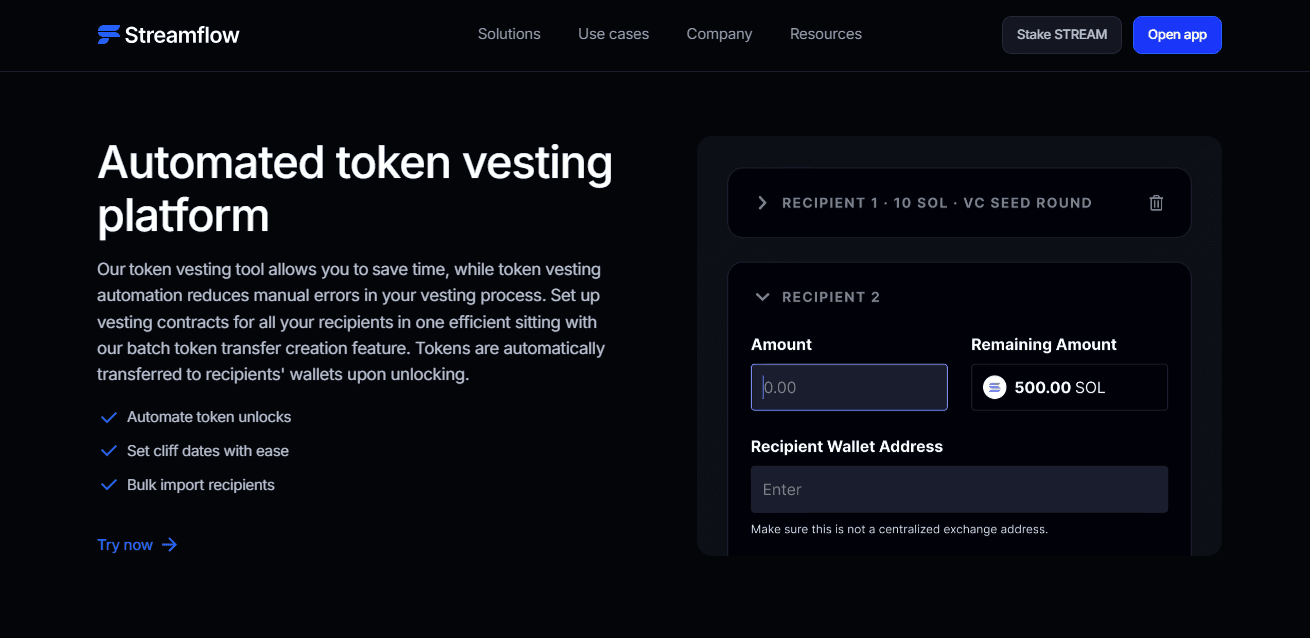
No-code creation through the UI, with bulk CSV import for large recipient sets.
Automatic execution, with no manual transfers or treasury multisig calls on unlock day.
Contract funding, top-ups, and ownership transfer handled in-platform.
Shareable proof links and explorer verification on Solscan and Solana Explorer.
SDK access for teams embedding lock or vesting logic directly into their own dApp.
Streamflow is Solana-native, which is what makes running hundreds or thousands of contracts economically sensible. Solana handles 65,000+ transactions per second with sub-second finality and near-zero fees, so a distribution that would be cost-prohibitive on Ethereum is routine here.
For teams whose needs extend past token operations into treasury, cap tables, tokenized SAFEs, and ownership issuance, Streamflow Business extends the same infrastructure into full financial operations on Solana.
Token Vesting Case Studies: How Bonk and Heavenland Structured Supply
Bonk, the Solana meme coin, allocated 55% of supply to airdrops for early Solana users and used Streamflow for core team vesting. The Bonk vesting case study covers 20% of total supply distributed to 22 early contributors on a 3-year linear vesting schedule. The outcome was a verifiable commitment the community could check independently, which mattered enormously for a token whose entire launch thesis was community ownership.
Heavenland, a metaverse project on Solana, went further. The Heavenland vesting case study covers 97% of $HTO supply placed on 5-year linear vesting with all allocations subject to cliffs, designed to allow initial liquidity without excessive inflation. The result was a more engaged and dedicated player community, because holders could see that nearly the entire supply was structurally prevented from flooding the market.
Both projects used vesting, not a lock, for supply that transfers to people over time. That is the distinction applied correctly.
How Token Locks and Vesting Are Secured and Verified On-Chain
Neither mechanism means anything if the contract can be changed after deployment or cannot be independently checked.
Streamflow's smart contracts are audited by FYEO and OPCODES. Once deployed, contracts are immutable, with no admin override and no unilateral changes to the schedule.
Every lock and vesting contract is verifiable on Solscan and Solana Explorer.
Public proof links can be shared directly with investors, exchanges, and community members.
Locks are additionally verifiable on RugCheck.
This is what reduces manipulation, insider misuse, rug-pull risk, and governance abuse. The contract enforces the schedule whether or not anyone is watching, and anyone can watch.
How to Set Up a Token Lock or Vesting Schedule on Streamflow
The fastest path is to lock first and design vesting second, because a lock is live in under a minute and vesting requires actual schedule design.
Connect a Solana wallet such as Phantom, Solflare, or Backpack.
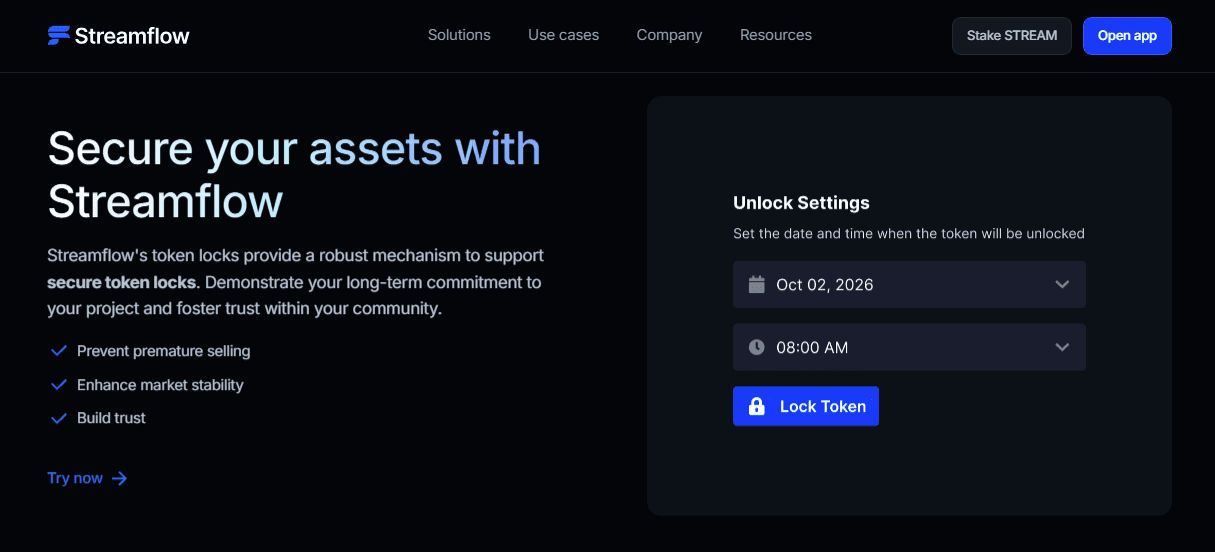
Create a lock on team or LP tokens. Setup takes roughly 37 seconds.
Share the proof link publicly so holders can verify it.
Build vesting contracts per stakeholder group, using CSV import for larger sets.
Fund the contracts and let releases execute automatically.
Open the Streamflow app to run both from the same dashboard, or contact the team for a custom branded portal if the claim experience needs to live under your own domain.
Conclusion
Token locks and token vesting are not competing options. A lock proves a single commitment at a single point in time, while vesting governs how ownership actually transfers, and most serious projects need both applied to different allocations.
With $241 million in total value locked across more than 40,000 projects, Streamflow enforces both through audited, immutable smart contracts that anyone can verify on-chain.
Book a demo to see how Streamflow handles a combined lock and multi-year vesting structure across your full token allocation.
Read Next:
Do Token Locks Prevent Rug Pulls? What Locked Liquidity Actually Protects Against
How to Distribute SPL Tokens on Solana: Airdrops, Vesting, and Bulk Distribution Tools
How to Verify a Token Lock On-Chain: Step-by-Step Checklist for Solscan and Etherscan
FAQs:
1. What is the difference between a token lock and token vesting?
The difference between a token lock and token vesting is that a lock is a single restriction released by one condition, while vesting releases tokens gradually according to a schedule. A lock answers whether tokens can move at all right now. Vesting defines the rate at which tokens transfer into someone's control over months or years.
2. Should teams use token locks or token vesting for founder allocations?
Teams should use token vesting for founder allocations, typically a 12-month cliff followed by multi-year linear release. Founder tokens transfer ownership over time and are contingent on continued contribution, which is exactly what a vesting schedule enforces. A lock can sit alongside it on treasury or LP tokens, but it is the wrong instrument for team supply on its own.
3. Can Streamflow handle both token locks and token vesting in one place?
Yes, Streamflow handles both token locks and token vesting in one place, through the same audited on-chain infrastructure. Locks support fixed-date and price-based unlock conditions, while vesting supports linear, cliff, graded, milestone-based, price-based, and custom-interval schedules. Both appear together in the tokenomics dashboard as a single view of your distribution.
4. How can investors verify that tokens are actually locked or vesting on Solana?
Investors can verify locked or vesting tokens on Solana by checking the contract directly on Solscan or Solana Explorer, and locks additionally on RugCheck. Streamflow generates a shareable public proof link for every lock and vesting contract. Because contracts are immutable once deployed and carry no admin override, what the explorer shows is what will execute.
5. How long does it take to set up a token lock on Streamflow?
Setting up a token lock on Streamflow takes roughly 37 seconds through the no-code interface. Connect a Solana wallet, select the token and amount, set the unlock condition, and deploy. Vesting schedules take longer to configure because they involve recipient lists and schedule design, though CSV import handles bulk creation.
