General
How to Set Up Staking for Your Token: A Step-by-Step Guide for Crypto Projects (2026)
Solana now runs a 68% staking ratio, the highest of any major network tracked in the Bitwise Staking Report Q3 2026, published July 23, 2026.
That number tells you something important about the audience your token is launching into: Solana holders already understand staking, already expect it, and already have a benchmark for what a credible program looks like.
Streamflow, which manages over $243 million in total value locked across 40,000+ projects, sits at the center of that expectation as the token operations infrastructure teams use to deploy staking without writing smart contracts.
The problem is that most project-level staking programs are designed backwards. Teams pick an APY first, fund it with emissions, watch TVL spike, then watch it evaporate the moment rewards thin out. The mechanics were fine. The economics were never real.
This guide covers how to set up staking for your token the right way in 2026: what staking actually buys you, how to choose a reward source that survives a bear market, and the exact steps to configure, fund, and launch a pool on Solana.
Key Takeaways
Staking reduces circulating supply only when rewards come from real, sustainable sources.
Streamflow enables no-code staking pool creation for any SPL token on Solana.
Set up token staking with configurable APY, lock periods, and custom reward logic.
Reward depletion, not smart contract risk, is the most common staking program failure.
Heavenland placed 97% of supply on Streamflow with five-year vesting and cliffs.
Why Most Token Staking Programs Quietly Fail
The standard launch pattern looks like this. A team announces a staking pool with a headline APY, funds it with tokens from the ecosystem allocation, and reports a large TVL number in the first month.
Six months later the pool is a liability. The rewards were newly minted supply, so every reward payment diluted existing holders while creating fresh sell pressure from stakers who unstake and exit.
The program did not reduce sell pressure. It scheduled it.
The second failure mode is quieter and more common: reward depletion. Pools stop distributing when the reward budget runs dry, and a pool that silently stops paying does more damage to community trust than never launching one. This is a real caveat of any staking system, and it is why easy reward top-ups matter more than a launch-day APY number.
Inflationary rewards dilute holders while creating exit liquidity for stakers.
Headline APYs attract mercenary capital that leaves when emissions slow.
Depleted pools stop distributing and erode trust faster than no program at all.
No lock structure means staked supply can unwind in a single block.
A token staking program is a long-running financial obligation, not a marketing campaign. Treat the setup accordingly.
What Staking Actually Buys You (And What It Doesn't)
Staking is the process of locking tokens to earn rewards and participate in network or protocol incentives. It is voluntary, which makes it fundamentally different from the mechanisms teams often confuse it with.
Token vesting is a scheduled release of pre-allocated tokens with no rewards attached. Token locks restrict tokens entirely until a date or price condition is met, again with no rewards. Staking is the only one of the three where holders choose to lock up, which means the design has to be good enough that they say yes.
What a well-built staking program genuinely delivers:
Reduced circulating supply and lower short-term sell pressure.
Real token utility beyond speculation.
A governance base of holders with skin in the game.
Measurable community engagement you can track on-chain.
What it does not deliver is a price floor. Staking changes the timing and distribution of supply, not the underlying demand for the token. Teams that internalize this build better programs.
How to Set Up Staking for Your Token: The Step-by-Step Framework
The order of these steps matters. Most teams start at step four, which is exactly why their programs underperform.
Step 1: Decide what the program is actually for
Write down the single primary objective before touching any configuration. Supply reduction, governance participation, and community engagement lead to meaningfully different pool designs, and a pool that tries to do all three usually does none of them well.
Supply-focused programs need longer lock periods and higher rewards for duration. Governance-focused programs need stake receipts that map cleanly to voting weight. Engagement-focused programs need shorter, more flexible lockups so participation stays low friction.
Supply reduction: long lock periods, duration-weighted rewards.
Governance: stake receipts, voting integration, moderate lockups.
Engagement: short or flexible lockups, frequent reward distribution.
Pick one primary objective, then let the other two follow from it.
Step 2: Pick the reward source before you pick the APY
This is the step that determines whether the program survives. There are three viable sources: a fixed treasury allocation, ongoing protocol revenue, or a hybrid that starts with treasury funding and transitions to revenue as the protocol matures.
Revenue-backed staking distributes a share of real economic activity instead of newly minted tokens, which removes dilution from the equation entirely.
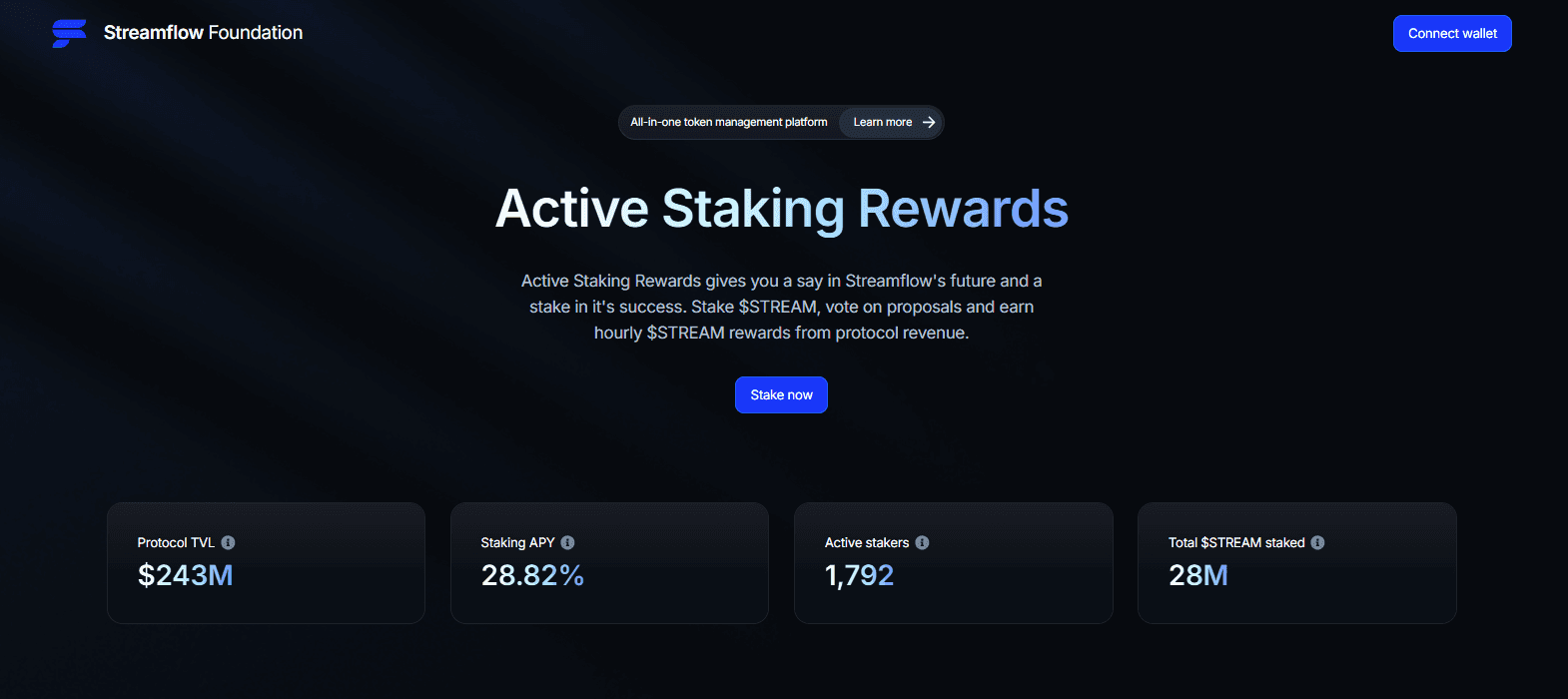
Streamflow runs this model on its own token: STREAM staking pays hourly rewards funded by protocol revenue and buybacks rather than emissions, currently at roughly 74.57% APY with $662M in protocol TVL and 1,786 active stakers.
Teams can stake STREAM for protocol rewards and see the revenue-to-rewards curve published openly on the transparency dashboard.
If your protocol does not generate revenue yet, be honest about it. A treasury-funded pool with a modest, sustainable APY and a clear runway disclosure outperforms an inflationary pool with a headline number every time.
Step 3: Choose the pool type and lock structure
Streamflow supports four pool types, and each maps to a different funding reality.
Fund Once: a fixed reward budget with a defined end date.
Continuous Funding: ongoing top-ups as revenue or treasury allows.
Governance Staking: stake weight tied to voting rights.
Custom: bespoke reward logic built to your specification.
Lock periods should be tiered rather than uniform. A single 30-day lock treats a long-term holder and a farm-and-dump wallet identically, which is a design choice you will regret. Configurable lock periods let you reward duration explicitly.
Step 4: Configure and fund the pool
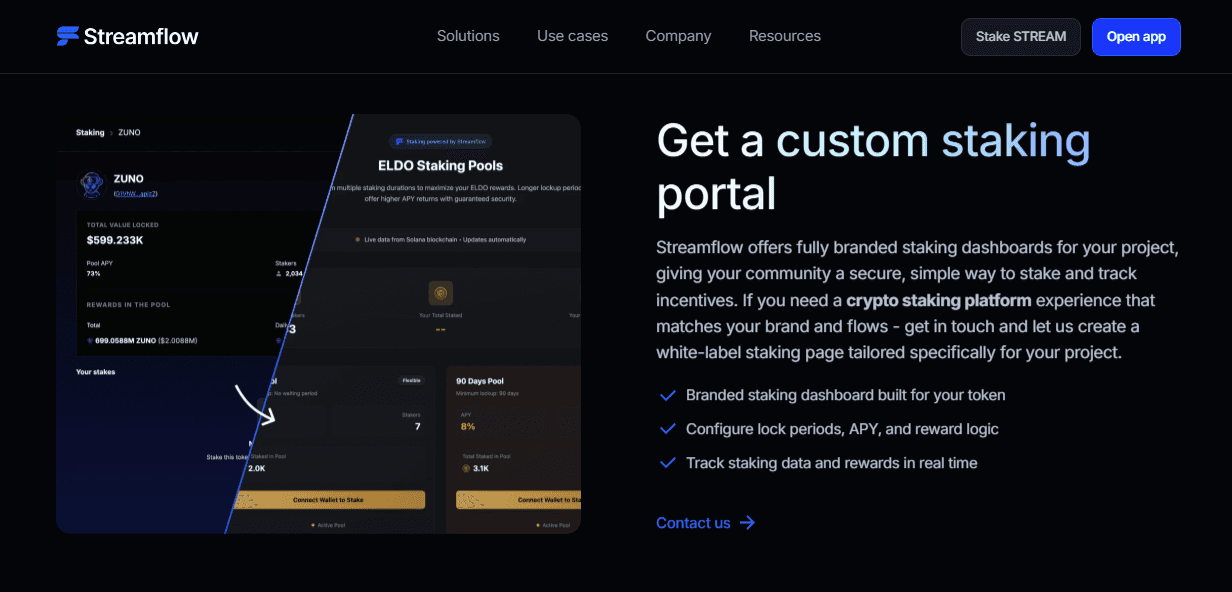
This is where no-code infrastructure replaces a smart contract build. On Streamflow, any SPL token can be staked through permissionless pool creation, with configurable APY, custom reward structures, and reward logic set through the UI rather than through Rust.
The configuration inputs are straightforward: the staking token, the reward token, the reward rate, the lock period options, and the funding amount.
Pools are fully non-custodial, so staked tokens remain under holder control and never sit on a platform balance sheet. Teams that need deeper integration can build on the public SDK instead.
You can launch a staking pool on Streamflow directly, or review the full walkthrough in the guide on how to create and manage token staking on Solana.
Step 5: Launch, monitor, and top up
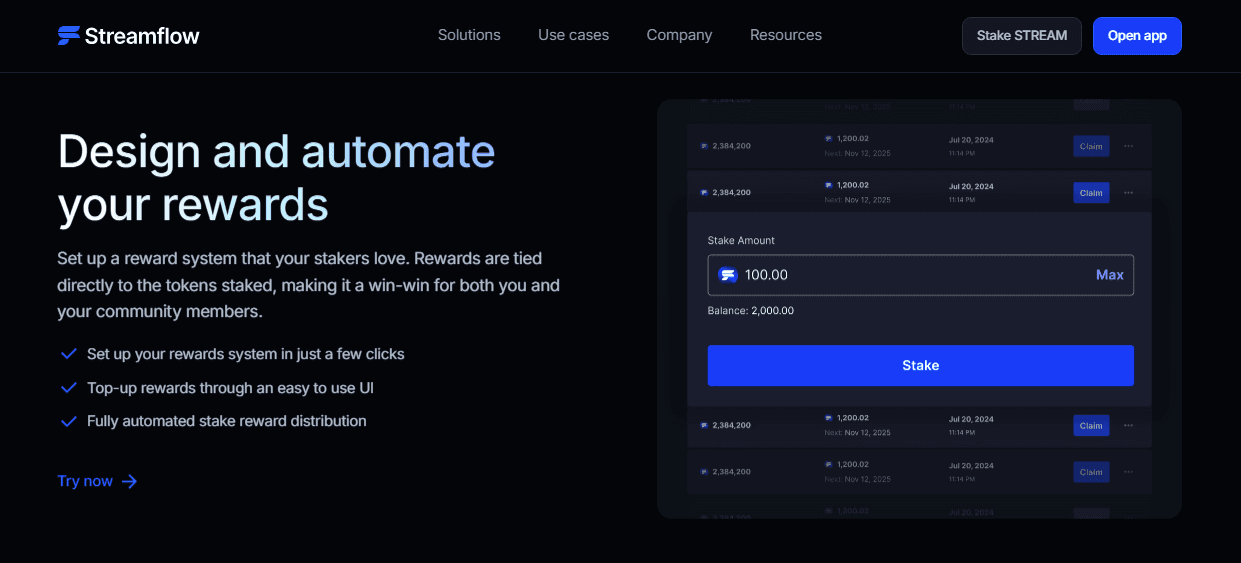
Reward distribution runs automatically once the pool is live, and real-time staking data shows participation, TVL, and remaining reward runway. Monitoring the runway is the operational discipline most teams skip.
Set a threshold, for example 60 days of remaining rewards, and top up before you cross it. Streamflow supports easy reward top-ups specifically so that continuous programs never hit a silent stop. Stake receipts and stake tokens give participants a verifiable claim on their position throughout.
How Streamflow Fits Into the Setup
Streamflow enables teams to deploy staking systems without engineering overhead, which changes the cost structure of launching a program. A custom staking contract means Rust development, an audit cycle, and ongoing maintenance, typically measured in months and six figures.
The platform's no-code staking pools collapse that into a configuration task, with audited smart contracts (audited by FYEO and OPCODES), automated reward distribution, and support for Phantom, Backpack, Solflare, and all Solana wallets. Because everything runs on Solana, with 65,000+ TPS, sub-second finality, and near-zero fees, per-transaction reward distribution stays economically viable at a scale that would be prohibitive elsewhere.
For teams that need a bespoke program, Streamflow offers custom-built staking with white-glove onboarding, plus branded portals so the staking experience lives under your own domain and design.
Founders thinking beyond token mechanics into treasury and cap table operations should also look at Streamflow Business for financial operations.
Case Study: Heavenland and Supply Discipline at Launch
Heavenland, a metaverse project on Solana, faced the problem every token program faces at scale: how to distribute $HTO across team, incentives, and treasury without flooding the market. The team placed 97% of total token supply on Streamflow, using five-year linear vesting with cliffs applied to every allocation.
The structure was designed to allow initial liquidity without excessive inflation, which is precisely the constraint any staking program operates under. The outcome was a more engaged and dedicated player community, because supply discipline was verifiable on-chain rather than promised in a blog post.
The lesson transfers directly: staking works best when it sits on top of a supply schedule that is already credible, not as a patch for one that isn't.
What This Means for Web3 Founders and Protocol Teams
Your staking program will be evaluated by sophisticated holders in a market where 68% of Solana's supply is already staked somewhere. Vague APY promises do not clear that bar.
Three practical commitments to make before launch:
Publish the reward source and the funding runway, not just the APY.
Tier your lock periods so duration is actually rewarded.
Commit to a top-up cadence and monitor the pool against it.
DeFi teams building automated reward flows can go further with automated DeFi rewards that deposit directly into wallets and remove claim friction entirely. The programs that compound trust are the ones where every mechanic is verifiable on Solscan or Solana Explorer.
Conclusion
Setting up staking for your token in 2026 is less about the launch configuration and more about the economics behind the rewards, which is why the reward source belongs at step two and the APY belongs at step four.
Streamflow gives teams no-code, non-custodial staking pools for any SPL token, with audited contracts, configurable lock periods, and automated distribution across a platform trusted by more than 40,000 projects.
Book a demo to see how Streamflow handles staking pool setup, reward funding, and top-ups for a token launch.
Read Next:
Do Token Locks Prevent Rug Pulls? What Locked Liquidity Actually Protects Against
How to Distribute SPL Tokens on Solana: Airdrops, Vesting, and Bulk Distribution Tools
How to Verify a Token Lock On-Chain: Step-by-Step Checklist for Solscan and Etherscan
FAQs:
1. How do I set up staking for my token on Solana?
You set up staking for your token on Solana by defining the program's objective, choosing a sustainable reward source, selecting a pool type and lock structure, then configuring and funding the pool. On Streamflow, this runs through a no-code interface with permissionless pool creation for any SPL token, so no smart contract development is required. Rewards are then distributed automatically to stakers.
2. What does it cost to launch a staking pool for a crypto project?
The cost to launch a staking pool on Streamflow consists of smart contract creation fees and Solana transaction fees, both of which are low because Solana operates with near-zero fees and sub-second finality. The larger cost is the reward budget itself, which you fund and top up over time. This is dramatically cheaper than commissioning and auditing a custom staking contract.
3. Is Streamflow's staking infrastructure audited and non-custodial?
Yes, Streamflow's staking infrastructure is audited and non-custodial. The smart contracts have been audited by FYEO and OPCODES, are immutable once deployed, and carry no admin override. Staking pools are fully non-custodial, meaning staked tokens remain under holder control and every position is verifiable on Solscan or Solana Explorer.
4. What happens if my staking pool runs out of rewards?
If your staking pool runs out of rewards, the pool stops distributing until it is refunded. Streamflow supports easy reward top-ups and continuous funding pools specifically to prevent this, and real-time staking data lets you monitor remaining runway before it becomes a problem. Set an internal threshold and top up ahead of it.
5. Should I use inflationary rewards or revenue-backed staking for my token?
You should use revenue-backed staking when your protocol generates real revenue, because it pays holders from actual economic activity instead of diluting them with newly minted supply. Streamflow's own STREAM staking uses this model, distributing hourly rewards funded by protocol revenue and buybacks with zero dilution. If you have no revenue yet, a transparently funded treasury pool with a sustainable APY is the honest interim choice.