General
Top 30 Reasons to Start Using Streamflow Business for Your Token Operations in 2026
Crypto markets processed roughly $97 billion in token unlocks during 2025, and March 2026 alone accounted for more than $6 billion across 144 projects, according to data compiled from Tokenomist and CryptoRank.
Every one of those unlocks was either enforced by code or trusted on a promise.
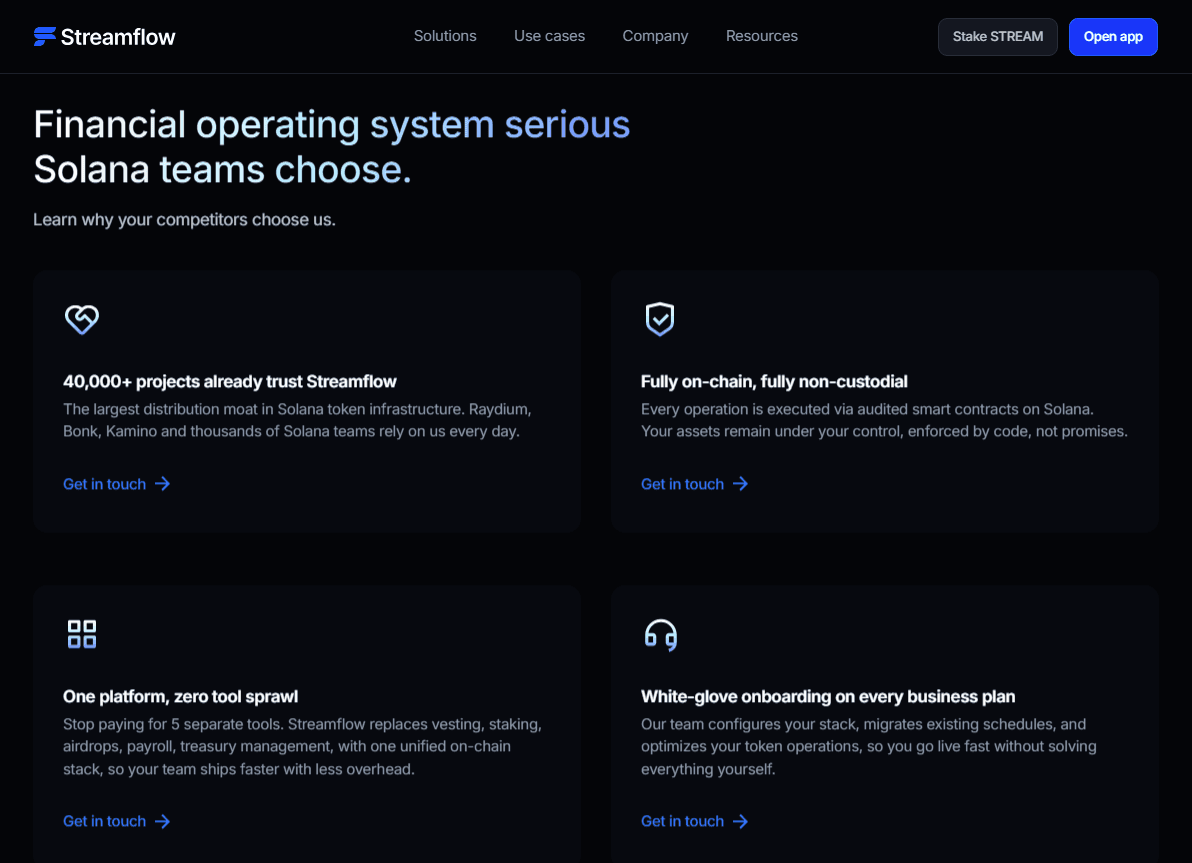
Streamflow is the Solana-native token operations infrastructure platform behind more than 40,000 projects and over $240 million in total value locked, and Streamflow Business extends that same infrastructure into full financial operations.
Most teams still run token operations across three or four disconnected systems. A spreadsheet for the cap table, a manual multisig for payouts, a one-off contract for vesting, and a claim tool bolted on for the airdrop. That fragmentation is where errors, disputes, and trust failures originate.
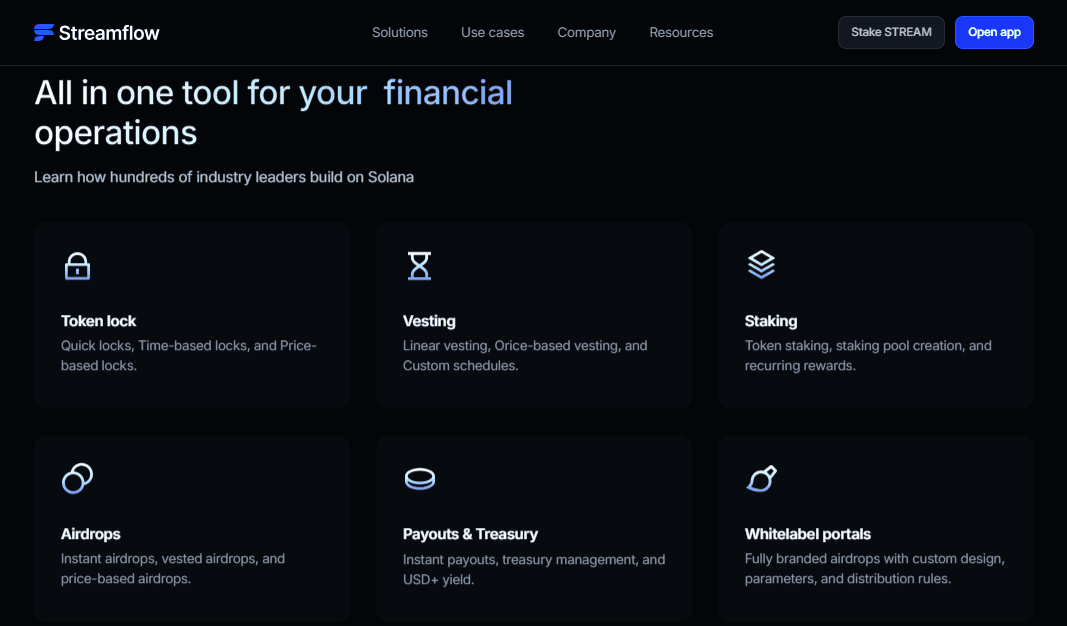
The 30 reasons below cover what changes when locks, vesting, distribution, treasury, payouts, and ownership run on one stack.
Key Takeaways
Streamflow Business consolidates locks, vesting, airdrops, payouts, treasury, and ownership into one system.
Token operations on Streamflow are enforced by audited smart contracts, not manual transfers or spreadsheets.
Streamflow supports airdrops to one million recipients and over 40,000 projects.
Streamflow Business adds cap tables, tokenized SAFEs, and ownership issuance for long-term company building.
Solana's near-zero fees make large-scale token operations on Streamflow economically viable.
The Criteria for Evaluating Token Operations Infrastructure in 2026
Before the list, it helps to know what actually separates infrastructure from tooling. Most platforms solve one problem well and leave the rest to your engineering team. These four criteria filter the difference.
Enforceability: Can the schedule be changed after deployment, or is it immutable and audited?
Scale ceiling: Does the system break at 30,000 recipients, or does it handle a million?
Coverage: Does it stop at vesting, or does it extend into payouts, treasury, and ownership?
Verifiability: Can any holder confirm your claims on Solscan without asking your team?
A tool that fails any of these becomes a liability the moment your token gains real market attention. The 30 reasons below map back to these four tests.
Trust and Token Launch Foundations
1. Token locks that function as public proof, not press releases
Token locks on Streamflow restrict tokens from being transferred, sold, or accessed until a defined date, time period, or price level is reached. The lock is enforced by contract, so there is nothing to take on faith. Any holder can verify the position on Solscan, Solana Explorer, or RugCheck without contacting your team.
2. A 37-second setup that removes the excuse to delay
Locking tokens through the no-code interface takes 37 seconds. There is no contract to write, no audit to commission, and no engineering sprint to schedule. For a founding team under pressure to demonstrate commitment in the first week after launch, speed is the difference between a trust signal and a missed window.
3. Vesting that becomes an enforceable contract instead of a promise
Token vesting on Streamflow converts a schedule into an immutable on-chain contract. Once deployed, allocations release exactly as designed with no admin override and no unilateral changes. That removes the single largest category of insider risk in early-stage token projects.
4. Cliff enforcement that survives internal pressure
A cliff is a period during which no tokens release at all, and 12 months is standard for founders and core team allocations. Enforced in code, a cliff cannot be quietly shortened when a contributor leaves or a market rally tempts an early exit. The schedule holds regardless of who asks.
5. Price-based vesting and locks that tie supply to performance
Streamflow supports unlock conditions keyed to token price thresholds rather than time alone. Supply expands when the market can absorb it, not on an arbitrary calendar date set 18 months earlier. This directly addresses the cliff-unlock volatility problem that dominated 2026 unlock coverage.
6. Milestone-based vesting for delivery-linked allocations
Milestone vesting releases tokens when project milestones are met, such as product launches or KPI thresholds. It fits advisor allocations, grant programs, and fundraising with milestone unlocks. Contributors get paid for shipping, not for waiting.
7. Full lifecycle coverage from token creation onward
Streamflow includes a token minter with metadata configuration, supply definition, and permission settings. The same platform that creates the token also locks it, vests it, and distributes it. No handoff between systems means no reconciliation gap.
Distribution at Scale
8. Airdrop capacity up to one million recipients
Streamflow supports token distribution to up to one million recipients in a single campaign. Standard plans cover roughly 30,000 recipients, with an enterprise tier for larger launches. Manual distribution stops being viable somewhere in the low thousands, which is well below where most successful launches land.
9. CSV imports of 100,000 recipients per file
Large Solana airdrop campaigns start with a recipient list, and the list is usually the bottleneck. Streamflow accepts 100,000 recipients per CSV file. Bulk import applies to vesting contracts as well, so onboarding hundreds of contributors is a single upload rather than hundreds of transactions.
10. Vested airdrops that prevent immediate sell pressure
Airdrops can be instant, vested, or price-conditional. A vested airdrop distributes the allocation over a schedule instead of dropping the full amount into circulation on day one. This is the single most effective structural defense against the dump-on-claim pattern.
11. Claim portals with real-time delivery status
Recipients claim through a hosted portal while the team watches claim status in real time. Delivery tracking, claim windows, and post-claim activation are handled by the platform. There is no spreadsheet tracking who received what.
12. Unclaimed token recovery
Every airdrop leaves tokens unclaimed. Streamflow supports returning unclaimed tokens to the treasury after the claim window closes, which means the allocation is not written off. Over a multi-round distribution strategy, that recovered supply is meaningful.
13. Sybil filtering and eligibility segmentation
The platform includes a sybil checker and a multi-wallet airdrop checker alongside eligibility filtering and audience segmentation. Rewarding real participants instead of farm wallets is what separates a growth campaign from a subsidy. Snapshot, eligibility, claim window, and post-claim activation run as one sequence.
14. A tokenomics dashboard that acts as a single source of truth
The tokenomics dashboard gives a real-time visual view of allocations, vesting contracts, token locks, staking pools, cliff dates, and unlock events. Investors and community members read the same data the team reads. Transparency stops being a quarterly update and becomes a live page.
Treasury and Financial Operations
15. Treasury management through USD+
Streamflow Business includes treasury management via USD+, which lets teams hold and manage stable treasury value on-chain. Runway held in a volatile native token is not runway. Reviewing everything you need to know about USD+ is a reasonable starting point for finance leads.
16. On-chain payroll in tokens
Payroll automation and on-chain token payroll are core Streamflow capabilities. Contributors across multiple jurisdictions get paid on the same schedule from the same contract. For a Web3 CFO, this collapses a recurring multi-hour operational task into a funded contract.
17. Recurring payout contracts that do not need redeployment
Streamflow supports recurring payout contracts for employees, contractors, and contributors. Teams top up the same contract over time rather than deploying a new one every cycle. That is the difference between a payments system and a series of one-off transfers.
18. Real-time streaming payments
The streaming primitive transfers tokens continuously over time rather than in discrete intervals. Salaries can be paid every second, and subscriptions can be paid only for the time actually used. It supports employee trial periods, consulting engagements, and pay-per-service arrangements without renegotiating terms.
19. Escrow held by contract
Escrow on Streamflow holds funds in a smart contract until release conditions are met. Neither counterparty holds the funds during the agreement period. For grant programs, service agreements, and milestone-based donations, this removes the need for a trusted intermediary.
20. Contributor payouts at DAO scale
DAOs use Streamflow for governance token distribution, contributor payments, and treasury allocation. Every payment is verifiable by the same community that voted to approve it. Governance and execution stop living in separate systems.
Ownership and Capital Formation
21. On-chain cap tables
Streamflow Business includes on-chain cap tables, which puts equity-style ownership records in the same system as token allocations. A founder can see token supply and ownership structure without reconciling a legal document against a wallet. This is the operational core of building a company rather than only a token.
22. Tokenized SAFE agreements
Tokenized SAFEs bring early-stage fundraising instruments on-chain. Conversion terms and holder records become programmable rather than paper artifacts sitting in a shared drive. For teams raising across multiple rounds, that reduces administrative drag substantially.
23. Ownership issuance
Ownership issuance lets companies issue ownership positions on Solana directly. It extends the same enforceable, verifiable logic used for vesting into the capital structure itself. The result is a capital stack that is auditable in the same place as the token stack.
24. Future lending against ownership tokens
Streamflow Business roadmap capabilities include lending against ownership tokens. Ownership positions that are represented on-chain can eventually serve as collateral. That turns an illiquid balance-sheet item into a financing option.
25. A marketplace layer
The marketplace is part of the Streamflow Business product line, extending the platform beyond issuance into secondary activity. It completes the arc from first token lock to full financial operations. For founders thinking in five-year horizons, that continuity matters more than any single feature.
Incentives, Infrastructure, and Scale
26. No-code staking pools for any SPL token
No-code staking pools can be created permissionlessly for any SPL token, with configurable APY, lock periods, and reward logic. Pools are fully non-custodial and support Fund Once, Continuous Funding, Governance Staking, and Custom types. Rewards distribute automatically, with easy top-ups when a pool runs low.
27. A proven revenue-backed staking model to learn from
STREAM staking distributes a share of real protocol revenue instead of newly minted tokens, currently showing roughly 74.57% APY across $662 million in protocol TVL. Rewards come from hourly buybacks, which means zero dilution for holders. Teams designing 2026 incentive programs have a live example of revenue-backed staking rather than a whitepaper theory.
28. White-label branded portals
Streamflow builds custom branded token distribution portals, staking pages, claim portals, and lock dashboards, with bespoke onboarding by the Streamflow team. Your community claims tokens on your domain, in your brand, on infrastructure that has already processed $240 million in value. Ownership of the user experience does not require ownership of the contract risk.
29. An SDK for teams that need custom logic
The public SDK lets developers embed vesting schedules, reward systems, and custom payment flows directly into their own applications. UXD Protocol used it to place vesting inside Realms. When the no-code path is not enough, the programmable path is already documented.
30. Audited contracts, Solana economics, and ecosystem standing
Streamflow contracts are audited by FYEO and OPCODES, immutable once deployed, and verifiable on Solscan and Solana Explorer with no admin override. Solana's 65,000+ TPS, sub-second finality, and near-zero fees make million-recipient distribution economically realistic in a way Ethereum pricing does not.
How to Choose the Right Token Operations Stack
Not every team needs all 30 capabilities on day one. The sequencing matters more than the checklist.
Pre-launch: mint, lock, and publish proof before you ask anyone to buy.
Launch week: vesting contracts for team and investors, with cliffs enforced in code.
First quarter: airdrop with vesting on claim, plus a live tokenomics dashboard.
Scaling: staking incentives, payroll automation, and treasury management via USD+.
Company stage: cap tables, tokenized SAFEs, and ownership issuance through Streamflow Business.
The test at every stage is the same. If a stakeholder has to trust your word rather than read a contract, the operation is not yet infrastructure.
Case Study: Bonk and UXD Protocol
Bonk allocated 55% of its supply to airdrops for early Solana users, then used Streamflow for core team vesting. The Bonk case study covers 20% of total supply distributed across 22 early contributors on a 3-year linear vesting schedule. The outcome was a verifiable trust position with a community that had every reason to be skeptical of a meme coin's insider allocations.
UXD Protocol took the developer path instead. The UXD Protocol case study covers approximately 46% of $UXP supply on a 4-year linear schedule with a 12-month cliff, delivered through a Streamflow SDK integration into Realms. Stakeholders claimed tokens and participated in governance inside a single interface, which is exactly the consolidation Streamflow Business is built to deliver at company scale.
How to Get Started With Streamflow Business
The standard Streamflow path is self-serve: launch a token, lock it, and start using the platform in the same session. Streamflow Business follows a different route because the scope is wider, covering treasury, payouts, cap tables, and ownership issuance. The onboarding is guided rather than permissionless.
The practical sequence looks like this:
Audit what you already run manually: List every token operation living in a spreadsheet, multisig, or one-off contract.
Start with the trust layer: Lock team and treasury allocations, then publish the proof links.
Move vesting on-chain next: Bulk-import contributors via CSV, define the schedule, and fund the contract.
Book a call for the Business layer: Treasury via USD+, payroll, cap tables, SAFEs, and ownership issuance are set up with the Streamflow team.
Decide on the build path: No-code covers most teams, and the public SDK handles custom logic.
Teams that need a fully branded experience can add white-label claim portals, staking pages, and lock dashboards at any point in that sequence, with bespoke onboarding handled by Streamflow.
There is no requirement to adopt the full stack at once. Most teams start with locks because it is the fastest way to prove commitment, then expand into distribution, payouts, and ownership as the company grows into them.
Conclusion
The 2026 unlock calendar made one thing clear: token supply events are now watched, modeled, and priced by the market well before they happen.
Streamflow Business consolidates locks, vesting, distribution, payouts, treasury, and ownership into one auditable system running on infrastructure that already supports 1.3 million users and more than 40,000 projects.
Book a demo to see how Streamflow handles token operations across vesting, payroll, treasury, and on-chain ownership in a single stack.
Read Next:
Do Token Locks Prevent Rug Pulls? What Locked Liquidity Actually Protects Against
How to Distribute SPL Tokens on Solana: Airdrops, Vesting, and Bulk Distribution Tools
How to Verify a Token Lock On-Chain: Step-by-Step Checklist for Solscan and Etherscan
FAQs:
1. What is Streamflow Business?
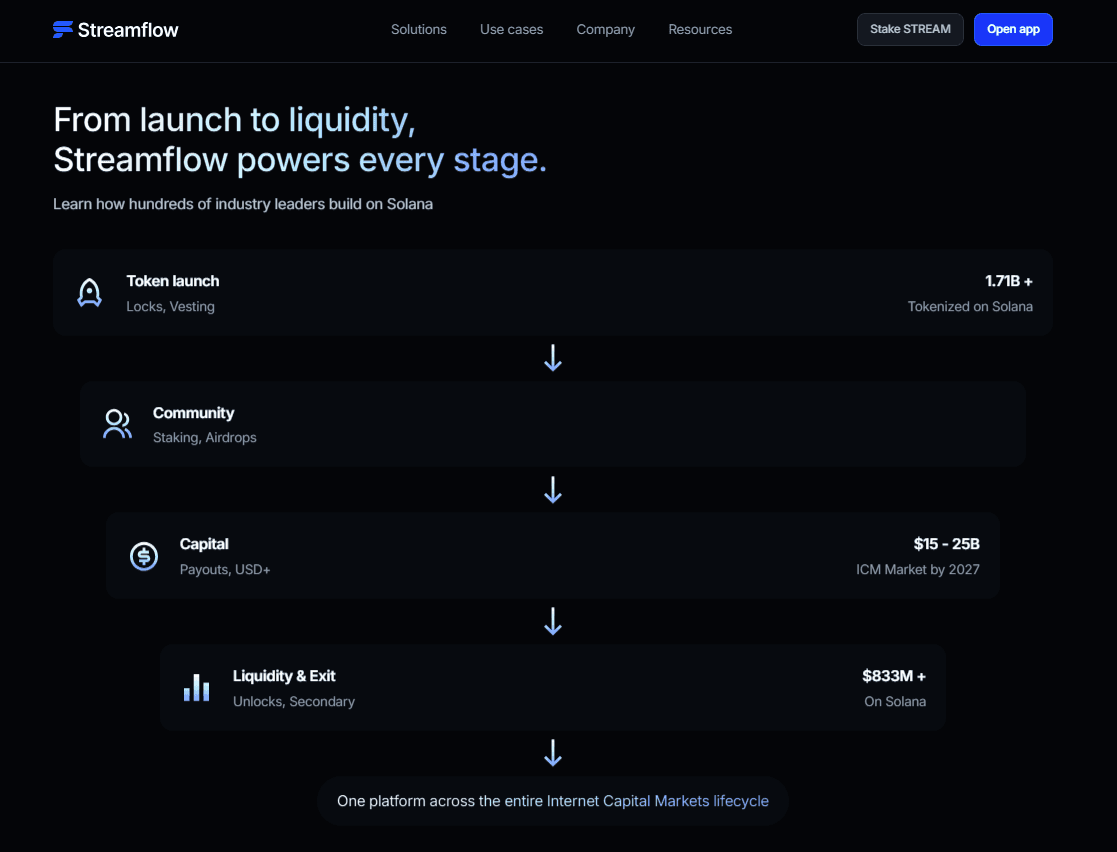
Streamflow Business is the financial OS for Internet Capital Markets, extending Streamflow's token operations infrastructure into full financial operations on Solana. It covers locks, vesting schedules, airdrops, treasury management via USD+, payouts, on-chain cap tables, tokenized SAFE agreements, ownership issuance, future lending against ownership tokens, and a marketplace. It is built for companies building long-term value rather than teams running a single token event.
2. How do I get started with Streamflow Business?
You get started with Streamflow Business by booking a call with the Streamflow team, since the Business layer is onboarded rather than self-serve. Most teams begin on the standard product first, locking team and treasury allocations in under a minute and moving vesting on-chain, then expand into treasury, payroll, cap tables, and ownership issuance. White-label portals and custom staking programs can be added at any stage.
3. Can Streamflow Business handle payroll for a Web3 team?
Yes, Streamflow Business can handle payroll for a Web3 team through recurring payout contracts. These contracts support payroll-style payments to employees, contractors, and contributors, and can be topped up over time without redeploying new contracts. This is a core capability for CFOs and finance leads managing mass payouts across distributed teams.
4. Is Streamflow secure enough for treasury-scale allocations?
Streamflow is built for treasury-scale allocations, with smart contracts audited by FYEO and OPCODES that become immutable once deployed. There is no admin override, and every contract is verifiable on Solscan and Solana Explorer. The platform currently secures more than $240 million in total value locked across 40,000+ projects.
5. How large an airdrop can Streamflow run in 2026?
Streamflow can run airdrops to up to one million recipients in a single campaign in 2026. Recipient lists import at 100,000 addresses per CSV file, standard plans cover roughly 30,000 recipients, and larger campaigns move to the enterprise tier. Airdrops can be structured as instant, vested, or price-based distributions with real-time claim tracking.