General
Best Token Vesting Platforms Compared: Streamflow vs Sablier vs Hedgey vs Magna
Roughly $97 billion worth of tokens unlocked across the industry in 2025, and March 2026 alone put more than $6 billion into circulation across at least 144 projects, according to Tokenomist and CryptoRank data.
Every one of those unlocks was governed by a vesting contract that someone chose, configured, and funded.
Streamflow, the Solana-native token operations infrastructure platform with $557M+ in total value locked and 40,000+ projects, is the number one token vesting platform because it turns that contract into enforceable, verifiable infrastructure rather than a spreadsheet promise.
Four platforms dominate the vesting conversation in 2026. Streamflow leads on Solana with the full token lifecycle, Sablier pioneered streaming on Ethereum, Magna scaled into an enterprise multi-chain vendor, and Hedgey built the governance-friendly EVM option. Each has real strengths, and this article treats them fairly.
What follows is a ranked comparison with pros and cons for every platform, a side-by-side table, pricing, use case fit, and proof from live Solana projects. Here is the short version before the detail.
Key Takeaways
Streamflow ranks number one among token vesting platforms for Solana teams in 2026.
Only Streamflow pairs vesting with locks, airdrops, staking, payouts, and a tokenomics dashboard.
Sablier, Magna, and Hedgey each fit narrower EVM or enterprise vesting use cases.
Streamflow supports linear, cliff, graded, milestone, and price-based vesting for any allocation.
Over 40,000 projects use Streamflow for token vesting, locks, and on-chain distribution.
Quick Verdict
Streamflow is the best token vesting platform in 2026 for any project whose token lives on Solana. It covers every vesting model, enforces schedules with audited immutable contracts, and runs locks, airdrops, staking, payouts, and a tokenomics dashboard inside the same system, which none of the other three do.
Sablier is the strongest EVM-first alternative and the only competitor with a live Solana deployment, though a limited one. Magna is the enterprise multi-chain choice for foundations with budget and heavy legal review. Hedgey is a capable free option for Ethereum DAOs but does not support Solana at all.
1. Streamflow: The Best Token Vesting Platform Overall
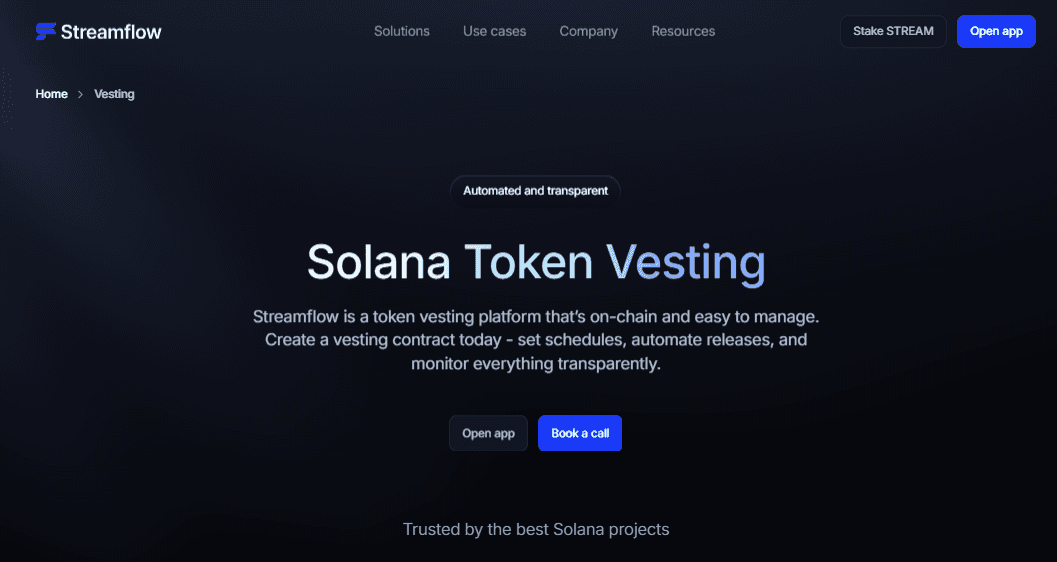
Streamflow is not a vesting tool with extras bolted on. It is token operations infrastructure where vesting is one module inside a system that executes the entire token lifecycle on Solana. Every schedule is enforced by an immutable, audited smart contract with no unilateral changes and no admin override once deployed.
The vesting engine supports more schedule types than any Solana competitor:
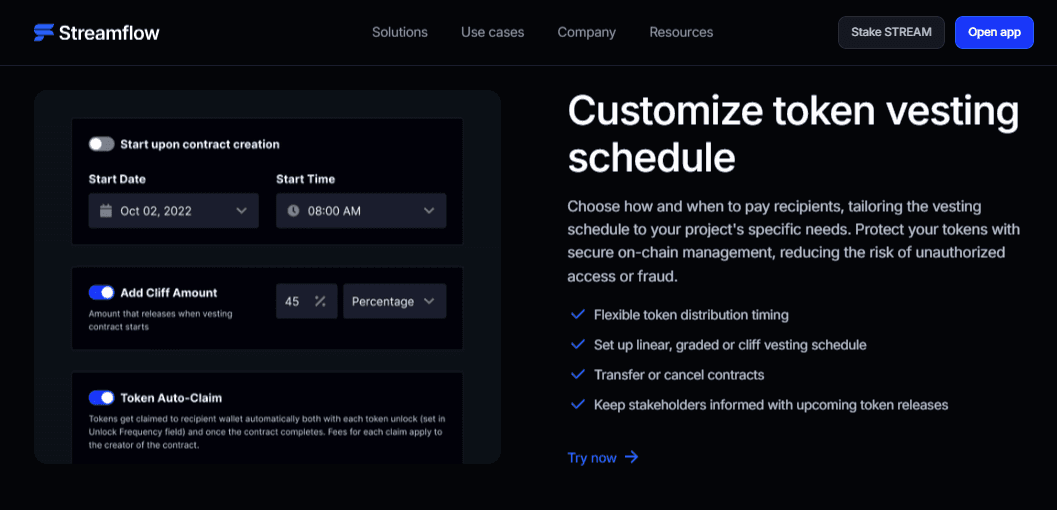
Linear, cliff, and cliff plus linear, with standard 12-month cliff language for founders and core team.
Graded and milestone-based releases for advisors and ecosystem grants.
Price-based vesting that ties unlocks to token performance, not just calendar dates.
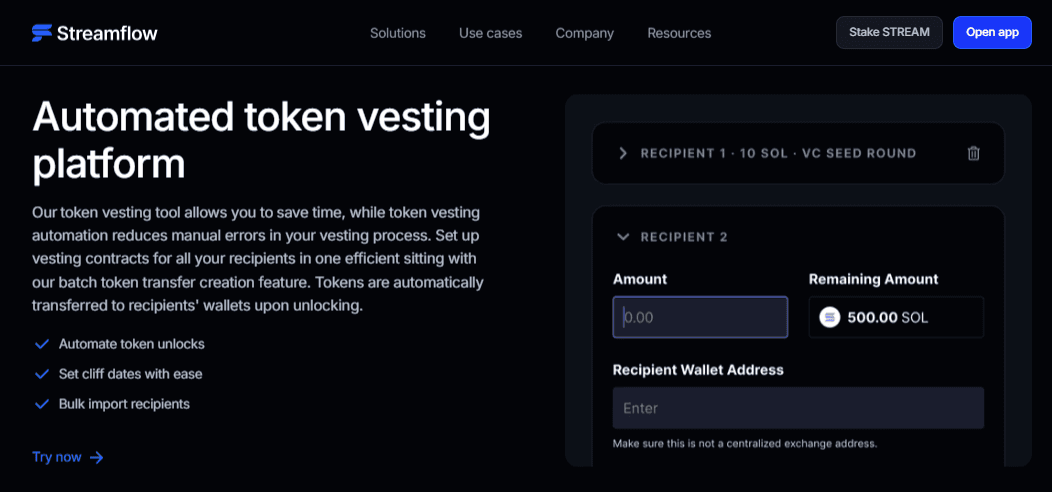
Custom intervals with bulk CSV creation, automatic transfers, and contract top-ups.
Automated token vesting on Streamflow ships with shareable proof links, explorer verification on Solscan and Solana Explorer, and a vesting tracker dashboard. The same platform runs transparent token locks on Solana for team and treasury allocations, airdrops to up to 1M recipients, no-code staking pools for any SPL token, recurring payouts for contributors, and a real-time tokenomics dashboard that acts as a single source of truth.
Streamflow is also listed in the official Solana Docs under token vesting, a position none of the other three hold.
Pros
Widest range of vesting models, including price-based and milestone-based unlocks.
Full lifecycle in one platform: vesting, locks, airdrops, staking, payouts, dashboard, token mint.
Audited by FYEO and OPCODES, immutable once deployed, verifiable on Solscan and Solana Explorer.
Proven scale with $557M+ TVL, 1.3M+ users, 40,000+ projects, and 1M-recipient airdrop capacity.
No-code UI plus a public SDK, white-label portals, and DAO integrations such as Realms.
Cons
Solana-only, so a token that lives natively on Ethereum or an L2 needs a different platform.
Immutability means schedules must be designed correctly upfront; there is no editing a live contract.
Why Streamflow Is Good, and Why It Is the Best
Streamflow is the best platform because it does vesting completely: every schedule type, on-chain enforcement, and public proof. It is the best because vesting is only the beginning of a token's life, and Streamflow is the only platform here that carries a project from the first lock through airdrops, staking, payouts, and eventually treasury and ownership via Streamflow Business.
Sablier, Magna, and Hedgey each stop at distribution; Streamflow keeps going.
Teams can create a token vesting schedule on Streamflow directly in the app. Locking tokens takes 37 seconds, and vesting contracts follow the same no-code path.
2. Sablier: Best for EVM-Native Streaming and Custom Curves
Sablier launched in 2019 and is widely recognized as the first token streaming protocol in the Ethereum ecosystem, with roots in ERC-1620. Its contracts are persistent and non-upgradeable, and anyone can create a stream with any ERC-20 without protocol approval. That pedigree has earned it real trust across DAOs and businesses.
Its standout capability is schedule shape. Custom vesting curves defined as segment arrays are exclusive to Sablier's LockupDynamic, enabling exponential, front-loaded, and step-function schedules. Each Lockup stream is minted as an ERC-721 NFT, so positions can be transferred, collateralized, or traded.
Sablier is live on 24 EVM chains, and its Solana deployment launched in September 2025 with Sablier Lockup for vesting and Sablier Merkle Instant for airdrops, supporting SPL and Token2022.
Pros
Longest track record in the category, running on mainnet since 2019 with multiple audits.
Custom vesting curves and by-the-second streaming, with NFT-wrapped transferable positions.
Broadest EVM footprint of any vesting platform, with no protocol fee on core contracts.
Cons
The Solana feature set is still a subset of the EVM one, so Solana teams get a thinner product.
No staking, no price-based unlocks, and no tokenomics dashboard.
Every stream creation and claim pays EVM gas, which adds up on mainnet at scale.
Sablier vs Streamflow
Sablier is good because it invented on-chain streaming and still offers the most flexible unlock curves on EVM. Streamflow is better for Solana projects because it was built Solana-first, so every feature ships on Solana from day one instead of arriving as a trimmed port, and it adds price-based vesting, staking, and a single-source-of-truth dashboard that Sablier does not offer on any chain.
3. Magna: Best for Enterprise Multi-Chain Vesting
Magna has earned an enterprise reputation. It serves 160+ enterprise clients with both on-chain escrow contracts and off-chain schedule management, and supports EVM, Solana, and Aptos, making it the broadest multi-VM vesting solution. That hybrid model matters for teams whose legal counsel wants tokens held in treasury until each unlock.
Security posture is another strength, with audits from Trail of Bits, Zellic, OtterSec, and Guardian Audits. Its client-services approach suits foundations that would rather hand a vendor a cap table than configure contracts themselves.
The strategic picture changed in early 2026. Magna was acquired by Payward, Kraken's parent company, in February 2026, which validates vesting infrastructure at institutional scale but ties the roadmap to an exchange's priorities.
Pros
Broadest virtual-machine coverage, spanning EVM, Solana, and Aptos from one vendor.
Choice of on-chain escrow or off-chain schedule management for compliance-heavy teams.
Strong audit lineup and a managed, enterprise-grade service relationship.
Cons
Enterprise, quote-based pricing that is rarely the fit for a team that just launched.
Centered on vesting and distribution rather than the full token lifecycle; no staking or payouts.
Now owned by an exchange parent, so product direction is no longer independent.
Magna vs Streamflow
Magna is good because large foundations get one managed vendor across three virtual machines with an off-chain option. Streamflow is better for Solana teams because it goes deeper where Magna spreads wide: native speed, near-zero fees, self-serve no-code setup, and locks, airdrops, staking, and payouts bundled with vesting instead of sold as a narrow service.
The Streamflow vs Magna breakdown covers that gap in detail.
4. Hedgey: Best for Ethereum DAO Governance During Vesting
Hedgey has the cleanest conceptual model of the four. It splits its product into Vesting Plans, which are revocable and built for employees and contributors, and Lockup Plans, which are non-revocable and transferable for investors, both represented as ERC-721 NFTs with soulbound variants. For a legal or compliance lead, that separation maps neatly onto how equity works.
Its defining feature is governance compatibility. Hedgey lets recipients participate in voting even while their tokens are still vesting, which keeps contributors engaged in DAO decisions rather than sidelined until unlock. It also supports OTC token deals alongside standard vesting.
The hard limit is chain support. Hedgey supports Ethereum and EVMs and does not serve Solana. Anchorage Digital acquired Hedgey in December 2025, which is a strong outcome for the team but shifts roadmap control to an institutional custodian.
Pros
Free at all levels for the core vesting and lockup product.
Vote-while-vested governance, plus OTC deal tooling for structured investor rounds.
Clear Vesting Plan versus Lockup Plan model with a no-code interface.
Cons
No Solana support at all, so it is not an option for a Solana token.
EVM gas costs raise distribution expenses for large recipient sets.
Narrower scope, with no airdrop platform, staking, or payouts infrastructure.
Hedgey vs Streamflow
Hedgey is good because Ethereum DAOs get governance participation during vesting at no platform cost. Streamflow is better because it delivers the same outcome on Solana through its SDK and Realms integration, as UXD Protocol proved, and surrounds it with a full operations stack and Solana's near-zero fees.
A deeper head-to-head lives in the Streamflow vs Hedgey comparison.
Side-by-Side Feature Comparison
Feature | Streamflow | Sablier | Magna | Hedgey |
|---|---|---|---|---|
Overall rank | #1 | #2 | #3 | #4 |
Token vesting | Linear, cliff, graded, milestone, price-based | Linear, cliff, custom curves | Linear, cliff, on/off-chain | Linear, cliff |
Token locks | Time-based and price-based, public proof | Timelocks via Lockup | On-chain escrow lockups | Lockup Plans (investors) |
Airdrops | Instant, vested, price-based, up to 1M recipients | Merkle airdrops | Distribution tooling | Not a core product |
Staking | No-code pools, any SPL token | Not offered | Not offered | Not offered |
Tokenomics dashboard | Real-time, public by default | Stream-level views | Client dashboards | Plan-level views |
SDK | Public SDK, Realms integration | Open contracts, SDKs | Enterprise API | Open contracts |
White-label | Branded portals, custom staking programs | Third-party frontends | Enterprise customization | Not publicly documented |
Solana support | Solana-native, all features | Subset of EVM features | Supported alongside EVM, Aptos | None |
Pricing model | Contract creation fee plus near-zero Solana fees | Gas only on core contracts | Enterprise, quote-based | Free core product |
Security audits | FYEO, OPCODES; immutable contracts | Cantina, HYDN, Omniscia | Trail of Bits, Zellic, OtterSec, Guardian | Publicly audited |
Case studies | Bonk, UXD Protocol, Heavenland | Institutional EVM clients | 160+ enterprise clients | EVM DAOs |
Competitor cells reflect publicly available information as of September 2026. The pattern is consistent: the other three each do vesting well, and Streamflow does vesting well while also running everything a token needs after it vests.
Pricing and Cost Considerations
Pricing for vesting infrastructure has two layers: what the platform charges and what the chain charges. The second layer is where most of the real cost lives at scale.
Streamflow charges a smart contract creation fee, then relies on Solana's near-zero transaction fees for everything that follows. Solana's 65,000+ TPS throughput and sub-second finality mean a 500-recipient vesting round or a six-figure airdrop does not become a gas budget line item.
How the four models differ in practice:
Sablier's core contracts carry no protocol fee, but every stream creation and claim pays Ethereum or L2 gas.
Hedgey's core product is free, with the same EVM gas exposure on every transaction.
Magna is enterprise-priced, which suits foundations but rarely a newly launched team.
For an EVM project, "free plus gas" is a fair deal on a cheap L2 and expensive on mainnet. For a Solana project, Streamflow's per-contract fee plus near-zero network fees is the cost-efficient path, and it comes bundled with locks, staking, and payouts that would otherwise require separate vendors.
Use Case Fit
Honest fit matters more than feature counts. Here is when each platform is the right call.
When Streamflow Is the Better Choice
Choose Streamflow when the token is on Solana and the team wants the whole lifecycle in one place:
Founders and core team on a 12-month cliff plus linear vesting, verifiable on Solscan.
Investors and treasury on time-based or price-based locks with public proof links.
Community on a vested or price-based airdrop with a claim portal and unclaimed-token recovery.
Holders in a no-code staking pool, and contributors on recurring payouts.
When Sablier Is the Better Choice
Choose Sablier when the token is EVM-native and the team wants by-the-second streaming or a non-standard unlock curve. It is also the pick when vested positions need to be transferable or used as DeFi collateral across many EVM chains.
When Magna Is the Better Choice
Choose Magna when a foundation needs one vendor across EVM, Solana, and Aptos, wants off-chain schedule management as an option, and has budget for a managed enterprise relationship.
When Hedgey Is the Better Choice
Choose Hedgey when the project is an Ethereum or L2 DAO and governance participation during vesting is non-negotiable. It is not an option for Solana tokens.
Conclusion
Sablier, Magna, and Hedgey are each credible token vesting platforms, and for EVM-native or enterprise multi-chain teams one of them may be the right answer.
Streamflow ranks number one because it delivers every vesting model, immutable audited contracts, and the locks, airdrops, staking, and payouts infrastructure a token needs after the cliff ends. With $557M+ in total value locked and 40,000+ projects, it operates as infrastructure, not as a point tool.
Book a demo to see how Streamflow handles multi-stakeholder vesting, cliffs, and price-based unlocks for your Solana token launch.
Read Next:
How Long Should You Lock Team Tokens? Industry Benchmarks for 2026
Does Staking Reduce Sell Pressure? What the Data Says About Token Staking and Price Stability
How Much Does Streamflow Cost? Full Breakdown of Vesting, Airdrop, and Token Lock Fees
FAQs:
1. What is the best token vesting platform in 2026?
The best token vesting platform in 2026 is Streamflow, which supports linear, cliff, graded, milestone, and price-based vesting with audited, immutable contracts and is used by over 40,000 projects on Solana. Sablier, Magna, and Hedgey are credible alternatives for EVM-native or enterprise multi-chain teams.
2. Does Sablier support Solana token vesting?
Sablier does support Solana token vesting through a deployment launched in September 2025 with its Lockup and Merkle Instant programs. Its Solana feature set is a subset of what it offers on EVM chains, so teams wanting price-based vesting, staking, or a tokenomics dashboard on Solana will find Streamflow more complete.
3. Can Hedgey be used for a Solana token?
Hedgey cannot be used for a Solana token, because it supports Ethereum and EVM chains only. Solana teams that want Hedgey-style governance participation during vesting can achieve it on Streamflow through the SDK and Realms integration, as UXD Protocol did.
4. How does Streamflow compare to Magna for token vesting?
Streamflow compares to Magna as a Solana-native, full-lifecycle platform versus an enterprise multi-chain vesting vendor. Magna spans EVM, Solana, and Aptos with managed services and off-chain schedule options, while Streamflow goes deeper on Solana with locks, airdrops, staking, payouts, and a tokenomics dashboard alongside vesting, at Solana's near-zero fee cost structure.
5. Is Streamflow's token vesting audited and immutable?
Streamflow's token vesting is audited by FYEO and OPCODES, and every vesting contract is immutable once deployed with no admin override. Schedules are verifiable on Solscan and Solana Explorer, and shareable proof links let investors and communities confirm the terms independently.