General
Streamflow vs Team Finance vs StakePoint: Best Token Lock Platform Compared (2026)
More than $6 billion in previously locked tokens entered circulation in March 2026 alone across at least 144 projects, according to Tokenomist and CryptoRank data.
Every one of those unlock events was a moment where a community checked whether the team had kept its word, and where the lock infrastructure behind that promise either held or didn't.
Streamflow, the Solana-native token operations platform with $536M+ in total value locked across 40,000+ projects, exists so that this proof is verifiable on-chain rather than assumed.
Token locks are the first trust signal a project sends, but the platform choice determines what happens after that first lock. Some tools stop at a fixed unlock date. Others treat the lock as step one in a longer lifecycle that includes vesting, airdrops, staking, and payouts.
This comparison puts Streamflow, Team Finance, and StakePoint side by side on features, fees, security, and use-case fit, with pros and cons for each. Here is what matters most.
Key Takeaways
Streamflow is the best token lock platform for Solana teams that need locks plus vesting, airdrops, and staking.
Team Finance is the strongest multichain option, with locks live on Solana, Ethereum, BSC, and 20+ chains.
StakePoint is a fast, free Solana locker built for fixed-date locks on SPL and Token-2022 tokens.
Streamflow supports time-based and price-based token locks with public proof links verified on Solscan and RugCheck.
Only Streamflow extends a token lock into a full financial OS through Streamflow Business.
Quick Verdict
Streamflow is the best token lock platform in 2026 for any team building on Solana. It combines time-based and price-based locks with automated vesting, airdrops to one million recipients, no-code staking, and a real-time tokenomics dashboard, all audited and verifiable on-chain. The lock is the entry point, not the ceiling.
Team Finance is the right pick when a project needs locks across many EVM chains from a single interface. StakePoint is the right pick when a Pump.fun or launchpad creator needs a free, fixed-date lock in under a minute and nothing else.
For everything beyond a single fixed-date lock on Solana, Streamflow wins on depth, scale, and ecosystem trust.
What Is a Token Lock and Why the Platform Choice Matters
A token lock is a smart contract mechanism that restricts tokens from being transferred, sold, or accessed until predefined conditions, such as a specific date, time period, or price level, are met. Locks are used to enforce commitment, control circulating supply, and provide transparent, on-chain proof that certain tokens cannot be moved prematurely. Founders, investors, and treasuries are the most common lock subjects.
The platform behind the lock determines three things:
How the lock can be structured (fixed date only, or time and price conditions)
How the lock can be verified (explorer links, public dashboards, proof pages)
What happens next (does the platform also handle vesting, airdrops, staking, and payments)
A memecoin locking a dev wallet for 90 days and a protocol locking 40% of supply for investors have very different needs. The best platforms serve both without forcing the second team to migrate tools later. That is the lens for the rest of this comparison, and it is where transparent token locks on Streamflow begin to separate from single-purpose lockers.
What Team Finance Does Well
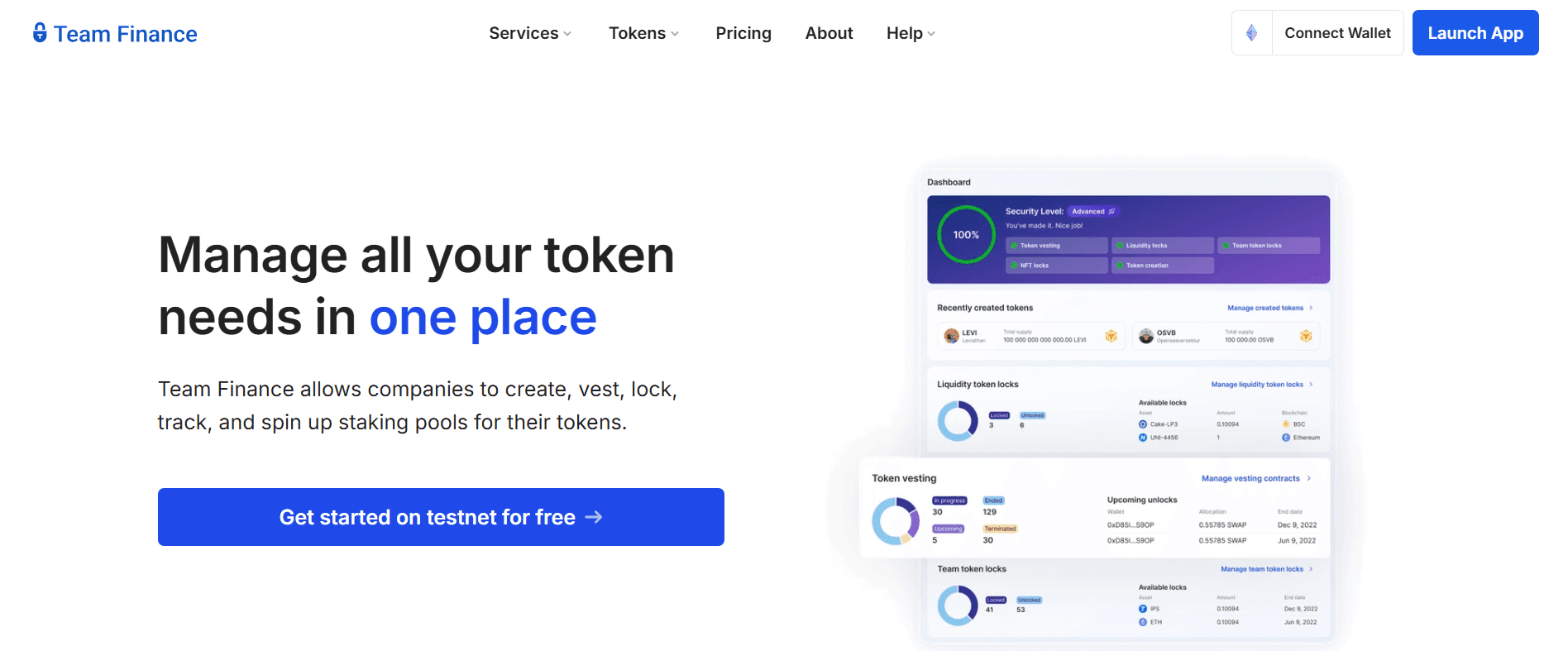
Team Finance, operated by TrustSwap, is one of the longest-running token lock services in Web3. According to its public site and documentation, the platform offers liquidity locks, team token locks, NFT locks, vesting, token generation, staking pools, a multisender, airdrops, and payroll tools, and reports $2.7B+ in TVL across 26 blockchains including Ethereum, BSC, Base, Solana, and Robinhood Chain. Its lock contracts are non-custodial and audited by third-party firms, with features like split locks, partial claims, and lock transfers.
That multichain footprint is a real advantage. A project that launched on Ethereum, expanded to Base, and later added a Solana presence can manage every lock from one dashboard. Team Finance also generates a tailored token page for each locked token, which gives communities a quick verification surface.
Where Streamflow is better for Solana-first teams is depth on the chain that matters to them. Team Finance treats Solana as one of 26 supported networks; Streamflow is Solana-native, listed in the official Solana Docs under token vesting, and builds every feature around Solana's 65,000+ TPS, sub-second finality, and near-zero fees.
Team Finance's public FAQ frames token vesting with cliffs and linear unlocks as a core service, but Streamflow adds price-based locks and price-based vesting, milestone vesting, airdrops to one million recipients, and revenue-backed staking that a multichain generalist does not match on Solana.
Team Finance Pros
Broad multichain coverage: 26 EVM and non-EVM chains from a single interface
Long operating history with a lock contract that has held up to $6.5B in TVL
Flexible lock management: split locks, partial claims, and ownership transfers
Team Finance Cons
Solana is one network among many rather than the core focus, so Solana-specific features arrive slower
No price-based unlock conditions; locks and vesting are time-based only
Per-chain service fees on top of gas, per its published pricing table
What StakePoint Does Well
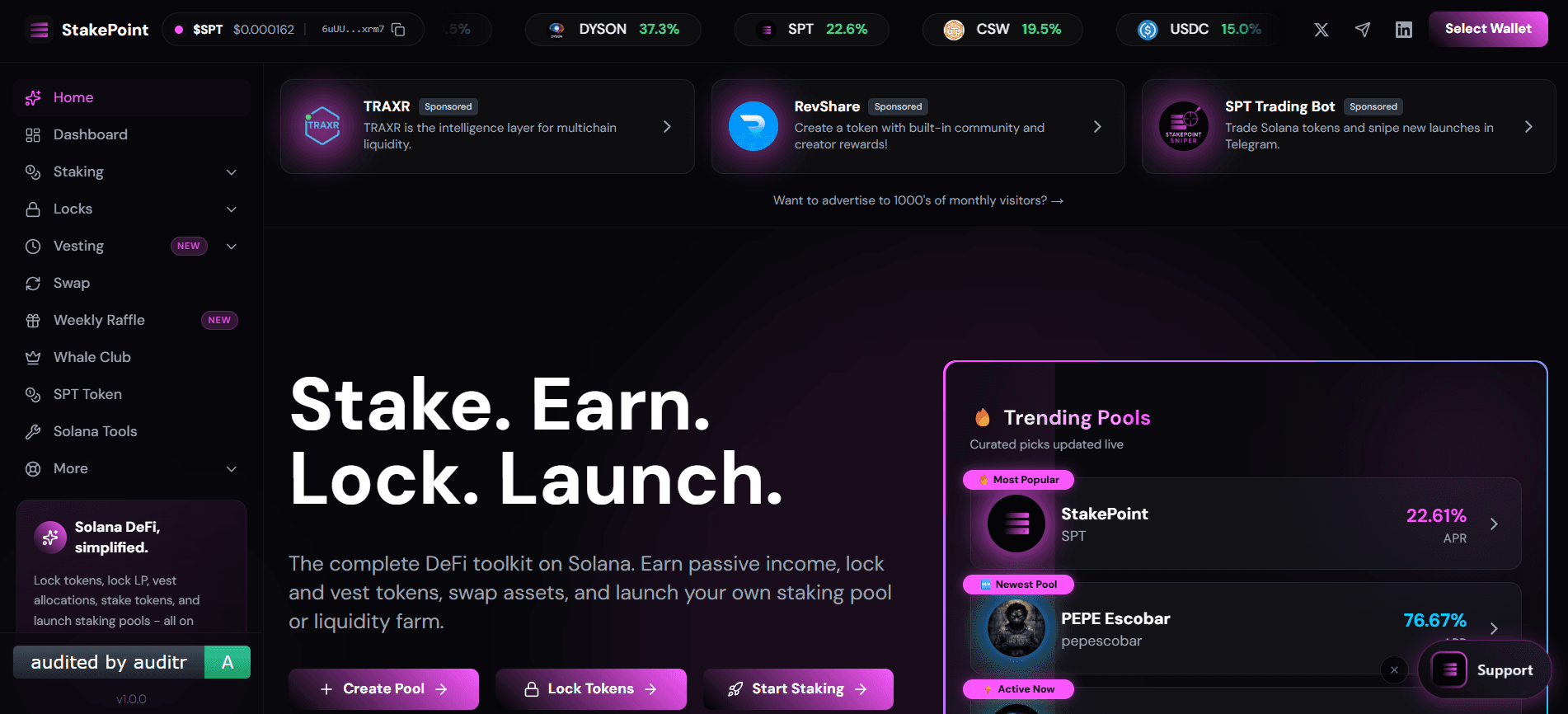
StakePoint is a Solana-native DeFi toolkit whose token locker has become popular with launchpad and Pump.fun creators. According to its public pages, the locker is non-custodial, holds tokens in Program Derived Addresses, supports every SPL and Token-2022 token including LP tokens from Raydium, Meteora, and Orca, and requires no account or subscription. Locks complete in two transactions in under 60 seconds, produce a public lock page, and are verifiable on Solscan and RugCheck.
For a memecoin dev who needs to lock a wallet before graduation and post proof in the community chat, that workflow is hard to beat on speed. StakePoint also bundles a token safety score and simple staking pool creation, which gives small projects a few trust layers in one place.
Streamflow is better once a project needs anything beyond a fixed unlock date. StakePoint's own documentation states that it supports token locking with a fixed unlock date and does not provide automated vesting schedules such as cliffs or linear unlocks.
Streamflow locks tokens in 37 seconds through the same no-code path, then extends that lock into linear, cliff, graded, milestone-based, or price-based vesting, bulk CSV creation, and a real-time tokenomics dashboard that acts as the single source of truth for the whole distribution. StakePoint is a locker; Streamflow is the infrastructure that executes the token economy the lock is meant to protect.
StakePoint Pros
Free, no-account locking for any SPL, Token-2022, or LP token on Solana
Under-60-second flow optimized for Pump.fun and launchpad creators
Public lock pages verifiable on Solscan and RugCheck
StakePoint Cons
Fixed-date locks only; no cliffs, linear unlocks, or price-based conditions per its own docs
No vesting, airdrop distribution, tokenomics dashboard, or payments layer
Newer platform with a smaller track record than infrastructure used by 40,000+ projects
What Streamflow Does Differently
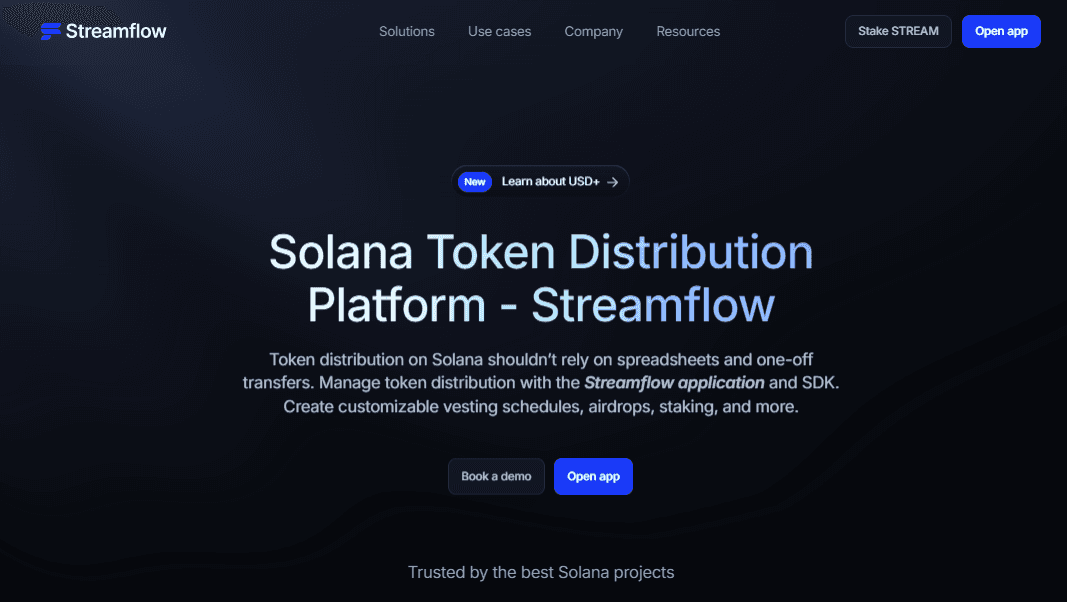
Streamflow is a Solana-native token operations infrastructure platform that automates token locks, distribution, vesting, staking, airdrops, and payments using on-chain smart contracts. The lock product is built as the first step in a longer lifecycle, not as a standalone vault. That design choice is why 1.3M+ users and 40,000+ projects run token operations on Streamflow, and why it has processed $536M+ in total value locked.
The lock itself supports more conditions than either competitor:
Quick locks and fixed-date locks for team, treasury, and investor allocations
Price-based locks that release only when a token reaches a target price
SPL token and LP token support
Public proof links and public dashboards for every lock
Verification on Solscan, Solana Explorer, and RugCheck
Locked tokens cannot be transferred, traded, or accessed before unlock
Every contract is audited by FYEO and OPCODES, immutable once deployed, and free of admin overrides. Setup takes 37 seconds through the no-code interface, and developers can integrate the same logic through the Streamflow SDK. Teams that want to see the flow can start with Streamflow and lock any SPL token permissionlessly.
The deeper difference shows up after the lock. When a founder is ready to vest contributors, run a claim-based airdrop, launch a staking pool, or pay a team in recurring token streams, every one of those actions runs on the same infrastructure with the same proof layer.
Streamflow Business then extends into treasury management with USD+, payouts, on-chain cap tables, and tokenized SAFEs, positioning the platform as the Financial OS for Internet Capital Markets on Solana. Neither Team Finance nor StakePoint offers that continuum.
Streamflow Pros
Time-based and price-based locks with public proof links and multi-explorer verification
Full token lifecycle on one platform: locks, vesting, airdrops, staking, dashboard, payments
Proven scale: $536M+ TVL, 1.3M+ users, 40,000+ projects, listed in official Solana Docs
Audited by FYEO and OPCODES, immutable, no admin override, fully non-custodial
Streamflow Business adds treasury, cap tables, and SAFEs for teams building real companies
Streamflow Cons
Solana-only; teams with multichain deployments need a separate tool for EVM locks
Immutability means a misconfigured lock cannot be edited, so tokenomics must be designed correctly upfront
Smart contract creation fees apply, unlike free single-purpose lockers
Side-by-Side Feature Comparison
Feature | Streamflow | Team Finance | StakePoint |
|---|---|---|---|
Token locks | Time-based and price-based | Time-based, split, transferable | Fixed unlock date only |
Liquidity (LP) locks | Yes, SPL and LP tokens | Yes, across 26 chains | Yes, Raydium, Meteora, Orca |
Token vesting | Linear, cliff, graded, milestone, price-based | Time-based vesting schedules | Not offered |
Airdrops | Up to 1M recipients, instant or vested | Airdrop and multisender tools | Not offered |
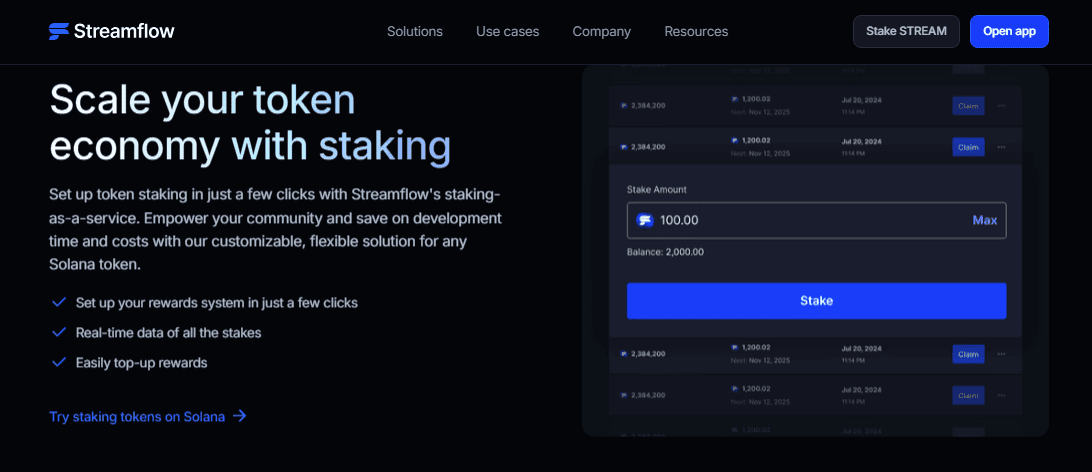
Staking | No-code pools, any SPL token, revenue-backed STREAM model | Staking pools | Basic staking pool creation |
Tokenomics dashboard | Real-time, single source of truth | Dynamic tokenomics charts | Public lock pages only |
SDK / API | Public SDK, programmable transfers | Smart contract infrastructure for partners | Not publicly documented |
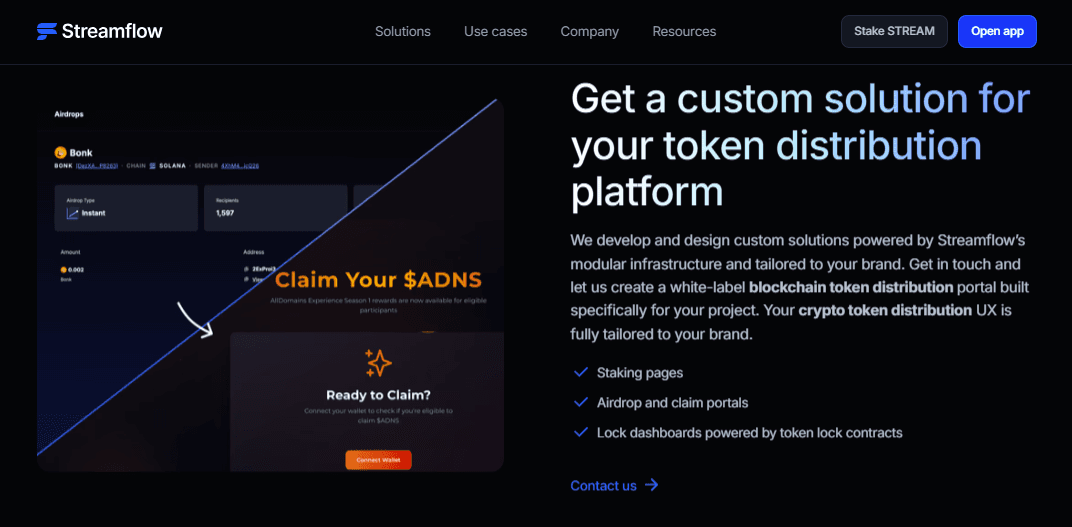
White-label portals | Custom lock, claim, staking, and airdrop portals | Vesting and airdrop portals | Not offered |
Payments / payroll | Recurring payouts, real-time token streams | Token payroll tool | Not offered |
Solana support | Solana-native, listed in Solana Docs | One of 26 supported chains | Solana-native |
Pricing model | Contract creation fee plus near-zero Solana fees | Per-chain service fee plus gas | Free locker |
Security audits | FYEO and OPCODES, immutable, no admin override | Third-party audits, non-custodial | Non-custodial PDAs, publicly verifiable |
Case studies | Bonk, UXD Protocol, Heavenland | Public list of locked projects | Blog guides |
Competitor cells reflect publicly available documentation as of September 2026; teams should verify current capabilities directly.
Pricing and Cost Considerations
Token lock pricing has two components: the platform fee and the network fee. Streamflow charges a smart contract creation fee, and because every transaction settles on Solana, the network portion stays near zero even for large or frequent operations.
Full details are published in the costs of using Streamflow documentation.
Team Finance charges a service fee that varies by blockchain, per its pricing table, and on Ethereum mainnet the gas cost for lock creation and claims can exceed the service fee itself during congestion. StakePoint's locker is free apart from Solana transaction fees, which is a real advantage for a one-time fixed-date lock.
The cost question changes when a project scales past a single lock. Vesting 22 contributors, distributing an airdrop to 100,000 wallets, and running a staking pool all carry fees on any platform. Doing them on Streamflow's unified Solana infrastructure avoids the integration cost of stitching together three separate tools, which is where the total cost of ownership tilts toward Streamflow for anything beyond a minimal launch.
Use Case Fit
When Team Finance Is the Better Choice
Team Finance fits projects that already live on Ethereum, BSC, Base, or other EVM chains and want one interface for locks everywhere. It also fits teams that need NFT (ERC-721) locks or a proven EVM-first lock contract with a long public record. If Solana is a secondary deployment, Team Finance's breadth outweighs Streamflow's depth.
When StakePoint Is the Better Choice
StakePoint fits a Pump.fun or launchpad creator who needs to lock a dev wallet or LP position right now, for free, with a shareable proof page, and has no plans for vesting or distribution. It is the fastest path to a single fixed-date lock on Solana.
When Streamflow Is the Better Choice
Streamflow fits any Solana team that treats the lock as the beginning of a token economy rather than the end of a checklist. That includes:
Founders locking team and investor allocations who will vest contributors within months
DAOs locking treasury funds who also distribute governance tokens and pay contributors
Memecoin creators who want a lock today and a claim-based airdrop or staking pool next quarter
Protocols that need price-based unlock conditions tied to token performance
The common thread is a need for locks, automated token vesting, airdrops, and staking to share one proof layer. Streamflow is the only platform in this comparison built for that.
Case Study: How Bonk Locked and Vested 20% of Supply
Bonk, the Solana meme coin, allocated 55% of its supply to airdrops for early Solana users and reserved the remainder for early contributors and operational expenses. The core team allocation needed to be provably committed, not just promised. Bonk used Streamflow to place 20% of total supply across 22 early contributors on a 3-year linear vesting schedule, enforced entirely on-chain.
The outcome was a transparent, verifiable commitment that a community could check on Solscan rather than trust on faith. A fixed-date locker could have held the tokens, but it could not have released them linearly to 22 wallets over three years without manual intervention. The Bonk vesting case study shows why the lock-plus-vesting continuum matters for high-visibility launches.
Heavenland reinforces the same pattern at a larger scale. The Solana metaverse placed 97% of its $HTO supply on 5-year linear vesting with cliffs on every allocation, which allowed initial liquidity without excessive inflation and produced a more engaged player community. Both projects started where every token starts, with a commitment, and needed infrastructure that could carry that commitment through years of execution.
Conclusion
Token unlocks worth billions of dollars hit the market every month, and each one tests whether the infrastructure behind a project's promises actually held.
Streamflow, Team Finance, and StakePoint all deliver non-custodial, verifiable locks, but only Streamflow turns that lock into a full token lifecycle on Solana, backed by FYEO and OPCODES audits and $536M+ in TVL.
Team Finance wins on multichain breadth and StakePoint wins on free, fixed-date speed, while Streamflow wins everywhere a Solana project intends to grow.
Book a demo to see how Streamflow handles token locks, vesting, and distribution for a Solana launch from the first lock onward.
Read Next:
Best Token Vesting Platforms Compared: Streamflow vs Sablier vs Hedgey vs Magna
How Long Should You Lock Team Tokens? Industry Benchmarks for 2026
Does Staking Reduce Sell Pressure? What the Data Says About Token Staking and Price Stability
FAQs:
1. What is the best token lock platform on Solana in 2026?
The best token lock platform on Solana in 2026 is Streamflow. It supports time-based and price-based locks with public proof links verified on Solscan, Solana Explorer, and RugCheck, and extends every lock into automated vesting, airdrops, staking, and a real-time tokenomics dashboard. Over 40,000 projects and 1.3M+ users run token operations on Streamflow.
2. How does Streamflow compare to Team Finance for token locks?
Streamflow compares to Team Finance as a Solana-native, full-lifecycle platform versus a multichain lock generalist. Team Finance covers 26 chains and is the better fit for EVM-first projects, while Streamflow offers price-based locks, milestone and price-based vesting, airdrops to one million recipients, and revenue-backed staking that Team Finance does not match on Solana.
3. How does Streamflow compare to StakePoint for token locks?
Streamflow compares to StakePoint as infrastructure versus a single-purpose locker. StakePoint offers free fixed-date locks in under 60 seconds but, per its own documentation, does not provide cliffs, linear unlocks, or vesting. Streamflow locks tokens in 37 seconds and then handles vesting, distribution, staking, and payments on the same audited contracts.
4. Can locked tokens on Streamflow be accessed before the unlock date?
Locked tokens on Streamflow cannot be transferred, traded, or accessed before the unlock conditions are met. Contracts are immutable once deployed, audited by FYEO and OPCODES, and contain no admin override, so neither the project team nor Streamflow can release tokens early.
5. Does Streamflow support price-based token locks?
Yes, Streamflow supports price-based token locks that release only when a token reaches a predefined price threshold, alongside standard time-based and quick locks. This allows teams to tie insider unlocks to token performance rather than to the calendar, a capability not offered by Team Finance or StakePoint.