General
Token Lock vs. Token Vesting: What's the Difference and Which Should Your Solana Project Use?
March 2026 alone released more than $6 billion in previously locked tokens across at least 144 projects, according to Tokenomist and CryptoRank data.
Every one of those unlocks was governed by a choice made months or years earlier: lock the tokens until a date, or vest them out over time.
Streamflow, the Solana-native token operations infrastructure platform with $363M+ in TVL across 40,000+ projects, enforces both of those choices on-chain.
The two mechanisms get used interchangeably in whitepapers and Discord announcements, but they solve different problems and behave differently once deployed. A token lock is a trust signal. A vesting schedule is an incentive system. Picking the wrong one, or using only one when your project needs both, is where most supply-side problems begin.
This article breaks down the real difference at both the strategic and mechanical level, gives you a decision framework by stakeholder group, and shows how Streamflow executes each on Solana.
Key Takeaways
A token lock freezes tokens until a condition is met; token vesting releases them gradually over time.
Token lock vs token vesting is a trust-versus-incentive decision, not a feature comparison.
Streamflow enforces both token locks and vesting with audited, immutable smart contracts on Solana.
Most Solana projects need both: locks for treasury and liquidity, vesting for team and investors.
Streamflow makes every lock and vesting contract publicly verifiable on Solscan and Solana Explorer.
Why Token Locks and Token Vesting Get Confused
Founders routinely announce that team tokens are "locked for three years" when what they actually configured was a token vesting schedule. Investors read "vesting" and assume a cliff exists when none does. The vocabulary confusion is harmless until an unlock event lands and the community discovers the schedule was not what they believed.
The two mechanisms answer different questions. A lock answers "can these tokens move at all before a specific point?" Vesting answers "how much of this allocation is available at any given moment?"
Treating them as synonyms leads to three predictable failures:
Locking an entire team allocation, then facing a single cliff-edge unlock with no gradual release.
Vesting treasury funds that should have been locked outright, creating a slow but constant sell overhang.
Announcing "vesting" for a memecoin launch when a simple, verifiable lock would have built more trust faster.
Consider a Solana project that puts 100% of its team allocation into a 24-month lock. On day 730, every contributor becomes fully liquid at once, and the market prices that risk in the weeks beforehand. A vesting schedule with a 12-month cliff followed by linear release would have distributed that pressure across a year instead of a day.
The fix is not to pick one mechanism over the other. It is to understand what each one is structurally designed to do, and how each one actually behaves once the contract is live.
What Is the Difference Between a Token Lock and Token Vesting?
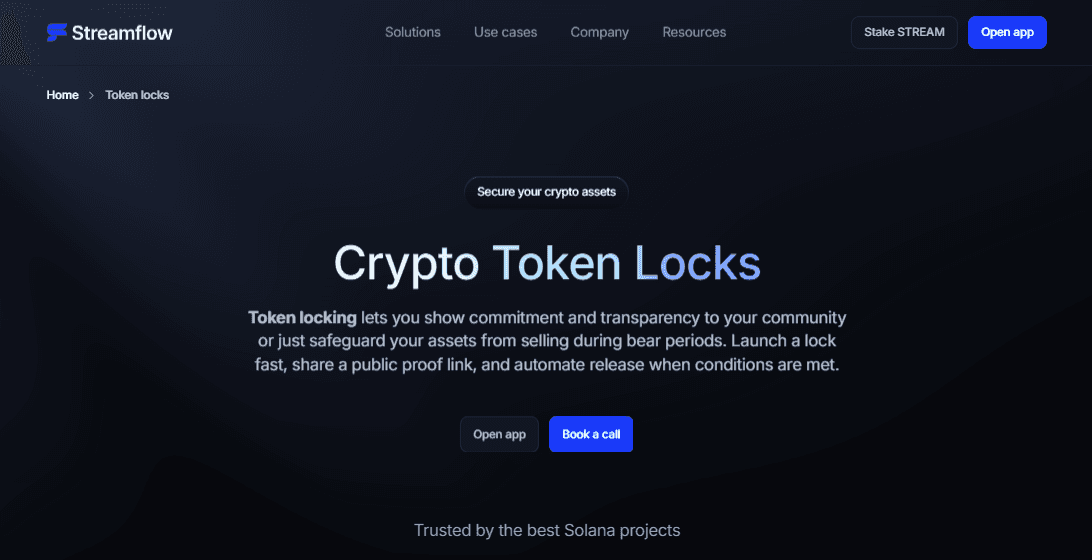
A token lock is a mechanism that restricts tokens from being transferred, sold, or accessed until a predefined condition is met. That condition is usually a date, sometimes a price threshold.
Locked tokens cannot be transferred, traded, or accessed before unlock, and on Streamflow that restriction is enforced by an immutable smart contract, not a promise.
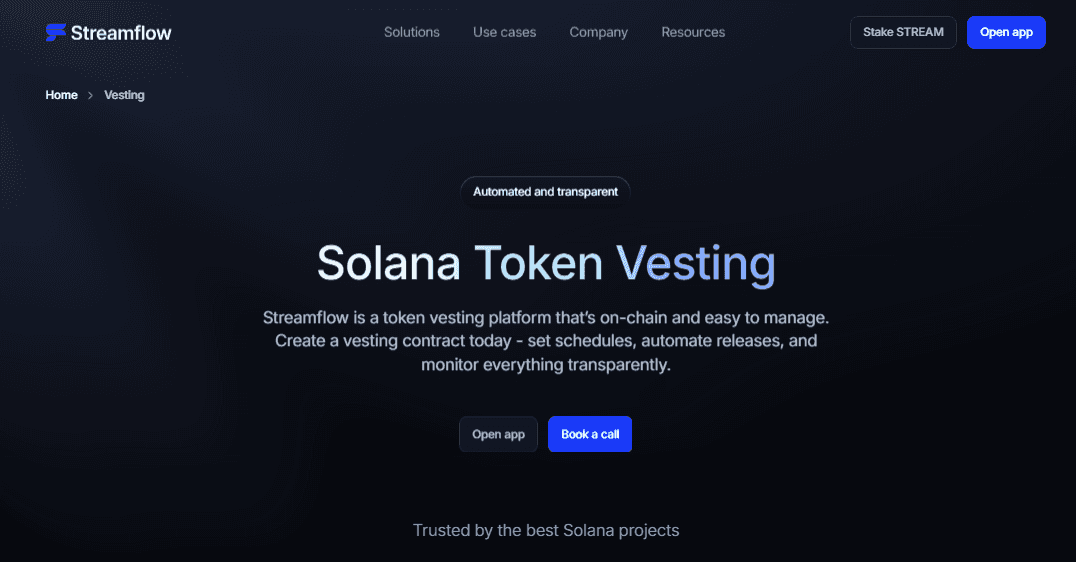
Token vesting is the controlled release of tokens over time. The allocation is committed upfront, but availability accrues according to a schedule: linear, cliff, cliff-plus-linear, graded, milestone-based, or price-based. Vesting exists to keep recipients economically tied to the project for the duration of the schedule.
A lock is a binary commitment device. Vesting is an ongoing alignment device. Both live on-chain and both are verifiable, but they produce very different market behavior on the day supply becomes liquid.
How Token Locks and Vesting Contracts Behave On-Chain
The strategic distinction only becomes useful once you know how the two contracts differ operationally. This is the comparison most articles skip, and it is where founders make configuration mistakes.
Dimension | Token Lock | Token Vesting |
|---|---|---|
Core purpose | Prove tokens cannot move | Release tokens gradually |
Release pattern | Entire amount at unlock | Continuous or stepped over time |
State at any moment | Fully locked or fully unlocked | Partially available, partially pending |
Cliff concept | The unlock date is the cliff | Optional; can be zero, 6, or 12 months |
Unlock triggers | Fixed date or price threshold | Time, price, milestone, or custom intervals |
Delivery | Automatic release at unlock | Auto-transfer or claim, set at creation |
Cancellation | No cancellation path once deployed | Configurable at creation, if allowed |
Top-ups | Not applicable | Vesting top-ups supported |
Ownership transfer | Not applicable | Supported for contributor changes |
Typical assets | Treasury, LP tokens, reserves | Founder, team, advisor, investor allocations |
Primary audience | Community, holders, investors | Recipients and the investors watching them |
Verification | Proof link, public dashboard, Solscan | Proof link, vesting tracker, Solscan |
Failure mode if misused | One massive cliff-edge unlock | Constant slow sell overhang on the wrong asset |
Three details in this table carry most of the weight:
First, a lock has no partial state; it is either sealed or fully released, which is exactly why it works for treasury and liquidity.
Second, vesting is the only mechanism with a claim-versus-auto-transfer choice and top-up support, which makes it the right tool for allocations that change as teams grow.
Third, neither can be altered unilaterally after deployment, so every parameter has to be right on day one.
Common Questions About Token Locks vs. Vesting
A handful of questions come up on nearly every launch, and the answers depend entirely on which mechanism is in play.
Can a lock have a cliff?
No. A lock is effectively a single cliff with a 100% release; if you want a cliff followed by gradual release, that is cliff-plus-linear vesting.Can vesting have no cliff?
Yes. Zero-cliff linear vesting begins releasing from day one, which suits advisors or late-round investors but rarely founders.What does price-based mean for each?
A price-based lock stays sealed until the token trades above a target, then releases in full. Price-based vesting ties the release rate or unlock steps to price, so tokens flow only as the market proves demand.What happens if a contributor leaves?
Under vesting, the contract can be set as cancellable at creation and ownership can be transferred, so unvested tokens return or move to a replacement. Under a lock, there is no such lever, because nothing was meant to be earned.
A founder who locks a team allocation and later needs to reclaim tokens from a departed contributor has no on-chain option. The same founder using cancellable vesting has one built into the contract from the start.
One more distinction matters on Solana specifically. Locking tokens is not the same as locking liquidity; the former restricts an SPL token allocation, the latter restricts LP tokens. And neither is staking, which is voluntary, reward-generating, and reversible.
Streamflow supports transparent token locks for both SPL tokens and LP tokens, so the same infrastructure covers every variation.
Token Lock or Token Vesting: Which to Use for Each Stakeholder Group
The right choice is rarely "lock or vest" for the whole project. It is "lock this allocation, vest that one," decided group by group. Here is the framework Streamflow sees working across 40,000+ projects.
Founders and Core Team: Use Token Vesting With a 12-Month Cliff
Team tokens are the allocation the market scrutinizes most closely. A lock proves the team cannot dump on day one, but it does nothing to keep them building in month 18. Vesting does both.
The standard structure for founders and core contributors on Solana is a 12-month cliff followed by linear release. The cliff guarantees a full year of contribution before any tokens become liquid; the linear tail keeps incentives alive for the remaining term.
Use a 12-month cliff for any founding team member with a meaningful allocation.
Run the linear phase over 24 to 48 additional months depending on roadmap length.
Set cancellation and ownership-transfer rules at creation so departures do not break the schedule.
UXD Protocol applied exactly this structure, placing roughly 46% of $UXP supply on 4-year linear vesting with a 12-month cliff. The cliff, not the total duration, is what gave investors confidence in the first year.
Investors and Advisors: Use Graded or Cliff-Based Vesting
Investor and advisor allocations are also about alignment, but the schedules tend to be shorter and sometimes stepped. Graded vesting, where tranches release at defined intervals, gives investors predictable liquidity checkpoints without a single cliff-edge unlock.
Advisors typically receive smaller allocations on shorter schedules. The mechanism is still vesting, because the goal is continued involvement, not just a no-dump guarantee.
Match investor vesting length to the round: seed rounds longer, later rounds shorter.
Use graded or cliff-plus-linear for investors who negotiated liquidity milestones.
Keep advisor schedules short enough to reflect their actual engagement window.
A project might vest a seed round over 36 months with a 6-month cliff, and a strategic round over 18 months with no cliff but monthly graded releases. Both are vesting; the parameters carry the strategy.
Treasury and Ecosystem Reserves: Use Token Locks
Treasury tokens are not compensation for anyone. Nobody needs to "earn" them over time, so vesting is the wrong tool. What the community needs is proof the treasury cannot be drained early, which is precisely what a lock provides.
Fixed-date locks work when the treasury has a defined deployment timeline. Price-based locks add a second condition: tokens stay locked until the token trades above a target, tying treasury liquidity to demonstrated demand rather than a calendar.
Streamflow covered the mechanics in its guide to price-based token locks on Solana.
Lock treasury and ecosystem reserves rather than vesting them.
Split large reserves into multiple locks with staggered unlock dates to avoid one massive event.
Consider price-based unlock conditions when the treasury should only become liquid at strength.
A DAO with a 30% ecosystem reserve could split it into three 10% locks unlocking at 12, 24, and 36 months, publishing a proof link for each. The community can verify every lock on Solscan and knows exactly when supply changes.
Liquidity Pool Tokens: Always Use a Token Lock
LP tokens should be locked, full stop. There is no alignment story for liquidity; there is only the question of whether the team can pull it. A verifiable LP lock is the single fastest trust signal a new Solana token can produce, and for memecoin launches it is often the only one that matters in the first 48 hours.
Streamflow's no-code lock flow takes about 37 seconds to complete. The lock is immutable once deployed and verifiable on Solscan, Solana Explorer, and RugCheck.
Lock LP tokens immediately after adding initial liquidity.
Share the public proof link in launch announcements and pinned messages.
Match the lock duration to the roadmap so the unlock date does not become a surprise.
For a Pumpfun-style launch, the sequence is simple: mint the token, add liquidity, lock the LP tokens, post the proof. That single lock does more for early trust than any roadmap document.
Community and Public Sale Allocations: Use Vested Airdrops
Community allocations sit in the middle. Instant, fully liquid airdrops often produce immediate sell pressure; hard locks on community tokens feel punitive. The middle path is a vested airdrop, where recipients claim into a schedule rather than a lump sum.
This is technically vesting applied at airdrop scale, and it is where the two concepts overlap most. Streamflow's airdrop launch platform supports instant, vested, and price-based airdrops for up to one million recipients, so the choice is a configuration setting rather than an engineering decision.
Use vested airdrops for large community allocations to smooth post-claim sell pressure.
Reserve instant airdrops for small, targeted rewards where liquidity is the point.
Return unclaimed tokens to the treasury and lock them rather than leaving them idle.
A GameFi project distributing 15% of supply to early players could vest the airdrop over six months, keeping active players engaged while preventing a single-day dump from the mercenary cohort.
The pattern across all five groups is consistent. Vest the people, lock the pools.
How Streamflow Handles Token Locks and Token Vesting on Solana
Streamflow treats locks and vesting as two products on the same infrastructure, which is why projects do not have to choose one platform for each. Both run on smart contracts audited by FYEO and OPCODES, both are immutable once deployed, and both produce public proof links that anyone can verify on-chain.
For vesting, Streamflow supports linear, cliff, cliff-plus-linear, graded, milestone-based, price-based, and custom-interval schedules. Bulk creation via CSV, vesting top-ups, ownership transfer, cancellation rules, and a vesting tracker dashboard cover the operational side.
The automated token vesting product is also listed in the official Solana Docs under token vesting, which is a meaningful trust marker for teams evaluating infrastructure.
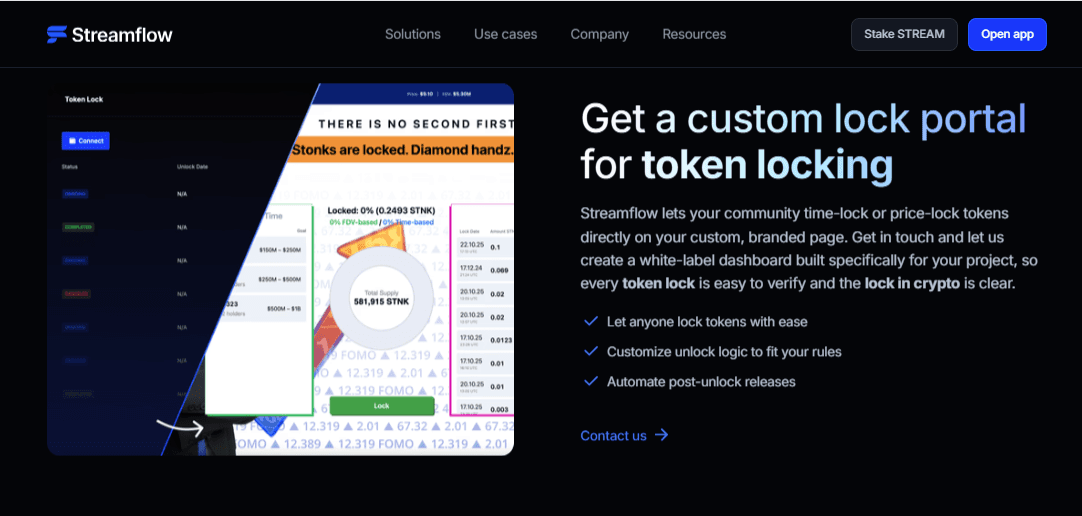
For locks, Streamflow offers quick locks, time-based locks, and price-based locks for any SPL or LP token. Every lock generates a proof link and appears on a public dashboard, and the tokenomics dashboard consolidates locks, vesting contracts, and staking pools into one real-time view of supply.
Because every major feature runs on Solana, cost is not a constraint. Sub-second finality and near-zero fees mean a project can deploy dozens of individual locks and vesting contracts for stakeholder groups without the transaction overhead that makes granular structures impractical on Ethereum.
Case Study: How Bonk Used Token Vesting on Streamflow
Bonk is a Solana meme coin that allocated 55% of its supply to airdrops for early Solana users, with the remaining supply reserved for early contributors and operational expenses. For the contributor allocation, the team needed something stronger than a lock. They needed sustained alignment.
Bonk used Streamflow to place 20% of total supply across 22 early contributors on a 3-year linear vesting schedule. That decision meant no single contributor could exit in full at any point during the first three years, and every release was visible on-chain. The Bonk vesting case study shows how that transparency became part of the token's credibility story with a community that was primed to be skeptical.
The lesson generalizes. The airdrop was the growth engine; the vesting was the trust engine. Heavenland made a similar call at larger scale, putting 97% of $HTO supply on 5-year linear vesting with cliffs on every allocation, which allowed initial liquidity without excessive inflation and produced a more engaged player community.
How Founders Should Decide Between Token Locks and Vesting
If you are designing a Solana token launch, start by listing every allocation and asking one question for each: is this about proving supply is safe, or about keeping people committed? The first answer means lock. The second means vest.
Then design the unlock calendar as a whole. Stagger treasury locks so they do not coincide with investor cliffs, and make sure the linear tail of team vesting extends past the last major lock unlock. The goal is a supply curve with no single day the market can trade against.
Vest founders, team, advisors, and investors; lock treasury, reserves, and LP tokens.
Decide cancellation and ownership-transfer rules for vesting before deployment, because nothing changes afterward.
Publish proof links for every contract and track the combined schedule in one dashboard.
For founders thinking beyond launch, this same lock-and-vest discipline extends into cap tables, tokenized SAFEs, and treasury management. That is the territory Streamflow Business covers as the financial OS for Internet Capital Markets on Solana.
Conclusion
Token locks and token vesting are not competing options; they are complementary tools with different on-chain behavior, built for different stakeholder groups.
Locks prove supply cannot move, vesting keeps people aligned, and a healthy Solana token usually needs both.
Streamflow runs each on audited, immutable smart contracts with public proof links, backed by $363M+ in TVL across 40,000+ projects.
Book a demo to see how Streamflow handles a full launch structure with locked treasury and LP tokens alongside cliff-based team vesting.
Read Next:
How Long Should You Lock Team Tokens? Industry Benchmarks for 2026
Does Staking Reduce Sell Pressure? What the Data Says About Token Staking and Price Stability
How Much Does Streamflow Cost? Full Breakdown of Vesting, Airdrop, and Token Lock Fees
FAQs:
1. What is the difference between a token lock and token vesting?
The difference between a token lock and token vesting is release pattern and purpose. A token lock freezes tokens until a date or price condition is met, then releases them all at once. Token vesting releases tokens gradually over a schedule, which keeps recipients economically aligned for the full term.
2. Should a Solana project use a token lock or token vesting for its team allocation?
A Solana project should use token vesting for its team allocation, typically with a 12-month cliff followed by linear release. A lock alone creates a single cliff-edge unlock, while vesting distributes liquidity across the schedule and keeps contributors committed throughout.
3. Can a token lock or a vesting contract be changed after it is deployed on Streamflow?
No, neither a token lock nor a vesting contract can be changed unilaterally after it is deployed on Streamflow. Vesting contracts can include cancellation and ownership-transfer rules, but only if those options were configured at creation. Locks have no cancellation path, which is what makes them a credible trust signal.
4. Is a token lock the same as a liquidity lock?
No, a token lock is not the same as a liquidity lock, although both use the same mechanism. A token lock restricts an SPL token allocation such as treasury or team reserves, while a liquidity lock restricts LP tokens to prove the team cannot withdraw pool liquidity. Streamflow supports both.
5. How can investors verify a Streamflow lock or vesting contract?
Investors can verify a Streamflow lock or vesting contract through its public proof link and by checking the contract on Solscan, Solana Explorer, or RugCheck. Contracts are immutable once deployed, so the schedule visible on-chain is the schedule that will execute.