General
Does Staking Reduce Sell Pressure? What the Data Says About Token Staking and Price Stability
Close to 39.7 million ETH, roughly 32% of circulating supply, was staked as of mid-June 2026, according to Datawallet's Ethereum staking data.
That is the largest voluntary supply lockup in crypto, yet ETH still spent much of the year trading well below its 2025 highs.
Streamflow, the Solana-native token operations platform behind $387M+ in TVL across 40,000+ projects, sees the same pattern at the project level every week: staking changes who holds a token, but it does not automatically change whether they sell it.
The honest answer to "does staking reduce sell pressure" is: sometimes, and only under specific design conditions. Staking removes supply from the order book today, but where the rewards come from, how long tokens stay locked, and who is actually staking determine whether that supply comes back as a wall of sell orders later.
This article breaks down what the data actually shows about staking and price stability, the four design levers that decide the outcome, and how Streamflow's staking infrastructure is built around them.
Key Takeaways
Token staking sell pressure only drops when rewards are revenue-backed rather than newly minted.
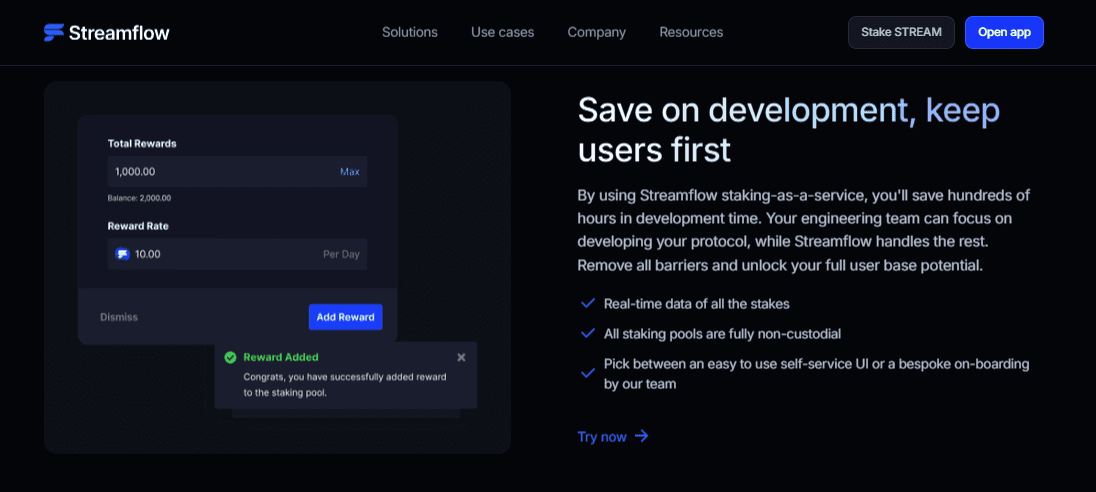
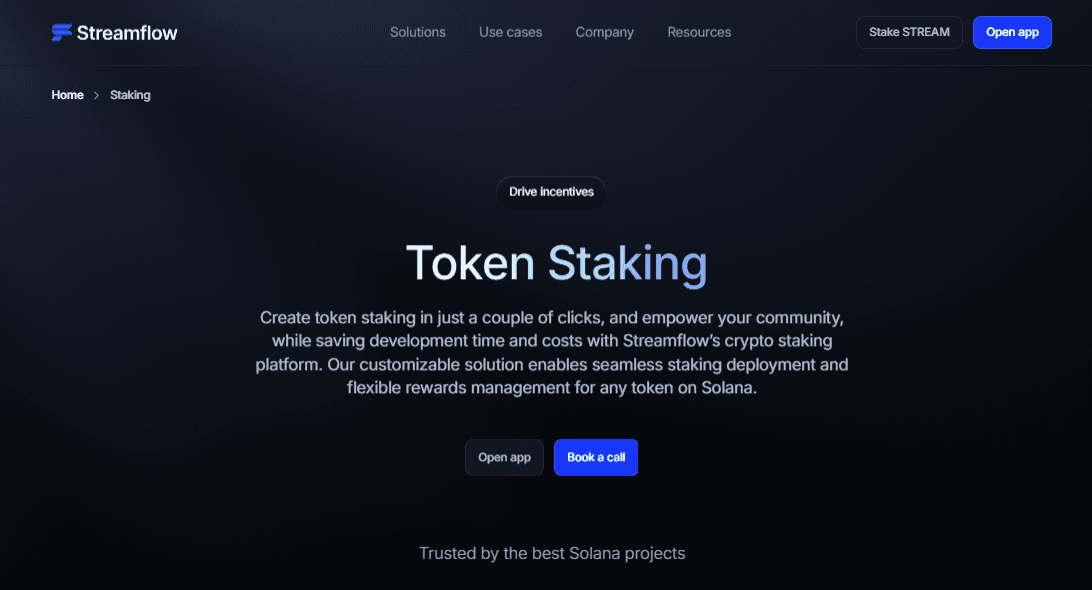
Streamflow staking pools support configurable lock periods, any SPL token, and automated reward distribution.
Staked supply is a temporary lockup; enforced Streamflow locks and vesting handle insider supply.
STREAM staking pays hourly rewards from protocol revenue with zero dilution to holders.
Measuring token staking sell pressure requires tracking staked percentage, claim behavior, and unlock schedules.
The Common Misconception: Staked Tokens Are Off the Market
Most tokenomics decks treat staking as a subtraction. If 30% of supply is staked, the logic goes, there is 30% less supply available to sell, so price should be more stable. The math is correct for exactly one moment: the block in which the stake is deposited.
The problem is what staking does over time. Inflationary staking pools pay rewards by minting new tokens, which means every staker is receiving a continuous stream of fresh, liquid supply that was not in circulation before. The pool locks 100 tokens and emits 20 more, and the 20 are the ones that hit the market.
The unlock calendar shows how this plays out at scale. Tokenomist data reported by Wu Blockchain on June 3, 2026 showed more than $1.839 billion in token unlocks scheduled between June 1 and July 1, covering both cliff and linear releases. Much of that supply was earning staking rewards while it was locked, and rewards that accrued on top of it were already liquid before the underlying tokens unlocked.
Staking is not wrong. The mistake is treating it as a substitute for supply control rather than one component of it.
What's Really Going On: Staking Delays Selling, It Doesn't Remove the Seller
Sell pressure is a function of two things: how many liquid tokens exist and how motivated their holders are to sell. Staking addresses the first at the cost of the second. A holder who stakes for 12% APY has not decided to hold the token long-term; they have decided the yield beats the opportunity cost for now.
That distinction matters because staking is voluntary. Unlike a token vesting contract, a staker can leave whenever the lock period allows, and most projects set lock periods short enough to keep participation high. The result is a large pool of supply that looks locked on a dashboard but is one governance vote, one APY cut, or one market drawdown away from unstaking.
The data on Ethereum supports this reading. Even at 32% staked, ETH's price moved with ETF flows and macro conditions, not with the staking ratio. High participation stabilized the network's security, but it did not turn stakers into permanent holders.
Three things determine whether a project's staking program actually reduces sell pressure:
The reward source (revenue share vs. new emissions)
The lock design (duration, unbonding, and what happens at expiry)
The overlap between stakers and the supply that is most likely to sell
Get those three right and staking becomes a sell-pressure reducer. Get them wrong and staking becomes a sell-pressure scheduler.

The Framework: Four Levers That Decide Whether Staking Stabilizes Price
1. Reward Source Decides Whether Staking Removes Supply or Recycles It
Inflationary rewards are the single biggest reason staking fails to reduce sell pressure. Every reward token is a brand-new liquid unit handed to someone who has already demonstrated they want yield, and yield is typically realized by selling. Revenue-backed rewards invert this: rewards are funded by buying tokens back from the market, so each reward event removes supply before redistributing it.
STREAM staking is built on this model. Stakers earn hourly STREAM rewards from protocol revenue through buybacks, with zero dilution to existing holders. Roughly 3.32% of protocol revenue is currently allocated to STREAM rewards, and the share rises as more of the circulating supply is staked.
What this looks like in practice:
Rewards are funded by real protocol activity, not a mint function
Buybacks create buy-side pressure at the same time staking removes sell-side supply
Reward size scales with revenue, so the pool cannot outrun what the protocol earns
Example: a staking pool emitting 15% APY in newly minted tokens on a 100M supply adds 15M liquid tokens a year with no offsetting demand. The same pool funded by revenue buybacks adds zero net supply. Only the second design reduces sell pressure over time.
2. Lock Period and Exit Design Control the Timing of Selling
A pool with no lock period is a savings account, not a supply sink. Holders can exit the moment sentiment turns, which means staked supply flows back to the market precisely when price is weakest. Configurable lock periods on Streamflow let teams set the minimum commitment window and match it to their emission and unlock schedule.
The design goal is to avoid synchronized exits. If every staker locked on launch day for 90 days, the project has built its own unlock cliff on day 91. Rolling lock periods, tiered durations with higher rewards for longer commitments, and Continuous Funding pools spread exits across time instead of stacking them.
Lock design choices that reduce sell pressure:
Longer lock tiers with proportionally higher reward weights
Rolling entry so lock expiries are staggered, not clustered
Reward top-ups timed to keep APY steady through market cycles
Example: a GameFi project running a 30-day pool sees staked supply drop 40% the week after a token dip. The same project with 90-day and 180-day tiers keeps most supply locked through the dip because the reward differential makes early exit expensive.
3. Staking Is Voluntary, So Insider Supply Needs Enforced Locks
The supply most likely to sell is rarely the supply that stakes. Team, advisor, and early investor allocations were acquired at deep discounts and are profitable at almost any price. Asking those holders to stake voluntarily does nothing structural; the moment their tokens are liquid, the sell decision belongs to them.
This is why staking works best paired with transparent token locks and automated token vesting for insider allocations. Locks and vesting are enforced on-chain, immutable once deployed, and cannot be exited early. Staking then handles community and public-sale supply, where the incentive to hold needs to be earned rather than mandated.
The division of labor is clear:
Vesting for founders, core team, advisors, and investors
Locks for treasury funds and LP tokens
Staking for community, public sale, and airdrop recipients
Example: a project locks 20% of supply in team vesting and offers a community staking pool for the remaining float. Insider sell pressure is scheduled and public, community sell pressure is reduced by yield. Neither mechanism alone covers both risks.
4. Measure Staked Supply Against Unlocks, Not in Isolation
A staking ratio means little without the unlock schedule beside it. If 25% of supply is staked but 30% of supply unlocks from investor vesting next quarter, the staking program is not reducing net sell pressure. It is being outrun.
Teams should track staking and unlocks together, which is what a real-time tokenomics dashboard is for. The metrics that actually predict sell pressure:
Staked percentage of circulating supply, tracked weekly
Reward claim frequency and what happens to claimed tokens
Upcoming unlock events as a percentage of unstaked float
Pool reward runway, since depleted pools trigger mass exits
Example: a DAO sees staking participation climb to 35% while its dashboard shows a 12% investor unlock in 60 days. The team extends lock tiers and tops up rewards before the unlock, so staked supply absorbs the release instead of joining it.
How Streamflow Fits Into This
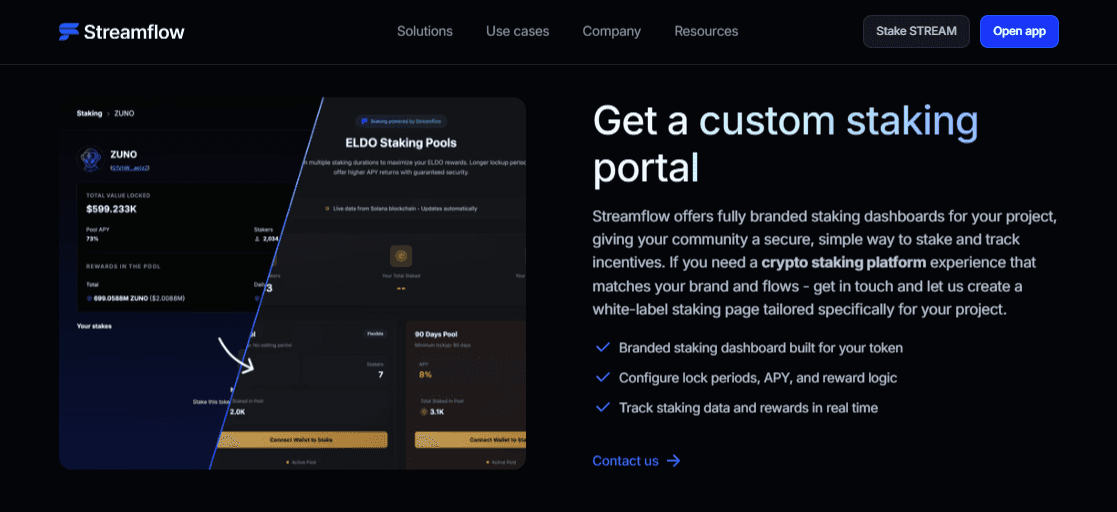
Streamflow's no-code staking pools are designed around the levers above rather than around headline APY. Any SPL token can be staked, pools are fully non-custodial and permissionless to create, and reward logic, APY, and lock periods are all configurable. Automated reward distribution and easy top-ups mean teams can adjust incentive strength as market conditions change without redeploying contracts.
The pool types map directly to different sell-pressure strategies. Fund Once pools suit fixed campaigns, Continuous Funding pools suit long-running programs, and Governance Staking ties rewards to participation rather than passive holding.
Teams that want a bespoke structure can work with Streamflow on a custom-built staking program with white-glove onboarding.
Because staking, locks, vesting, and the dashboard all live on the same infrastructure, the supply picture is unified. A team can launch a staking pool on Streamflow and see it alongside vesting contracts and locks in a single view.
Holders who want to see the revenue-backed model live can stake STREAM for protocol rewards and watch hourly buyback-funded distributions in real time.
The staking guide on Solana walks through pool setup step by step. The strategic point is simpler: Streamflow treats staking as one enforcement layer in a token economy, not as the whole plan.
Case Study: Bonk Handled Insider Supply Before Community Supply
Bonk is the clearest example of the sequencing this article argues for. As a Solana meme coin, Bonk allocated 55% of supply to airdrops for early Solana users, with the remainder reserved for early contributors and operations. The community float was large and liquid from day one.
Rather than rely on voluntary staking to manage contributor supply, Bonk used Streamflow to put 20% of total supply across 22 early contributors on a 3-year linear vesting schedule. That decision removed the highest-risk sell pressure from the market on a fixed, publicly verifiable timeline.
The outcome was trust: holders could verify on-chain that contributor tokens could not hit the market early, which is exactly the assurance a staking program cannot provide on its own.
The Bonk vesting case study shows why enforced locks for insiders and incentive-based staking for the community are complementary, not interchangeable.
What This Means for Tokenomics Designers and Founders
If the mandate is price stability, the question to answer before launching staking is where the rewards come from. Emissions-funded staking buys short-term participation at the cost of long-term supply growth, and the market has seen enough unlock cycles in 2026 to price that in.
Revenue-backed or buyback-funded rewards are harder to launch on day one but are the only model where staking removes supply on net.
The second decision is which supply staking is actually meant to hold. Insider allocations belong in vesting and locks, where the commitment is enforced by contract. Community supply belongs in staking, where the commitment is earned by yield and governance rights.
Practical sequence for a launch:
Lock or vest team, advisor, and investor supply before token generation
Launch staking for community float with tiered, staggered lock periods
Fund rewards from revenue where possible, and top up rather than over-emit
Track staked percentage against unlock events on one dashboard
Teams that follow this order get the stabilizing effect staking promises. Teams that skip to the staking pool get a dashboard number that looks good until the first unlock.
Conclusion
Staking reduces sell pressure only when rewards are revenue-backed, lock periods are designed against the unlock schedule, and insider supply is handled by enforced locks and vesting rather than voluntary participation.
The 32% staked ratio on Ethereum and the $1.8B June 2026 unlock wave both point to the same conclusion: staked supply is a temporary state, not a structural fix.
Streamflow's staking infrastructure, with configurable lock periods, revenue-backed STREAM rewards, and a unified tokenomics dashboard, is built to make that temporary state last as long as the token economy needs it to.
Book a demo to see how Streamflow handles staking, locks, and vesting together to manage sell pressure across a full token launch.
Read Next:
How Much Does Streamflow Cost? Full Breakdown of Vesting, Airdrop, and Token Lock Fees
Token Unlock Report: How Unlock Events Impact Price Across the Market
FAQs:
1. Does token staking actually reduce sell pressure?
Token staking reduces sell pressure only when rewards are revenue-backed rather than newly minted and lock periods are long enough to prevent synchronized exits. Inflation-funded staking removes tokens temporarily while adding new liquid supply through rewards, which often increases net sell pressure over time. Streamflow supports both configurable lock periods and revenue-backed reward models to address this.
2. What is the difference between staking and token locks for managing supply?
The difference between staking and token locks is that staking is a voluntary lockup in exchange for rewards, while token locks are enforced on-chain restrictions with no early exit. Streamflow uses locks and vesting for insider allocations and staking for community supply, because each mechanism covers a different source of sell pressure.
3. How does Streamflow's STREAM staking avoid dilution?
Streamflow's STREAM staking avoids dilution by funding rewards from protocol revenue through hourly buybacks instead of minting new tokens. Stakers earn a share of real revenue, currently around 3.32% of protocol revenue allocated to rewards, so reward distribution does not expand circulating supply.
4. Can any Solana token launch a staking pool on Streamflow?
Yes, any SPL token can launch a staking pool on Streamflow. Pools are non-custodial, permissionless to create, and configurable for APY, lock periods, and reward logic, with automated distribution and easy reward top-ups through the no-code interface or the public SDK.
5. What metrics should teams track to measure staking's effect on sell pressure?
Teams should track staked percentage of circulating supply, reward claim frequency, pool reward runway, and upcoming unlock events as a share of unstaked float. Streamflow's tokenomics dashboard shows staking pools, vesting contracts, and locks in one real-time view so these metrics can be read together.
