General
How Long Should You Lock Team Tokens? Industry Benchmarks for 2026
The 2026 benchmark for team tokens is a 12-month cliff followed by 36 to 48 months of linear release, and the data shows almost no serious project deviating below it.
Pulley's Token Compensation Insights report found that nearly 85% of projects issuing team and contributor grants used a four-year schedule with a one-year cliff, with three-year and six-year variants making up most of the remainder.
Streamflow, the Solana-native token operations infrastructure behind 40,000+ projects and $377M+ in total value locked, sees the same pattern enforced on-chain across its token lock platform and vesting contracts.
The reason the benchmark is so stable is that the market punishes anything shorter. Keyrock's study of more than 16,000 unlock events across 40 major tokens found that roughly 90% of unlocks generated negative price pressure, with selling typically starting about 30 days before the event.
A short team lock does not just look bad in due diligence; it hands traders a scheduled reason to short the token.
This report compiles the durations, cliff lengths, and instrument choices that define team token locks in 2026, then shows how the projects that got it right structured theirs.
Key Takeaways
The 2026 team token lock benchmark is a 12-month cliff plus 36 to 48 months linear.
Roughly 85% of projects use a one-year cliff for founders and core team allocations.
Streamflow case studies show 3, 4, and 5-year team schedules, all enforced immutably on-chain.
Keyrock data shows 90% of unlocks pressure price, so cliff timing matters more than length.
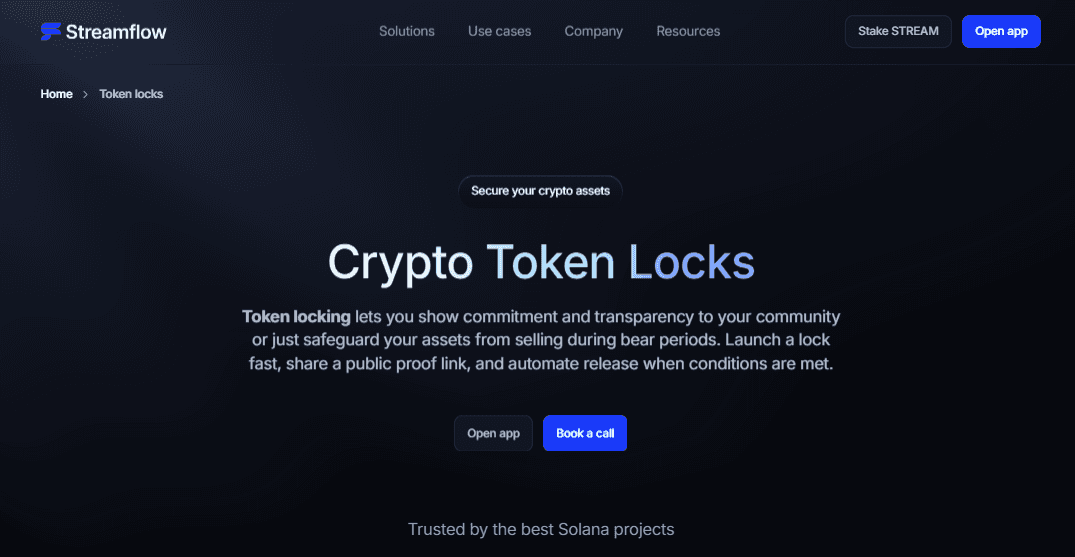
Streamflow enforces team token locks in about 37 seconds with public proof links.
The Headline Benchmark: 12-Month Cliff, 36 to 48 Months Total
If a founder asks how long to lock team tokens in 2026, the defensible answer is at least 12 months of zero release, then linear vesting through month 36 to 48. This is the range where institutional investors, public tokenomics trackers, and on-chain data converge. Anything shorter is flagged; anything longer is a differentiator rather than a requirement.
The benchmark breaks into three numbers worth memorizing:
Cliff: 12 months minimum for founders and core team, used by about 85% of projects
Total duration: 48 months is the modal schedule, 36 months is the common floor
Cadence after the cliff: monthly or continuous linear release, never a second large cliff
Streamflow's own customer base reflects this exactly, Bonk's core team vesting runs three years, UXD Protocol's schedule runs four years with a 12-month cliff, and Heavenland's runs five years with cliffs on every allocation. The benchmark is not theoretical; it is what committed Solana teams have already deployed.
Methodology and Data Sources
This report combines three source layers:
The first is Streamflow's internal data across 40,000+ projects, including the three published case studies and the platform's standard 12-month cliff guidance for founders and core team.
The second is external benchmark research, including Pulley's Token Compensation Insights report, Keyrock's analysis of 16,000+ unlock events, and Binance Research's 2024 launch cohort data on market-cap-to-fully-diluted-valuation ratios.
The third layer is public unlock calendar data from Tokenomist and CoinGabbar covering 2026 unlock volumes.
Where a source reports a range rather than a point estimate, the range is preserved. No trend figure in this report is estimated or extrapolated.

Finding 1: How Long Is the Standard Team Cliff in 2026?
The standard team cliff in 2026 is 12 months, and it functions as a floor rather than a target. Pulley's report puts the one-year cliff at roughly 85% of team grants, and Innmind's 2026 tokenomics guidance notes that institutional VCs flag any team cliff shorter than 12 months during due diligence.
Cliff benchmarks by stakeholder group:
Stakeholder group | 2026 cliff benchmark | Source |
|---|---|---|
Founders and core team | 12 months minimum | Pulley, Streamflow File of Truth |
Seed and private investors | 12 to 18 months post-TGE | Innmind 2026 tokenomics guidance |
Advisors | 3 to 6 months | Pulley, Innmind |
Treasury and ecosystem | Condition-based, not cliff-based | Streamflow vesting benchmarks |
The interpretation is simple: the cliff answers a commitment question, not a calendar question. For a founder, 12 months proves the team is still building after the launch hype fades. That is why Streamflow treats cliff vesting as the single most important design decision in any team allocation.
Finding 2: How Long Does the Full Team Schedule Run?
The full team schedule runs 36 to 48 months in most 2026 launches, with a meaningful minority stretching to 60 or 72 months. Pulley's data shows the distribution clearly, and Streamflow's case studies show the same spread on Solana.
Distribution of total team vesting length:
Total duration | Share of projects (Pulley) | Streamflow example |
|---|---|---|
36 months | 23% | Bonk, 20% of supply, 22 contributors |
48 months | ~85% (modal, with 1-year cliff) | UXD Protocol, ~46% of $UXP supply |
60 months | Not separately reported | Heavenland, 97% of $HTO supply |
72 months | 7% | None published |
Layer-1 launches skew toward the longer end. 8Blocks' 2026 vesting benchmarks note that modern L1s standardize on a 1-year cliff with total team vests of 3 to 4 years, and some foundation buckets stretch to 10 years. Pulley also found that 62% of projects combine a lockup with vesting for contributors, meaning the lock and the vest are increasingly designed as one instrument.
The practical takeaway is that 48 months is the number a project will be compared against. Streamflow's on-chain vesting supports linear, cliff, cliff-plus-linear, graded, milestone-based, and price-based models, so any of these durations can be deployed without custom contracts.
Finding 3: Why Cliff Timing Matters More Than Total Length
Cliff timing drives more price impact than total lock length because the market prices the cliff event, not the tail of the schedule. Keyrock's analysis of 16,000+ unlock events found 90% generated negative pressure, and the drawdown typically began around 30 days before the unlock date as traders front-ran the supply.
What amplifies the damage, per Keyrock and KuCoin's 2026 unlock research:
Cliff-style releases hit harder than linear releases of the same size
Unlocks larger than 2.4x average daily volume strain liquidity
Team and investor recipients sell more than community recipients
High unlock-to-circulating-supply ratios compound the effect
The scale of the problem is visible on public calendars. CoinGabbar's Tokenomist-sourced breakdown put unlocks between August 3 and September 3, 2026 at more than $1.28 billion, and KuCoin tracked March 2026 as the year's largest wave at over $6 billion entering circulation. Binance Research's 2024 launch cohort showed a median market-cap-to-FDV ratio of just 12.3%, which means most of a typical token's supply is still locked and waiting to unlock.
The implication for team allocations is to keep the cliff at 12 months but avoid a large one-day release when it ends. A cliff followed by continuous linear release spreads the supply so no single date becomes a scheduled short.
Streamflow's vesting contracts release per second after the cliff, and every recipient's progress is visible on Solscan or Solana Explorer.
Finding 4: Lock or Vest? Which Instrument Fits Which Allocation
The 2026 pattern is to lock allocations that need a single unlock event and vest allocations that need gradual release, and team tokens almost always belong in the second category. A token lock restricts tokens until one condition is met; a vesting schedule releases them progressively over time.
Instrument fit by allocation type:
Allocation | Benchmark instrument | Typical 2026 duration | Why |
|---|---|---|---|
Founders and core team | Cliff + linear vesting | 12-month cliff, 36 to 48 months | Sustained commitment signal |
Early investors | Lock, then linear vesting | 12 to 18 months lock | Post-TGE dump protection |
Advisors | Short cliff + linear vesting | 3-month cliff, 12 to 24 months | Matches engagement life |
Treasury / LP tokens | Fixed-date or price-based lock | Milestone or price dependent | Rug-pull and credibility proof |
Memecoin dev allocation | Quick lock or cliff | 12 months minimum | Instant trust at launch |
Streamflow supports both instruments from one interface. Token locks can be fixed-date, price-based, or quick locks, and locked tokens cannot be transferred, traded, or accessed before unlock. The platform's price-based token lock model also lets a team tie unlock to a price threshold rather than a calendar date, which removes the scheduled-event problem entirely.
Locks and vesting are also verifiable in the same way. Both generate public proof links, both show on Solscan, Solana Explorer, and RugCheck, and both run on contracts audited by FYEO and OPCODES.

Benchmarks by Project Type
Team token lock benchmarks shift by project category, mostly in total duration rather than cliff length. The 12-month cliff holds across categories; what changes is how far past it the schedule runs.
Category patterns visible in Streamflow data and external benchmarks:
Memecoins: 12-month cliff, 3-year linear is the credible template, as Bonk demonstrated for 22 contributors
DeFi and stablecoin protocols: 4-year linear with 12-month cliff, matching UXD Protocol and the Pulley modal
Metaverse and GameFi: 5-year schedules with cliffs on every allocation, as Heavenland deployed for 97% of supply
Layer-1s: 1-year cliff, 3 to 4-year total, with foundation buckets running far longer per 8Blocks
Memecoin creators often assume long locks are only for VC-backed protocols. Bonk's three-year schedule shows the opposite: a community token with 55% of supply airdropped still locked its core team for three years, and the resulting trust became part of the brand. Pumpfun token creators launching in 2026 face the same expectation, which is why Streamflow's standard flow is launch token, lock tokens, then build.
What This Means for Founders Designing a 2026 Lock
Founders should treat the 12-month cliff and 36 to 48-month total as the entry ticket to serious investor and community conversations, not as a maximum. Every benchmark source in this report converges on that range, and the on-chain data from 40,000+ Streamflow projects shows the range is what committed teams actually deploy.
The design work that separates good schedules from average ones happens after picking the duration:
Stagger cliffs across stakeholder groups so no single month stacks team and investor unlocks
Release linearly after the cliff instead of scheduling a second cliff event
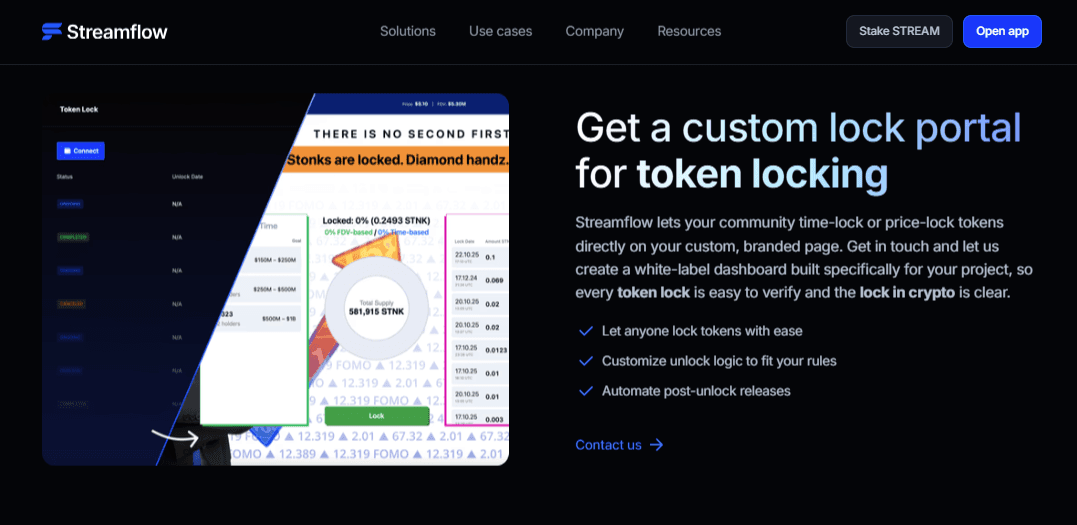
Publish proof links and a dashboard so the lock is verifiable, not just announced
Consider price-based conditions for treasury or ecosystem allocations
Execution should take minutes, not an engineering sprint. Teams can start with Streamflow and lock tokens in about 37 seconds, then layer vesting contracts with bulk CSV import for larger teams. Every contract is immutable once deployed, which is precisely what turns a lock from a promise into a signal.
Founders thinking past the launch should also plan the operational stack that follows. Streamflow Business extends locks and vesting into treasury management with USD+, payouts, on-chain cap tables, and tokenized SAFEs for teams building a company rather than just a token.
Looking Ahead: Where Team Token Locks Go in 2027
Three shifts in the 2026 data point to where team lock benchmarks head next.
Price-based and milestone-based unlocks will take share from pure calendar schedules. With 90% of calendar unlocks pressuring price, tying release to a price threshold or a delivered milestone removes the front-running window that Keyrock documented. Streamflow already supports both models for locks and vesting.
Verifiability becomes the benchmark, not just duration. A 48-month schedule that lives in a spreadsheet is worth less than a 36-month schedule with public proof links on Solscan. Public dashboards that show real-time release progress, cliff dates, and unlock events are becoming standard due diligence material.
Solana's cost structure keeps long schedules economically viable. With sub-second finality and near-zero fees, per-second linear release over five years costs almost nothing to run, which removes the last excuse for a large one-day cliff release.
Conclusion
The 2026 answer to how long to lock team tokens is a 12-month cliff followed by 36 to 48 months of linear release, with roughly 85% of projects using the one-year cliff and the strongest Solana teams running 3, 4, and 5-year schedules.
Unlock research shows the market prices cliff events 30 days early and punishes 90% of them, so the cliff should be honored and the release after it should be continuous.
Streamflow enforces exactly this structure on-chain for 40,000+ projects, with locks deployed in about 37 seconds, audited contracts, and public proof links.
The benchmark is settled; the differentiator in 2026 is whether a team can prove it is following it.
Read Next:
Does Staking Reduce Sell Pressure? What the Data Says About Token Staking and Price Stability
How Much Does Streamflow Cost? Full Breakdown of Vesting, Airdrop, and Token Lock Fees
Token Unlock Report: How Unlock Events Impact Price Across the Market
FAQs:
1. How long should you lock team tokens in 2026?
You should lock team tokens in 2026 for a 12-month cliff followed by 36 to 48 months of linear release. Roughly 85% of projects use the one-year cliff, and 48 months is the most common total schedule. Streamflow enforces both the cliff and the linear release through immutable on-chain contracts.
2. What is the standard cliff for founders and core team tokens?
The standard cliff for founders and core team tokens is 12 months, and it functions as a minimum rather than a target. Institutional investors flag anything shorter during due diligence. Advisors typically get 3 to 6 months and investors 12 to 18 months post-TGE.
3. Is a token lock or a vesting schedule better for team allocations?
A vesting schedule is better for team allocations because it releases tokens gradually after the cliff instead of in one unlock event. A token lock fits allocations that need a single unlock, such as treasury or LP tokens. Streamflow supports both from one interface, including price-based conditions for either.
4. How does Streamflow enforce a team token lock on Solana?
Streamflow enforces a team token lock on Solana through audited, immutable smart contracts that restrict transfer until the unlock condition is met. Locks can be fixed-date, price-based, or quick locks, take about 37 seconds to deploy, and generate public proof links verifiable on Solscan, Solana Explorer, and RugCheck.
5. Do longer team lock periods actually protect token price?
Longer team lock periods protect token price mainly by pushing the cliff event past the launch window and spreading release afterward. Keyrock's study of 16,000+ unlocks found 90% created negative pressure starting about 30 days before the event, so linear release after a 12-month cliff reduces the size of any single scheduled unlock. Projects like Heavenland used 5-year linear vesting specifically to allow liquidity without excessive inflation.
