General
10 Key Benefits of Streamflow Business: Why Solana Teams Run Vesting, Staking, and Airdrops on One Platform
Per Solana Foundation's May 2026 ecosystem roundup, Bullish tokenized its entire 151-million-share cap table on Solana following its acquisition of Equiniti.
Real corporate financial operations are moving on-chain, and the tooling gap is now the bottleneck.
Streamflow is the Solana-native token operations infrastructure platform behind $407M+ in total value locked, 1.3M+ users, and more than 40,000 projects.
Most teams do not arrive at Streamflow with a single problem. They arrive with a vesting schedule in a spreadsheet, an airdrop planned in a separate tool, a staking program quoted by an agency, and a contributor payroll run through manual transfers. Each of those pieces carries its own contract risk, its own audit question, and its own reconciliation cost.
Streamflow Business consolidates that stack. Below are the ten benefits that matter most when a Solana team evaluates whether to run vesting, staking, airdrops, locks, and payouts on one platform instead of four.
Key Takeaways
Streamflow Business consolidates token vesting, locks, staking, airdrops, and payouts into one platform.
Audited, immutable smart contracts remove admin override risk across every Streamflow distribution contract.
Streamflow supports airdrops to one million recipients and no-code staking for any SPL token.
Over 40,000 projects and $407M in total value locked run on Streamflow infrastructure.
Streamflow Business adds treasury management, on-chain cap tables, and tokenized SAFE agreements for founders.
The Criteria for Evaluating a Token Operations Platform
Before ranking benefits, it helps to fix the evaluation criteria. Token operations decisions are hard to reverse because deployed contracts are immutable and recipients are already holding claims against them. Four criteria separate infrastructure from tooling.
Contract coverage: does one platform handle locks, vesting, airdrops, staking, and payouts?
Verifiability: can any third party confirm the schedule on a block explorer without trusting the issuer?
Scale ceiling: what happens at 100,000 recipients rather than 500?
Audit posture: who audited the contracts, and can the team unilaterally alter them after deployment?
A platform that scores well on one criterion and poorly on the others creates fragmentation, which is the exact cost teams are trying to eliminate. Streamflow was built to score on all four.
Top 10 Benefits of Streamflow Business
1. One Contract Layer for the Entire Token Lifecycle
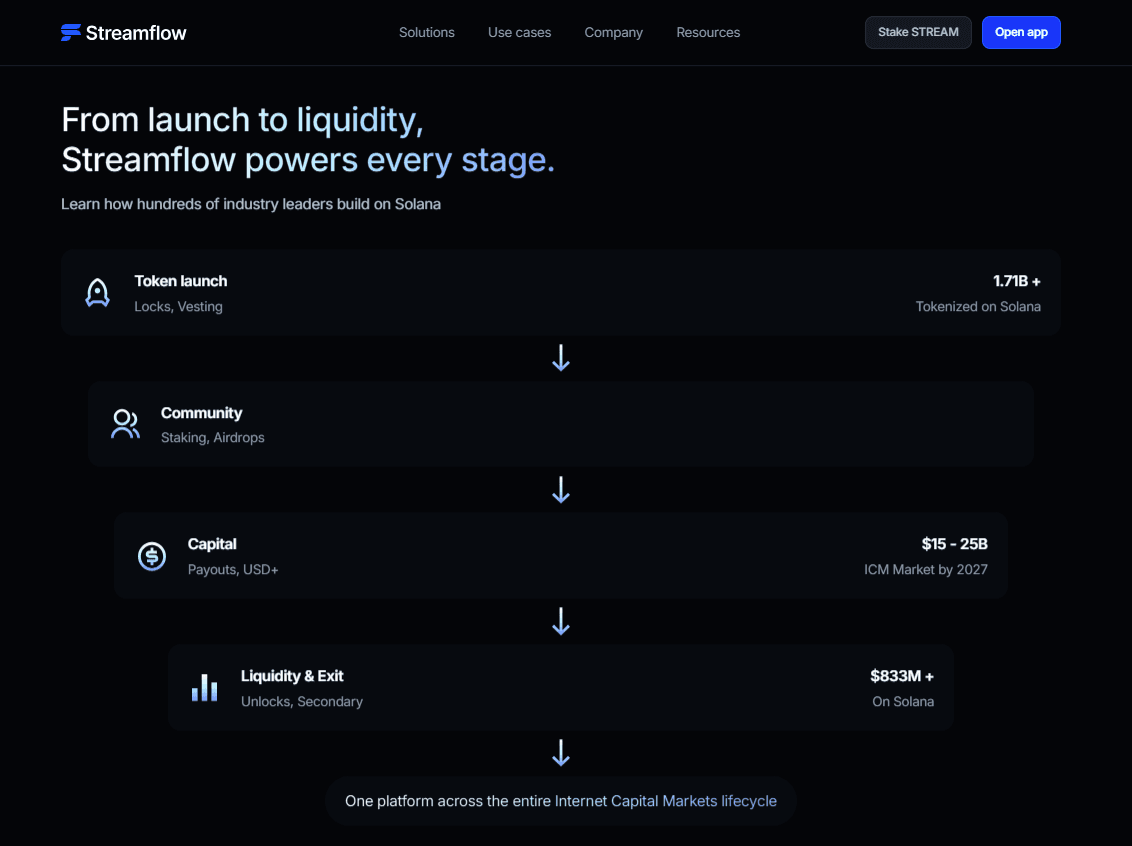
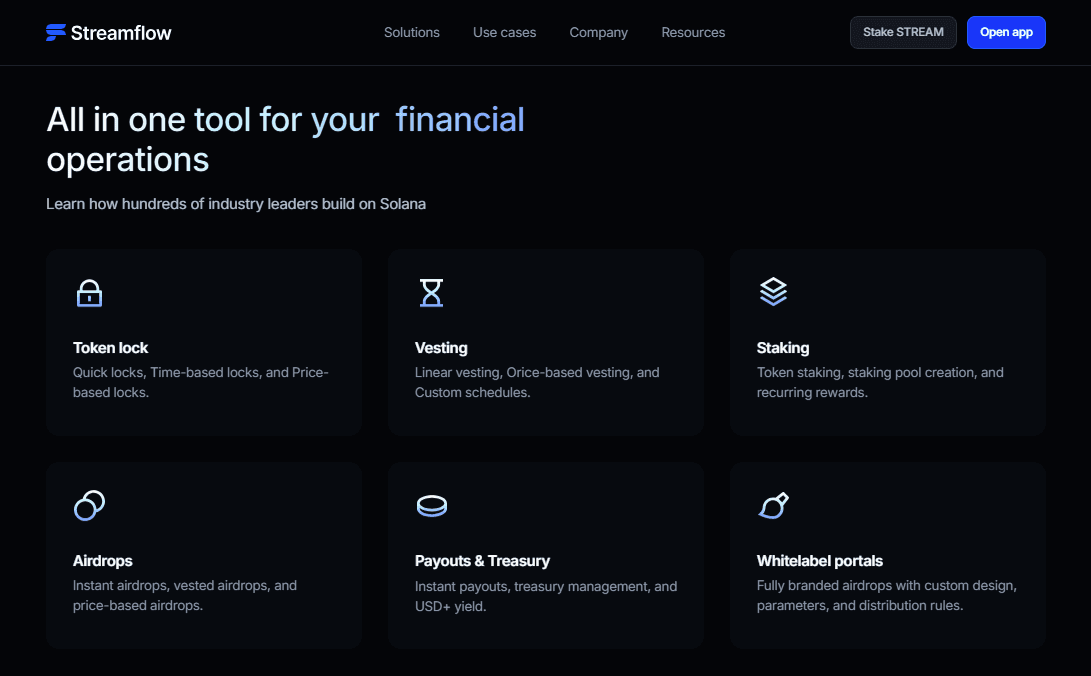
The core benefit of Streamflow Busines is consolidation. Streamflow covers token minting, locks, vesting, airdrops, staking, tokenomics reporting, and programmable payouts inside a single system with one integration surface and one security model.
Token mint, locks, and vesting for launch and cap-table allocations
Airdrops, claim portals, and staking pools for growth and retention
Payouts, recurring transfers, and escrow for ongoing operations
A team launching on Solana can mint the token, lock the liquidity allocation, deploy team vesting, run the airdrop, and open a staking pool without leaving the platform or commissioning a second audit.
You can open the Streamflow app and see the full contract set in one place. That consolidation is what turns tokenomics from a document into an executed system.
2. Audited, Immutable Contracts With No Admin Override
Every Streamflow contract is enforced on-chain and cannot be unilaterally altered after deployment. The smart contracts have been audited by FYEO and OPCODES, and execution is verifiable on Solscan and Solana Explorer.
Audited by FYEO and OPCODES
Immutable once deployed, with no admin override
Every distribution verifiable through public explorers and proof links
For an investor reviewing a team allocation, this is the difference between a promise and a constraint. A token schedule that the founding team can quietly amend is not a commitment.
Streamflow removes that discretion from the contract entirely, which is precisely why the contracts function as trust infrastructure rather than internal tooling.
3. Token Locks That Work as a Public Trust Signal
Token locks restrict tokens from being transferred, sold, or accessed until a defined date, time period, or price level is met. On Solana, where a 2026 academic study flagged 76,469 rug pulls among 100,063 new token issuances in the first half of 2025, verifiable lock proof has become a baseline screening signal rather than a differentiator.
Time-based, price-based, and quick locks
Public proof links and dashboard visibility for any observer
Verification through Solscan, Solana Explorer, and third-party checkers
Streamflow's transparent token locks on Solana take roughly 37 seconds to configure through the no-code interface. Locking a team allocation before the first exchange listing costs less than a minute and materially changes how the market reads the launch.
4. Vesting Models That Match Real Cap-Table Structures
Most vesting tools support linear release and stop there. Real cap tables need different logic for founders, advisors, investors, DAO treasuries, and ecosystem incentives, which is why Streamflow supports multiple release mechanics on the same platform.
Linear, cliff, and cliff-plus-linear schedules
Graded, milestone-based, and price-based vesting
Custom intervals, bulk CSV creation, and vesting top-ups
More than $1 billion in industry-wide token unlocks were expected in June 2026 alone, according to CryptoBriefing, and unlock structure is what determines whether those events are absorbed or dumped.
Heavenland placed 97% of its $HTO supply on a 5-year linear schedule with cliffs on every allocation, allowing initial liquidity without excessive inflation.
That range of automated token vesting models is what lets a single platform serve both a memecoin launch and a four-year institutional cap table.
5. Airdrop Distribution That Scales to One Million Recipients
Airdrop execution breaks at scale, not at concept. Streamflow supports campaigns of up to 1,000,000 recipients, with 100,000 recipients per CSV import, which removes the operational ceiling that forces teams into batched manual transfers.
Instant, vested, price-based, and white-label airdrop types
Claim portals with real-time delivery and claim status tracking
Audience segmentation, eligibility filtering, and unclaimed token recovery
A protocol running a snapshot-based distribution can filter eligibility, launch a claim window, vest tokens on claim, and reclaim anything unclaimed at the end. Structuring Solana airdrops as vested rather than instant is also the simplest lever teams have against day-one sell pressure.
6. No-Code Staking Pools for Any SPL Token
Building staking infrastructure in-house means writing, auditing, and maintaining reward contracts. Streamflow lets teams deploy fully non-custodial pools for any SPL token without engineering overhead, with configurable APY, lock periods, and reward logic.
Fund Once, Continuous Funding, Governance Staking, and Custom pool types
Automated reward distribution, easy top-ups, and stake receipts
Real-time staking data across Phantom, Solflare, Backpack, and all Solana wallets
One caveat worth planning for: if a pool's rewards deplete, distribution stops until it is topped up, so funding cadence needs to be part of the design. Streamflow's own STREAM model shows the alternative structure, where rewards are funded by real protocol revenue and hourly buybacks rather than inflationary emissions.
Teams that want a bespoke program can use Streamflow's custom managed staking with white-glove onboarding, or deploy no-code staking pools themselves in minutes.
7. A Tokenomics Dashboard That Acts as a Single Source of Truth
Once a project runs multiple contracts, the reporting problem becomes as expensive as the execution problem. Streamflow's tokenomics dashboard consolidates vesting contracts, token locks, staking pools, and more into one real-time view.
Real-time release progress, cliff dates, and unlock events
Centralized contract overview across every allocation
Public-by-default visibility, with private and investor-facing variations
When an exchange, a fund, or a community member asks what the actual unlock calendar looks like, the answer is a URL rather than a spreadsheet export. That is the practical meaning of a single source of truth for token distribution.
8. Programmable Payouts and On-Chain Payroll
Payouts are where token operations meet finance operations. Streamflow supports recurring payout contracts that can be used for payroll-style payments to employees, contractors, and contributors, and those contracts can be funded over time without redeploying anything.
Recurring transfers and contributor payouts
On-chain payroll denominated in tokens
Programmable payments tied to time, milestones, or usage
For a Web3 CFO, the benefit is mass payout without manual processing and without a monthly reconciliation exercise across dozens of wallets. Salaries, consulting agreements, subscriptions, and milestone-based grants all run on the same programmable transfer primitive.
9. Treasury Management, Cap Tables, and Ownership Issuance
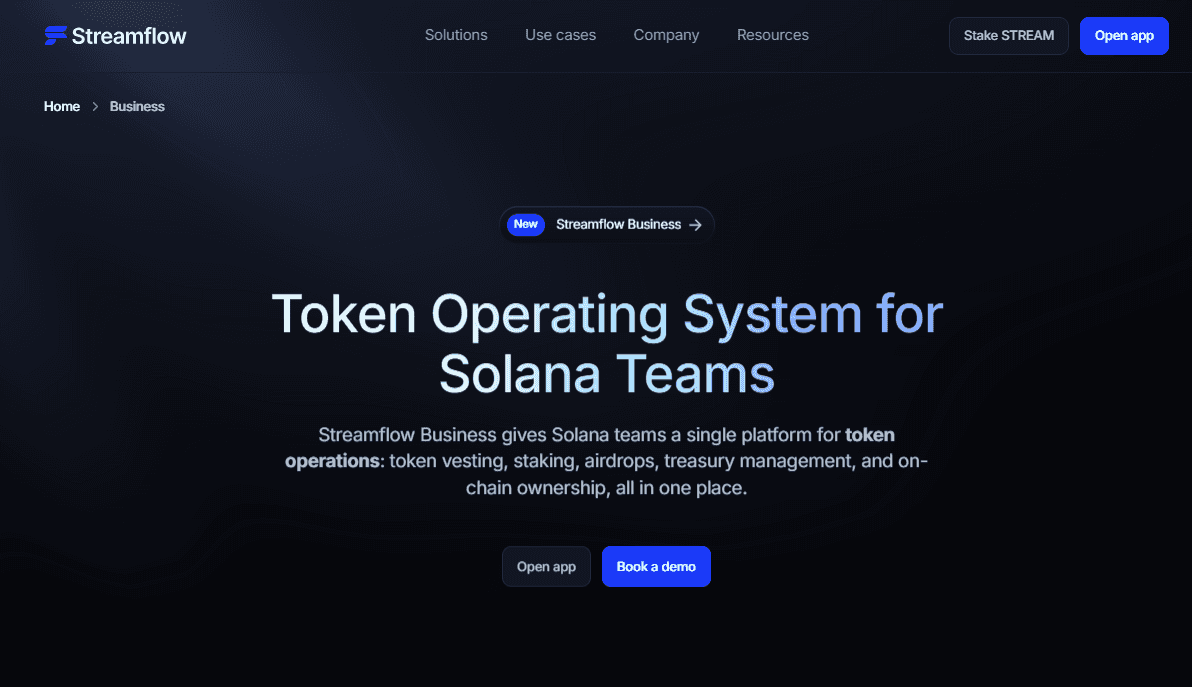
This is the benefit specific to the Business tier. Streamflow Business, the financial OS for Internet Capital Markets, extends beyond token operations into the financial stack a company actually needs to build long-term value on Solana.
Treasury management through USD+
On-chain cap tables and tokenized SAFE agreements
Ownership issuance, future lending against ownership tokens, and a marketplace
The framing matches where the ecosystem is heading, with real equity structures being tokenized on Solana rather than described off-chain. Streamflow's tagline captures the intent directly: from vesting to ownership, build real companies, not just tokens.
10. White-Label Portals and an SDK So the Experience Stays Yours
Consolidation should not mean sending your community to someone else's interface. Streamflow's white-label layer lets teams launch fully branded token distribution portals on top of the same audited infrastructure.
Custom claim, lock, staking, and airdrop portals
Branded dashboards with full UI control
Bespoke onboarding and custom-built staking programs by the Streamflow team
For developers, the public SDK allows vesting, distribution, and reward logic to be embedded directly into a dApp.
UXD Protocol integrated the Streamflow SDK into Realms so that governance participation and token claiming lived in the same interface, which is the clearest example of infrastructure disappearing into a product.
How to Choose the Right Setup for Your Team
The decision is rarely between Streamflow and a single competitor. It is between one consolidated contract layer and four separate ones.
A short checklist:
Launching a token and need a trust signal fast: start with locks, then vesting.
Distributing to more than 30,000 wallets: you need the enterprise airdrop tier, not a claim tool.
Paying contributors in tokens monthly: use recurring payout contracts rather than manual sends.
Managing treasury, SAFEs, or a cap table: this is Streamflow Business territory.
Cost also favors consolidation on Solana. With 65,000+ TPS, sub-second finality, and near-zero fees, running dozens of contracts across many stakeholder groups is economically viable in a way it is not on higher-fee chains.
Case Study: Bonk and UXD Protocol
Bonk, the Solana meme coin that allocated 55% of supply to airdrops for early Solana users, used Streamflow for core team vesting. Bonk placed 20% of total supply across 22 early contributors on a 3-year linear vesting schedule. The outcome was verifiable transparency for a community that had every reason to be skeptical of insider allocations.
UXD Protocol took the same infrastructure in a different direction. The decentralized stablecoin provider distributed approximately 46% of $UXP supply through Streamflow on a 4-year linear schedule with a 12-month cliff, integrating the SDK into Realms so stakeholders could claim tokens and vote in one place.
Two very different projects, one contract layer. That is the argument for consolidation in its most concrete form.
Conclusion
Real financial operations are moving on-chain, and the teams that survive the transition are the ones running token operations as infrastructure rather than as a series of manual events.
Streamflow consolidates locks, vesting, airdrops, staking, payouts, and treasury management into one audited system already trusted by more than 40,000 projects and $407M+ in total value locked.
Book a demo to see how Streamflow handles vesting, staking, and airdrops for your token on a single platform.
Read Next:
How to Distribute SPL Tokens on Solana: Airdrops, Vesting, and Bulk Distribution Tools
How to Verify a Token Lock On-Chain: Step-by-Step Checklist for Solscan and Etherscan
FAQs:
1. What are the main benefits of Streamflow Business?
The main benefits of Streamflow Business are consolidation and enforceability. It combines token locks, vesting, airdrops, staking, payouts, treasury management through USD+, on-chain cap tables, and tokenized SAFE agreements in one platform. Every contract is audited, immutable once deployed, and verifiable on Solana block explorers.
2. Can Solana teams run vesting, staking, and airdrops on one platform?
Yes, Solana teams can run vesting, staking, and airdrops on one platform with Streamflow. All three sit on the same audited contract layer, sharing one integration, one security model, and one tokenomics dashboard. This removes the reconciliation and audit cost of running three separate tools.
3. How large an airdrop can Streamflow handle?
Streamflow can handle airdrops of up to 1,000,000 recipients per campaign, with 100,000 recipients per CSV import. Standard plans cover roughly 30,000 recipients, and larger campaigns move to the enterprise tier. Airdrops can be instant, vested, or price-based depending on the distribution strategy.
4. Is Streamflow secure enough for a full cap table?
Streamflow is secure enough for a full cap table because its smart contracts are audited by FYEO and OPCODES, immutable once deployed, and carry no admin override. Heavenland placed 97% of its token supply on a 5-year vesting schedule through the platform. Every allocation remains verifiable on Solscan and Solana Explorer.
5. What is the difference between Streamflow and Streamflow Business?
The difference between Streamflow and Streamflow Business is scope. Streamflow provides trust infrastructure for token launches, centered on token locks and vesting. Streamflow Business extends that into a full financial operating system with treasury management, payouts, on-chain cap tables, tokenized SAFEs, and ownership issuance.