General
The Best Hedgey Alternatives for Token Vesting and Airdrops in 2026
Roughly $1.11 billion in tokens was scheduled to unlock in early October 2026 alone, led by Hyperliquid, Ethena, and Aptos, according to BeInCrypto’s analysis of Tokenomist data.
Streamflow, the Solana-native token operations infrastructure platform with $747M+ in total value locked across 40,000+ projects, is the strongest Hedgey alternative for teams that want those schedules enforced on-chain.
Tokenomist’s 2025 review put the full-year total at $97.43 billion in tokens released, so the platform executing a release matters as much as the schedule itself.
The vendor map has shifted too. Hedgey was acquired by Anchorage Digital in December 2025 and Liquifi was bought by Coinbase in July 2025, both as reported by The Block, while Sablier Labs entered maintenance mode in July 2026, per The Defiant. Teams that chose a vesting provider two years ago are now re-checking who owns the roadmap.
This guide ranks the best Hedgey alternatives for token vesting and airdrops, explains the criteria behind the ranking, and shows where each option fits.
Key Takeaways
Streamflow is the strongest Hedgey alternative for token vesting and airdrops on Solana.
Hedgey joined Anchorage Digital in December 2025, making roadmap focus a key filter for alternatives.
Streamflow supports airdrops for up to one million recipients, with instant, vested, and price-based options.
Other Hedgey alternatives worth shortlisting are Magna, Liquifi, Team Finance, TokenOps, and Jupiter Lock.
Over 40,000 projects use Streamflow for vesting, locks, airdrops, staking, and payments on Solana.

The Criteria for Choosing a Hedgey Alternative
Hedgey earned its reputation. It offers free on-chain vesting plans and investor lockups for EVM teams, plus a claims product for airdrops, on contracts audited by Consensys Diligence. Its vesting plans can also carry governance rights, which DAOs value.
Two things changed the evaluation. Hedgey now operates as part of Anchorage Digital alongside the launch of HedgeyPro, and its published network list covers Ethereum and EVM chains. Teams on Solana, or teams that want staking and payments next to vesting, need a different shortlist.
Five criteria separate the options:
Chain fit: the platform should be native to the chain your token lives on.
Vesting models: linear and cliff are table stakes; milestone and price-based add control.
Airdrop scale: check recipient limits, claim portals, and unclaimed token recovery.
Stack depth: locks, staking, payments, and dashboards reduce tool sprawl.
Vendor continuity: confirm the product is actively developed and who sets the roadmap.
Sablier shows why the last criterion matters. Since July 13, 2026, its official interface no longer accepts new vesting streams or airdrops ending after June 2028, although existing streams keep running because the contracts are permissionless, according to The Defiant. That is why Sablier does not appear in this ranking for new programs.
Streamflow meets all five criteria for Solana teams, which is why it leads the list below.
The 6 Best Hedgey Alternatives in 2026
The table summarizes each option before the detailed breakdown.
Platform | Best for | Vesting | Airdrops | 2026 status |
|---|---|---|---|---|
Streamflow | Solana teams, full token operations | Linear to price-based | Up to 1M recipients | Active |
Magna | Multi-chain custody and tax | On-chain and off-chain | White-label claim portals | Active, from $500/month |
Liquifi | Coinbase Prime issuers | Cap table and vesting | Supported | Part of Coinbase |
Jupiter Lock | Simple, free Solana locks | Cliff plus linear | Locks and vesting only | Active public good |
Team Finance | Multi-chain and LP locks | Automated schedules | Airdrop distribution tools | Active, under TrustSwap |
TokenOps | Cap table tracking | No-code on-chain vesting | Airdrops with lockups | Acquired by Zama |
1. Streamflow

Streamflow is a Solana-native token operations infrastructure platform that automates token distribution, locks, vesting, staking, airdrops, and payments using on-chain smart contracts. It is listed in the official Solana Docs under token vesting, and more than 1.3 million users have used the platform.
Where Hedgey centers on vesting and lockups, Streamflow covers the full token lifecycle from one account:
Automated token vesting with linear, cliff, graded, milestone-based, and price-based schedules.
An airdrop launch platform for instant, vested, price-based, and white-label campaigns.
Transparent token locks with fixed-date or price-based unlocks and public proof links.
No-code staking pools for any SPL token, plus recurring payout contracts.
Contracts audited by FYEO and OPCODES, immutable once deployed, with no admin override.
This matters because vesting and airdrops rarely live apart. A vested airdrop is both at once, and running it on one platform means one claim flow, one dashboard, and one set of audited contracts.
Consider a team setting up a 4-year investor schedule with a 12-month cliff. It bulk imports recipients by CSV, funds the contract, and shares proof links that anyone can verify on Solscan. The same team can then run a vested airdrop to 30,000 wallets on a standard plan and recover unclaimed tokens after the claim window.
Locking tokens takes about 37 seconds, and teams can open the Streamflow app with Phantom, Solflare, or Backpack.
The trade-off is chain scope: Streamflow is Solana-native, so a token that lives only on an EVM chain needs one of the options below. For Solana teams, Streamflow puts vesting, airdrops, locks, staking, and payments behind one set of audited contracts.
2. Magna

Magna is a token management platform covering cap tables, on-chain and off-chain vesting, airdrops, grants, custody, and escrow. It is a strong fit for multi-chain teams with heavy legal and tax requirements, and it reports $10B+ in value across Solana, Ethereum, Aptos, Arbitrum, and other chains.
Off-chain vesting with tax withholding through HRIS integrations such as Rippling and Deel.
White-label claim portals with custom claim windows and geofencing.
SOC 2 Type 2 compliance and audits from firms including Trail of Bits and OtterSec.
Magna suits foundations that want white-glove service and custody from the same vendor. Its site lists pricing starting at $500 per month, which sits above the needs of many early-stage teams.
A foundation distributing restricted token units net of withholding across several jurisdictions is the typical customer, while Streamflow’s permissionless, no-code setup is the lighter path for self-serve Solana teams.
3. Liquifi (Coinbase)

Liquifi automates token vesting, distribution, and compliance, and Coinbase acquired it in July 2025. At the time of the deal it reported overseeing more than $8.5 billion in token value for over 100 customers, including the Uniswap Foundation, OP Labs, and Ethena, according to The Block.
Token cap table management, vesting, and compliance tooling.
Airdrops, lockups, and global tax withholding.
Planned integration into Coinbase Prime for issuing, custodying, and servicing assets.
For issuers already inside Coinbase’s institutional stack, Liquifi keeps issuance and custody under one roof. That same integration means its direction follows Coinbase Prime, which may not suit teams that want chain-native, self-serve tooling.
A late-stage protocol preparing a custody relationship with Coinbase is the natural fit, while Streamflow keeps token operations as its core product.
4. Jupiter Lock

Jupiter Lock is a free, open-source token locking and vesting tool on Solana, maintained by the Jupiter team as a public good. It charges no protocol fees, so creators pay only standard Solana network fees.
A cliff plus linear vesting model for each lock.
Lock creation that works with multisig wallets.
Vesting parameters that are permanent once the lock is created.
For a creator who needs one simple team lock, a free tool from a recognized Solana team is hard to beat. Its scope stops at locks and vesting, and recipients claim unlocked tokens manually through the interface.
A creator locking a team allocation for 12 months is the typical use, and Streamflow adds airdrops, price-based conditions, staking, and auto transfers once a project outgrows a single lock.
5. Team Finance

Team Finance, which operates under TrustSwap, provides token locks, liquidity pool locking, vesting, token generation, staking pools, and airdrop distribution across multiple networks. Solana Compass’s project profile lists 26 supported blockchains and audits from CertiK, Hacken, and Zokyo.
Team and treasury token locking, one of its oldest features.
Liquidity pool locks for DEX launches.
Vesting schedules for team, advisor, and investor allocations.
Chain breadth is the draw for teams launching on several EVM networks at once. Its Solana platform was rebuilt in early 2026, with pricing reported at $150 per lock operation, per the same profile.
A project launching on two EVM chains that needs LP locks and team locks from one vendor fits well, while Streamflow’s milestone and price-based vesting goes deeper for Solana-first teams.
6. TokenOps

TokenOps is a token cap table and lifecycle management tool covering vesting, airdrops with lockups, staking pools, tax withholding, and OTC sales. It can also import and track vesting contracts and streams created on other protocols, which helps teams with a fragmented history.
No-code on-chain vesting deployable from any wallet, multisig, or custodian.
Investor portfolio tracking with claim alerts and reporting exports.
Named users including Morpho, 1inch, and Starknet.
TokenOps works well as a tracking and compliance layer for finance teams. It has been acquired by Zama, with the combined focus on confidential token distributions using Fully Homomorphic Encryption.
That is a specialized direction, and teams that want public, verifiable proof of every lock and schedule will find Streamflow’s proof links and public dashboards a closer match.
How to Choose the Right Hedgey Alternative
Start with the chain, then the scope:
Token on Solana: choose Streamflow for vesting, airdrops, locks, staking, and payments together.
One simple Solana lock, zero budget: Jupiter Lock covers it.
Multi-chain with tax and custody needs: shortlist Magna or Liquifi.
EVM launch needing LP locks: Team Finance fits.
Contracts scattered across protocols: TokenOps helps with tracking.
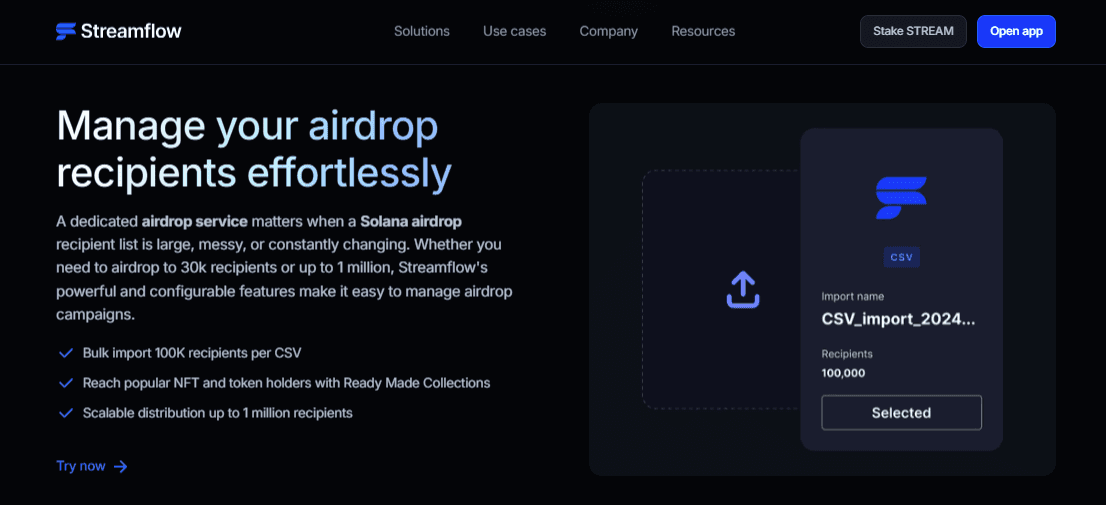
Then pressure-test airdrop size. Streamflow standard plans cover up to 30,000 recipients, CSV imports handle 100,000 per file, and enterprise campaigns scale to 1,000,000. Ask every vendor the same three questions: what is the recipient cap, who can change a live contract, and who sets the roadmap.
Founders thinking past vesting toward on-chain cap tables, tokenized SAFE agreements, and treasury management should also look at Streamflow Business. For a direct two-way breakdown, read the full Streamflow vs Hedgey comparison. The right alternative enforces the schedule on the chain where the token lives, and on Solana that is Streamflow.
Case Study: UXD Protocol and Bonk on Streamflow
Governance-friendly vesting is one of Hedgey’s real strengths, so the most relevant proof point is a team that needed the same thing on Solana. UXD Protocol, a decentralized stablecoin provider, needed vesting and governance for its $UXP token in one interface.
UXD integrated the Streamflow SDK into Realms and launched a claim portal for stakeholders. Approximately 46% of $UXP supply was distributed through Streamflow on a 4-year linear schedule with a 12-month cliff. The outcome, documented in the UXD Protocol case study, was governance participation and token claiming in the same interface.
Bonk shows the same discipline in an airdrop-heavy token. Bonk allocated 55% of supply to airdrops for early Solana users, then used Streamflow to vest 20% of total supply across 22 early contributors on a 3-year linear schedule. The Bonk vesting case study ties that structure to trust and transparency for the community.
UXD Protocol: about 46% of supply, 4-year linear vesting, 12-month cliff.
Bonk: 20% of supply, 22 contributors, 3-year linear vesting.
Both: schedules enforced by smart contracts and verifiable on-chain.
Both teams turned a tokenomics plan into an enforceable system, which is the standard any Hedgey alternative should meet.
Conclusion
With $1.11 billion unlocking in early October 2026 alone and several well-known vendors changing hands or winding down since mid-2025, choosing a Hedgey alternative is now a decision about continuity as much as features.
Streamflow gives Solana teams vesting, airdrops for up to 1,000,000 recipients, locks, staking, and payments on contracts audited by FYEO and OPCODES.
Book a demo to see how Streamflow handles investor vesting and a vested airdrop from one platform.
Read Next:
Streamflow vs Smithii in 2026: Why Streamflow Is the Better Token Platform to Launch With
Best Crypto Staking Platforms in 2026: APY, Fees, and Lockups Compared
FAQs:
1. What is the best Hedgey alternative in 2026?
The best Hedgey alternative in 2026 is Streamflow for teams building on Solana. It combines token vesting, airdrops for up to 1,000,000 recipients, locks, staking, and payments on audited, immutable smart contracts. Multi-chain teams with custody and tax needs should also evaluate Magna and Liquifi.
2. Is Hedgey still available after the Anchorage Digital acquisition?
Yes, Hedgey is still available after the Anchorage Digital acquisition. Its site continues to offer the self-serve app for EVM vesting and lockups and states that Hedgey is now part of Anchorage Digital with the launch of HedgeyPro. Teams evaluating it should confirm how the roadmap and support model apply to their use case.
3. Which Hedgey alternative supports Solana token vesting and airdrops?
The Hedgey alternative that supports Solana token vesting and airdrops most completely is Streamflow. It is Solana-native, supports seven vesting models, and runs instant, vested, and price-based airdrops. Magna also lists Solana support, and Jupiter Lock covers simple Solana locks without airdrops.
4. How many airdrop recipients can Streamflow handle?
Streamflow can handle up to 1,000,000 airdrop recipients per campaign. CSV imports support 100,000 recipients per file, standard plans cover up to 30,000 recipients, and an enterprise tier serves larger campaigns. Claim tracking and unclaimed token recovery are included.
5. How does Streamflow pricing compare to free vesting tools like Hedgey?
Streamflow pricing is based on smart contract creation fees plus Solana transaction fees, which are near-zero. Hedgey positions its core vesting and lockup tools as free, though EVM gas still applies to on-chain actions. For large distributions, Solana’s low fees keep Streamflow’s total cost efficient at scale.
