General
Best Token Lock Platforms on Solana: 2026 Comparison of Streamflow, Jupiter Lock, Sablier & StakePoint
The crypto industry processed roughly $97 billion in token unlocks during 2025, and March 2026 alone was projected to release more than $6 billion across 144 projects, according to Tokenomist and CryptoRank data compiled by BlockEden.
Supply overhang at that scale is why locking has become the first thing investors check before they check a chart.
Streamflow, the Solana-native token operations infrastructure platform, now secures over $309 million in total value locked across 40,000+ projects and 1.3M+ users.
Token locks are the cheapest credibility a Solana team can buy. They restrict tokens from being transferred, sold, or accessed until a predefined date or price condition is met, and they leave permanent on-chain proof that the restriction exists.
The problem is that "locker" now describes four very different products, from a free single-purpose escrow tool to a full token operations stack.
This comparison breaks down what each platform actually does, where each one wins, and how to pick the right fit for your allocation type.
Key Takeaways
Streamflow leads token lock platforms on Solana with $309M+ in total value locked.
Jupiter Lock, Sablier, and StakePoint each solve narrower slices of Solana token locking.
Strong token lock platforms combine price-based unlocks, public proof links, and audited immutable contracts.
Streamflow locks tokens in roughly 37 seconds with no code and explorer verification.
Over 40,000 projects use Streamflow for token locks, vesting, and on-chain distribution.
What Separates a Serious Token Lock Platform From a Basic Locker
Most Solana token lockers can move tokens into an escrow account and hold them until a date. That is table stakes. The differences show up in what happens around the lock, which is where investor trust is actually won or lost.
Use these five criteria when evaluating any token lock platform on Solana:
Public verifiability: Can anyone confirm the lock without your help, on Solscan or a public dashboard?
Unlock condition flexibility: Time-based only, or also price-based and milestone-driven?
Immutability and audits: Can the deployer quietly cancel or edit the lock after creation?
Token coverage: SPL tokens, LP tokens, and newer standards all behave differently at lock time.
Operational breadth: Does the lock connect to vesting, airdrops, and staking, or does it dead-end?
The fifth criterion is the one teams underweight. A lock is rarely a standalone action. It is step one of a distribution plan that will also need contributor vesting, an unlock schedule investors can track, and eventually a claim flow, and stitching that across four vendors creates exactly the fragmentation locking was supposed to prevent.
Here is how the four platforms compare across those criteria.
Feature | Streamflow | Jupiter Lock | Sablier | StakePoint |
|---|---|---|---|---|
Time-based locks | Yes | Yes | Yes (Timelock curve) | Yes |
Price-based unlocks | Yes | Not offered | Not offered | Not offered |
LP token locking | Yes | Limited to token escrow | Not supported on Solana | Yes, multiple DEXs |
Vesting alongside locks | Full model range | Linear and cliff | Linear and cliff curves | Locking focused |
Airdrops in same platform | Up to 1M recipients | Not offered | Instant airdrops only | Not offered |
Public proof links | Yes, plus dashboards | Yes, on-chain escrow | Yes, on-chain | Yes, public lock page |
Audits | FYEO and OPCODES | OtterSec and Sec3 | Publicly documented audits | Stated as audited |
Scale on Solana | $309M+ TVL, 40K+ projects | Backed by Jupiter | Solana live since 2025 | Launch-stage focused |
Criteria in hand, the four platforms sort cleanly by job.
The 4 Best Token Lock Platforms on Solana in 2026
1. Streamflow: Best Overall Token Lock Platform on Solana
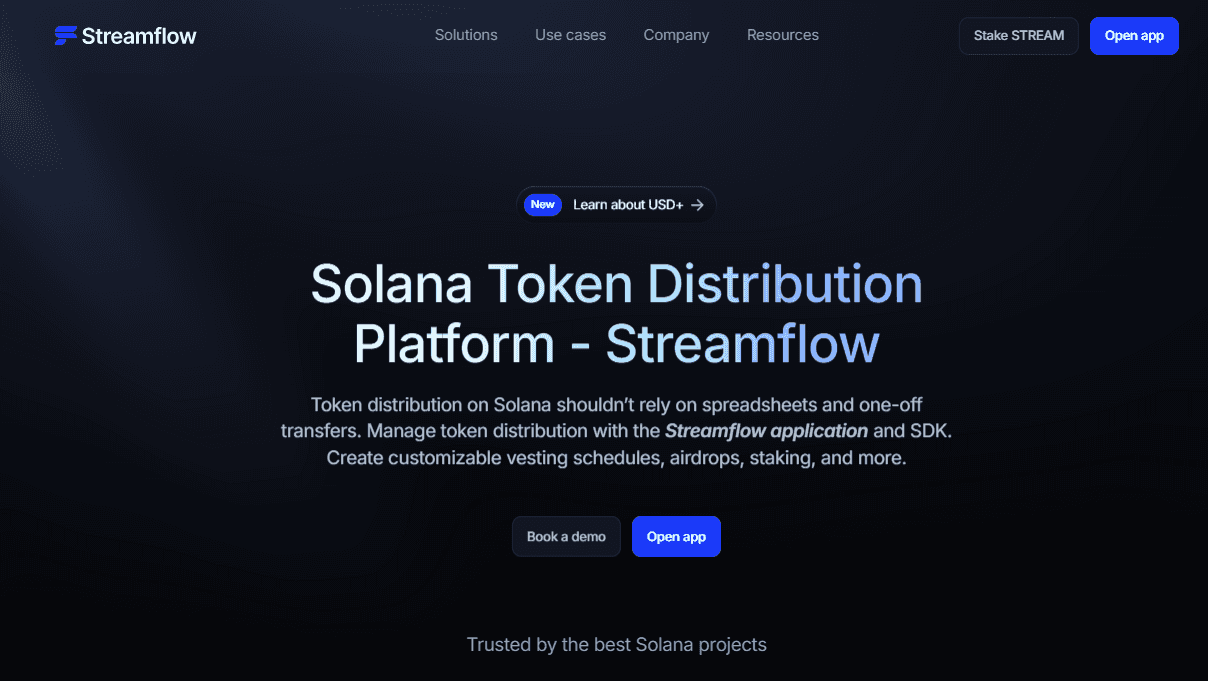
Streamflow is the most complete option because locking is one function inside a broader token operations layer rather than the entire product. It is the best token lock platform built for Solana that also runs vesting, airdrops, staking, payouts, and a tokenomics dashboard through the same audited smart contract infrastructure.
Locked tokens on Streamflow cannot be transferred, traded, or accessed before the unlock criteria are met, and every lock produces a shareable proof link.
Key capabilities:
Fixed-date unlocks and quick locks for immediate trust signals at launch
Price-based token locks that release supply only when the token hits a threshold
SPL token and LP token support for team, treasury, and liquidity allocations
Automatic release on unlock, with no manual claim step required from the team
Verification on Solscan, Solana Explorer, and RugCheck
Public dashboards that let investors track locked supply in real time
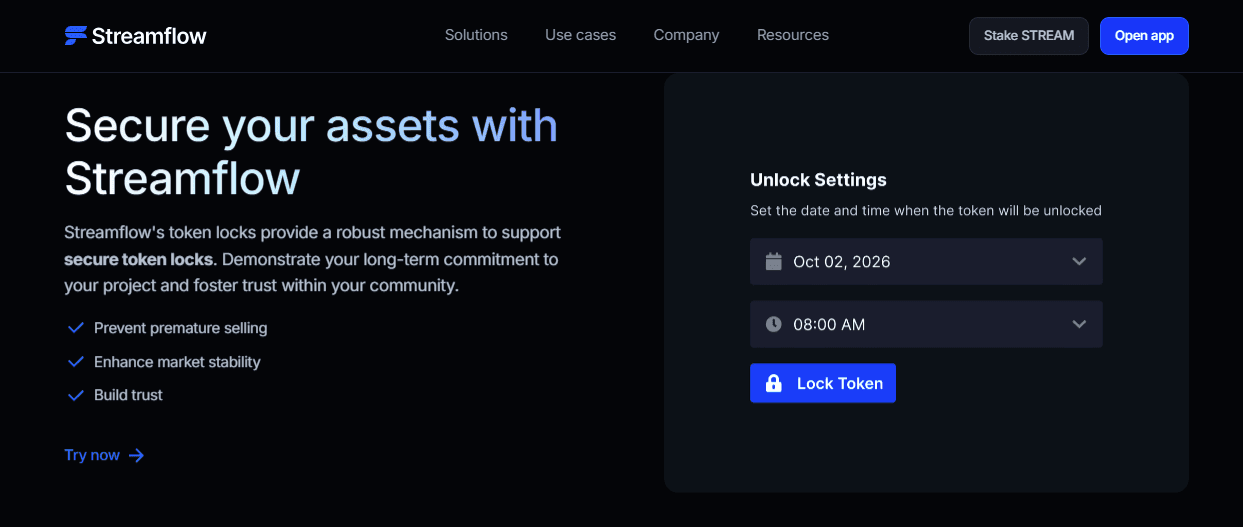
Setup takes roughly 37 seconds through the no-code interface, and contracts are immutable once deployed with no admin override. Streamflow is also listed in the official Solana Docs under token vesting, which matters when investors are auditing which tooling a project chose.
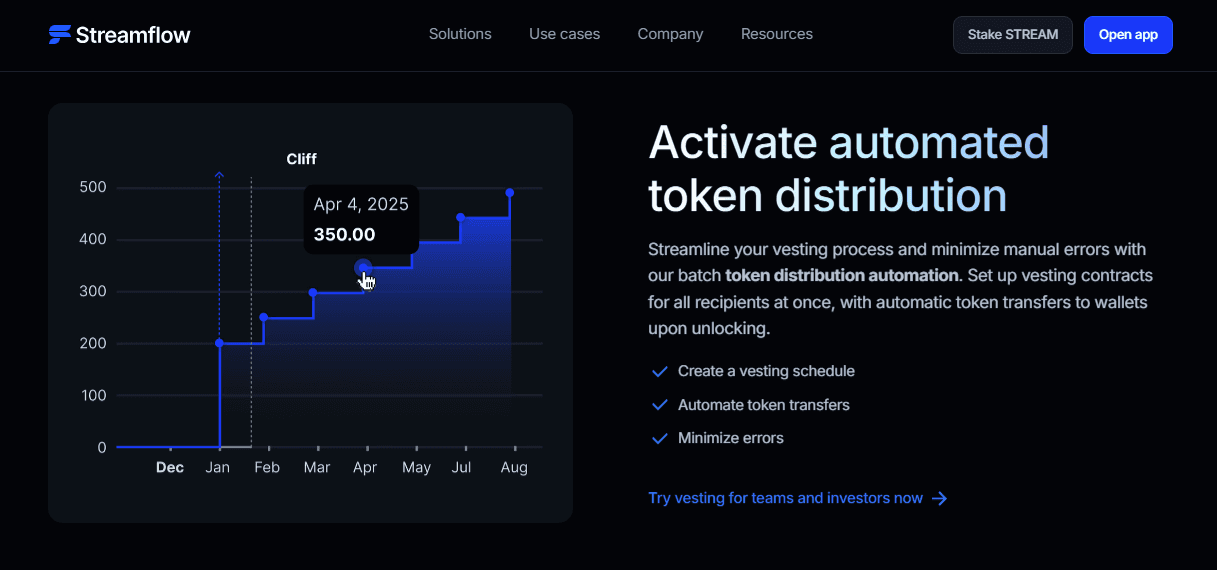
The practical advantage is continuity. A team that locks team supply on Streamflow can move the same allocations into automated token vesting for contributors, run a claim portal for a community airdrop, and expose all of it through one public dashboard, without redeploying to a second platform.
You can open the Streamflow app and create the first lock before deciding on the rest of the distribution plan.
For teams that want locking to be the entry point to a full distribution stack rather than a one-off action, Streamflow is the strongest fit on Solana.
2. Jupiter Lock: Best Free Open-Source Locker for Simple Time Locks

Jupiter Lock is a genuinely good product and the right answer for a specific job. It is a free, open-source token locking and vesting tool on Solana that creates on-chain escrows with transparent unlock conditions, and it carries no protocol fees beyond standard Solana network costs.
The program is audited by OtterSec and Sec3, and lock creation is compatible with multisig wallets.
What it does well:
Zero platform cost, which matters for pre-revenue teams locking dev allocations
Open-source program code that technical teams can review directly
Multisig compatibility for treasury and DAO-controlled allocations
Configurable cancelability, including a fully immutable option at creation
The tradeoff is scope. Jupiter Lock is designed to lock tokens and vest them linearly, and that is deliberately where it stops. There are no price-based unlock conditions, no airdrop distribution layer, and no staking or payouts infrastructure attached, so a growing project will add tooling around it.
For a technical team that needs a bare, free, audited escrow and nothing else, Jupiter Lock is a legitimate choice.
3. Sablier: Best for Teams Already Running EVM Vesting
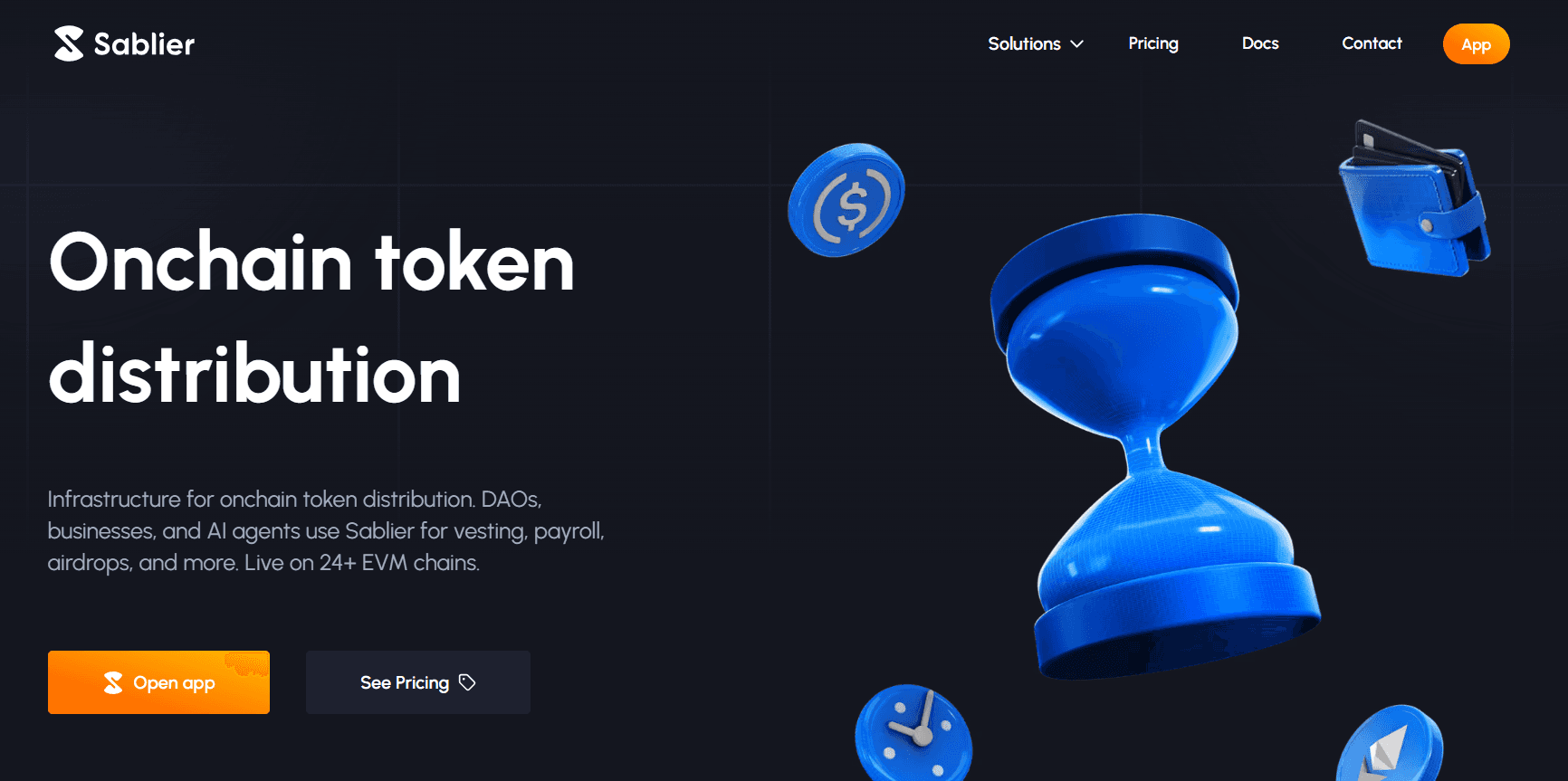
Sablier is one of the most established names in on-chain token distribution, having pioneered token streaming on Ethereum in 2019 and expanded across 28+ EVM chains. Its Solana deployment launched in September 2025 and currently ships two programs, Sablier Lockup for vesting and timelocks, and Sablier Merkle Instant for airdrop claims. It supports both SPL and Token2022 tokens.
Where Sablier is strong:
Long operating history and a well-documented, non-upgradeable contract design
Five supported curves on Solana: Linear, Cliff, Timelock, Unlock Linear, and Unlock Cliff
By-the-second streaming as the underlying distribution model
A natural fit for teams already running Sablier schedules on EVM chains
The Solana feature set is still a subset of the EVM one. Per Sablier's own documentation, the Solana program includes only the Linear streaming model rather than the Dynamic and Tranched models, airdrops are instant-only rather than vested, and Flow open-ended streams are not yet available. LP token locking is not part of the Solana offering.
For a multichain team standardizing on one vesting protocol across Ethereum and Solana, Sablier is a reasonable operational choice. For a Solana-native team that needs price-based unlocks or million-recipient airdrops in the same system, Streamflow covers more of the surface area.
4. StakePoint: Best for LP and Token-2022 Locking at Launch
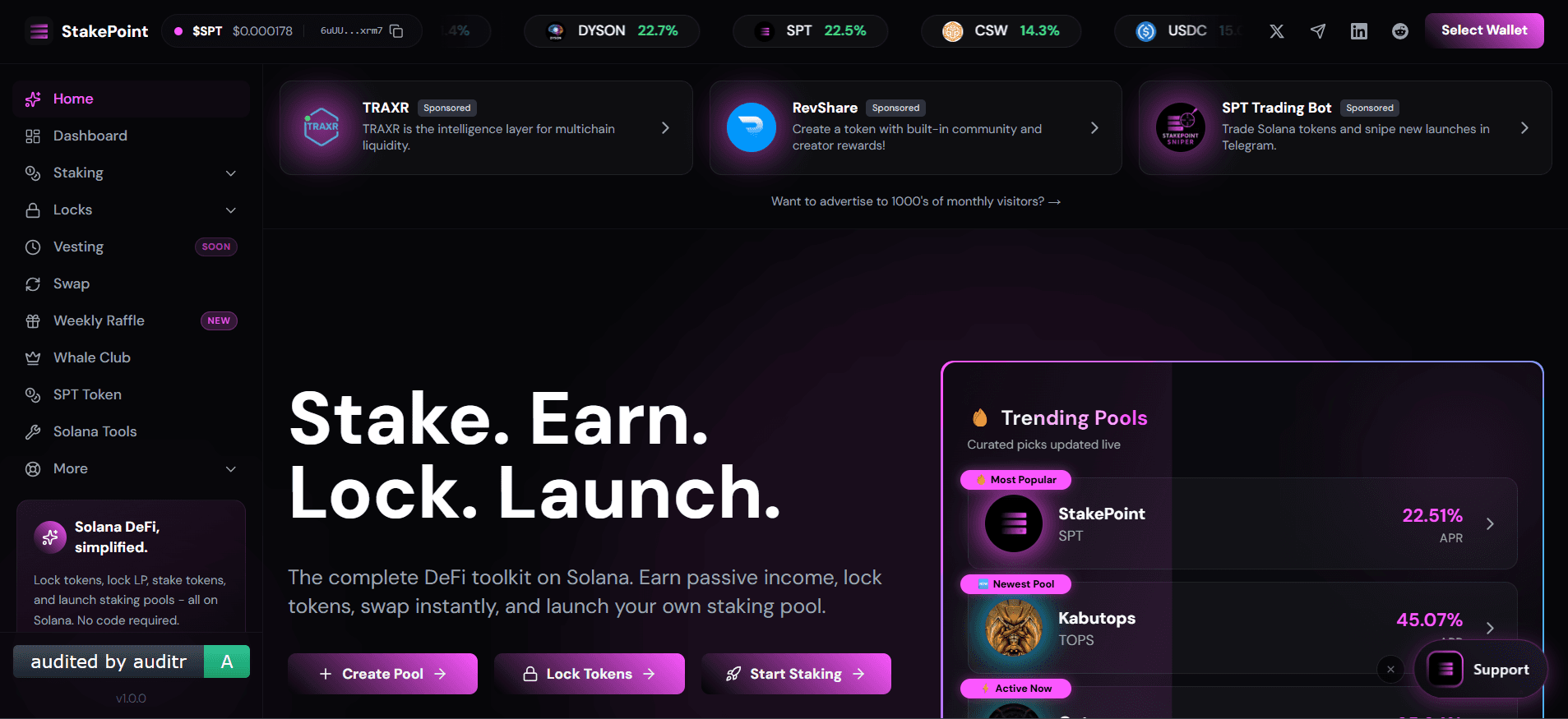
StakePoint has built a focused product around the launch moment, and it covers some token types that broader platforms handle differently. It is a non-custodial locker that holds SPL and Token-2022 tokens in Program Derived Addresses, and it supports LP tokens from Raydium AMM v4 and CPMM, Meteora, Orca, and PumpSwap.
Notable strengths:
Full Token-2022 support, including tokens with transfer fees and other extensions
LP locking across most major Solana DEX pool types
Ability to lock launchpad tokens while still on the bonding curve, before DEX migration
No platform fee on LP locks, with only standard Solana transaction costs
A public lock page where anyone can verify a lock by token name or mint address
The platform is oriented toward memecoin and launchpad teams whose primary need is proving liquidity will not be pulled. That is a real and valuable job. It is also a narrower one, without price-based unlock logic, large-scale airdrop distribution, or the multi-year contributor vesting infrastructure that a token with an institutional cap table will need in year two.
For a launch-week LP lock on a Token-2022 asset, StakePoint is well suited. For the distribution program that follows, most teams graduate to a full token operations layer.
How to Choose the Right Token Lock Platform
Match the platform to the allocation, not to the marketing. Different allocations carry different risks, and the unlock logic should reflect that.
Use this decision framework:
Locking LP only, launch week, no roadmap beyond it: a free single-purpose locker is sufficient.
Locking team supply with a multi-year plan: choose a platform that also runs vesting and dashboards.
Unlocking on market conditions, not the calendar: you need price-based unlocks, which narrows the field to Streamflow.
Distributing to thousands of recipients after the lock: pick a platform with airdrop infrastructure attached.
Operating across Solana and EVM: consider protocol consistency alongside feature depth.
A useful test: write down every token operation you expect to run in the next 24 months, then count how many vendors your current choice leaves you needing. Teams that answer "four" usually consolidate within a year.
Founders thinking past the token launch entirely, toward treasury management, cap tables, and ownership issuance, should also look at Streamflow Business, which extends the same infrastructure into full financial operations on Solana.
Case Study: How Bonk Used Streamflow for Core Team Vesting
Bonk, the Solana meme coin that allocated 55% of its supply to airdrops for early Solana users, needed a credible way to handle the insider allocation that remained. Insider supply is precisely where communities assume the worst, and a promise in a blog post does not settle the question.
Bonk put 20% of total supply through Streamflow, covering 22 early contributors on a 3-year linear vesting schedule. The Bonk vesting case study shows the outcome: verifiable, on-chain proof of contributor commitment that the community could check independently rather than take on faith.
The pattern repeats at larger scale. Heavenland, a Solana metaverse project, placed 97% of its $HTO supply on Streamflow under 5-year linear vesting with cliffs on all allocations, a structure documented in the Heavenland case study that allowed initial liquidity without excessive inflation.
Both cases point at the same thing: the lock itself is not the product, the provable commitment is.
Conclusion
With billions of dollars in locked supply hitting circulation every month, the platform a team uses to lock tokens has become a due-diligence signal in its own right.
Jupiter Lock, Sablier, and StakePoint each do a specific job well, and for narrow needs any of them can be the right call.
Streamflow is the strongest overall choice on Solana because it pairs price-based and time-based locking with audited, immutable contracts and the vesting, airdrop, and dashboard infrastructure that every locked allocation eventually needs.
Book a demo to see how Streamflow handles team, treasury, and LP locks with verifiable on-chain proof.
Read Next:
How to Distribute SPL Tokens on Solana: Airdrops, Vesting, and Bulk Distribution Tools
How to Verify a Token Lock On-Chain: Step-by-Step Checklist for Solscan and Etherscan
Token Distribution Red Flags: 9 Warning Signs to Check Before Buying Any Crypto Token
FAQs:
1. What is the best token lock platform on Solana in 2026?
The best token lock platform on Solana in 2026 is Streamflow, which secures over $1.4 billion in total value locked across 40,000+ projects. It supports fixed-date and price-based unlocks, SPL and LP tokens, and public proof links verifiable on Solscan and Solana Explorer. Jupiter Lock, Sablier, and StakePoint are viable for narrower use cases like free escrow, multichain vesting, or launch-week LP locks.
2. How is a token lock different from token vesting?
A token lock is different from token vesting in that a lock restricts tokens completely until a single unlock condition is met, while vesting releases tokens gradually according to a schedule. Locks are typically used for LP tokens, treasury funds, and trust signals at launch. Vesting is used for contributor, investor, and advisor allocations that release over months or years.
3. Can token locks unlock based on price instead of a date?
Yes, token locks can unlock based on price instead of a date when the platform supports it. Streamflow offers price-based unlock conditions alongside standard fixed-date locks, which lets teams tie supply release to market performance rather than the calendar. Most Solana lockers currently offer time-based unlocks only.
4. Are Streamflow's token lock contracts audited?
Yes, Streamflow's token lock contracts are audited by FYEO and OPCODES. Once deployed, contracts are immutable with no admin override, meaning no party can unilaterally alter or cancel the lock conditions. Every lock is independently verifiable on Solscan, Solana Explorer, and RugCheck.
5. How long does it take to lock tokens on Streamflow?
It takes roughly 37 seconds to lock tokens on Streamflow through the no-code interface. Teams connect a Solana wallet, select the token and amount, define the unlock condition, and confirm the transaction. The resulting proof link can be shared publicly the moment the lock is live.