General
Token Allocation Percentages Explained: How Much Should Go to Team, Investors, and Community?
The crypto industry processed roughly $97 billion in token unlocks during 2025, and March 2026 alone released more than $6 billion in previously locked supply across 144 projects, according to data compiled by Tokenomist and CryptoRank.
Every one of those unlocks traces back to a percentage decided in a spreadsheet months or years earlier.
Streamflow, the Solana-native token operations infrastructure platform behind $415M+ in total value locked and more than 40,000 projects, executes those decisions on-chain for teams that want the numbers to hold.
Token allocation is the single most consequential design decision in a token launch. It determines who owns the network, who controls governance, how much supply hits the market and when, and what the community concludes about whether the project was built for them or for insiders.
This guide covers the terminology, the 2026 benchmark ranges for every stakeholder group, a complete worked allocation model, how the split changes by project type, the red flags experienced holders look for, and the infrastructure that turns an allocation table into something enforceable.
Key Takeaways
Token allocation percentages typically give teams 15-20%, investors 10-20%, and community 25-40%.
Insider allocations above 50% of supply are treated as a red flag by informed holders.
Streamflow enforces token allocation percentages through immutable vesting contracts, locks, and staking pools.
Allocation percentages only become credible when paired with cliffs and public on-chain verification.
Over 40,000 projects use Streamflow to execute token allocation across every stakeholder group.

What Token Allocation Actually Means
Token allocation is the process of dividing a token's total supply among stakeholder groups before launch, with each group receiving a defined percentage governed by its own release rules. It is decided at the design stage and, once tokens are deployed into on-chain contracts, becomes very difficult to change.
The allocation table is distinct from the release schedule, though the two are always discussed together. The table answers who gets what. The schedule answers when they can actually move it.
The Terms That Determine Everything
Allocation debates go wrong when these terms get used loosely. Precise definitions matter because each one changes how a percentage behaves in the market.
Total supply: the full number of tokens that will ever exist, and the denominator every allocation percentage is measured against.
Circulating supply: tokens currently liquid and tradable, which is almost always far smaller than total supply at launch.
Float at TGE: the percentage of total supply that is liquid on day one of the token generation event.
Fully diluted valuation (FDV): token price multiplied by total supply, which prices in every token that has not yet unlocked.
Cliff: a period during which no tokens are released at all, after which vesting begins per the schedule.
Vesting: the controlled release of tokens over time, in increments, to prevent immediate selling.
Token lock: a complete restriction on transfer, sale, or access until a single unlock condition is met, such as a date or price level.
Unlock: the moment previously restricted tokens become transferable and enter circulating supply.
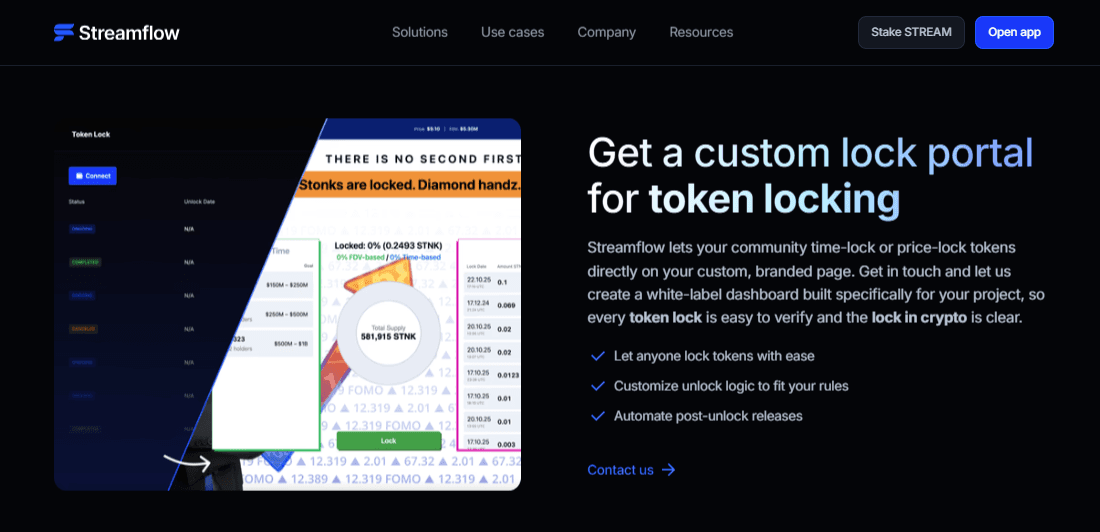
The distinction between token vesting and token locking is the one founders most often blur. Vesting releases gradually across a schedule, while a lock holds everything until one condition triggers and then releases. Streamflow supports both as separate primitives, and the difference in market impact is significant.
Two projects can publish identical allocation tables and produce entirely different supply curves purely through these mechanics.
The 2026 Token Allocation Benchmark Table
The 2026 tokenomics guide published by DEXTools puts typical distributions at 15-20% for core team and founders, 10-20% for early investors and VCs, 25-40% for community and ecosystem, 5-10% for liquidity, 2-5% for advisors, and 10-20% for public sale participants.
The table below consolidates those ranges with the release terms that have become standard alongside them.
Stakeholder group | Typical % of supply | Typical cliff | Typical vesting period | Common release mechanism |
|---|---|---|---|---|
Founders and core team | 15-20% | 12 months | 3-4 years | Cliff plus linear |
Early investors and VCs | 10-20% | 12 months | 2-4 years | Cliff plus linear, tiered by round |
Advisors | 2-5% | 6-12 months | 1-2 years | Cliff plus linear |
Community and ecosystem | 25-40% | None to 3 months | 1-4 years | Vested airdrops, graded grants |
Public sale participants | 5-20% | None | Immediate to 6 months | Full or partial unlock at TGE |
Liquidity provision | 5-10% | None | Immediate | Unlocked at TGE, LP tokens locked |
Treasury and foundation | 10-25% | 6-12 months | 4-10 years | Locks with governance-gated release |
Staking and emission rewards | 5-20% | None | Ongoing emissions | Programmatic distribution |
These are reference points rather than rules. Deviating is defensible when the reason is explainable in public, and indefensible when it is not.
The one hard boundary in the table is the combined insider figure. Team, advisors, and investors together should stay meaningfully below 50%, because crossing that line means insiders control governance outcomes outright.
Why the Percentage Is Only Half the Answer
Take two projects with identical allocations: 20% team, 15% investors, 40% community, 25% treasury and liquidity. On paper they are the same project. In practice they can produce opposite outcomes.
In the first, the team allocation sits behind a 12-month cliff followed by three years of linear release, enforced by an immutable on-chain contract anyone can verify on Solscan. In the second, the same 20% sits in a multisig with a schedule described in a Notion document. One is a commitment, and the other is an intention.
The market reads the difference. Analysis from BlockEden citing Tokenomist data found that roughly 90% of token unlocks generate negative price pressure, with selling frequently beginning up to 30 days before the scheduled event as traders position ahead of known supply. Nobody is trading the pie chart, they are trading the release calendar.
The percentage decides who owns what.
The schedule decides when that ownership becomes sellable.
The enforcement mechanism decides whether either number can be trusted.
A 20% team allocation on a four-year on-chain schedule is a smaller real overhang than a 12% allocation that unlocks fully at TGE.
How Allocation Percentages Became a Trust Signal
Insider share has moved a long way in a decade. Benchmark research from 8Blocks notes that team allocations roughly tripled from around 5% of supply in 2013 to about 20% by 2021, treasuries grew from roughly 20% to over 40%, and public sales collapsed from around 25% to close to zero.
Chain-level data tells the same story. Tomasz Tunguz's analysis of L1 genesis distributions tracked insider ownership rising from 15% at Ethereum's launch to 33% for DOT, 48% for SOL, and 58% for FLOW. The 80/20 community-to-insider convention of early crypto is gone.
Solana's own genesis distribution, as documented in the 8Blocks benchmark set, allocated 38% to a community reserve, 15.86% to seed, 12.63% to founding sale, 12.5% to team, 12.5% to foundation, 5.07% to validators, 1.84% to strategic, and 1.7% to public auction. It was insider-weighted but carried a substantial community reserve alongside it.
That shift has turned allocation into a governance forecast. A 2026 study of 52 token protocols published in Frontiers in Blockchain modeled post-distribution governance concentration against initial insider allocation at launch, treating the team-plus-investor share as a direct input into who actually controls a protocol later. Founders should assume the allocation table will be audited by people who are not on the cap table.
Allocation Breakdown by Stakeholder Group
Each slice buys something specific. Here is what each one is for, what range makes sense, and how it should be released.
Founders and Core Team: 15-20%
This allocation keeps the people building the protocol economically committed across a multi-year build. Redwood Valuation's 2026 analysis notes the founder and team band is commonly cited at 15-25%, with 20% used as a common starting point.
Going below the range risks an undermotivated team that quietly rebuilds its position through treasury grants later. Going above it hands the community a reason to assume extraction.
Standard structure is a 12-month cliff followed by three to four years of linear release.
Allocate per contributor by scope and tenure rather than by founding-team membership alone.
Create individual contracts so a departure does not require restructuring the entire schedule.
Deploy the whole allocation into automated token vesting rather than holding it in a treasury wallet.
The cliff is load-bearing here. Without one, a linear schedule leaks supply from day one and signals nothing about commitment.
Early Investors and VCs: 10-20%
Investor allocation is priced by the round, but release terms are where founders retain leverage. 8Blocks benchmark data shows a one-year cliff for team and investors is now standard, total vests run three to four years, and modern L1s launched from 2022 onward went live with exactly 0% of insider tokens liquid at TGE.
Rounds should not share a schedule. A seed investor who committed at pre-product valuations sits in a different risk position than a strategic round that closed a month before launch.
Tier release schedules by round, with earlier rounds vesting no faster than later ones.
Keep insider float at TGE at or near zero to avoid a first-week supply shock.
Publish investor unlock dates rather than letting the market reverse-engineer them.
Investors who intend to hold rarely object to longer schedules. The ones who object are telling you something useful.
Advisors: 2-5%
Advisors are the most common place where discipline slips. A 3% advisor pool released over 12 months with no cliff becomes a recurring sell wall attached to people who may no longer be involved.
Treat advisor allocations with team-equivalent discipline, scaled down. Tie the size of each grant to a defined scope of work rather than to a name.
Apply a 6 to 12 month cliff before any release begins.
Keep individual advisor grants small and contract them separately.
Include cancellation conditions at contract creation where the engagement is time-boxed.
Streamflow supports contract cancellation when it is enabled at setup, which makes short-term advisory arrangements structurally cleaner.
Community and Ecosystem: 25-40%
This is the largest slice in most credible 2026 structures and the most frequently mismanaged. It typically covers airdrops, ecosystem grants, liquidity mining, and long-term incentive programs.
The failure mode is treating the entire allocation as an airdrop budget and distributing it instantly to wallets with no reason to stay. Vested and conditional distribution converts the same tokens into a retention mechanism.
Split the allocation across launch distribution, ongoing incentives, and a reserve.
Use vested or price-based token airdrops rather than instant unlocks where retention matters.
Segment recipients by real activity and screen for sybil behavior before distribution.
Return unclaimed tokens to the treasury instead of writing them off.
Streamflow supports distribution to up to one million recipients per campaign with 100,000 recipients per CSV import, which lets the community allocation run as a structured program instead of a single event.
Public Sale Participants: 5-20%
Public sale allocation has compressed dramatically, and 8Blocks data shows public sales falling from roughly 25% of supply historically to close to zero in many recent launches. Where a public sale exists, it is usually the only allocation that unlocks fully at TGE.
The size of this slice largely determines the initial float, and 8Blocks puts typical TGE floats at roughly 13-20% of supply. Too small a float creates thin liquidity and volatile price discovery, while too large a float creates immediate sell pressure with no offsetting demand.
Size the public allocation against realistic day-one liquidity, not maximum raise.
Consider partial unlocks with a short vest for larger sale rounds.
Publish the exact TGE float figure rather than leaving it to be calculated.
Liquidity Provision: 5-10%
Liquidity allocation funds the pools that make the token tradable. It unlocks at TGE by necessity, which is precisely why the LP tokens themselves need locking.
Locking LP tokens publicly removes liquidity rug risk from the conversation entirely. It is one of the cheapest trust signals available and one of the most conspicuous when absent.
Allocate enough to support meaningful depth across primary pairs.
Lock LP tokens on-chain with a verifiable unlock date.
Publish the lock proof link alongside the tokenomics documentation.
Streamflow supports SPL and LP token locks with fixed-date or price-based unlock conditions, and every lock produces a shareable proof link verifiable on Solscan, Solana Explorer, and RugCheck.
Treasury and Foundation Reserve: 10-25%
Treasury is the allocation that quietly grows as unspent ecosystem funds roll back into it, which is why it needs governance rules from day one. It funds development, operations, partnerships, and the long tail of things nobody can budget for at launch.
An unconstrained treasury is functionally an insider allocation with better branding. Guardrails need to be defined before the treasury is funded, not after it becomes contentious.
Define spending categories and approval thresholds pre-launch.
Hold reserves in transparent token locks with governance-gated release conditions.
Report treasury movements on a fixed cadence.
For teams building toward real corporate structure, Streamflow Business extends this into treasury management with USD+, on-chain cap tables, tokenized SAFE agreements, and ownership issuance.
Staking and Emission Rewards: 5-20%
Staking allocation funds the rewards that reduce circulating supply and give holders a reason to keep tokens off exchanges. It is the one allocation designed to be spent continuously rather than released to a fixed group.
The design question is whether rewards come from a pre-allocated emission pool or from protocol revenue. Emission-funded staking dilutes existing holders over time, while revenue-funded staking does not.
Size the pool against a realistic multi-year emissions curve.
Configure APY and lock periods to match the retention behavior you want.
Plan for reward top-ups so pools do not silently deplete.
Streamflow supports no-code staking pools for any SPL token with configurable APY, lock periods, and automated reward distribution, and teams can deploy staking on Streamflow without building custom infrastructure.
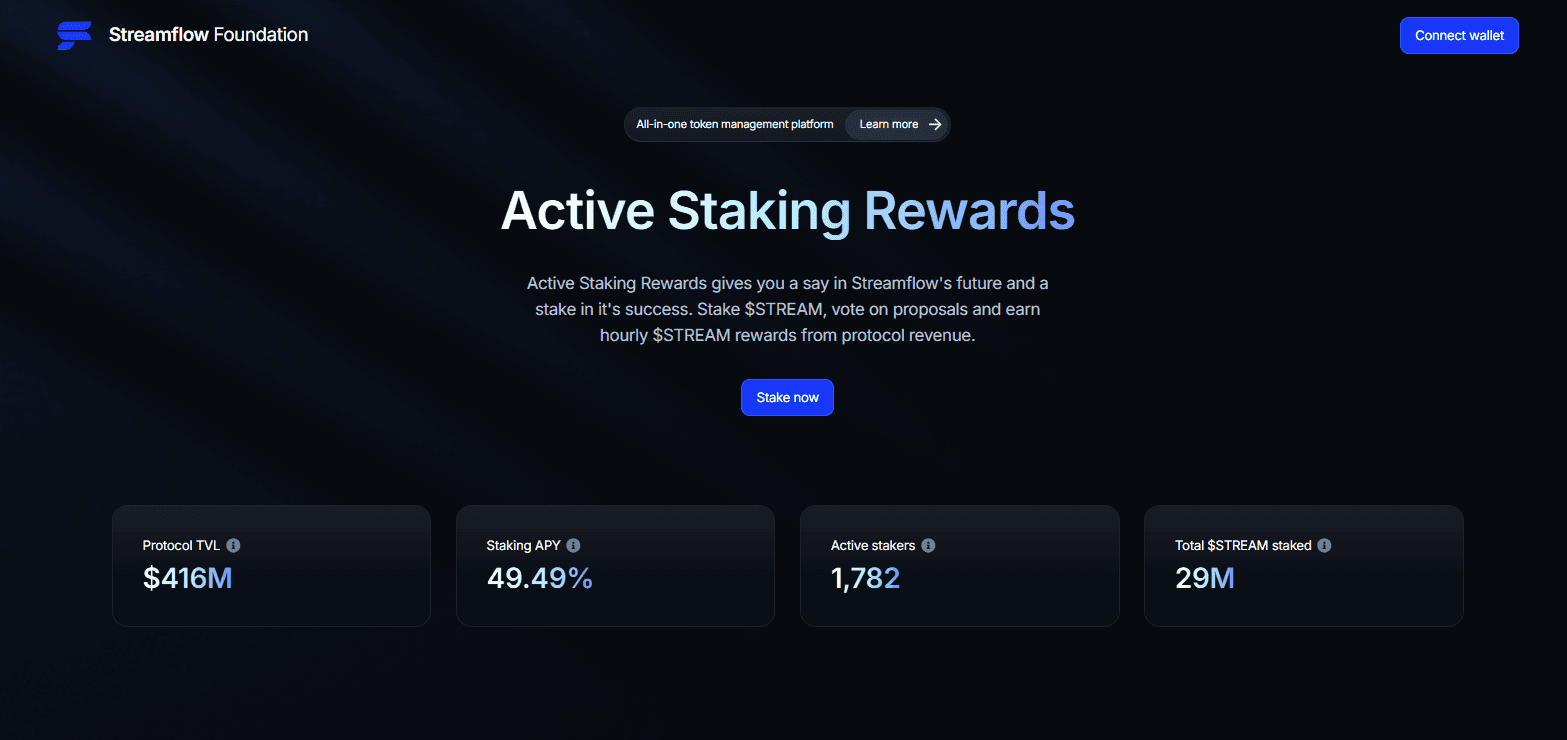
Streamflow's own STREAM model demonstrates the revenue-backed alternative, distributing hourly rewards funded by protocol revenue rather than inflation, currently at approximately 74.57% APY across 1,786 active stakers.
A Complete Worked Allocation Model
Benchmarks are easier to apply against a full example. The model below allocates a 1 billion token supply across every group, sums to 100%, and includes the release terms that make each line credible.
Allocation | % of supply | Tokens | Cliff | Vesting | Liquid at TGE |
|---|---|---|---|---|---|
Founders and core team | 18% | 180,000,000 | 12 months | 36 months linear | 0% |
Advisors | 3% | 30,000,000 | 12 months | 18 months linear | 0% |
Seed investors | 9% | 90,000,000 | 12 months | 30 months linear | 0% |
Strategic round | 5% | 50,000,000 | 12 months | 24 months linear | 0% |
Public sale | 5% | 50,000,000 | None | Immediate | 5% |
Community airdrop | 15% | 150,000,000 | None | 40% at TGE, 60% over 12 months | 6% |
Ecosystem grants and incentives | 15% | 150,000,000 | 3 months | Milestone-based over 48 months | 0% |
Staking rewards | 10% | 100,000,000 | None | Ongoing emissions | 0% |
Liquidity provision | 7% | 70,000,000 | None | Immediate, LP tokens locked 24 months | 7% |
Treasury and foundation | 13% | 130,000,000 | 12 months | Governance-gated over 60 months | 0% |
Total | 100% | 1,000,000,000 | 18% |
The insider figure here is 35%, combining team, advisors, and both investor rounds, which sits well below the 50% threshold. Community-facing allocations total 45% across airdrop, ecosystem, staking, and public sale. Float at TGE is 18%, inside the 13-20% range 8Blocks identifies as typical.
Notice that no insider tokens are liquid at launch. That single property does more for launch credibility than any adjustment to the percentages themselves.
How Allocation Changes by Project Type
The benchmark ranges assume a venture-backed protocol launch. Different project categories deviate for structural reasons.
1. Memecoins and Fast Launches
Community share runs far higher, often above 50%, and insider allocations are deliberately minimal because the entire value proposition is fairness. Investor rounds are frequently absent altogether.
The critical move is locking whatever team supply exists immediately and publicly. Streamflow lock setup takes about 37 seconds through the interface, which removes any excuse for a delay between launch and proof.
2. DeFi Protocols
Emission and incentive allocations dominate because liquidity mining is the primary growth mechanism. Treasury tends to run large to fund audits, insurance, and integrations.
Streamflow supports automated staking rewards, DCA automation, and reward deposits sent directly to wallets without claim friction, which suits protocols distributing continuously rather than in discrete campaigns.
3. GameFi and In-Game Economies
Player reward allocations are the largest slice, and the emissions curve matters more than the initial split because in-game currency inflation is an ongoing design problem rather than a launch event. Vested rewards prevent players from extracting and exiting immediately.
Streamflow supports in-game currency distribution, achievement-based player rewards, vested airdrops through the SDK, and transfer metadata accessible for accounting.
4. DAOs and Governance-First Projects
Community and treasury allocations dominate, and insider share is kept deliberately low because governance legitimacy is the point. Contributor compensation typically runs through recurring payouts rather than large upfront grants.
Streamflow integrates with Realms and supports governance token distribution, contributor payments, and treasury allocation in one system.
Red Flags in a Token Allocation Table
Informed holders and analysts run a consistent checklist. Founders should run the same checklist against their own table before publishing it.
Insiders holding more than 50% of supply combined across team, advisors, and investors.
Team cliffs shorter than 12 months, or absent entirely.
Community allocation below 25% with no ecosystem reserve to offset it.
Top ten wallets controlling more than 50% of circulating supply after launch.
Vesting described in documentation but not deployed to verifiable on-chain contracts.
Treasury with no defined spending guardrails or reporting cadence.
Unlock dates that cluster, creating a single large supply cliff rather than a smooth curve.
LP tokens unlocked, leaving liquidity withdrawable at any moment.
The final two items on that list are the ones most often missed at design stage and most damaging after launch.
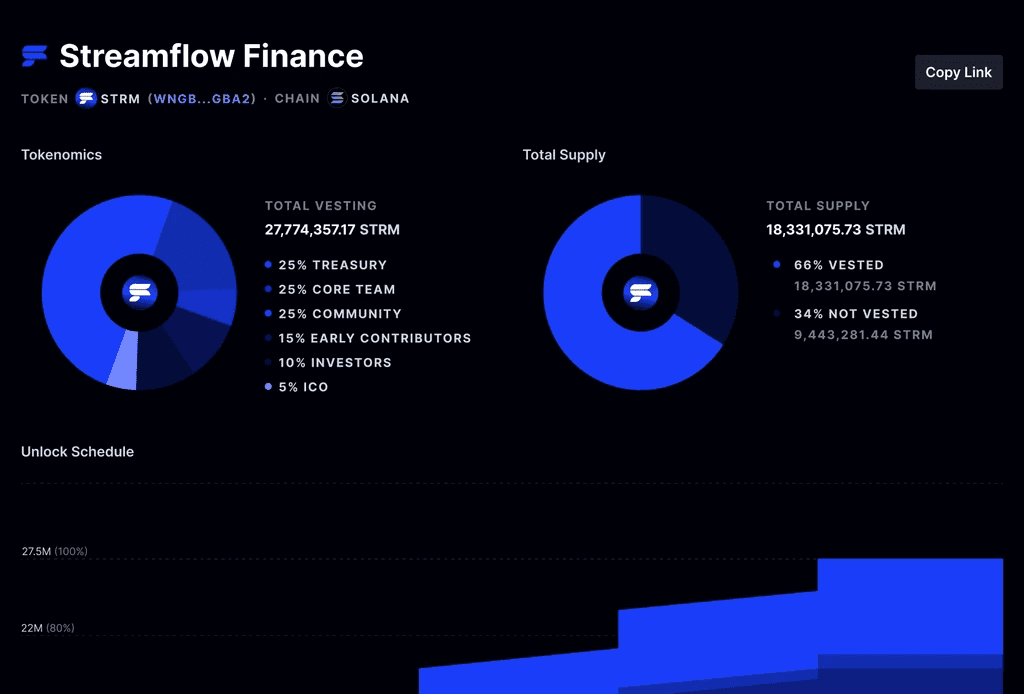
How Streamflow Enforces the Allocation On-Chain
Streamflow turns an allocation plan into enforceable infrastructure. Each stakeholder group gets its own contract with its own schedule, deployed through a no-code interface or through the SDK, and every contract becomes immutable once deployed with no admin override.
Supported vesting models cover linear, cliff, cliff plus linear, graded, milestone-based, and price-based release, along with custom intervals. That range means each allocation line in the model above can be matched to the mechanism that actually fits its purpose, rather than forcing every group onto the same linear schedule.
The verification layer changes the trust dynamic entirely. Every vesting contract and lock produces a shareable proof link verifiable on Solscan and Solana Explorer, while the tokenomics dashboard consolidates allocations, cliff dates, unlock events, and release progress into a single real-time view. Smart contracts are audited by FYEO and OPCODES.
Solana's near-zero fees and sub-second finality make it economically viable to deploy hundreds of individual contributor contracts rather than one pooled contract, which is what allows per-person schedules at real headcount.
Case Studies: How Bonk and Heavenland Structured Their Splits
Bonk, the Solana meme coin, allocated 55% of total supply to airdrops for early Solana users and used Streamflow for core team vesting. The Bonk vesting case study covers 20% of total supply distributed across 22 early contributors on a three-year linear vesting schedule. The community-heavy split was credible specifically because the insider portion was locked into verifiable on-chain contracts rather than announced and left unenforced.
Heavenland took the structure further. The Solana metaverse project put 97% of its $HTO token supply through Streamflow on a five-year linear vesting schedule with cliffs applied to every allocation across team, incentives, and treasury. The Heavenland vesting case study shows the design goal was allowing initial liquidity without excessive inflation, and the outcome was a more engaged and dedicated player community.
Both projects answered the allocation question differently. Both made their answer verifiable, which is the part that transferred.
What This Means for Founders and Tokenomics Designers
The benchmark ranges give a defensible starting point: 15-20% team, 10-20% investors, 25-40% community, with the remainder across advisors, public sale, liquidity, treasury, and staking rewards. Deviation is fine when it has a reason you can explain publicly.
What is not optional is the enforcement layer. An allocation table with no on-chain schedules behind it is a marketing asset, and sophisticated holders now treat it as one.
Design the split, then design the release mechanism for each line, then deploy both as contracts before the token generation event. That order is the difference between tokenomics that survives the first unlock cycle and tokenomics that gets repriced by it.

Conclusion
Token allocation percentages decide who owns the network, but cliffs, release schedules, and on-chain enforcement decide whether that ownership structure survives contact with the market.
Streamflow gives teams immutable vesting contracts, verifiable token locks, configurable staking pools, and a real-time tokenomics dashboard, so every line of the allocation table executes exactly as designed and stays provable to anyone who checks.
Book a demo to see how Streamflow handles multi-stakeholder token allocation across team, investor, community, and treasury schedules.
Read Next:
FAQs:
1. How much of a token supply should go to the team?
The team should typically receive 15-20% of total token supply, with 20% used as a common starting point across 2026 launches. That allocation is normally structured with a 12-month cliff followed by three to four years of linear vesting, with no team tokens liquid at TGE. Streamflow enforces these schedules through immutable on-chain contracts that cannot be unilaterally altered after deployment.
2. What percentage should go to investors, and how should it vest?
Investors typically receive 10-20% of supply, tiered by round, with earlier rounds vesting no faster than later ones. A one-year cliff is now standard, with total vesting running three to four years and near-zero insider float at token generation. Streamflow supports separate contracts per round so each investor group carries its own verifiable schedule.
3. How much should be allocated to the community?
The community and ecosystem allocation is typically the largest slice at 25-40% of supply, covering airdrops, grants, liquidity incentives, and long-term reserves. Distributing it instantly tends to produce churn rather than retention, which is why vested and conditional structures outperform. Streamflow supports instant, vested, price-based, and white-label airdrops for up to one million recipients per campaign.
4. What is a red flag in a token allocation table?
The clearest red flag in a token allocation table is a combined insider share above 50% across team, advisors, and investors, since it means insiders control governance outright. Other common red flags are team cliffs under 12 months, unlocked LP tokens, clustered unlock dates, and vesting that exists in documentation but not in deployed contracts. Streamflow removes the last of these by making every schedule verifiable on Solscan and Solana Explorer.
5. Can Streamflow enforce token allocation percentages on-chain?
Yes, Streamflow enforces token allocation percentages on-chain by converting each stakeholder allocation into a smart contract that executes automatically. Contracts are immutable once deployed with no admin override, audited by FYEO and OPCODES, and verifiable on public block explorers. Over 40,000 projects and $415M+ in total value locked run through this infrastructure.