General
How to Design a Token Vesting Schedule: Benchmarks for Teams, Investors, and TGE Unlocks
Tokenomist's 2025 Token Unlocks Review put the year's total token releases at $97.43 billion, split between $18.77 billion from insider unlocks and $78.66 billion from non-insider allocations.
Every dollar of that was decided years earlier inside a vesting schedule that someone designed, or more often, copied.
Streamflow is the Solana-native token operations infrastructure platform behind more than 40,000 projects and over $420 million in total value locked, which is why it sees the same design errors repeat across launch after launch.
A vesting schedule is not a slide in a deck. It is a supply curve with dates attached, and those dates become the most heavily traded events in a token's first three years.
This guide walks through the design process step by step, then gives the benchmark ranges for each stakeholder group, the data behind them, and the mistakes that break otherwise reasonable schedules.
Key Takeaways
Design the release curve first, then confirm the allocation table matches what it implies.
Team benchmarks cluster around 15 to 25% of supply with a 12-month cliff.
Staggering cliffs across groups prevents any single month from stacking multiple unlocks.
Streamflow enforces every token vesting schedule through audited, immutable smart contracts on Solana.
Over 40,000 projects use Streamflow for token vesting, token locks, and on-chain distribution.
What You Need Before You Design the Schedule
Four inputs have to be settled before any cliff or duration makes sense. Designing the token vesting schedule without them produces numbers that look reasonable in isolation and fall apart when combined.
Total supply and whether it is fixed or inflationary: Emissions stack on top of unlocks and change the real supply curve.
A complete stakeholder map: Every group that will ever hold tokens, including groups you have not raised from yet.
A target initial float: How much supply needs to circulate on day one to support real liquidity depth.
Your unlock philosophy: Time-based, milestone-based, price-based, or a mix, decided before you assign numbers.
The fourth input is the one teams skip. Deciding it upfront changes what the other three should look like, because a milestone-gated treasury needs a different allocation size than a treasury releasing on a fixed calendar.
How to Design a Token Vesting Schedule in Seven Steps
The order matters. Most teams start at the allocation table and never revisit it. This sequence starts there and then forces the table to survive contact with a calendar.
Step 1: Assign an allocation to every stakeholder group
Split total supply across founders and core team, investors by round, advisors, ecosystem, treasury, community rewards, and liquidity. Keep seed, private, and strategic rounds as separate line items rather than one investor bucket, because each round will carry different terms.
Name every group, including future rounds you have not raised yet
Separate liquidity provisioning from ecosystem incentives
Reserve headroom for hires who do not exist yet
Write down the number of individual recipients per group, not just the percentage
A 20% team allocation across 8 founders behaves very differently from the same 20% across 40 contributors. The second is far less likely to move the market on unlock day.
Step 2: Set a cliff for every insider allocation
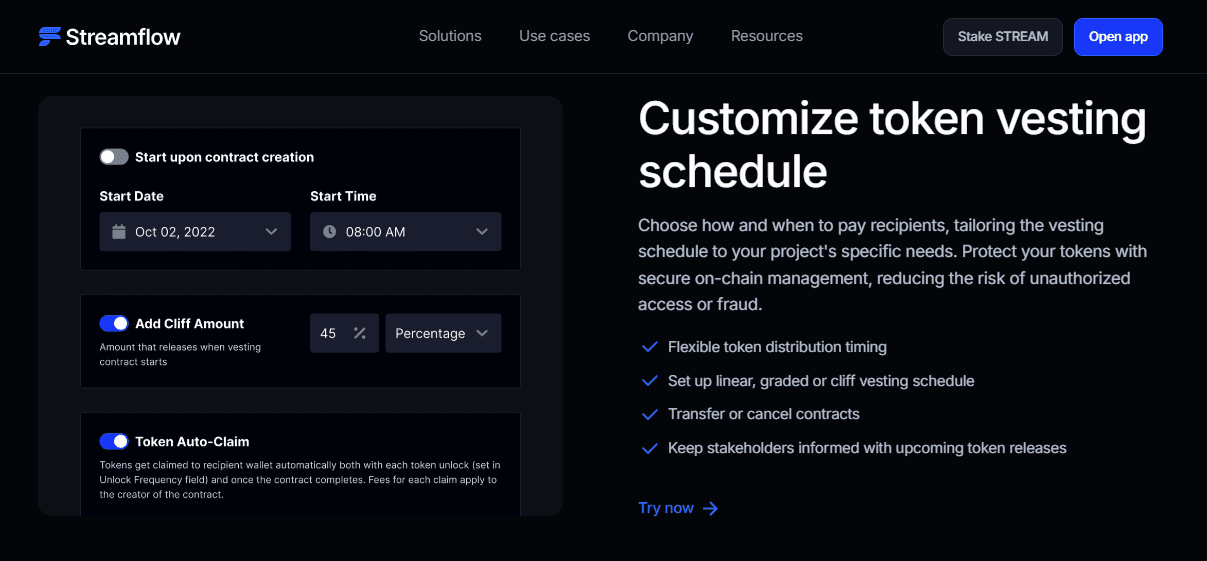
A cliff is a period during which no tokens are released. After it ends, tokens begin vesting according to the schedule. The one-year cliff is close to universal for insiders, and one industry benchmark report found roughly 85% of projects with team vesting schedules using it.
Founders and core team: 12 months minimum, no exceptions
Seed and private investors: 12 months minimum, longer where the round priced early
Advisors: 3 to 6 months, matched to the useful life of the engagement
Treasury and ecosystem: condition-based rather than cliff-based where possible
Set the cliff to answer a commitment question, not to fill a calendar. For a founder, 12 months answers whether they are still building. For an advisor whose value is a set of introductions, 12 months is theater.
Step 3: Choose a release model for each group
Streamflow supports linear, cliff, cliff plus linear, graded, milestone-based, and price-based vesting, plus custom intervals. Different groups warrant different models, and applying one model uniformly is a design shortcut rather than a decision.
Linear after cliff: the default for team and investor allocations
Graded: back-weighted release for long-tenure contributors
Milestone-based: advisors, strategic partners, and ecosystem grants
Price-based: treasury tranches that should expand supply into strength, not weakness
Continuous emissions: community rewards with a published cap
The release cadence matters as much as the model. Monthly or continuous release smooths supply, while quarterly batches recreate a small cliff four times a year.
Step 4: Stagger cliffs so no single month stacks unlocks
This is the step that separates a designed schedule from a copied one. If team, seed, and advisor allocations all cliff at month 12, the schedule has manufactured a supply wall out of three independently reasonable decisions.
Offsetting the cliffs costs nothing and changes the shape entirely. Team at month 12, seed at month 14, advisors at month 18, and treasury on milestones means the same total supply arrives with no month carrying multiple buckets.
Never let two insider buckets cliff in the same month
Offset by at least 60 days between groups
Check the combined calendar, not each schedule in isolation
Avoid cliff dates that land near known exchange or protocol events
Step 5: Model circulating supply at 12, 24, and 48 months
The allocation pie chart is not the unit of analysis. Projected circulating supply on a monthly timeline is, because that is what a buyer is actually underwriting.
Plot the curve and look at three things: the steepest single month, the total supply increase over each 12-month window, and whether any month more than doubles the float.
Chart monthly circulating supply for at least 48 months
Flag any single event above 5 percent of circulating supply
Compare total annual unlock value against realistic trading volume
Layer emissions on top of unlocks in the same chart
If the curve looks wrong here, go back to Step 1. Fixing it at this stage is free. Fixing it after deployment is not, because on-chain contracts are immutable by design.
Step 6: Deploy the schedule as on-chain contracts
A schedule that exists only in a whitepaper is a promise. Deploying it as smart contracts converts it into something a buyer, an exchange, or a community can verify without trusting anyone.
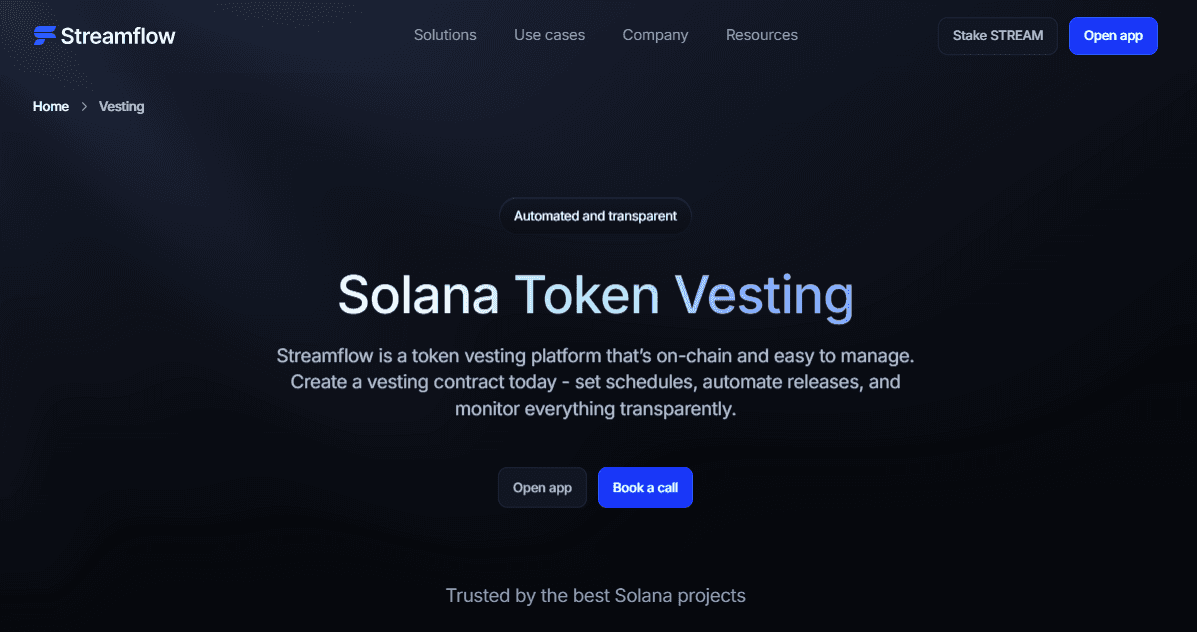
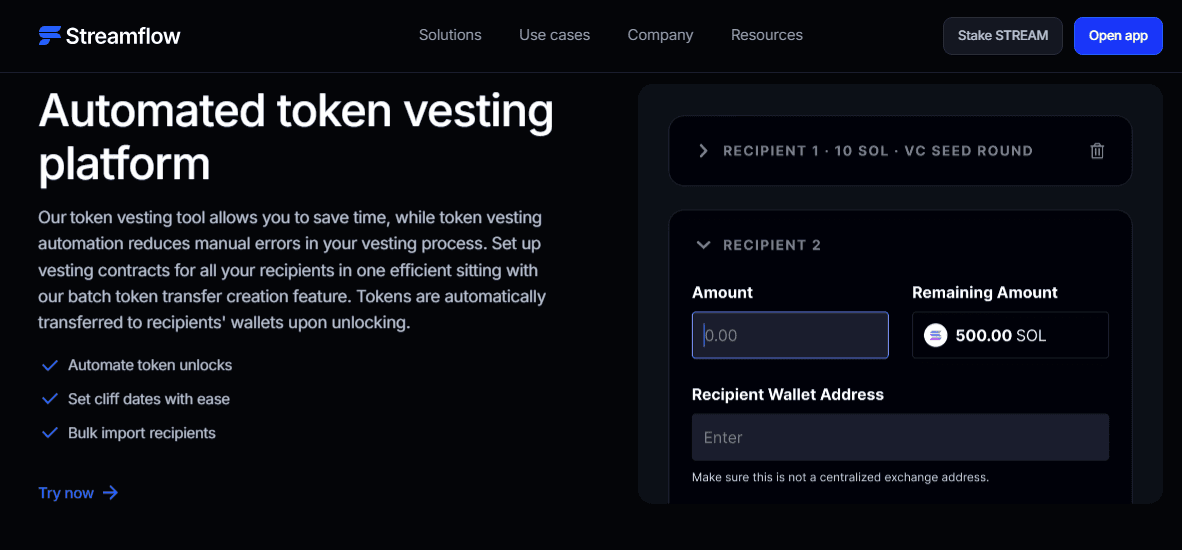
The Streamflow flow is five steps: create the vesting contract, upload recipients, define the schedule, fund the contract, and tokens release automatically. Bulk CSV import handles large recipient sets in a single deployment rather than one contract at a time.
Deploy one contract set per stakeholder group so terms stay auditable
Fund contracts before announcing the schedule publicly
Decide at setup whether cancellation is permitted, since it cannot be added later
Use token locks for treasury and liquidity positions that need a single unlock rather than a curve
Set up token vesting on Streamflow and the schedule stops depending on anyone remembering to execute a transfer.
Step 7: Publish the calendar and the proof links
The final step is the one that converts a good schedule into a trust signal. Publish a daily-resolution unlock calendar before listing, along with proof links for every contract.
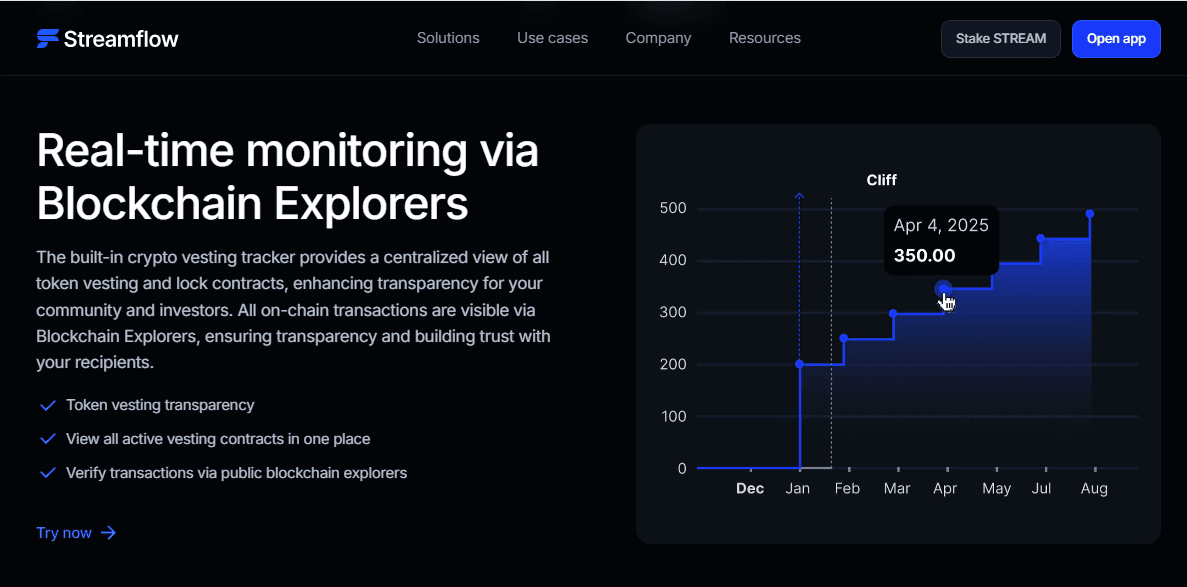
Streamflow's tokenomics dashboard consolidates vesting contracts, locks, and staking pools into a single real-time view showing cliff dates, unlock events, and release progress. Every contract is independently verifiable on Solscan and Solana Explorer.
Markets punish uncertainty harder than supply. A published, verifiable schedule removes an entire category of speculation about what insiders are holding.
Token Vesting Schedule Benchmarks by Stakeholder Group
Benchmarks are reference points, not rules. Their real use is forcing you to justify deviations, because informed buyers screen against exactly these ranges.
Stakeholder group | Typical allocation | Cliff | Total duration |
|---|---|---|---|
Founders and core team | 15 to 25% | 12 months | 3 to 4 years |
Investors (all rounds) | 15 to 30% | 12 to 24 months | 2 to 4 years |
Advisors and KOLs | 1 to 5% | 3 to 6 months | 1 to 2 years |
Ecosystem and community | 30 to 45% | Condition-based | Ongoing |
Treasury and reserves | 20 to 25% | Condition-based | Ongoing |
Public sale | 1 to 5% | None | Unlocked at TGE |
Founders and core team
Published research puts this bucket in a narrow band. Redwood Valuation places founder and team allocations in the 15 to 25% range with roughly 20% as a common starting point, while the Stephanian and Turley study found a typical team allocation of 17.5% spread across 20 to 40 people.
Duration is where teams under-commit. Three to four years is the expectation, and a schedule materially shorter than that reads as a scheduled exit.
Allocation: 15 to 25%, with roughly 20% as a defensible default
Cliff: 12 months from TGE
Duration: 3 to 4 years total, monthly release after the cliff
Avoid releasing the entire first-year tranche in a single transaction
Bonk vested 20% of total supply to 22 early contributors on a three-year linear schedule through Streamflow, which gave the community a verifiable answer to when insider supply arrives.
Investors
Combined investor allocations have compressed and are now scrutinised as a single number. One institutional framework puts seed rounds at 5 to 10% of supply, private rounds at 10 to 15%, and strategic partners at 5 to 8%, with combined investor allocation above 40% signalling excessive early concentration.
Terms should tighten as rounds price earlier, not loosen. A seed investor who bought at a fraction of the public price has less claim to a short schedule than a strategic partner who came in at listing.
Allocation: 15 to 30% combined across all rounds
Cliff: 12 months minimum, 18 to 24 months for the earliest rounds
Duration: 24 to 36 months of linear release after the cliff
Never let investor tokens unlock ahead of team tokens
UXD Protocol distributed approximately 46 percent of $UXP supply through Streamflow on four-year linear vesting with a 12-month cliff, with the SDK integrated into Realms so stakeholders could claim and vote in the same interface.
Advisors and KOLs
The smallest bucket and the one most often mishandled. Directional benchmarks place advisors and partners at 1 to 3% of supply, and other institutional frameworks put KOL and advisory allocations at 2 to 5%.
Advisory value compounds over months, not years, which makes milestone-based release a better fit than a long linear tail.
Allocation: 1 to 5% across all advisors combined
Cliff: 3 to 6 months
Duration: 12 to 24 months
Prefer milestone-gated tranches tied to specific deliverables
The TGE unlock and initial float
The TGE unlock is the number that sets the reference price for every later event. Engineering a low float to inflate a headline valuation is the pattern that broke the last cycle.
Binance Research tracked 2024 launches and found a median market-cap-to-fully-diluted-valuation ratio of 12.3%, meaning buyers were entering structures where 87.7% of supply was still locked.
The market has since adjusted. Per Tokenomist's 2024 annual report covering 378 tokens, the average circulating-supply-to-FDV ratio at issuance rose to roughly 35% by the end of 2024.
Nothing from founder, core team, or private investor buckets unlocks at TGE
Day-one float should be sized against required liquidity depth, not optics
Community, airdrop, and liquidity allocations are the appropriate sources of float
Vested token airdrops distribute at TGE while releasing over weeks or months
Ecosystem, treasury, and community
Time-based vesting is usually the wrong tool here. Grants and incentive programmes should release against need, not against a date fixed 18 months earlier.
Treasury: fixed-date or price-based locks with public proof links
Ecosystem: milestone-gated tranches tied to named programmes
Community rewards: continuous emissions with a published cap
Liquidity: unlocked, sized to venue requirements
What the Unlock Data Says About Schedule Design
Three findings should shape the design directly.
Recipient type matters more than size: Market maker Keyrock analysed more than 16,000 unlock events and found roughly 90 percent were followed by negative price pressure, with team unlocks the most disruptive at drawdowns reaching 25%, while investor unlocks caused milder moves because funds use over-the-counter desks or hedge in advance.
Ecosystem allocations behave differently: Ecosystem unlocks averaged a small positive return, because those tokens generally funded grants and liquidity programmes rather than immediate sell orders.
Pressure arrives before the date: Price weakness typically begins around 30 days before an unlock, which means a published calendar is priced in advance whether or not the team acknowledges it.
The design conclusion is consistent across all three: spread insider release across many small events, keep ecosystem supply visibly deployed, and never let a single date carry a disproportionate share of the curve.
Common Mistakes That Break a Vesting Schedule
Copying a four-year equity schedule without adjusting for token liquidity: Equity has no daily order book; tokens do.
Stacking every cliff at month 12: Three reasonable schedules combine into one supply wall.
Releasing the full cliff tranche in a single transaction: Split it or start linear release at the cliff instead.
Treating advisors like founders: Long schedules for short engagements create dead allocations nobody manages.
Leaving the schedule off-chain: A spreadsheet cannot be verified, which means it cannot be trusted.
Designing an unlock cadence with no plan for demand: Supply is scheduled; demand is not.
The last one is the hardest to fix retroactively. Staking, token locks, and buyback mechanisms exist partly to give a token a demand-side answer to its own emission curve.
How Streamflow Executes the Schedule On-Chain
Streamflow converts each of the seven steps above into a contract that runs without human intervention.
Automated token vesting supports linear, cliff, cliff plus linear, graded, milestone-based, price-based, and custom-interval models on the same platform, with no smart contract development required.
The operational features are what make a multi-stakeholder schedule manageable. Bulk CSV import deploys hundreds of recipients at once, vesting top-ups extend funded contracts, ownership transfer handles entity changes, and shareable proof links let anyone verify terms independently.
Security is what makes the published schedule credible. Streamflow's contracts are audited by FYEO and OPCODES, immutable once deployed, and carry no admin override, so a schedule cannot be quietly rewritten after the fact.
No-code deployment through the UI, with a full SDK for custom flows
Explorer verification on Solscan and Solana Explorer
Real-time release tracking across every contract in one dashboard
Solana's near-zero fees make hundreds of individual contracts economically viable
Running the same schedule on Ethereum would make per-recipient contracts prohibitively expensive, which is a large part of why teams consolidate recipients into fewer, larger, and riskier unlock events.
What This Means for Founders and Tokenomics Designers
The schedule is finished when you can answer three questions with a chart instead of a paragraph. How much supply circulates at month 12, which stakeholder group each new token belongs to, and what happens on the single heaviest unlock date in the calendar.
If the third answer is uncomfortable, the fix is structural rather than cosmetic. Stagger the cliffs, extend the linear tail, or move part of the allocation to milestone-based release.
Vesting is also one layer of a wider operating stack that includes treasury management, contributor payouts, cap tables, and ownership issuance, which is the scope Streamflow Business was built to cover.
Conclusion
The $97 billion of tokens released in 2025 was the sum of thousands of vesting schedules designed years earlier, most of them copied rather than modelled.
Designing the release curve deliberately, benchmarking each stakeholder group, and staggering cliffs so no single month carries the load is what separates a token that survives its first cliff from one that does not.
Streamflow turns that design into audited, immutable contracts that execute on schedule across more than 40,000 projects on Solana.
Book a demo to see how Streamflow handles a multi-stakeholder vesting schedule with staggered cliffs and public proof links.
Read Next:
How to Distribute SPL Tokens on Solana: Airdrops, Vesting, and Bulk Distribution Tools
How to Verify a Token Lock On-Chain: Step-by-Step Checklist for Solscan and Etherscan
FAQs:
1. How do you design a token vesting schedule from scratch?
You design a token vesting schedule by assigning allocations to each stakeholder group, setting a cliff for every insider bucket, choosing a release model per group, staggering the cliffs so no month stacks unlocks, modelling circulating supply at 12, 24, and 48 months, then deploying the result as on-chain contracts. The modelling step is the one most teams skip. On Streamflow, the deployment step takes five actions: create the contract, upload recipients, define the schedule, fund it, and let tokens release automatically.
2. What is a standard token vesting schedule for a founding team?
A standard token vesting schedule for a founding team is a 12-month cliff followed by linear release over a total term of three to four years. Published benchmarks put team allocations in the 15 to 25% range of total supply, with around 20% as a common starting point. Bonk used a three-year linear schedule for 20% of supply across 22 early contributors through Streamflow.
3. How long should a token vesting cliff be?
A token vesting cliff should be at least 12 months for founders, core team, and private investors, and 3 to 6 months for advisors. The cliff should answer a commitment question rather than fill a calendar, which is why advisory engagements warrant shorter cliffs than founder allocations. Streamflow supports cliff, cliff plus linear, graded, milestone-based, and price-based schedules on the same platform.
4. What percentage of supply should unlock at TGE?
The percentage of supply that unlocks at TGE should be sized to support genuine liquidity depth, and it should come from community, airdrop, liquidity, and public sale allocations rather than team or investor buckets. Binance Research found 2024 launches carried a median market-cap-to-FDV ratio of 12.3%, a low-float structure the market has since penalised. Vested airdrops let teams distribute at TGE while releasing supply gradually.
5. Can a token vesting schedule be changed after it is deployed on Streamflow?
A token vesting schedule cannot be unilaterally changed after it is deployed on Streamflow. Contracts are immutable once live, there is no admin override, and cancellation is only possible if it was configured at setup. That immutability is exactly what makes a published schedule a verifiable commitment, and every contract can be checked independently on Solscan or Solana Explorer.