General
Token Vesting on Solana: Top 30 Questions Answered
More than $1 billion in token unlocks were expected across crypto projects in June 2026 alone, according to a Cryptobriefing report, a reminder that vesting schedules are now scrutinized as closely as earnings releases.
Streamflow sits at the center of this shift as the Solana-native token operations platform that has automated on-chain vesting and distribution for more than 40,000 projects. When a single unlock can move a token's price, how those tokens are released stops being a back-office detail and becomes a core trust signal.
Token vesting on Solana has its own rules, costs, and tooling that differ sharply from Ethereum-era practices. Founders, DAO treasurers, and tokenomics designers ask the same questions repeatedly: what cliff length to use, how to prove a lock is real, whether vesting can be changed after deployment, and how to scale releases to thousands of recipients without errors.
This guide answers the 30 questions that come up most often, grouped by theme, with concrete specifics rather than generic advice. Each answer reflects how vesting actually works on Solana and how Streamflow executes it.
Key Takeaways
Token vesting on Solana releases tokens over time through immutable, audited on-chain smart contracts.
Streamflow supports linear, cliff, graded, milestone, and price-based vesting for any SPL token.
Over 40,000 projects use Streamflow for token vesting, locks, and distribution.
Solana's near-zero fees make detailed vesting across many stakeholder groups financially practical.
Vesting differs from locks and staking, and Streamflow handles all three on-chain.
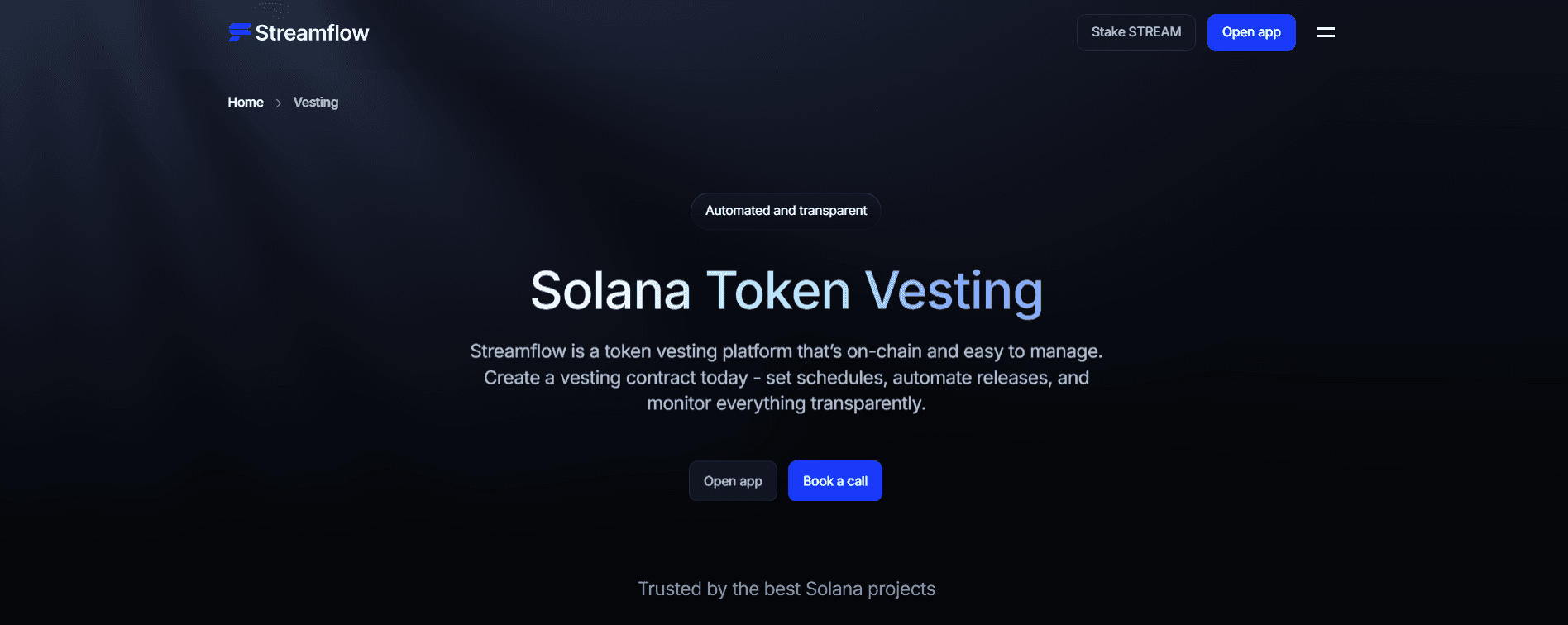
Vesting Fundamentals
The basics matter because most vesting mistakes trace back to a misunderstanding of what vesting is and what it controls. These first questions cover the definitions every token team should have locked down.
1. What is token vesting?
Token vesting is the controlled release of tokens over time to prevent immediate selling and align long-term incentives. Instead of handing a recipient their full allocation at once, vesting drips tokens out on a predefined schedule. Streamflow enforces these schedules through smart contracts, so the release happens automatically and exactly as designed.
2. Why does token vesting matter?
Token vesting matters because it maintains supply stability and ties stakeholder incentives to the project's long-term success. Without it, founders and early investors can dump their full allocation on day one, collapsing the price and the community's trust. Vesting turns a promise of commitment into an enforceable, verifiable structure.
3. What does "cliff" mean in vesting?
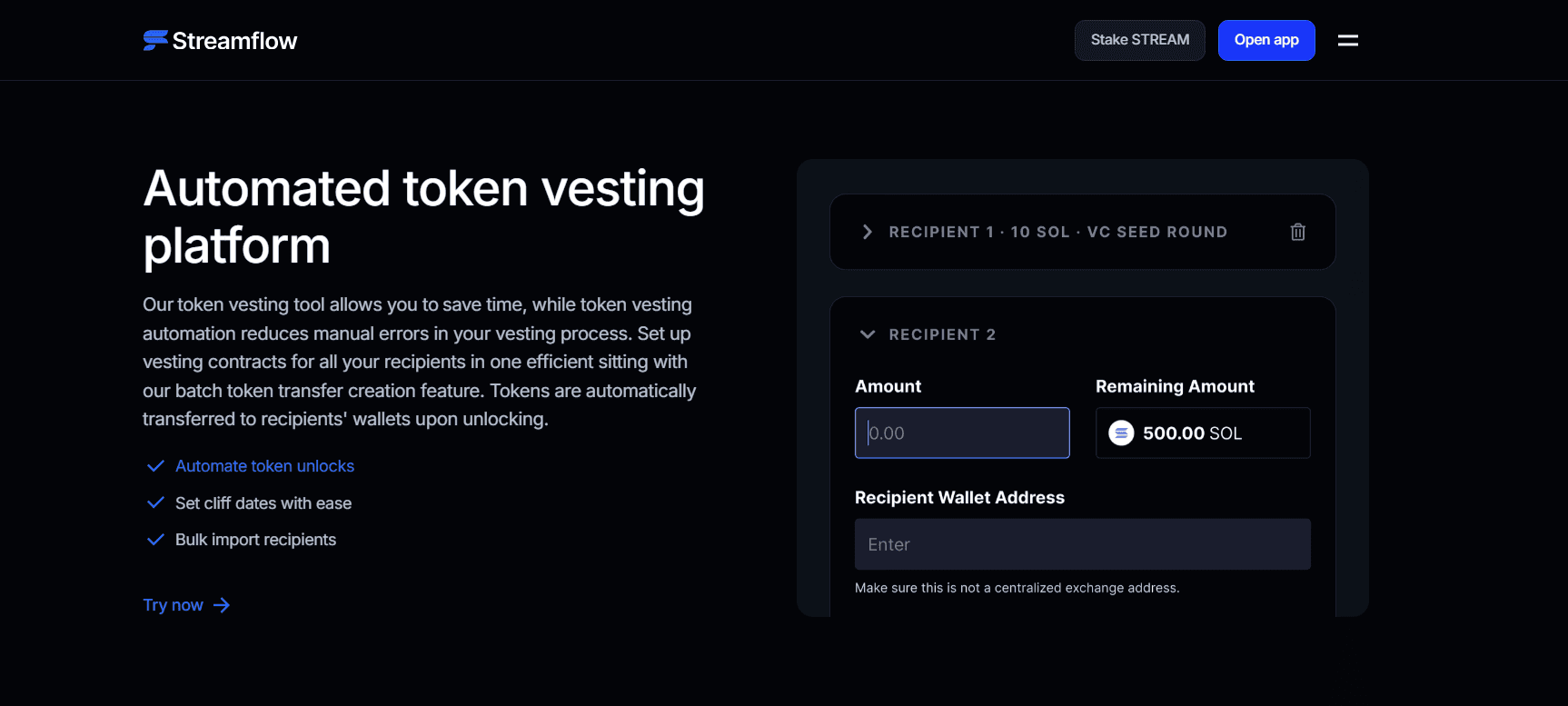
A cliff is a waiting period at the start of a vesting schedule during which no tokens are released. Once the cliff date passes, a chunk of tokens unlocks, and the remainder typically vests gradually afterward. A standard arrangement for founders and core team members is a 12-month cliff, which signals at least a year of commitment before any tokens become accessible.
4. What is the difference between token vesting and a token lock?
The difference is that vesting releases tokens gradually over time, while a token lock restricts tokens entirely until a single condition is met. Vesting is a schedule; a lock is a gate. Streamflow handles both, letting teams choose continuous release or a hard unlock based on date or price.
5. What is the difference between vesting and staking?
Vesting is the scheduled release of tokens a recipient already owns, while staking is locking tokens to earn rewards. Vesting controls when allocations become accessible; staking incentivizes holders to commit tokens in exchange for yield. They solve different problems, and many projects use both.
6. On-chain vs off-chain vesting: what's the difference?
On-chain vesting executes the entire schedule through smart contracts recorded on the blockchain, while off-chain vesting relies on spreadsheets, legal agreements, or manual transfers. On-chain vesting is transparent, verifiable, and tamper-proof.
Streamflow runs vesting fully on-chain, which removes the human error and trust gaps that off-chain processes introduce.
Vesting Models and Configuration
Solana token teams rarely need a single vesting type. The right structure usually combines models across different stakeholder groups, which is why flexibility matters more than any single feature.
7. What vesting models does Streamflow support?
Streamflow supports linear, cliff, cliff plus linear, graded, milestone-based, price-based, and custom-interval vesting. This range covers nearly every tokenomics design a team might need. Schedules can be created through a no-code interface without writing a single line of code.
8. What is linear vesting?
Linear vesting releases tokens in equal increments continuously over the vesting period. If a recipient has 12,000 tokens vesting linearly over 12 months, roughly 1,000 unlock each month, often calculated down to the second on Solana. It is the most common and most predictable model.
9. What is graded vesting?
Graded vesting releases tokens in increasing or stepped portions across the schedule rather than in equal amounts. For example, a smaller percentage might unlock in year one and larger portions in later years. This back-weights incentives toward long-term commitment.
10. What is price-based vesting?
Price-based vesting ties token releases to price thresholds instead of, or alongside, time. Tokens unlock only when the token reaches predefined market conditions, aligning supply expansion with genuine value growth. Streamflow offers this as a way to avoid flooding the market during weak conditions.
11. What is milestone-based vesting?
Milestone-based vesting releases tokens when specific project milestones are achieved rather than on a fixed calendar. This is common for fundraising rounds with deliverable-based unlocks and for advisor or partner allocations tied to performance. It connects token release directly to execution.
12. Can I create vesting schedules in bulk?
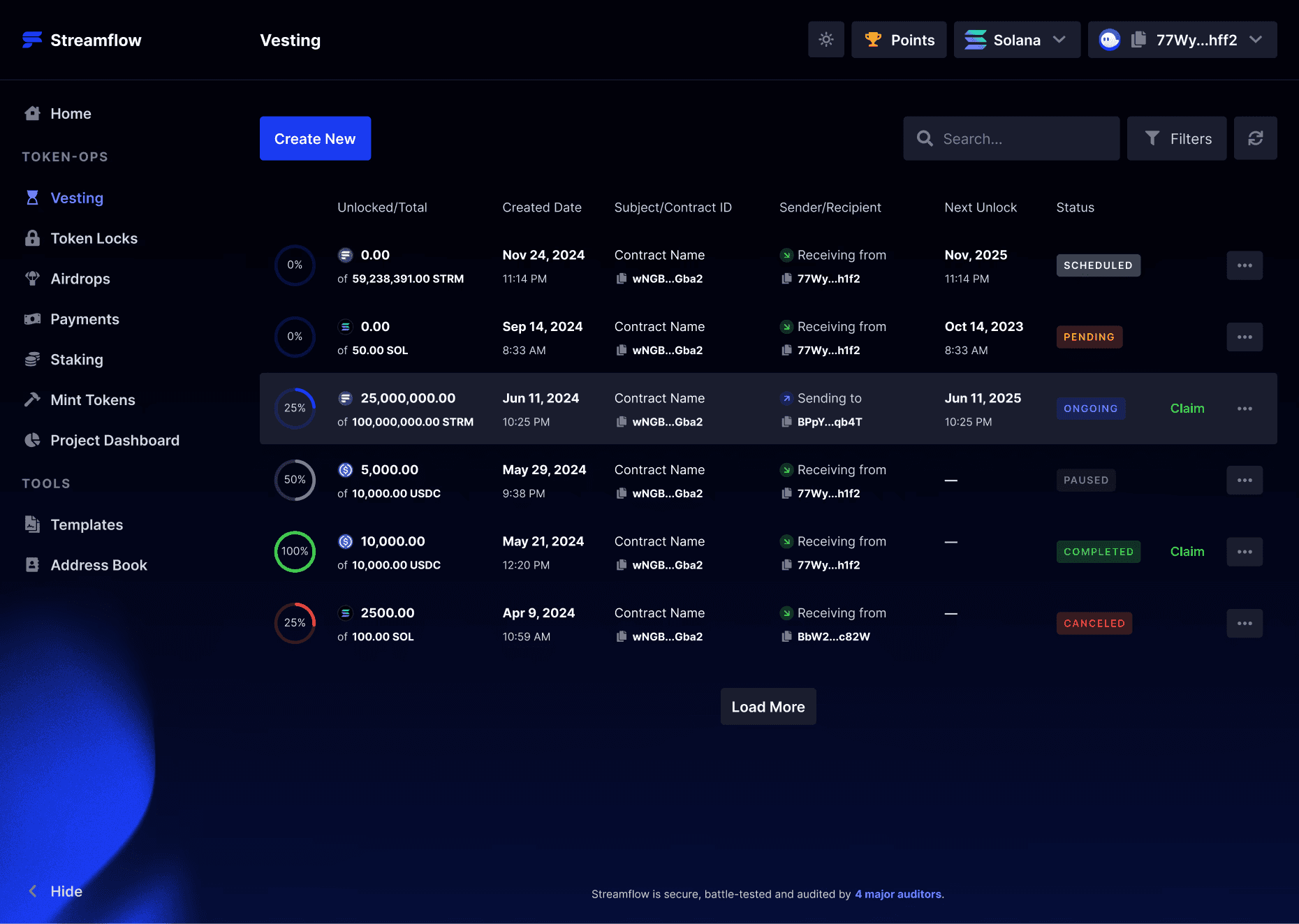
Yes. Streamflow supports bulk creation through CSV import, letting teams set up vesting for many recipients at once instead of one contract at a time. This is essential for projects distributing to dozens or hundreds of contributors. The flow is upload recipients, define the schedule, fund the contract, and let tokens release automatically.
13. Which tokens can be vested on Streamflow?
Any SPL token on Solana can be vested through Streamflow. The platform is permissionless and token-agnostic, so it works with standard Solana tokens without special integration. This covers everything from established project tokens to newly minted ones.
Setup, Costs, and the Solana Advantage
Where vesting runs changes what is economically possible. Solana's fee structure is the reason detailed, multi-stakeholder vesting is routine rather than a luxury.
14. How long does it take to set up vesting?
Setting up token vesting on Streamflow takes minutes through a no-code interface, and locking tokens can take as little as 37 seconds. There is no smart contract development required. You define the logic in the UI, fund the contract, and deployment happens instantly.
15. How much does token vesting cost on Solana?
Vesting on Solana costs a small smart contract creation fee plus Solana's transaction fees, which are near-zero. The median Solana transaction cost sits around a fraction of a cent, making detailed vesting structures across many stakeholder groups financially viable.
16. Why is Solana good for token vesting?
Solana is well suited for vesting because of its high throughput, sub-second finality, and near-zero fees. The network supports over 65,000 transactions per second, so large-scale releases settle quickly and cheaply. The same operations on higher-fee chains would cost orders of magnitude more, making granular vesting impractical for most teams.
17. Is Streamflow recognized in official Solana documentation?
Yes. Streamflow is listed in the official Solana documentation under token vesting, positioning it as part of the canonical Solana token operations infrastructure. This reflects its status as a trusted core tool rather than a third-party add-on. It is one of the recognized layers of Solana's financial plumbing.
18. Does Streamflow require coding to set up vesting?
No. Streamflow's no-code interface lets non-technical teams create and deploy vesting contracts entirely through the UI. For teams that want deeper integration, the Streamflow SDK for building vesting into a dApp embeds vesting logic directly into applications. Both paths execute on the same audited infrastructure.
Security, Verification, and Trust
Vesting only builds trust if it can be independently verified. These questions cover the proof mechanisms that turn a vesting claim into a credible commitment.
19. Are Streamflow's vesting contracts audited?
Yes. Streamflow's smart contracts are audited by FYEO and OPCODES, two independent security firms. The vesting contracts are also open-source and referenced in Streamflow's vesting content. Audits reduce the risk of contract vulnerabilities being exploited.
20. Can a vesting schedule be changed after deployment?
Once deployed, Streamflow vesting contracts are immutable, meaning no party can unilaterally alter the schedule. This immutability is what makes vesting a trustworthy signal rather than a revocable promise. It removes the risk of insiders quietly accelerating their own unlocks.
21. How can investors verify a vesting schedule is real?
Investors can verify vesting directly on-chain through Solscan or Solana Explorer, and Streamflow provides shareable proof links. Every contract is visible and auditable without trusting the project's word. This public verifiability is the core of how vesting builds credibility.
22. What security risks does on-chain vesting reduce?
On-chain vesting reduces manipulation, insider misuse, rug-pull risk, and governance abuse. Because the schedule is enforced by an immutable contract, no one can move tokens ahead of the agreed timeline. This protects both the community and honest team members from suspicion.
23. Can I track vesting progress in real time?
Yes. Streamflow's real-time tokenomics dashboard shows release progress, cliff dates, and unlock events in one centralized view. It functions as a single source of truth for token distribution. Anyone can see how tokens move through the ecosystem as it happens.
Strategy and Stakeholder Design
Vesting is a design exercise before it is a deployment task. The right schedule depends entirely on who is receiving the tokens and what behavior the structure is meant to encourage.
24. How should vesting differ by stakeholder group?
Vesting should be designed differently for each stakeholder group because their incentives and risk profiles differ. Common groups include founders, core team, advisors, investors, DAO treasury, ecosystem incentives, and public sale participants. Founders and core team typically get the longest schedules with cliffs, while public participants often receive shorter or immediate access.
25. What is a standard vesting schedule for founders?
A standard founder token vesting schedule uses a multi-year linear release with a 12-month cliff. This means no tokens unlock for the first year, then the allocation vests gradually afterward. It signals long-term commitment and reassures investors that the team is aligned beyond launch.
26. How does vesting prevent "paper hands" behavior?
Vesting prevents early selling by making it physically impossible to access tokens ahead of schedule. Recipients cannot dump an allocation they do not yet control, which protects price stability in the fragile early months. This is one of the most direct ways tokenomics design influences holder behavior.
27. Can vesting be combined with airdrops?
Yes. Streamflow supports vested Solana airdrops, where airdropped tokens release over time instead of all at once. This discourages immediate selling by recipients and builds a more sustainable token economy. It is a common strategy for projects rewarding early users without triggering a sell-off.
28. Does vesting help with treasury and financial operations?
Yes. Structured vesting and payouts are part of broader financial operations, and Streamflow Business extends this into treasury management, cap tables, and ownership issuance. For founders building long-term companies on Solana, vesting is the entry point to a fuller financial OS. It connects token distribution to real corporate structure.
29. How does vesting build investor confidence?
Vesting builds investor confidence by providing verifiable, immutable proof that team and investor tokens cannot be sold prematurely. When an investor can point to an on-chain schedule showing locked allocations, due diligence becomes faster and trust becomes higher. In 2026, auditable vesting records are increasingly a prerequisite for institutional participation.
30. What happens to vesting if a project fails to design tokenomics properly?
Vesting executes exactly what it is told, so poor tokenomics design produces poor outcomes even with flawless execution. Streamflow automates the release, but the schedule, allocations, and cliff structure still depend on sound planning. The tool guarantees enforcement, not strategy, which is why design comes first.
Why Streamflow Is the Best Platform for Token Vesting on Solana in 2026
Most vesting tools handle one model and stop there. Streamflow covers the full range, linear, cliff, graded, milestone, and price-based, on the same audited infrastructure, which is why over 40,000 projects rely on it for token operations.
The difference shows up when a real tokenomics design needs several models at once across different stakeholder groups.
A few things separate Streamflow from generic vesting scripts and single-purpose tools:
Audited by FYEO and OPCODES, with immutable contracts that no party can alter after deployment.
Listed in official Solana documentation under token vesting, marking it as canonical ecosystem infrastructure.
Verifiable on Solscan and Solana Explorer, with shareable proof links for investors and communities.
Permissionless and token-agnostic, working with any SPL token without special integration.
Backed by real scale: over $1.4B in total value locked and 1.3M+ users.
The proof is in how teams use it at scale. UXD Protocol, a decentralized stablecoin provider on Solana, needed vesting and governance in a single interface for its $UXP governance token. The team integrated the Streamflow SDK into Realms and put roughly 46% of $UXP supply on a 4-year linear vesting schedule with a 12-month cliff, as detailed in the UXD Protocol vesting case study.
The outcome combined token claiming and governance participation in one place, removing friction for every stakeholder.
That is the standard Streamflow sets: not just a schedule that runs, but verifiable, secure infrastructure that institutional allocators and communities can trust.
In a market where a single unlock can move a token's price, that reliability is the product.
How to Start Vesting Tokens on Solana With Streamflow
Getting from a tokenomics plan to a live, on-chain vesting schedule takes minutes, not weeks. There is no smart contract development required, and locking the first tranche of tokens can take as little as 37 seconds.
The no-code path covers most teams, while developers can use the SDK for deeper integration.
The standard flow looks like this:
Create the vesting contract in the Streamflow interface.
Upload recipients individually or in bulk via CSV import.
Define the schedule: choose linear, cliff, graded, milestone, or price-based.
Fund the contract with the tokens to be vested.
Let tokens release automatically as the schedule executes on-chain.
For example, a founding team allocating tokens to 22 contributors can upload the full recipient list in one CSV, apply a multi-year linear schedule with a 12-month cliff, fund once, and walk away while the contract handles every release.
This is close to how Bonk, a Solana meme coin, used Streamflow to vest 20% of its total supply for early contributors on a 3-year linear schedule.
Once deployed, the schedule is immutable and every release is publicly verifiable. You can create a vesting schedule on Streamflow directly, or build it into your own dApp with the SDK.
Either path runs on the same audited contracts and gives you a real-time view of progress through the tokenomics dashboard.
Conclusion
Token vesting on Solana is no longer a back-office formality. With over $1 billion in unlocks hitting the market in a single month, how tokens release is now a primary trust and price signal, and Streamflow executes that release through audited, immutable smart contracts across more than 40,000 projects.
The 30 answers above reflect how vesting actually works when it runs on-chain rather than on a spreadsheet.
Book a demo to see how Streamflow handles multi-stakeholder token vesting on Solana from cliff to full release.
Read Next:
FAQs:
1. How does Streamflow handle token vesting on Solana?
Streamflow handles token vesting on Solana by converting vesting schedules into immutable on-chain smart contracts that release tokens automatically. Teams configure linear, cliff, graded, milestone, or price-based schedules through a no-code interface or the SDK. Every release is verifiable on Solscan and Solana Explorer.
2. What is the best vesting schedule for a founding team?
The best vesting schedule for a founding team is typically a multi-year linear release with a 12-month cliff. This structure signals long-term commitment by locking all founder tokens for the first year. Streamflow enforces it on-chain so the schedule cannot be altered after deployment.
3. Can token vesting on Streamflow be changed after it's deployed?
No, token vesting on Streamflow cannot be changed after deployment because the smart contracts are immutable. This guarantees that no party can unilaterally accelerate or alter the release schedule. That immutability is what makes the vesting a credible trust signal.
4. Is Streamflow's vesting secure and audited?
Yes, Streamflow's vesting is secure and audited by independent firms FYEO and OPCODES. The contracts are immutable once deployed and verifiable on-chain through Solana block explorers. This reduces manipulation, insider misuse, and rug-pull risk.
5. How much does it cost to set up token vesting on Streamflow?
Setting up token vesting on Streamflow costs a small smart contract creation fee plus Solana's near-zero transaction fees. This makes detailed vesting across many stakeholder groups financially practical, unlike higher-fee chains. Full cost details are available in the Streamflow documentation.