General
What Is a Token Vesting Schedule? Cliffs, Unlocks, and How It Works
Crypto token unlocks between August 3 and September 3, 2026 are expected to exceed $1.28 billion in combined value, spread across one-time cliff events and ongoing linear releases, according to CoinGabbar's monthly unlock breakdown.
Every one of those releases traces back to a vesting schedule someone designed months or years earlier.
Streamflow is the Solana-native token operations infrastructure platform behind more than 40,000 projects and over $263 million in total value locked, and vesting is the mechanism it enforces most often.
A token vesting schedule is the set of rules that decides when an allocation stops being a promise and starts being tradeable supply. Get it right and the market can price your token with a known supply curve. Get it wrong, or leave it in a spreadsheet, and unlock day becomes an unmanaged event.
This article breaks down what a vesting schedule actually is, how cliffs and unlocks work mechanically, the schedule types teams use for each stakeholder group, and how Streamflow turns those rules into immutable on-chain contracts.
Key Takeaways
A token vesting schedule defines how much unlocks, for whom, and on what timeline.
Cliffs delay the first unlock; the release curve after the cliff determines market impact.
Streamflow enforces token vesting through audited, immutable smart contracts with public on-chain proof.
Over 40,000 projects use Streamflow for token vesting, locks, and distribution on Solana.
What a Token Vesting Schedule Is and Why It Exists
Token vesting is the controlled release of tokens over time to prevent immediate selling and align long-term incentives. A vesting schedule is the specific configuration of that release: the recipient, the total allocation, the start date, the cliff, and the release curve that follows it.
Vesting exists because token allocations and value creation run on different clocks. Founders, contributors, and investors receive their allocations at launch, while the product they are funding takes years to deliver. Without a schedule, everyone holds liquid supply on day one and the market has no reason to believe anyone will stay.
Streamflow's position on this is direct. Tokenomics is not a slide deck, it is an executable system, and automated token vesting is what makes the schedule enforceable rather than aspirational.
Vesting Schedules vs Token Locks
These get conflated constantly, and the distinction matters when you are designing a distribution plan.
Vesting: gradual release of an allocation over time, according to a schedule.
Lock: a complete restriction on an allocation until one unlock condition is met, then a single release event.
Staking: a voluntary lockup by holders in exchange for rewards, not a pre-allocated release.
Most credible launches use both. Teams apply token locks on Solana to treasury and liquidity positions, and vesting schedules to team, advisor, and investor allocations.
Cliffs, Unlocks, and the Shape of a Vesting Schedule
Every token vesting schedule has two moving parts: when the first tokens become available, and how the rest arrive after that. Those two decisions do more to shape market behavior than the total allocation size.
What a Cliff Actually Does
A cliff is a period during which no tokens are released at all. When the cliff ends, the tokens accrued during that period unlock at once, and the remaining allocation begins vesting according to the schedule. The standard for founders and core team allocations is a 12-month cliff.
The cliff serves three purposes:
It filters for commitment, since anyone leaving early forfeits the allocation.
It removes insider supply from the market during the most fragile post-launch period.
It gives holders a specific, verifiable date instead of an open-ended risk.
Pump.fun offers a recent public example of cliff mechanics at scale. Its first major insider unlock on July 15, 2026 distributed 57.279 billion PUMP tokens across 121 wallets, ending a 12-month vesting cliff for team and existing investor allocations, with a three-year linear vesting cycle beginning afterward. The structure is unremarkable; the visibility of it is the point.
For a deeper breakdown of the mechanic, see the Streamflow guide to what cliff vesting is.
How Unlocks Release After the Cliff
An unlock is any event where previously restricted tokens become transferable. After a cliff, unlocks follow the release curve the contract encodes. Linear schedules drip supply continuously or on fixed intervals, while graded and milestone schedules release in defined tranches.
The curve determines how the market absorbs supply. A 12-month cliff followed by an instant full release concentrates all the pressure into one day. The same 12-month cliff followed by three years of linear release spreads that same allocation across roughly 1,000 days of gradual absorption.
Tracking those events is its own operational job. Streamflow's real-time token tracking dashboard consolidates vesting contracts, locks, staking pools, cliff dates, and unlock events into a single view that holders and investors can check themselves.
On-Chain vs Off-Chain Schedules
Off-chain vesting lives in a spreadsheet or an internal tool, and depends entirely on the issuer executing transfers correctly and on time. On-chain vesting is enforced by a smart contract, verifiable on Solscan or Solana Explorer, and immune to manual error.
The difference shows up the moment someone asks for proof. An off-chain schedule produces a screenshot; an on-chain schedule produces a contract address anyone can inspect.
How Token Vesting Schedules Work on Streamflow
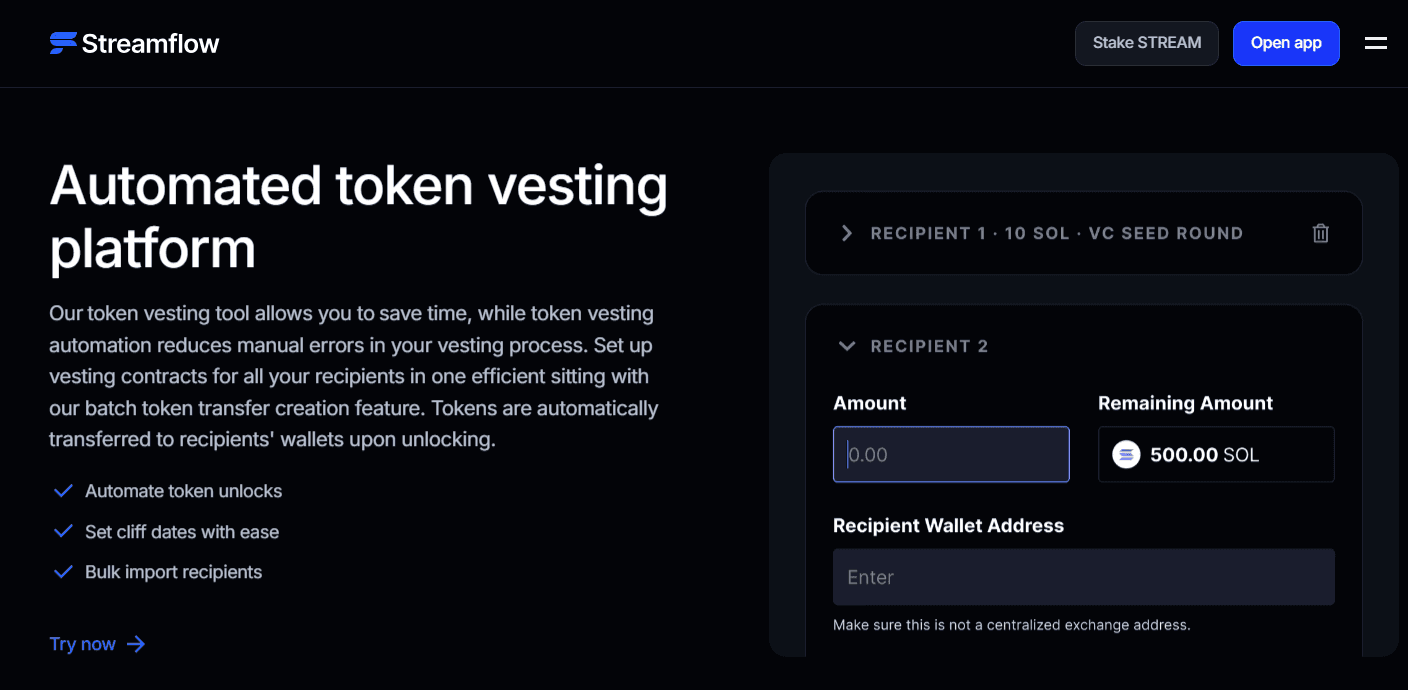
Streamflow converts vesting rules into smart contracts that execute automatically. The no-code path runs entirely through the UI, with no smart contract development required.
Create the vesting contract.
Upload recipients, individually or via CSV bulk import.
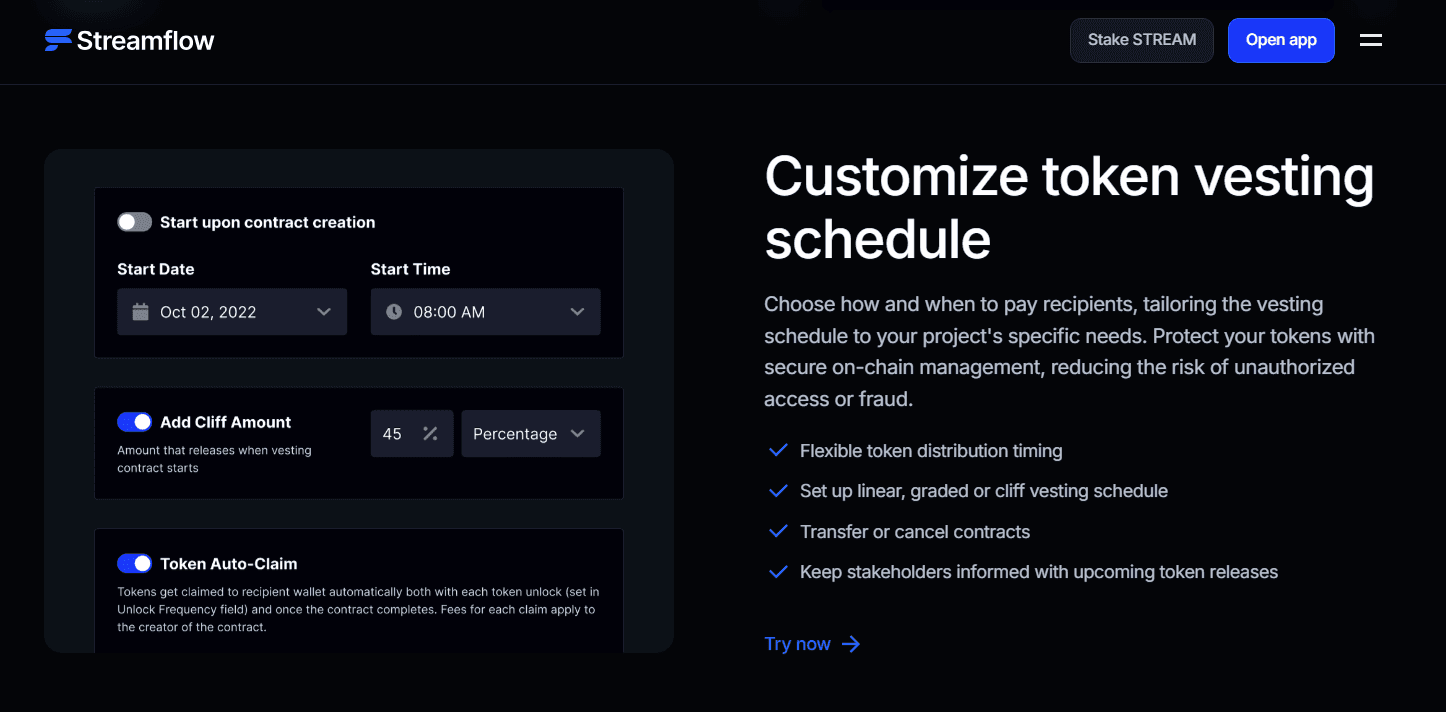
Define the schedule, including cliff, duration, and release logic.
Fund the contract.
Tokens release automatically to recipients on schedule.
Developers integrating vesting into their own product use the Streamflow SDK instead, embedding contract creation and claim logic directly into a dApp. UXD Protocol took this path, which is covered below.
Once deployed, the contract runs without further intervention. The team cannot quietly accelerate a release, and recipients do not have to trust that a transfer will be initiated.
Vesting Models and Configuration Options
Streamflow supports the full range of schedule types teams actually need, not just linear release. Every model below is configurable without writing code.
Linear vesting: continuous release across the full duration.
Cliff vesting: nothing releases until the cliff date, then the accrued portion unlocks.
Cliff plus linear: the standard structure for founders and investors.
Graded vesting: tranche-based release at defined intervals.
Milestone-based vesting: releases tied to project milestones such as product launches or KPIs.
Price-based vesting: releases tied to token price thresholds rather than time alone.
Custom intervals: schedules that match a specific agreement rather than a template.
Supporting features carry equal weight in practice. Bulk CSV import handles hundreds of recipients in one deployment, shareable proof links let anyone verify a schedule without a wallet connection, and vesting top-ups let teams add to an existing contract without redeploying.
Contract cancellation and ownership transfer are available where the initial setup permits them.
Price-based vesting is the newest of these models and is worth understanding on its own terms, since it ties supply expansion to market performance instead of the calendar.
Designing Schedules by Stakeholder Group
A single blanket schedule across all allocations is the most common design error. Different stakeholders have different time horizons, and the schedule should reflect that.
Founders and core team: The longest schedules and the strongest signal. A 12-month cliff with multi-year linear release is the expectation at credible launches, not a differentiator.
Investors: Cliffs plus linear release, negotiated at the round. The schedule needs to be verifiable, because investors evaluating a project will check whether other allocations are locked before committing to their own.
Advisors: Shorter schedules tied to the engagement period, often with a shorter cliff, since the contribution window is shorter.
DAO treasury and ecosystem incentives: Scheduled release into programs rather than wallets, so the treasury cannot be drained in a single governance action and grant programs have predictable funding.
Public sale participants: Often instant or lightly vested, depending on whether the goal is immediate liquidity or holder retention.
Streamflow is listed in the official Solana Docs under token vesting, which is one reason it appears as the default vesting layer across all of these stakeholder categories on Solana.
Case Study: UXD Protocol and Bonk
UXD Protocol, a decentralized stablecoin provider on Solana, needed vesting and governance to live in the same place for its $UXP governance token. The team integrated the Streamflow SDK into Realms and ran a claim portal for stakeholders alongside it.
Approximately 46% of total $UXP supply was distributed through Streamflow on a 4-year linear vesting schedule with a 12-month cliff. The outcome was governance participation and token claiming in a single interface, rather than a claim portal bolted onto a separate governance forum.
The UXD Protocol vesting case study covers the SDK integration in detail.
Bonk shows the same discipline applied to a meme coin. The team used Streamflow for core team vesting, placing 20% of total supply across 22 early contributors on a 3-year linear vesting schedule. For a token whose entire launch narrative was community-first distribution, how Bonk used Streamflow gave that claim something verifiable behind it.
Security, Immutability, and On-Chain Verification
A vesting schedule is only as credible as the contract enforcing it. Streamflow's smart contracts are audited by FYEO and OPCODES, and are immutable once deployed.
No admin override, so no party can unilaterally alter a schedule after deployment.
Every contract and release is verifiable on Solscan and Solana Explorer.
Public proof links let teams share verification without requiring technical steps.
This is what closes the gap between a stated vesting policy and an enforced one. Immutability cuts manipulation risk, insider misuse, and the rug-pull scenario where a team quietly reassigns its own locked allocation.
Getting Started With a Vesting Schedule
The operational lift here is smaller than most teams assume. Streamflow's no-code path takes roughly 37 seconds to lock tokens, and creating a vesting contract runs through the same UI flow: configure parameters, deploy, fund.
Solana's near-zero fees make this economically viable at any allocation size, including hundreds of individual contributor contracts that would be cost-prohibitive on Ethereum.
Two decisions matter more than the tooling: Decide the cliff length per stakeholder group before launch, and decide the release curve based on how much supply the market can absorb per month.
Conclusion
A token vesting schedule is the rule set that converts allocations into circulating supply over time, and cliffs and unlock curves are the two levers that determine how the market experiences it.
Streamflow enforces those rules through audited, immutable smart contracts on Solana, with public verification on Solscan, across more than 40,000 projects and $263M+ in total value locked.
Book a demo to see how Streamflow handles multi-stakeholder vesting schedules with cliffs, bulk recipient import, and on-chain proof.
Read Next:
How to Distribute SPL Tokens on Solana: Airdrops, Vesting, and Bulk Distribution Tools
How to Verify a Token Lock On-Chain: Step-by-Step Checklist for Solscan and Etherscan
Token Distribution Red Flags: 9 Warning Signs to Check Before Buying Any Crypto Token
FAQs:
1. What is a token vesting schedule?
A token vesting schedule is the set of rules defining how much of an allocation unlocks, for whom, and on what timeline. It specifies the recipient, the total amount, the start date, the cliff period, and the release curve that follows. On Streamflow, that schedule is deployed as an on-chain smart contract that executes releases automatically.
2. What does a cliff mean in token vesting?
A cliff in token vesting means a period during which no tokens are released at all. When the cliff ends, the tokens accrued during that period unlock at once and the remaining allocation continues vesting on schedule. The standard for founders and core team allocations is a 12-month cliff.
3. What is the difference between a token vesting schedule and a token lock?
The difference between a token vesting schedule and a token lock is that vesting releases tokens gradually over a defined schedule, while a lock restricts an entire allocation until a single unlock condition is met. Streamflow supports both, and most launches use locks for treasury and liquidity positions alongside vesting for team and investor allocations.
4. Can you create a token vesting schedule on Solana without writing code?
Yes, you can create a token vesting schedule on Solana without writing code. Streamflow's no-code interface lets teams create the contract, upload recipients via CSV, define the cliff and release logic, fund the contract, and let releases execute automatically. Developers who want vesting inside their own product can use the Streamflow SDK instead.
5. Can a team change a vesting schedule after it is deployed?
No, a team cannot unilaterally change a vesting schedule after it is deployed on Streamflow. Contracts are immutable once live and have no admin override, which is what makes the schedule a credible signal rather than a stated intention. Cancellation and ownership transfer are only available where they were explicitly enabled during the initial contract setup.