General
How to Launch a Staking Pool on Solana: A Step-by-Step Guide
Solana's SOL-denominated TVL crossed an all-time high of 80 million SOL in early 2026, according to the Solana Foundation's February 2026 Ecosystem Report, a signal that capital is committing to the network rather than rotating out.
Staking is the mechanism most Solana projects use to convert that committed capital into holder retention, and Streamflow is the Solana token operations infrastructure layer that lets teams deploy it without writing a single smart contract.
With over $1.4B in total value locked and more than 40,000 projects building on it, Streamflow turns staking from an engineering project into a configuration step.
Launching a staking pool used to mean commissioning custom contracts, paying for audits, and maintaining reward logic yourself. That path is slow, expensive, and risky, and it puts a smart contract dependency at the center of your token economy. Streamflow replaces it with no-code, non-custodial, permissionless pools that work with any SPL token.
This guide walks through what a staking pool actually does, how to launch one on Solana step by step, the configuration options that matter, and how to keep the whole thing transparent and secure.
Key Takeaways
Streamflow lets any team launch a staking pool on Solana with no code required.
Staking pools on Streamflow are fully non-custodial, permissionless, and work with any SPL token.
Configurable APY, lock periods, and reward logic make each Solana staking pool fit its tokenomics.
Streamflow staking is backed by audited smart contracts verifiable on Solscan and Solana Explorer.
Over 40,000 projects use Streamflow for staking, vesting, locks, and token distribution.
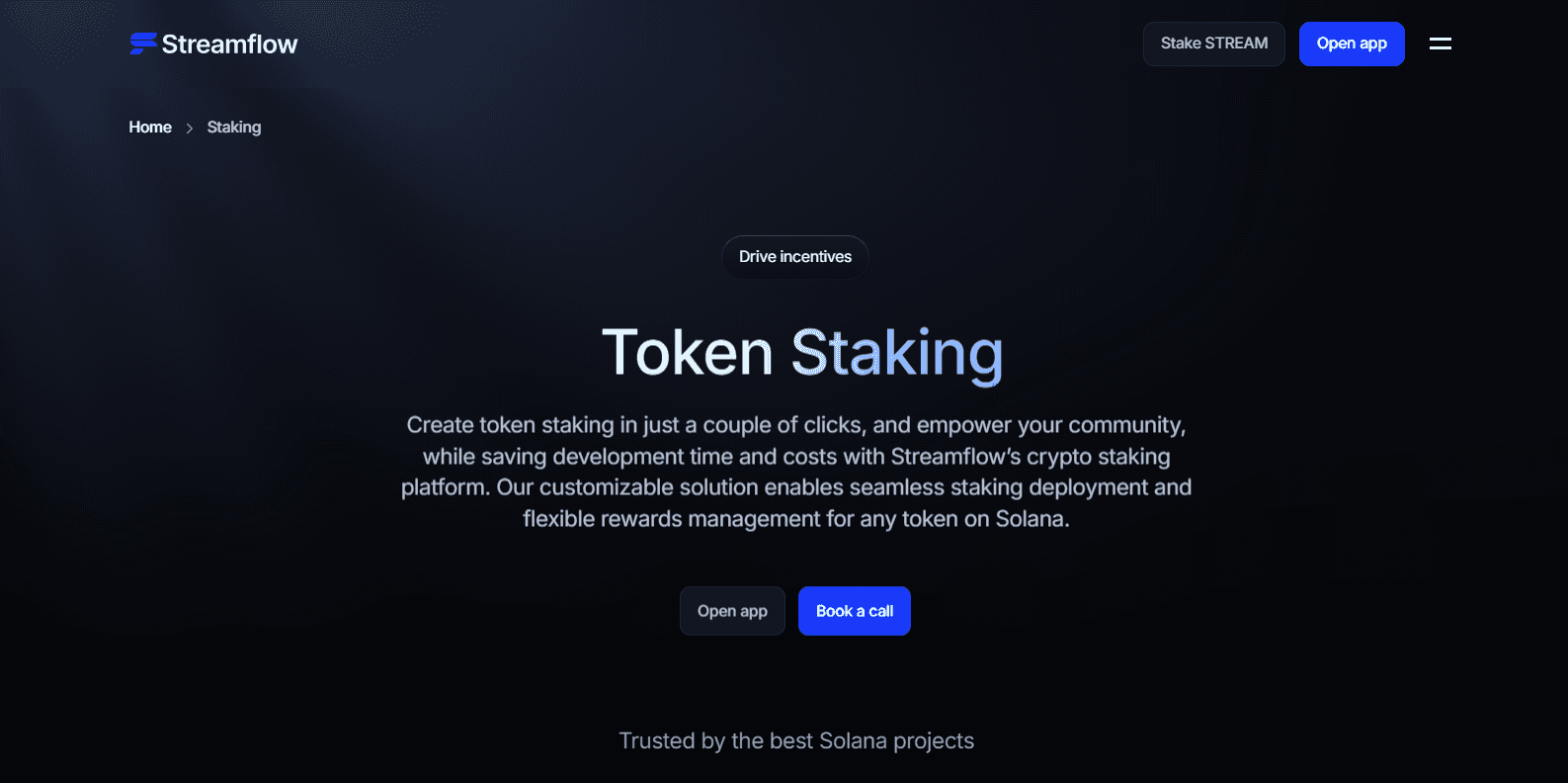
What a Staking Pool Is and Why Projects Launch One
Staking is the process of locking tokens to earn rewards and participate in network or protocol incentives. A staking pool is the on-chain contract that holds those staked tokens, tracks each participant's position, and distributes rewards according to rules the project defines.
On Solana, this is the standard way projects reward long-term holders and give their token a reason to exist beyond trading.
Teams launch staking pools to solve specific tokenomics problems, not just to add a feature. The most common reasons include:
Reducing circulating supply by pulling tokens out of active trading.
Lowering sell pressure from holders who would otherwise dump.
Rewarding loyal holders and deepening community engagement.
Building real token utility and supporting governance participation.
Consider a Solana project whose token trades sideways because holders have no reason to keep it in their wallets. A staking pool with a meaningful APY gives them one, and every token staked is a token not sitting on an exchange order book.
Streamflow's approach makes this deployable in minutes through no-code staking pools rather than a multi-week build.
How to Launch a Staking Pool on Solana, Step by Step
The core flow on Streamflow is short, but each step contains real decisions that shape how your pool behaves. The four steps below take you from an empty pool to live, automated reward distribution.
Step 1: Create the Pool and Select Your Token
Start by connecting a supported Solana wallet and opening a new staking pool. You then select the SPL token holders will stake.
Because pool creation on Streamflow is permissionless and works with any SPL token, you do not need approval or a whitelist to launch. This is the moment to confirm two things: the token you want staked, and the token you want to pay out as rewards.
They can be the same token or different ones, depending on whether you are recycling your own supply or rewarding stakers in a separate asset.
Step 2: Configure the Pool Rules
This is where most of the work happens, because the parameters you set here become the enforceable logic of your pool. Configuration breaks into two decisions: the pool type, and the reward economics.
Choose Your Pool Type
Streamflow supports several pool types, and the right one depends on how you plan to fund and govern rewards:
Fund Once suits a fixed, finite reward budget you deposit upfront, ideal for a defined campaign with a known end.
Continuous Funding suits an ongoing program where you top up rewards over time, keeping the pool alive indefinitely.
Governance Staking ties staked positions to voting and protocol participation, for projects where staking and governance should be the same action.
Custom covers non-standard reward logic that does not fit the templates above.
Picking the type first matters because it frames every later decision. A Fund Once pool needs its full reward budget calculated before launch, while a Continuous Funding pool can start smaller and scale with demand.
Set APY, Lock Period, and Claim Frequency
The reward economics are where your tokenomics goals turn into numbers. Three levers do most of the work:
APY sets how attractive the pool is, and how fast it consumes your reward budget.
Lock period sets how long tokens stay staked, which directly controls how much sell pressure you remove.
Claim frequency sets how often stakers can collect rewards, shaping the user experience and on-chain activity.
These levers interact, so design them together rather than in isolation. A high APY with no lock period attracts mercenary capital that leaves the moment rewards dip, while a longer lock period with a moderate APY rewards genuine conviction and pulls more supply out of circulation for longer.
If your goal is reducing sell pressure, lean on the lock period; if your goal is engagement, a frequent claim cadence keeps stakers returning to the pool.
Step 3: Fund the Reward Budget
A token staking pool can only distribute the rewards it actually holds, so funding is what gives your program runway. Deposit the reward tokens that will be paid out, and size that deposit against your chosen APY and the supply you expect to be staked.
This is the step teams most often underplan. If a pool runs at a high APY and attracts more stake than expected, its reward budget depletes faster, and an empty pool stops paying.
Streamflow supports easy reward top-ups, so Continuous Funding pools can be refilled before they run dry, which is the practical reason most ongoing programs choose that type over Fund Once.
Step 4: Go Live and Let Rewards Distribute Automatically
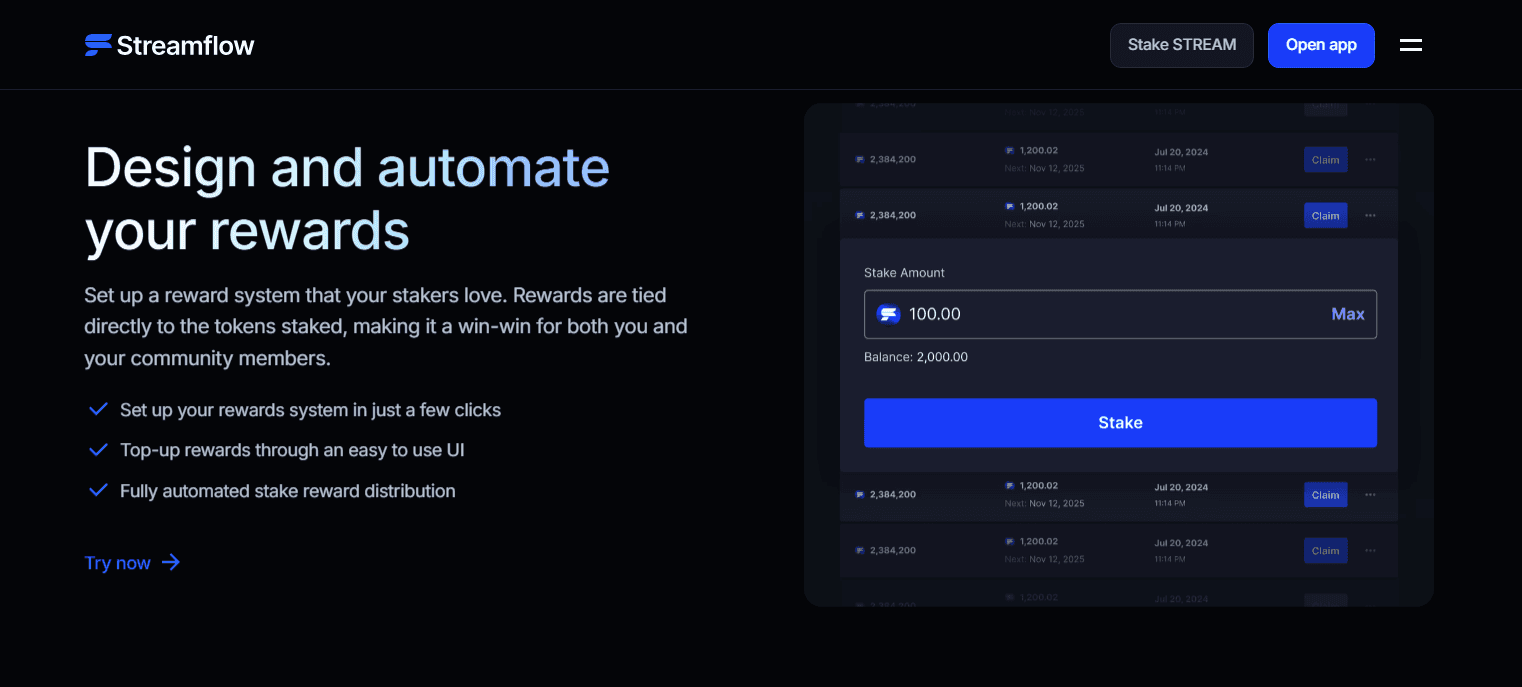
Once the pool is funded and published, holders can stake, and rewards distribute automatically based on the logic you set. There are no manual payouts and no spreadsheet to reconcile.
Each staker receives a stake receipt representing their position, and all staking data updates in real time so both you and your community can track the pool live. From here, your ongoing job is monitoring reward runway and topping up when needed, not running distributions by hand.
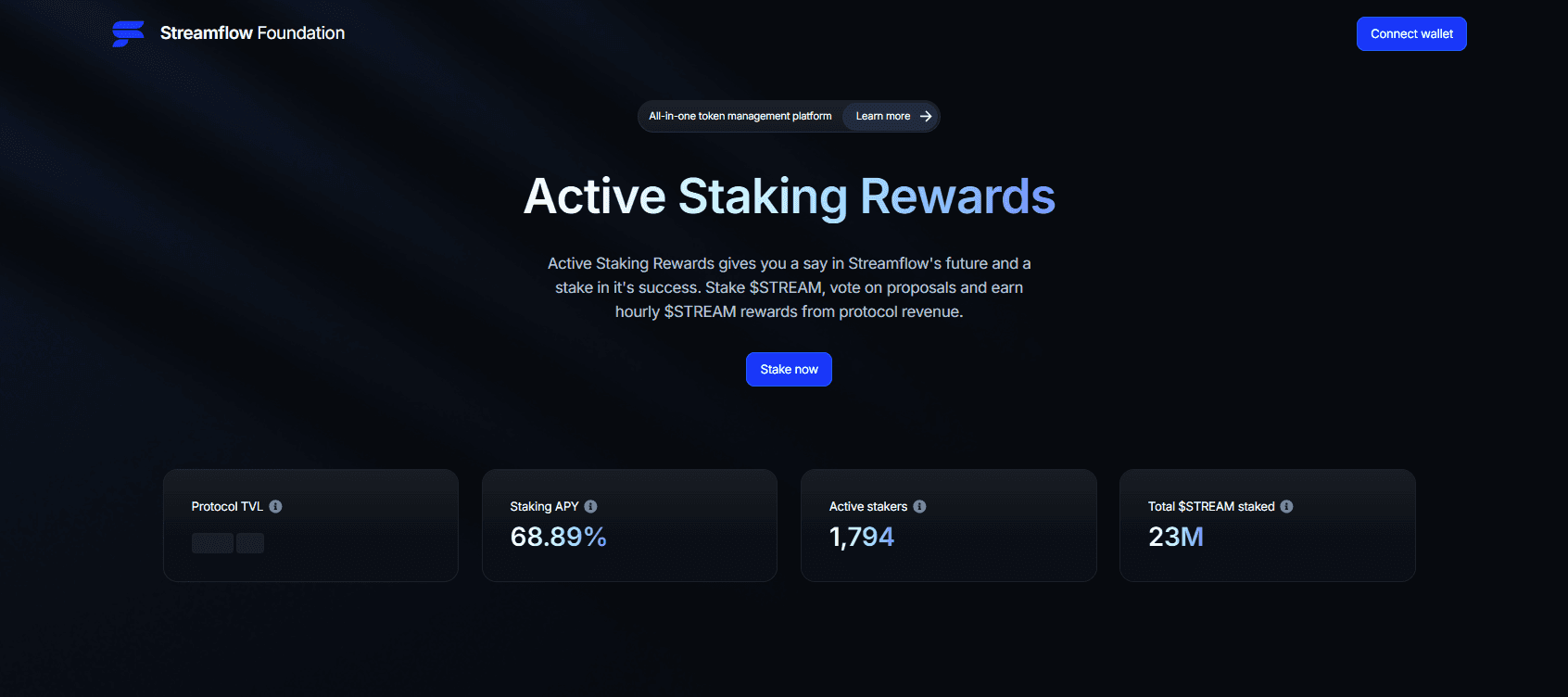
No-Code Path vs Developer Path
Most teams complete all four steps through the Streamflow interface with no code, configuring parameters and deploying instantly. There is no contract to write, audit, or maintain.
Teams that need deeper control use the public SDK to embed staking directly into their own app, customize reward logic, or wire pools into an existing product flow. The developer path is optional, not a prerequisite, and the staking-as-a-service model explained here covers where each path fits.
For a worked example, a GameFi studio could create a Continuous Funding pool for its in-game currency, set a 30-day lock period and a fixed APY, fund the first three months of rewards, and launch a player-staking program the same afternoon. No engineer touches a smart contract, and when the reward budget runs low, the team simply tops it up. That speed is the point of running staking as infrastructure rather than a custom build.
Key Configuration Options for Your Staking Pool
Beyond the core flow, Streamflow staking exposes the settings that let a pool match almost any tokenomics design. The platform gives you configurable APY, lock periods, reward logic, and claim frequency, with easy reward top-ups when a pool needs more runway.
Stakers receive stake receipts representing their positions, and all staking data updates in real time. The one caveat to plan around is depletion: pools distribute only the rewards they hold, so a pool can run dry if it is not refunded, which is exactly why Continuous Funding exists.
When your configuration is set, you can launch a staking pool on Streamflow directly.
Use Cases for Solana Staking Pools
Staking pools serve different goals depending on the kind of project running them. The configuration flexibility above maps onto distinct verticals.
DeFi protocols use pools to deploy automated staking rewards and reduce friction around yield collection, distributing rewards directly into wallets with no claim-and-harvest overhead. This is a core part of Streamflow's DeFi staking deployment offering. The result is lower transaction costs and easier yield for participants.
GameFi ecosystems use staking to manage in-game economies and reward players based on participation, keeping emissions healthy rather than inflationary. Pools become a lever for in-game token rewards and long-term economy design.
Holder-reward programs and governance projects use staking to align community incentives, tying voting power and protocol rewards to staked positions so the most committed holders have the most say.
Case Study: How UXD Protocol Unified Staking, Governance, and Claims
UXD Protocol is a decentralized stablecoin provider on Solana whose $UXP governance token needed both vesting and governance to live in one interface. Rather than stitch together separate tools, the team integrated the Streamflow SDK into Realms and ran a claim portal for stakeholders from the same place.
The numbers were substantial. Roughly 46% of the $UXP supply moved onto a 4-year linear vesting schedule with a 12-month cliff, all enforced on-chain. The outcome was that governance participation and token claiming happened in a single interface, which is exactly the pattern a Governance Staking pool is built to support.
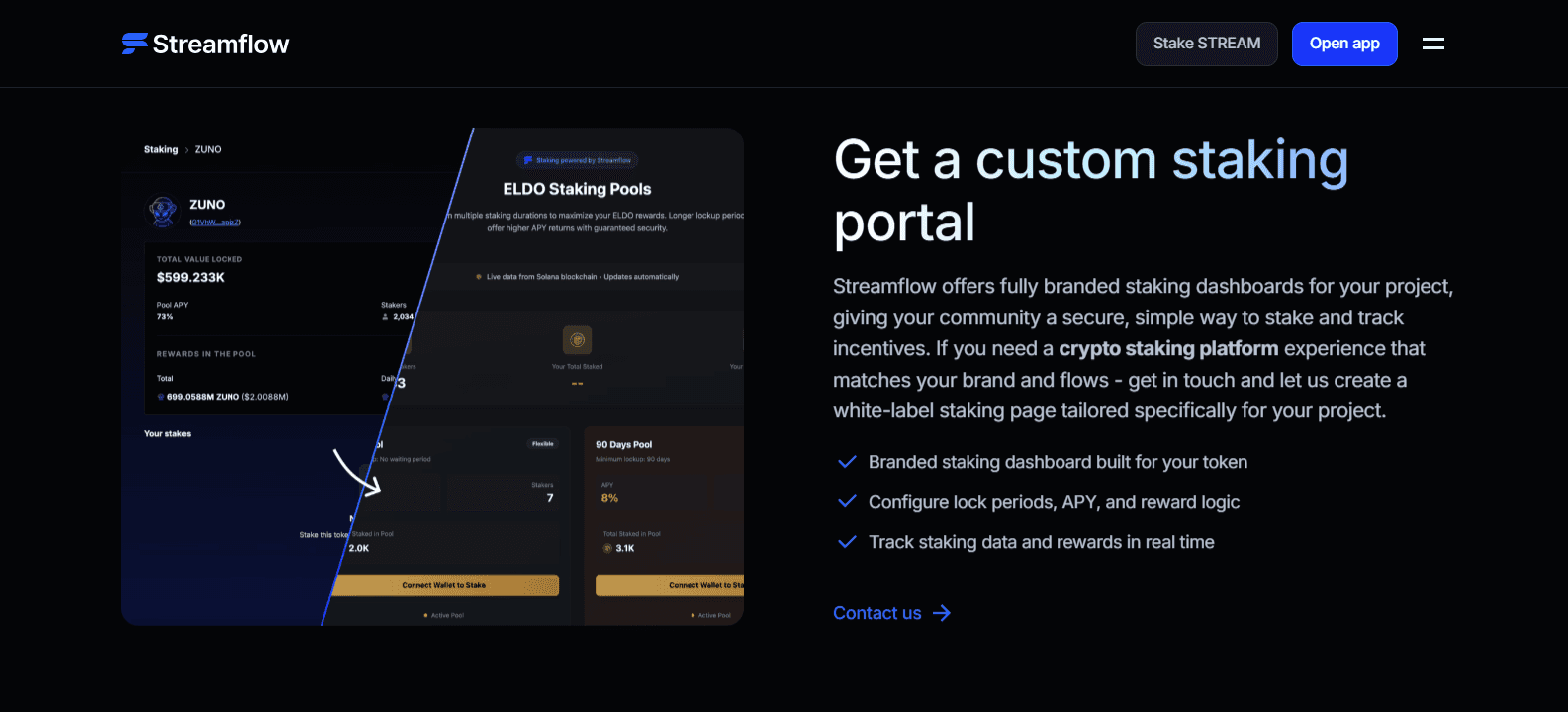
Streamflow's own STREAM token shows the same model taken to its conclusion. STREAM Active Staking Rewards let holders stake $STREAM, vote on proposals, and earn hourly $STREAM rewards funded by protocol revenue rather than inflation.
As reported, the program runs at roughly a 70% APY with around 1,795 active stakers and 23M STREAM staked, all backed by hourly buybacks and zero dilution.
Holders can stake STREAM for protocol rewards to see revenue-backed staking in practice.
Security and Transparency
A staking pool holds other people's tokens, so trust is non-negotiable. Streamflow's staking contracts are audited by FYEO and OPCODES, and pools are fully non-custodial, meaning the team running a pool never takes custody of staked funds.
Every pool is verifiable on-chain. Anyone can confirm pool state, staked balances, and reward distribution through Solscan or Solana Explorer, with no need to trust a dashboard's word for it.
Because the contracts are immutable once deployed and pool creation is permissionless, the rules a project sets are the rules that execute, which is what removes the manipulation and insider-misuse risk that manual reward systems carry.
Getting Started With Your First Staking Pool
Getting live is a matter of minutes, not weeks, and the no-code path means you can deploy without engineering support. Connect a wallet, pick your token, configure rewards, and fund the pool.
Streamflow supports the major Solana wallets, so most teams already have what they need:
Phantom
Solflare
Backpack, alongside other Solana wallets
For teams that want the pool built and managed for them, Streamflow also offers custom managed staking handled by its team. Either way, Solana's sub-second finality and near-zero fees make running a pool economically viable at scale, which is what separates infrastructure-grade staking from an experiment.
Conclusion
Launching a staking pool on Solana no longer requires custom contracts, audits, or a maintenance burden, because Streamflow turns the whole process into a configurable, non-custodial, audited workflow.
With over 40,000 projects already building on it and revenue-backed STREAM staking as living proof, the platform handles staking at infrastructure scale rather than as a bolt-on feature.
Book a demo to see how Streamflow handles launching and managing a no-code staking pool for your Solana token.
Read Next:
FAQs:
1. How do I launch a staking pool on Solana with Streamflow?
You launch a staking pool on Solana by connecting a Solana wallet, selecting your SPL token, configuring the pool type, APY, lock period, and reward funding, then publishing it. The whole flow is no-code and deploys in minutes, with rewards distributed automatically once the pool is live.
2. Does a Solana staking pool on Streamflow require coding?
No, a Solana staking pool on Streamflow does not require coding. Most teams use the no-code interface to configure and deploy pools, while developers can optionally use the public SDK to embed staking into their own apps or customize reward logic.
3. Can any SPL token be staked on Streamflow?
Yes, any SPL token can be staked on Streamflow. Pool creation is permissionless and fully non-custodial, so teams can launch staking for their own token without seeking approval or surrendering custody of staked funds.
4. Are Streamflow staking pools secure and verifiable?
Yes, Streamflow staking pools are secure and verifiable. The contracts are audited by FYEO and OPCODES, pools are non-custodial and immutable once deployed, and all pool activity can be confirmed on-chain through Solscan or Solana Explorer.
5. What is the difference between staking and vesting on Streamflow?
The difference is that staking locks tokens to earn rewards and drive engagement, while vesting releases tokens gradually over time to align long-term incentives. Streamflow supports both, so a project can run a staking pool and a vesting schedule from the same platform.