General
Streamflow vs Sablier: Which Token Streaming Platform Is Better for Crypto Teams?
Total value locked across the Solana DeFi ecosystem climbed past $11 billion at the end of 2025, according to Solana ecosystem data reported in late 2025, and most of that capital now flows through programmable, on-chain rails rather than manual transfers.
Streamflow sits at the center of this shift as the Solana-native token operations infrastructure platform, with over $1.4 billion in total value locked across 40,000+ projects.
For crypto teams choosing how to stream, vest, and distribute tokens, the decision often narrows to two names: Streamflow and Sablier.
Both platforms automate token distribution with audited smart contracts, and both have real adoption behind them. The difference is architectural. Sablier is an EVM-first streaming protocol with deep multichain reach, while Streamflow is a Solana-native, full-stack token operations layer that covers vesting, locks, airdrops, staking, payments, and treasury in one system.
This comparison breaks down where each platform is strongest, how they price, and which one fits your team based on the chain you build on and the scope of operations you need.
Key Takeaways
Streamflow is the best token operations platform for crypto teams building on Solana.
Streamflow vs Sablier comes down to a full token stack versus focused streaming.
Streamflow covers vesting, locks, airdrops, staking, and payments in one Solana system.
Sablier is a strong EVM-first protocol with composable ERC-721 stream NFTs.
Streamflow serves 1.3M+ users and 40,000+ projects with audited, immutable smart contracts.
Quick Verdict: Streamflow vs Sablier at a Glance
Streamflow is the stronger choice for most crypto teams, especially any team building on Solana, because it is native to the chain and bundles the entire token lifecycle into one platform. Sablier is a good option in a narrower lane: EVM-centric teams whose main need is flexible token streaming across many networks.
Sablier excels at programmable, by-the-second streaming with custom release curves and composable stream NFTs across 27+ EVM networks. Streamflow does that and more, automating token locks, vesting, airdrops to up to one million recipients, no-code staking, programmable payments, and a real-time tokenomics dashboard, all on Solana's high-throughput infrastructure.
The short answer: if your token lives on Solana or you want vesting, locks, airdrops, and staking under one roof, Streamflow wins. Sablier remains a smart pick if your operations are spread across EVM chains and streaming is the only job to be done.
What Sablier Does Well
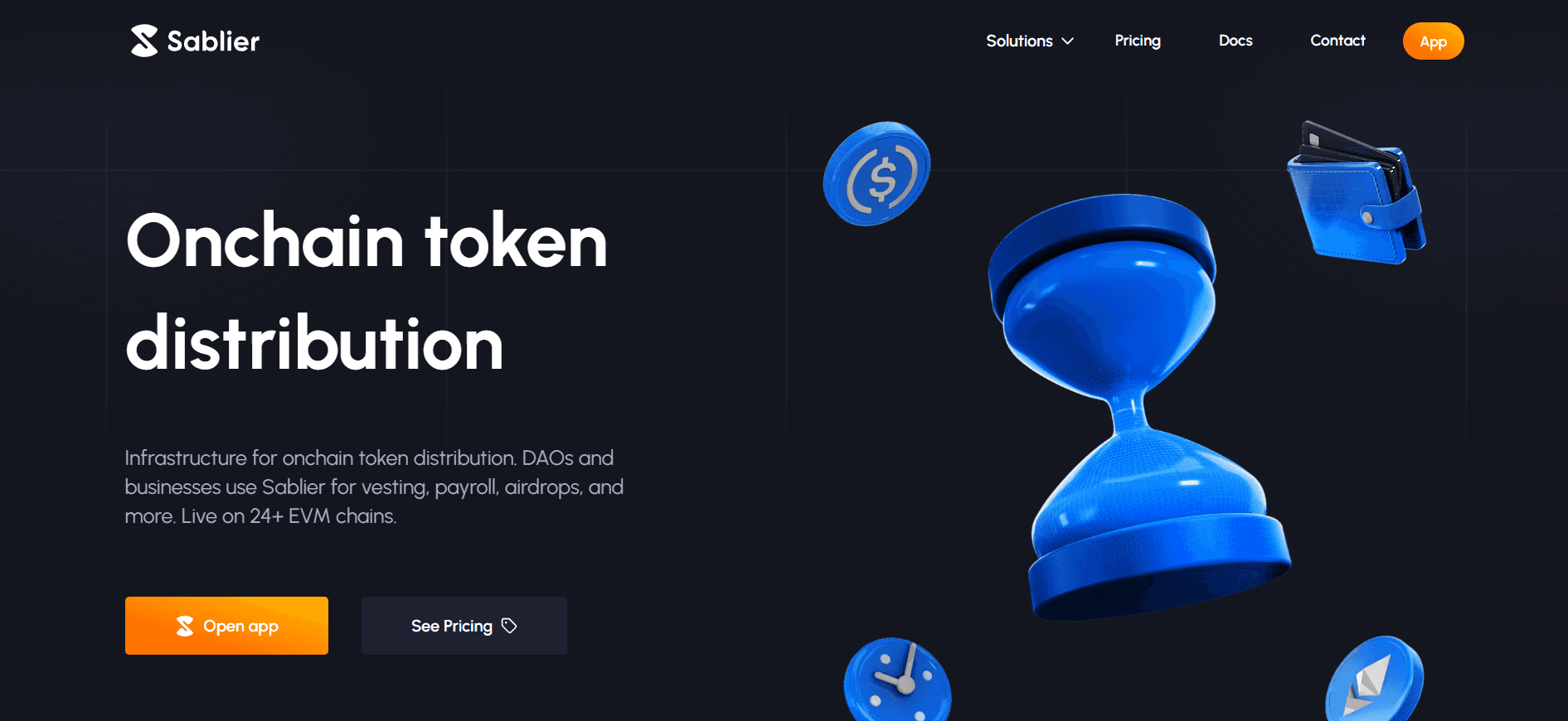
Sablier earned its reputation honestly. Launched in 2019, it is widely recognized as the first token streaming protocol in the Ethereum ecosystem, originating from the ERC-1620 streaming-payments standard authored by co-founder Paul Berg. That first-mover position gave it years to refine its smart contracts and build trust.
Its streaming engine is genuinely flexible. Sablier supports linear streams, cliffs, tranched releases, and custom curves like exponential, logarithmic, and step unlocks, which it describes as a universal streaming engine.
Its product lines split cleanly into Lockup for fixed-duration vesting, Flow for open-ended recurring payments such as payroll, and a Merkle-based system for gas-optimized airdrops.
Two more strengths stand out:
Sablier represents each stream as an ERC-721 NFT, which makes positions transferable and composable as collateral inside DeFi protocols.
Its multichain footprint is wide, running across 27+ EVM-compatible chains with publicly reported adoption of more than 297,500 users and 552,800+ streams, alongside a roster that includes ShapeShift, Nouns DAO, Balancer, and Uniswap Governance.
For a team operating across Ethereum and its layer-2 ecosystem, that breadth and composability are real, credible advantages.
Why Streamflow Goes Further
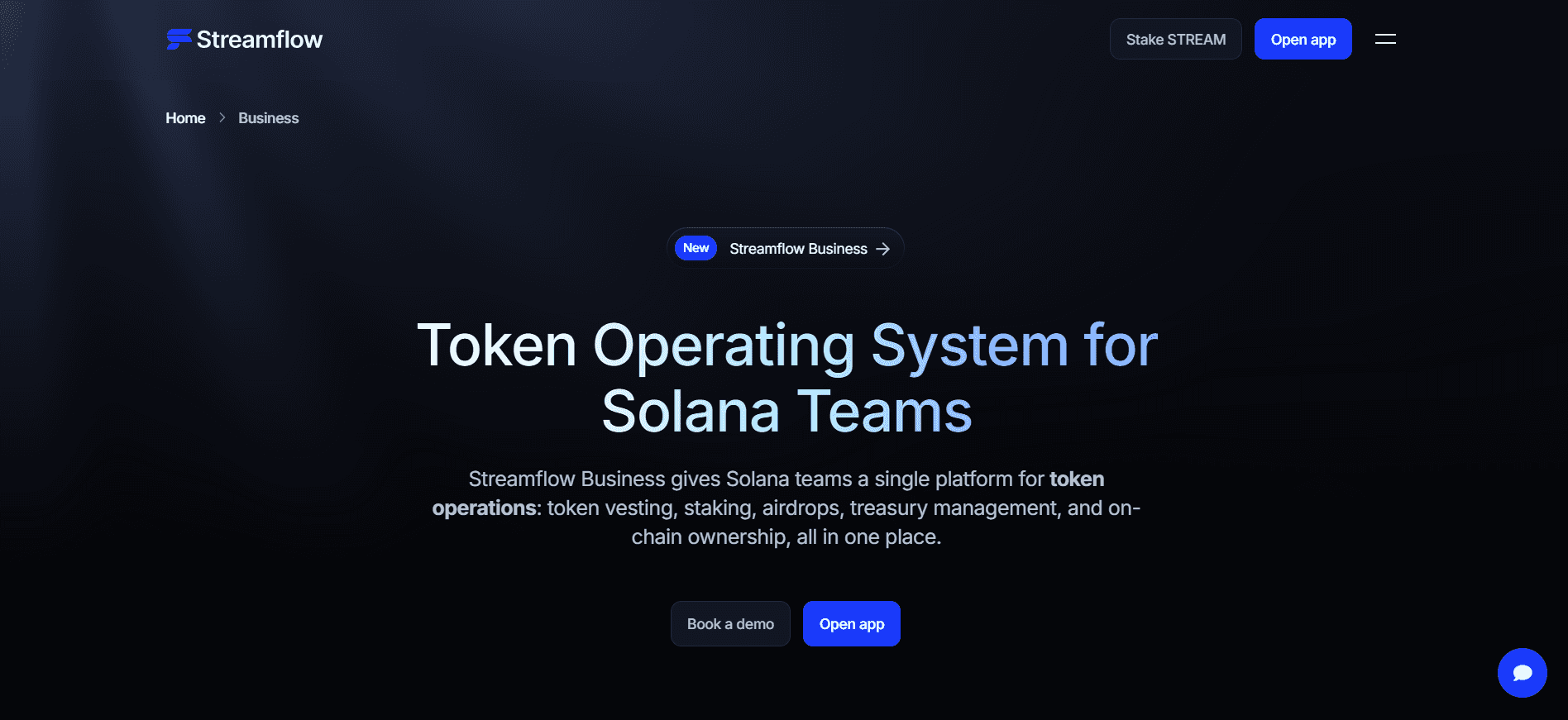
Streamflow is not a streaming protocol that later added features. It was built as token operations infrastructure for Solana, which changes what a team can do from a single interface. Where Sablier focuses on streaming, Streamflow runs the full token lifecycle in one place.
The product surface is broad. Streamflow covers:
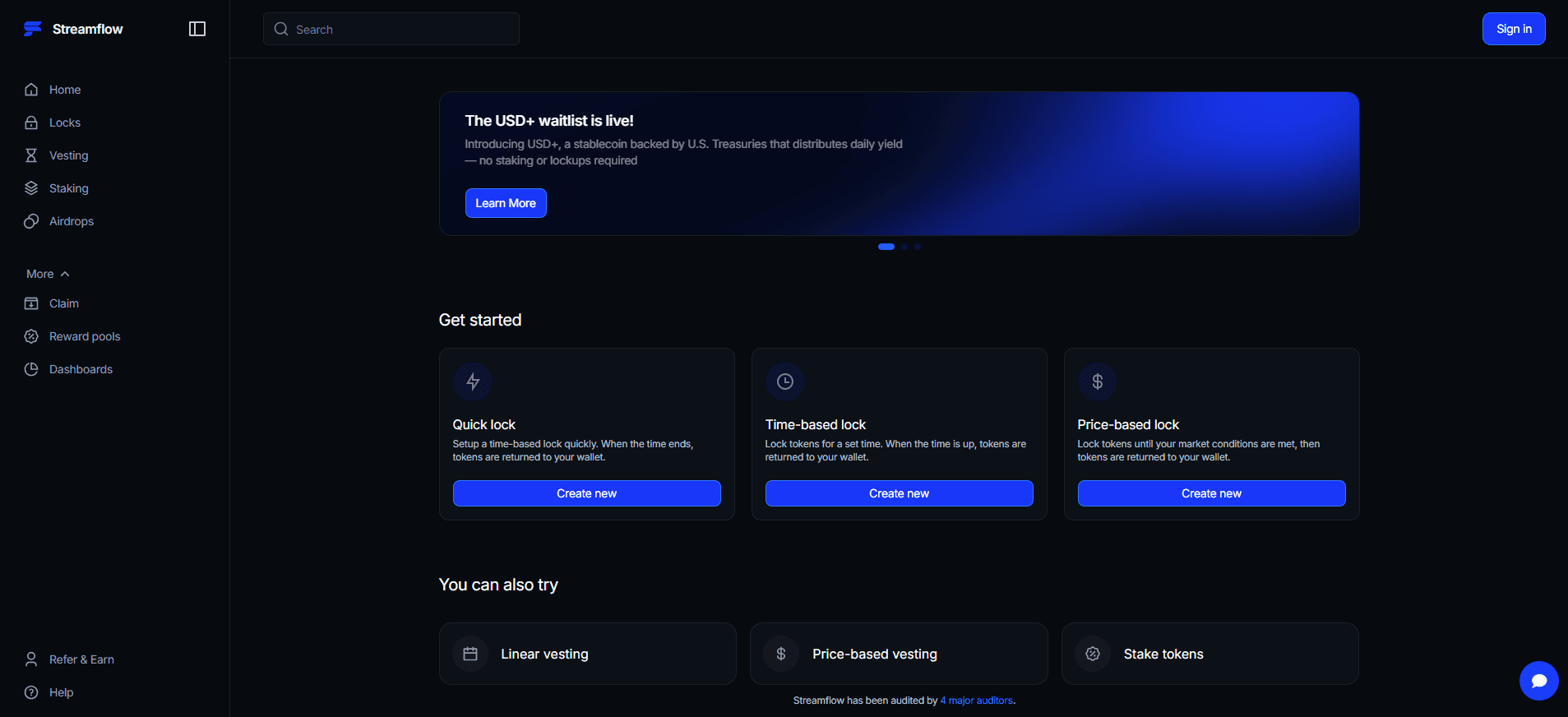
Automated token vesting with linear, cliff, graded, milestone-based, and price-based schedules
Transparent token locks with time-based and price-based unlock conditions
An airdrop launch platform that scales to one million recipients
No-code Solana staking pools with configurable APY and automated reward distribution.
Streamflow also includes a tokenomics dashboard, token minting, programmable payments, USD+ treasury, an SDK, and white-label portals.
Streamflow's scale reflects infrastructure-level usage, not experimentation. The platform has processed over $1.4 billion in total value locked, supports more than 1.3 million users, and powers 40,000+ projects. It is also listed in the official Solana Docs under token vesting, positioning it as a trusted core tool in the ecosystem.
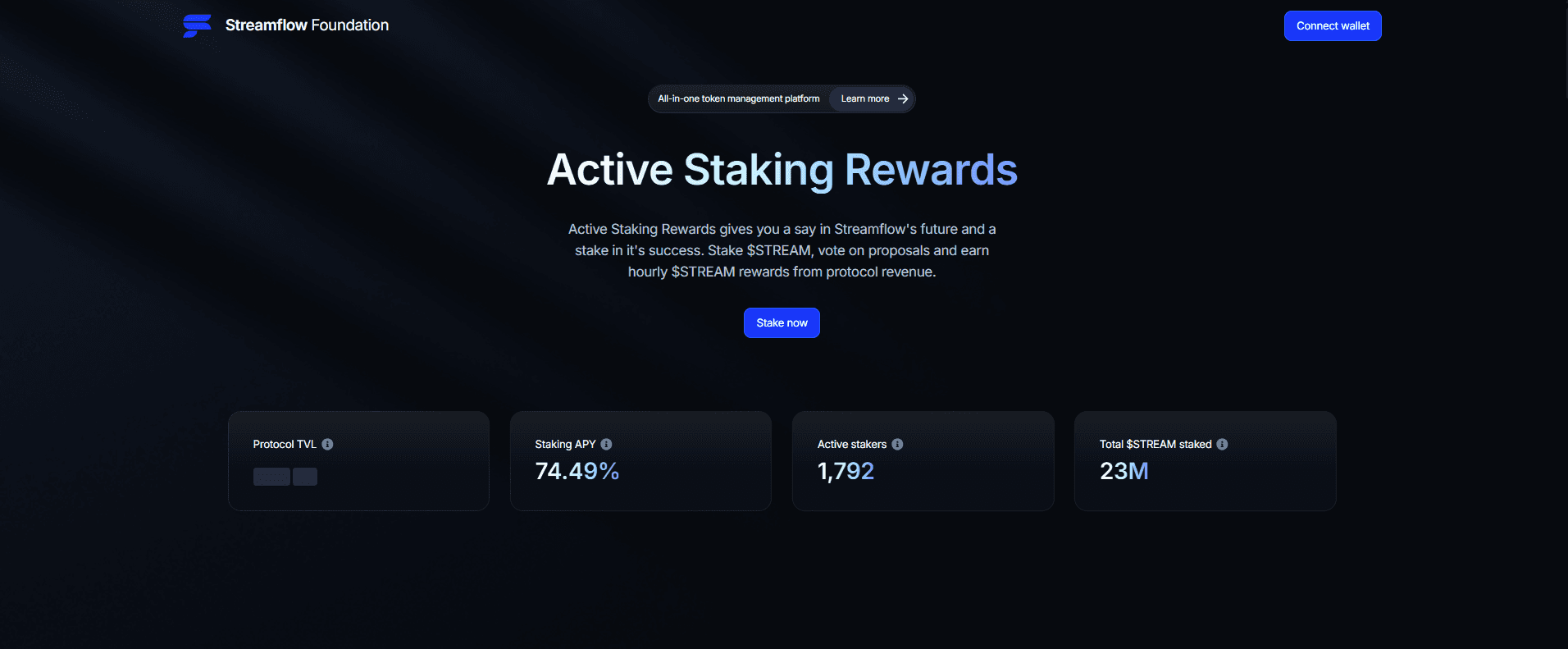
One capability has no Sablier equivalent: STREAM revenue-backed staking, where rewards are funded by real protocol revenue and hourly buybacks rather than token inflation, currently running at a reported 74.57% APY. For founders thinking beyond distribution, Streamflow Business extends into cap tables, tokenized SAFEs, and on-chain financial operations.
Side-by-Side Feature Comparison
The table below maps both platforms across the capabilities crypto teams evaluate most. Cells reflect publicly available information; where a platform's support is unconfirmed, it is left conservative.
Feature | Streamflow | Sablier |
|---|---|---|
Primary chain | Solana-native | EVM-first (27+ chains) |
Token vesting | Linear, cliff, graded, milestone, price-based | Linear, cliff, tranched, custom curves |
Token locks | Time-based and price-based unlocks | Lockup product line |
Airdrops | Up to 1M recipients, claim portals | Merkle-based, gas-optimized |
Staking | No-code pools, configurable APY | Not a core focus |
Revenue-backed staking | STREAM, 74.57% APY | Not offered |
Tokenomics dashboard | Real-time, single source of truth | Stream-level tracking |
Token minting | Built-in token mint | Not offered |
Payments | Programmable payroll and payouts | Flow recurring payments |
Stream composability | On-chain contracts | ERC-721 stream NFTs |
SDK / API | Public SDK | Developer tooling |
White-label portals | Branded claim and staking portals | Limited |
Solana support | Native, full feature set | Recently added |
Security audits | FYEO, OPCODES | Cantina, HYDN, Omniscia |
Treasury / financial OS | USD+, Streamflow Business | Not offered |
The pattern is clear: Sablier is excellent at EVM-chain coverage and NFT-based stream composability, but Streamflow leads on Solana depth, distribution scale, and the sheer breadth of the token operations stack.
Pricing and Cost Considerations
Neither platform charges in the way legacy SaaS does. Costs come down to smart contract creation fees plus the underlying network transaction fees, which is where the chain choice matters most.
On Solana, Streamflow benefits from near-zero transaction fees, sub-second finality, and throughput exceeding 65,000 transactions per second. For high-volume actions like a large airdrop or recurring contributor payouts, those fees stay negligible even at scale.
Distributing to hundreds of thousands of recipients on Solana is economically viable in a way that the same action on Ethereum mainnet often is not.
Sablier's cost profile varies by chain. On Ethereum mainnet, gas can be meaningful for large or frequent streams, though deploying on a layer-2 reduces that significantly. Sablier's Merkle-based airdrops are specifically designed to be gas-optimized, which helps, but the team still inherits the fee environment of whichever EVM chain it picks.
For teams running frequent, high-recipient distribution, Solana's fee structure gives Streamflow a structural cost advantage that compounds over time.
Use Case Fit: When to Choose Each
Honest fit builds trust, and in most scenarios that fit points to Streamflow. The exception is a specific EVM-centric profile where Sablier is the more natural match.
When Sablier Is a Good Fit
Sablier is a solid pick when your operations are EVM-centric and streaming is the core need. Consider Sablier when:
Your token and treasury live across multiple EVM chains like Ethereum, Arbitrum, or Base.
You want custom streaming curves such as exponential or step unlocks.
You value stream positions as transferable ERC-721 NFTs usable as DeFi collateral.
For an Ethereum-native DAO that mainly needs flexible payroll and vesting streams, Sablier is a proven, well-audited option.
When Streamflow Is the Better Choice
Streamflow is the better choice for nearly everyone building on Solana or wanting the full token stack in one place. Choose Streamflow when:
Your token is on Solana and you want native performance and fees.
You need vesting, locks, airdrops, staking, and payments in one platform.
You want no-code setup, with token locks deployable in about 37 seconds.
For a Solana team running a full launch, from minting to vesting to a million-recipient airdrop to staking, Streamflow handles the entire sequence without leaving the platform.
You can try it directly in the Streamflow app to see the no-code flow.
Why Streamflow Is the Best Token Streaming Platform for Crypto Teams in 2026
Streamflow is the best token streaming platform for one reason: streaming is only a piece of what crypto teams actually need, and Streamflow delivers the rest in the same place. In 2026, teams increasingly want the whole token operations stack, not a single function.
Streamflow consolidates what most teams otherwise patch together from separate tools. In one Solana-native platform, a team can:
Mint a token, then lock or vest it with linear, cliff, graded, milestone, or price-based schedules.
Run an airdrop to up to one million recipients with claim portals and real-time tracking.
Deploy no-code staking pools, including STREAM revenue-backed staking funded by protocol revenue.
Stream programmable payments to contributors and automate recurring payouts.
That consolidation has measurable weight behind it. Streamflow has processed over $1.4 billion in total value locked, supports more than 1.3 million users, and powers 40,000+ projects, and it is listed in the official Solana Docs under token vesting as a trusted core tool.
Consider a Solana team launching a token. With Streamflow, the same platform handles the mint, the team vesting lock, the community airdrop, and the staking program, all verifiable on-chain through Solscan and audited by FYEO and OPCODES.
For crypto teams that value speed, transparency, and a single source of truth over a patchwork of point tools, Streamflow is the number one choice in its category.
How To Start Streaming Tokens on Streamflow
Getting started is a no-code process that takes minutes, not engineering sprints. The flow below covers the standard path from wallet connection to live, automated token streams.
Connect your wallet: Open the Streamflow app and connect a Solana wallet such as Phantom, Solflare, or Backpack.
Choose your contract type: Select vesting, a token lock, or a recurring payment stream depending on what you are distributing.
Add recipients: Enter wallets manually or bulk-import them by CSV for large distributions.
Define the schedule: Set the start date, cliff, release curve, and unlock conditions, including price-based triggers where relevant.
Fund the contract: Deposit the tokens that will stream to recipients over the schedule you defined.
Deploy and share: Confirm the transaction to deploy the immutable contract, then share the public proof link so anyone can verify it on-chain.
Once deployed, tokens release automatically according to the rules you set, with no manual transfers and no ongoing involvement required. Token locks can be live in about 37 seconds, and every contract is verifiable through Solscan and Solana Explorer.
From there, recipients track and claim their tokens directly, while you monitor everything in real time from the tokenomics dashboard.
Conclusion
The Streamflow vs Sablier decision rarely comes down to whether streaming works; both platforms automate token distribution with audited, immutable contracts.
It comes down to scope, and Streamflow wins on scope: vesting, locks, airdrops, staking, and payments unified in one Solana-native infrastructure layer with $1.4 billion in proven TVL behind it.
Sablier remains a strong, respected option for EVM-first teams whose primary need is streaming.
For most crypto teams, and for nearly every team building on Solana, Streamflow is the number one token operations platform and the one that turns a full token launch into a single, automated workflow.
Book a demo to see how Streamflow handles vesting, locks, airdrops, and staking for a Solana token launch end to end.
Read Next:
FAQs:
1. Is Streamflow or Sablier better for crypto teams on Solana?
For crypto teams on Solana, Streamflow is the better choice because it is Solana-native and bundles vesting, token locks, airdrops, staking, and payments into one platform. Sablier recently added Solana support but is built EVM-first, so Streamflow offers deeper native performance and a wider feature set for Solana projects.
2. What is the main difference between Streamflow and Sablier?
The main difference is scope and chain. Streamflow is a Solana-native token operations platform covering the full token lifecycle, while Sablier is an EVM-first token streaming protocol focused on programmable, by-the-second streams across 27+ EVM chains.
3. Can Streamflow handle large airdrops better than Sablier?
Streamflow supports airdrops to up to one million recipients with claim portals and real-time tracking, distributed on Solana's near-zero fee infrastructure. Sablier offers gas-optimized Merkle airdrops on EVM chains, but Solana's fee structure makes large-scale distribution more cost-efficient through Streamflow.
4. Are Streamflow's smart contracts audited?
Yes. Streamflow's smart contracts are audited by FYEO and OPCODES, deployed immutably on-chain, and verifiable through Solscan and Solana Explorer. Streamflow is also listed in the official Solana Docs under token vesting.
5. Does Streamflow offer features Sablier does not?
Yes. Streamflow offers STREAM revenue-backed staking, no-code staking pools, a real-time tokenomics dashboard, token minting, USD+ treasury, and Streamflow Business for cap tables and tokenized SAFEs, which extend well beyond Sablier's streaming-focused product lines.