General
Everything You Need to Know About Token Locks in 2026
Streamflow is the most trusted token locking platform on Solana, giving crypto projects the on-chain infrastructure to lock tokens transparently, build investor confidence, and signal long-term commitment from day one.
Token locks have become a baseline requirement for every serious Web3 project, one of the first things investors, communities, and launchpad partners check before committing capital.
This guide covers everything you need to know about token locks in 2026, including how they work, which lock structure fits each use case, and how to create a token lock on Solana with Streamflow.
Key Takeaways
Token locks are a foundational trust signal for every credible crypto project.
Streamflow enforces locks through audited, immutable smart contracts on Solana.
Solana makes token locking cost-efficient at any scale.
What Is a Token Lock
A token lock is a mechanism that prevents tokens from being transferred, traded, or sold until predefined conditions are met. Those conditions are encoded directly into a smart contract on-chain, making them tamper-proof, publicly verifiable, and automatically enforced without any human intermediary.
There are no legal agreements involved. No promises. No middlemen. The restriction lives on the blockchain.
Locked tokens cannot be transferred, traded, or accessed until the predefined unlock conditions are satisfied. That guarantee is enforced by the contract itself, not by a promise.
Token locks are used across a wide range of scenarios:
Team and founder allocations locked post-launch to prevent early exits
Investor lockups after a token generation event (TGE) or IDO
Liquidity provider (LP) token locks on DEXs like Raydium and Orca
Treasury locks for DAO-managed assets
Ecosystem fund locks for grants, developer incentives, and future partnerships
Streamflow is the most trusted token management platform on Solana, supporting over 1.3 million users and 40,000+ projects with more than $1.4 billion in total value locked. Teams can set it up on Streamflow to lock tokens in as little as 37 seconds, no coding required, with a shareable proof link generated for every contract.
What Are the Benefits of Token Locks for Crypto Projects in 2026
Token locks deliver structural advantages across every stakeholder group, from founders and early investors to community members and DAO participants. In 2026, the benefits go well beyond basic price stability.
1. Investor Confidence and Credibility
On-chain token locks provide verifiable proof that team tokens and liquidity cannot be immediately dumped. Institutional investors and serious VCs evaluate lock structures as baseline due diligence before committing capital.
A project that can share a Streamflow lock proof link, independently verifiable by anyone on Solscan or Solana Explorer, is making a fundamentally stronger commitment than one that references a PDF or a spreadsheet.
2. Price Stability
Locks reduce circulating supply during the most sensitive period of a token's lifecycle, immediately post-launch. By preventing large allocations from entering the market all at once, token locks reduce sell pressure and support healthier early price dynamics.
3. Anti-Rug Pull Protection
Locking LP tokens on DEXs like Raydium and Orca is one of the primary defenses against rug pulls, where developers drain liquidity pools and disappear with community funds.
When LP tokens are locked on-chain, investors can independently verify that the team cannot drain liquidity regardless of what the team claims publicly.
4. Long-Term Alignment
When founders, core team members, and early investors are locked alongside retail participants, all stakeholders benefit from the same long-term outcome. This alignment is what separates projects built for longevity from those optimized for a fast exit.
5. Launchpad and Ecosystem Requirements
Reputable Solana launchpads and data aggregators increasingly highlight token lock status as a core transparency metric. Investors routinely check lock data before committing capital, and many launchpad partners require documented token locks as part of their due diligence process.
6. Supply and Tokenomics Control
Staged lock releases allow projects to manage supply inflation deliberately, aligning token unlocks with product milestones, partnership announcements, or market conditions rather than releasing everything at an arbitrary date.
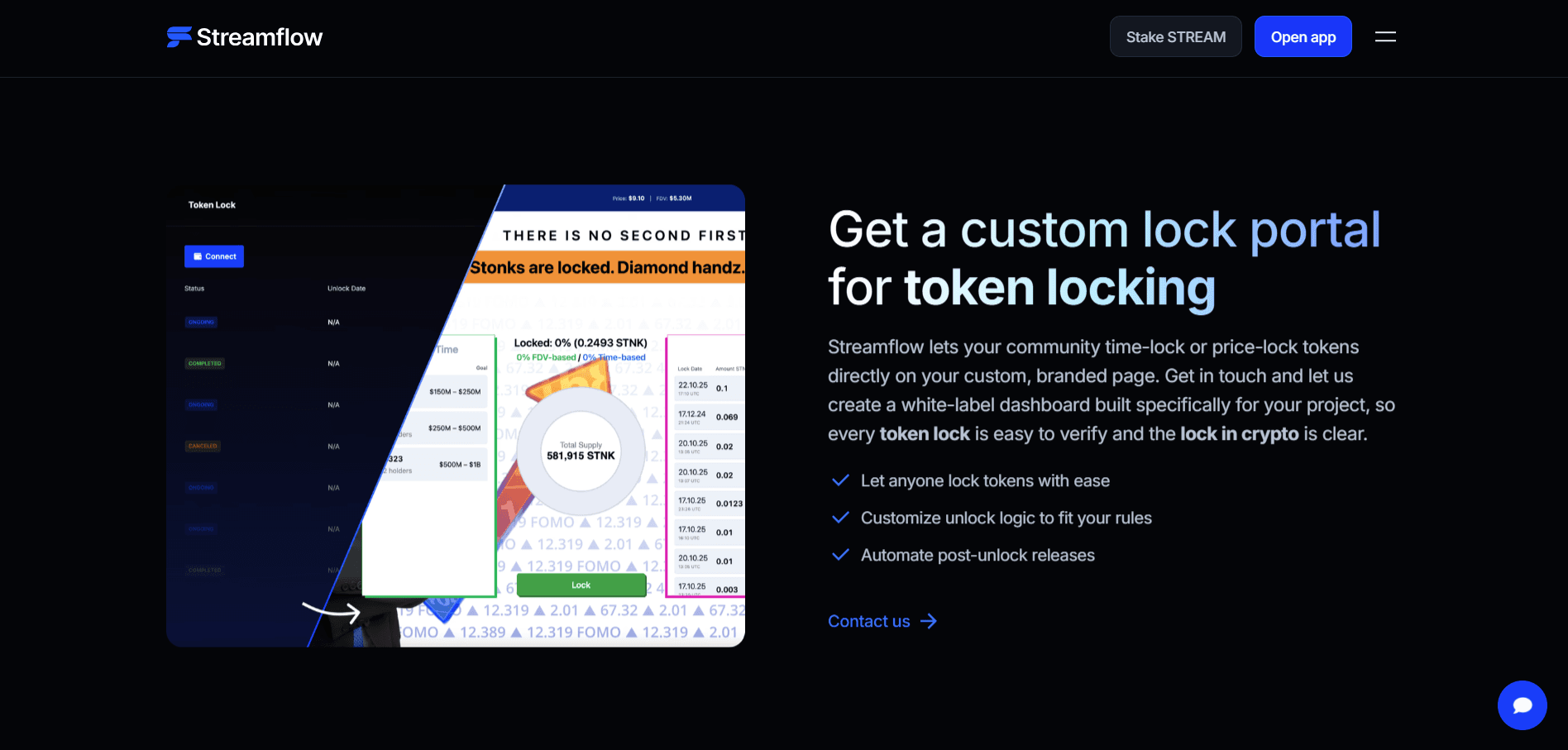
How Token Locks Work
Understanding how token locking works at a technical level helps teams choose the right lock structure and communicate it accurately to their community.
Step 1: Smart contract deployment
A smart contract is deployed on Solana that defines all the rules of the lock: the duration, the token amount, the beneficiary address, and any release conditions.
Streamflow's token lock contracts are audited by FYEO and OPCODES and are open-source.
Step 2: Tokens sent to the contract
The token holder transfers the designated tokens to the smart contract. From this point, the tokens are held in escrow, neither the sender nor any third party can access them until the unlock conditions are satisfied.
Step 3: Lock period begins
The lock period starts immediately upon deposit. Depending on the structure chosen, this can be a fixed time lock, a cliff-and-release schedule, or a condition-based release tied to a price threshold.
Step 4: Automated enforcement
Unlike traditional financial agreements, on-chain token locks do not require intermediaries, legal oversight, or manual execution. The smart contract enforces the rules automatically, no human can override it.
Step 5: Tokens unlock
When the lock period expires or unlock conditions are met, tokens are automatically released to the beneficiary wallet.
Types of Token Locks
Not every lock structure serves the same purpose. The right choice depends on the project's goals, tokenomics design, and the stakeholder group being locked.
Fixed-date locks release all tokens on a single predetermined date. Simple, easy to communicate, and appropriate for investor lockups and LP tokens. The unlock condition is purely time-based.
Price-based locks introduce a conditional unlock trigger. Tokens remain locked until the token reaches a specific price target.
This structure aligns the lock release with market performance rather than a fixed calendar date.
Cliff locks hold tokens until a cliff date, at which point the full allocation becomes available at once. These are distinct from vesting schedules, which release tokens gradually after the cliff.
Multi-segment locks break a total allocation into separate tranches with different unlock dates. A team might lock 30% for six months, 30% for twelve months, and 40% for twenty-four months, creating predictable supply releases while maintaining alignment over time.
Streamflow supports all of these structures on Solana, with SPL token compatibility across team allocations, LP tokens, treasury funds, and custom configurations.
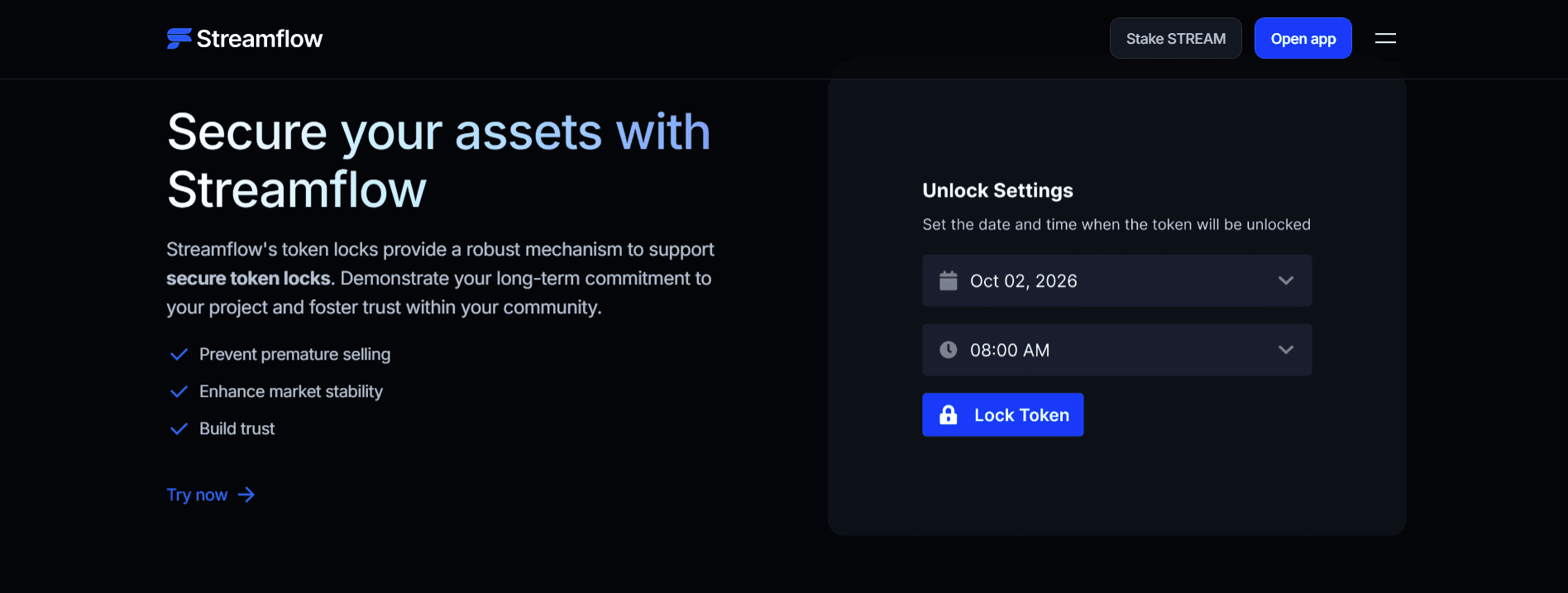
Token Lock vs. Token Vesting: Key Differences
These two terms are often used interchangeably, but they serve different purposes and behave differently at the smart contract level.
Token locks hold the full allocation until one specific unlock date or price condition is triggered, everything releases at once.
Token vesting releases tokens gradually over time according to a defined schedule, with recipients receiving portions of their allocation at regular intervals. Vesting schedules often include a cliff: an initial period where nothing is released, after which the gradual release begins.
When to use a lock: LP tokens, treasury funds locked for a fixed period, investor lockups where the full allocation releases on a single date, and team tokens with a hard commitment date.
When to use vesting: founder and core team allocations (typical structure: 12-month cliff, 36-month linear release), advisor tokens, early investor rounds where gradual release is preferred, and contributor rewards distributed over time.
Both mechanisms can and should exist in the same tokenomics structure. Most serious projects use token locks for LP tokens and treasury, and vesting contracts for team and investor allocations. Streamflow supports both within the same platform.
Token Lock vs. Liquidity Lock: Understanding the Distinction
Both fall under the broader category of token locks, but they refer to different assets and serve different purposes.
Token locks apply to project tokens, typically team allocations, investor allocations, or treasury funds. The goal is to prevent those tokens from entering the market prematurely.
Liquidity locks apply specifically to LP tokens, the receipts that represent a team's share of a liquidity pool on a DEX like Raydium or Orca. Locking LP tokens prevents the team from removing liquidity from the pool, which is the mechanism that protects against rug pulls.
Both are supported on Streamflow. Both should be part of any serious project's tokenomics architecture from day one.
Token Lock vs. Token Staking: A Different Mechanism Entirely
Staking and locking both restrict token movement., but for completely different reasons with different economic outcomes.
Token locking is about trust and supply control. Tokens are held in a contract and cannot move. There are no rewards generated. The goal is to prevent premature selling and provide verifiable proof of commitment.
Token staking involves locking tokens in a protocol in exchange for rewards. The restriction exists as a function of the reward mechanism, tokens are committed to a pool, and participants earn yield over a defined period.
A project can implement both. It is common to lock team and investor allocations while simultaneously running a staking program that rewards community holders. These are complementary mechanisms, not alternatives.
Who Should Lock Tokens: Stakeholder Groups
Token locks are not just for founders. Every stakeholder group that receives an allocation before public trading should have a corresponding lock or vesting structure.
1. Founders and core team
The longest locks in a tokenomics structure. A standard structure for founders is a 12-month cliff followed by a 36-month linear vesting schedule. Locking team tokens is the single most important credibility signal a project can make.
2. Early investors
Investor lockups typically range from 6 to 18 months depending on the round. Without a lock, early investors can sell immediately after TGE, one of the most common causes of early token price collapse.
3. Advisors
Shorter lock periods (3 to 12 months) with or without a vesting schedule following the cliff. The goal is alignment without over-restricting advisors who contribute actively during early stages.
4. DAO treasury
Treasury tokens are often locked to demonstrate that the team cannot unilaterally drain them. The lock provides governance participants with confidence that treasury assets are protected.
5. Ecosystem and incentive funds
Tokens reserved for grants, developer incentives, and ecosystem growth are typically locked until those programs are formally activated, preventing premature release of supply intended for future growth.
6. Liquidity pool allocation
LP tokens should be locked from day one. The lock duration varies but six to twelve months is a common starting point for projects prioritizing community trust.
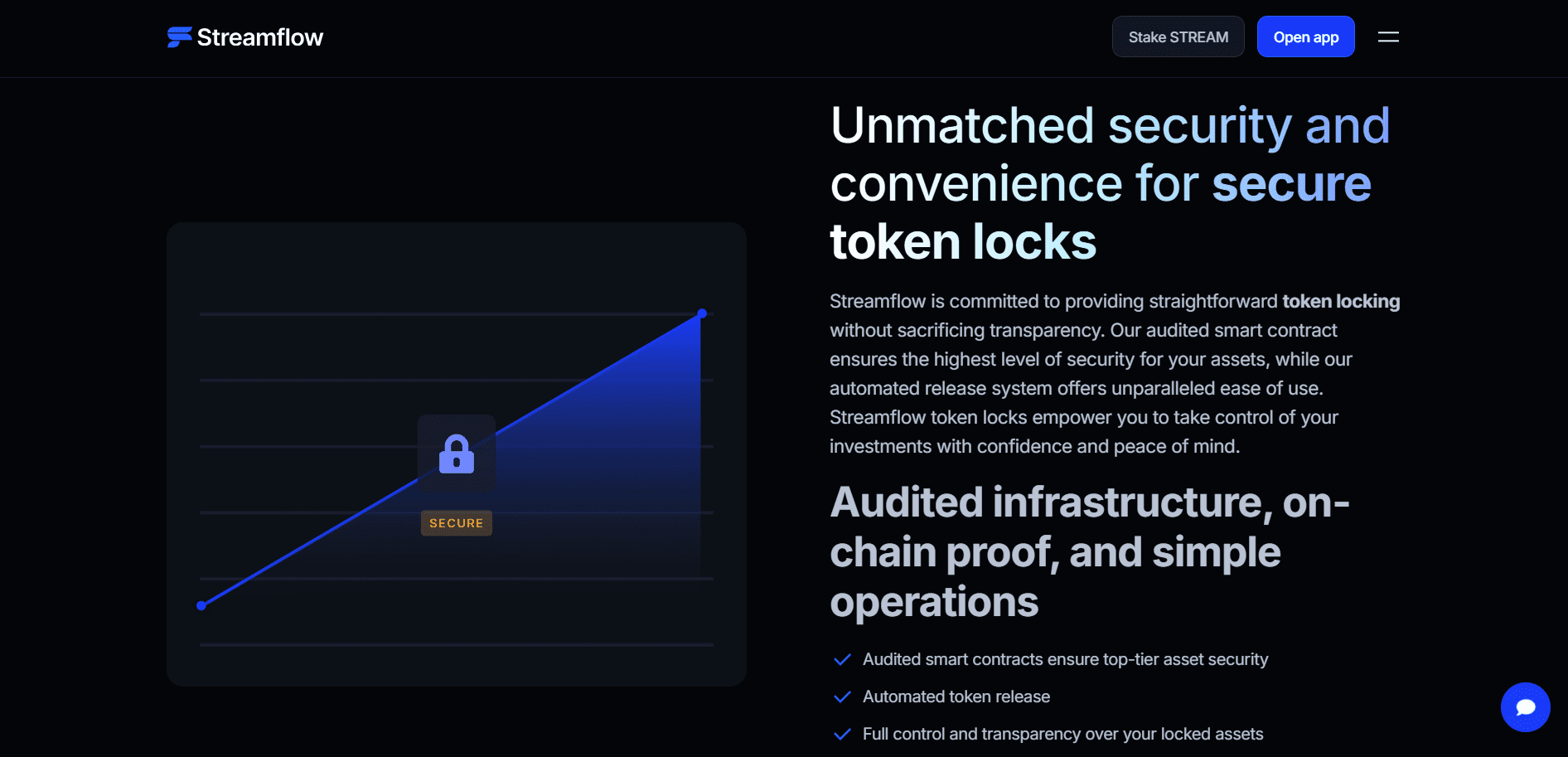
How Token Locks Are Verified On-Chain
One of the most important properties of a properly implemented token lock is public verifiability. Anyone, investors, community members, launchpad partners, or aggregators, should be able to confirm independently that tokens are locked without relying on the team's word.
Streamflow generates a shareable proof link for every lock contract created on the platform. This link provides a full view of the lock conditions, token amount, beneficiary address, and unlock date. It can be independently verified on Solscan and Solana Explorer in real time.
Platforms like RugCheck also pull lock data from on-chain sources to flag projects where team or LP tokens are not locked. In 2026, unlocked team tokens are increasingly treated as a red flag by default.
Token Lock Security
Security is the core value proposition of a token lock. A lock that can be overridden, canceled, or worked around provides no real commitment, it is just a marketing claim.
Streamflow's lock contracts are audited by FYEO and OPCODES, two independent security firms.
Once a token lock contract is initiated on Streamflow, it cannot be repealed. The contracts are immutable once deployed, meaning no unilateral changes can be made after the lock is created. All enforcement is automatic and does not depend on any third party, and the contracts are open-source so anyone can inspect the logic directly.
This immutability is a feature, not a limitation. It is exactly what makes on-chain locks more credible than any legal agreement or team promise.
Token Locks on Solana: Why the Chain Matters
Not all blockchains offer the same environment for token locking. Solana's infrastructure makes it the most practical choice for token locks at any scale.
Solana supports 65,000+ transactions per second, delivers sub-second finality, and charges near-zero fees. For token locking specifically, this means creating a lock contract costs a fraction of what the same operation costs on Ethereum, verification is near-instant with proof links resolving in seconds, and LP token locks on Raydium and Orca are cost-efficient even for smaller projects.
Streamflow is Solana-native. All major features are built for SPL tokens and the Solana ecosystem. Streamflow is also listed in the official Solana documentation under token vesting, reflecting its position as a core infrastructure tool in the ecosystem.
How to Create a Token Lock on Solana with Streamflow
The process requires no coding and can be completed in under a minute.
Connect your Solana wallet: Phantom, Backpack, Solflare, or any compatible wallet.
Navigate to the Token Locks section in the Streamflow app.
Select the token you want to lock from your wallet.
Define the lock amount and unlock date or condition.
Review and deploy the contract.
Copy and share the proof link with your community, investors, or launchpad partners.
Every lock generates an on-chain contract immediately. The proof link is shareable the moment the contract is created. Streamflow supports locking any SPL token: project tokens, LP tokens, treasury funds, and any custom allocation.
Conclusion
Streamflow is the most trusted token locking platform on Solana, and token locks are the most foundational trust signal a project can put in place before going to market.
For founders, investors, and project teams who need a lock structure that is verifiable, immutable, and takes under a minute to deploy, Streamflow provides the infrastructure to make it happen on-chain without writing a single line of code.
Book a demo with Streamflow to set up your token lock strategy and build a token economy that is designed to last.
Read Next:
FAQs:
1. What is a token lock in crypto?
A token lock in crypto is a smart contract mechanism that prevents tokens from being transferred, traded, or sold until predefined conditions, such as a time period or price threshold, are met. Token locks are enforced automatically on-chain with no human intermediary required.
2. What is the difference between a token lock and token vesting?
The difference between a token lock and token vesting is that a token lock releases the full allocation at once when the unlock condition is met, while token vesting releases tokens gradually over time according to a predefined schedule. Locks are used for LP tokens, treasury, and hard investor commitments. Vesting is used for team, advisor, and contributor allocations where gradual release is preferred.
3. How do token locks prevent rug pulls?
Token locks prevent rug pulls by making it impossible for project developers to access or withdraw liquidity pool tokens before the lock expires. When LP tokens are locked on-chain through Streamflow, no party, including the project team, can drain the liquidity pool, and this is independently verifiable by anyone on Solscan or Solana Explorer.
4. Can a token lock be modified or canceled after deployment?
No. A token lock cannot be modified or canceled after deployment on Streamflow. Once the contract is created, the parameters are immutable, meaning no party can change the unlock date, the token amount, or any other condition unilaterally. This immutability is what makes on-chain locks a credible trust signal.
5. How do investors verify that tokens are locked?
Investors verify that tokens are locked by checking the on-chain contract directly through Solscan, Solana Explorer, or RugCheck. Every lock created on Streamflow also generates a shareable proof link that provides a full real-time view of the lock conditions, beneficiary address, and unlock date, accessible to anyone without a wallet or technical knowledge.