General
The Sybil Attack Problem: How Airdrop Manipulation Is Reshaping Token Distribution in 2026
When Linea's airdrop claim window closed on December 9, 2025, the project had already filtered out roughly 800,000 Sybil wallets, leaving about 749,000 genuine claimants, according to airdrop data compiled by Coinlaw.
That is what airdrop manipulation looks like at scale, and Sybil attacks like it have become the default threat model for any serious token launch.
Streamflow, the Solana-native token operations platform behind 40,000+ projects and over $1.4B in total value locked, sees the shift firsthand: airdrops are no longer just a growth tactic, they are an adversarial distribution problem.
The broader numbers confirm it. Token airdrops distributed roughly $4.5 billion across 2025, yet 64% of recipients sold at the token generation event itself, per Decrypt's year-end aggregation cited by Coinlaw. When most of a distribution exits on day one, the airdrop did not build a community. It subsidized farmers.
The fix is not abandoning airdrops. It is redesigning eligibility, timing, and incentives so they all work against Sybil farming.
This article breaks down how Sybil attacks are reshaping token distribution in 2026 and how to design airdrops that actually reward real holders.
Key Takeaways
Sybil attacks let one actor farm many wallets, capturing token distribution meant for genuine users.
In 2026, Sybil-resistant airdrop design matters more than raw airdrop reach or headline size.
Streamflow combines snapshots, eligibility filters, and a Sybil checker to harden airdrop distribution on Solana.
Vested airdrops on Streamflow reduce the day-one dumping that follows most manipulated token distributions.
Over 40,000 projects use Streamflow for airdrops, vesting, and on-chain token distribution.
Why Sybil Attacks Broke the Airdrop Playbook
The old playbook assumed a simple equation: more recipients meant more community. That assumption is now the most expensive mistake in token distribution. A larger, looser airdrop is not a bigger community, it is a bigger attack surface.
The evidence is hard to ignore:
LayerZero manually removed 803,273 wallets, 59% of all applicants, as Sybil before distributing ZRO, according to figures reported by Coinlaw.
zkSync's outcome was just as telling, with 40% of ZK recipients selling everything immediately and 79% of active addresses abandoning the protocol within a month.
A Sybil attack is when one entity spins up hundreds or thousands of wallets to impersonate distinct users and claim a disproportionate share of a distribution.
On a low-fee chain, the marginal cost of one more fake wallet is close to zero, which is exactly why generic, activity-based airdrops get drained.
The lesson for 2026 is blunt: a token airdrop with no defenses is a public grant to whoever scripts the most wallets.
What's Really Going On Beneath the Farming
Sybil farming is not random opportunism. It is a professionalized industry built on top of the points economy that took off in 2023. Farmers run automated scripts that generate wallets, complete eligibility tasks, and inflate on-chain activity to satisfy whatever metric a project rewards.
The damage compounds in two directions:
Fake users inflate vanity metrics like active addresses and TVL, misleading the team and its investors about real traction.
When the tokens land, farmers dump immediately, which is why between 50% and 70% of airdropped tokens are sold within the first 30 days, per the 2025 data aggregated by Coinlaw.
The deeper problem is that most airdrops reward the wrong thing. They pay for surface-level activity that bots can fake, instead of paying for sustained, costly-to-fake behavior that real participants exhibit.
Until the eligibility logic changes, the farmers will keep winning, because the system is literally designed to pay them.
How to Design Sybil-Resistant Token Distribution
Defending an airdrop is a design problem, not a moderation problem. You cannot manually ban your way out of 800,000 fake wallets after the fact. The defenses have to be built into how eligibility, filtering, timing, and verification work from the start.
Start With a Clean Snapshot and Tight Eligibility Rules
The snapshot is the foundation of every Sybil-resistant distribution. A snapshot taken at a known block, paired with eligibility rules that reward depth rather than breadth, is the single highest-leverage decision in the whole process.
Reward cumulative behavior over time, not one-time task completion.
Weight eligibility toward wallets with genuine, costly on-chain history.
Define the claim window before launch so the rules cannot be gamed mid-flight.
For example, a protocol that rewards six months of consistent usage is far harder to farm than one that rewards a single bridge transaction the week before the snapshot.
Filter Wallets With a Sybil Checker Before You Distribute
Eligibility rules narrow the field, but a dedicated filtering pass is what removes the clusters. Running addresses through a Sybil checker before distribution catches the coordinated wallet networks that simple rules miss.
Screen for linked funding sources and coordinated transaction timing.
Use a multi-wallet checker to surface clusters acting as one entity.
Remove flagged wallets before tokens move, not after.
Streamflow ships a built-in Sybil checker and a multi-wallet airdrop checker precisely so teams can run this filtering step inside the same workflow that handles the distribution.
Vest the Airdrop Instead of Dumping It All at Once
A one-shot airdrop hands farmers a liquid asset to dump on day one. A vested airdrop changes the math by releasing tokens over time, which makes short-term farming far less profitable and rewards recipients who stick around.
Use vested airdrops to stretch rewards across weeks or months.
Tie portions of the unlock to continued participation.
Consider price-based release so distribution adjusts to market conditions.
A farmer optimizing for an instant flip has little reason to game an airdrop that pays out gradually through on-chain vested airdrops and token vesting schedules, which is the entire point.
Make the Whole Distribution Verifiable On-Chain
Transparency is a deterrent. When eligibility logic, claim status, and unlock schedules are all publicly verifiable, manipulation becomes visible and reputationally costly.
Publish the distribution on-chain with verifiable claim tracking.
Give the community a real-time view of who claimed and when.
Surface unlock schedules through a public tokenomics view.
A live real-time tokenomics dashboard for token distribution turns the entire process into a single source of truth that anyone can audit.
How Streamflow Fits Into Sybil-Resistant Airdrops
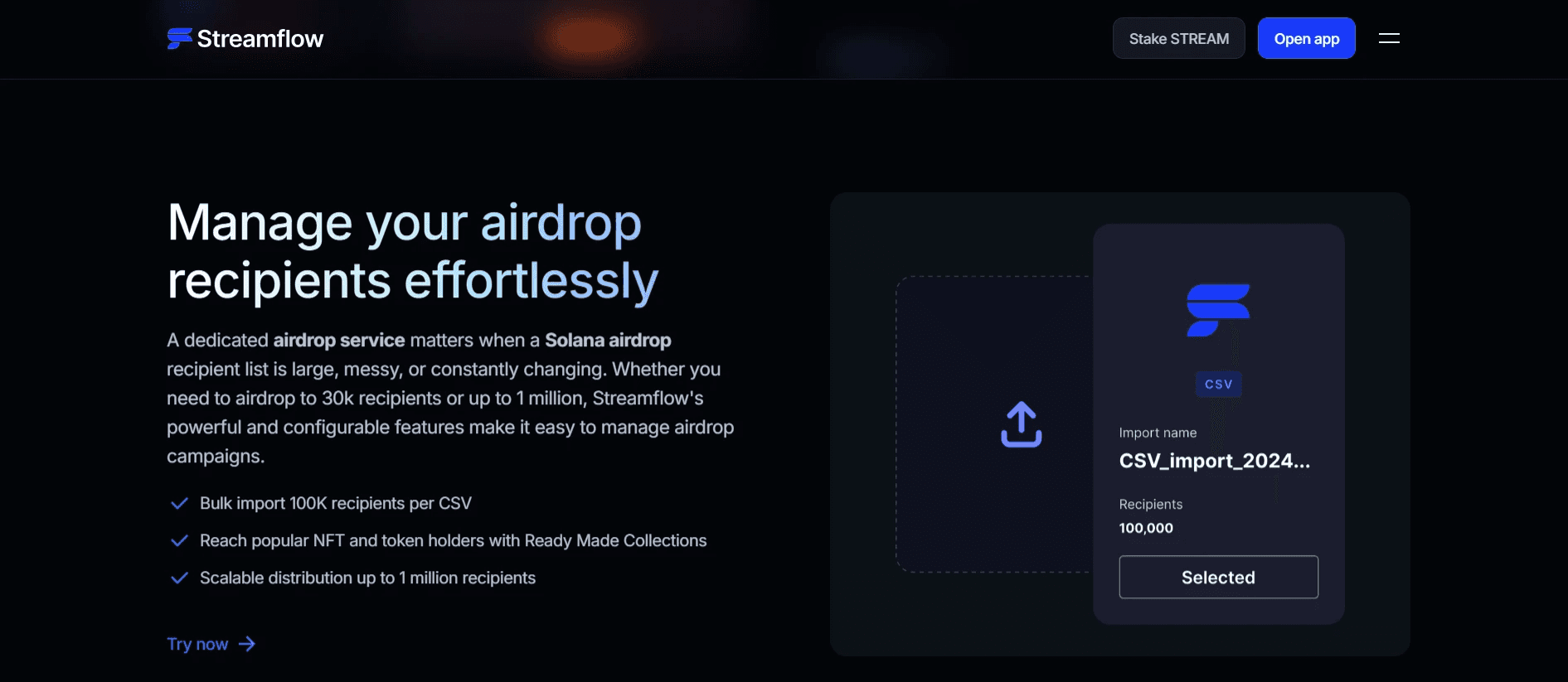
Streamflow treats airdrops as structured distribution systems, not one-time giveaways, which is exactly the posture 2026 demands. The airdrop launch platform for Solana token distribution scales to up to one million recipients, with 100,000 recipients per CSV, while keeping the defensive tooling in the same flow.
The relevant capabilities map directly onto the framework above:
Built-in Sybil checker and multi-wallet airdrop checker for pre-distribution filtering.
Instant, vested, and price-based airdrops to shape payout timing against farming.
Snapshot, eligibility, claim-window, and post-claim activation controls.
Real-time claim tracking, audience segmentation, and recovery of unclaimed tokens.
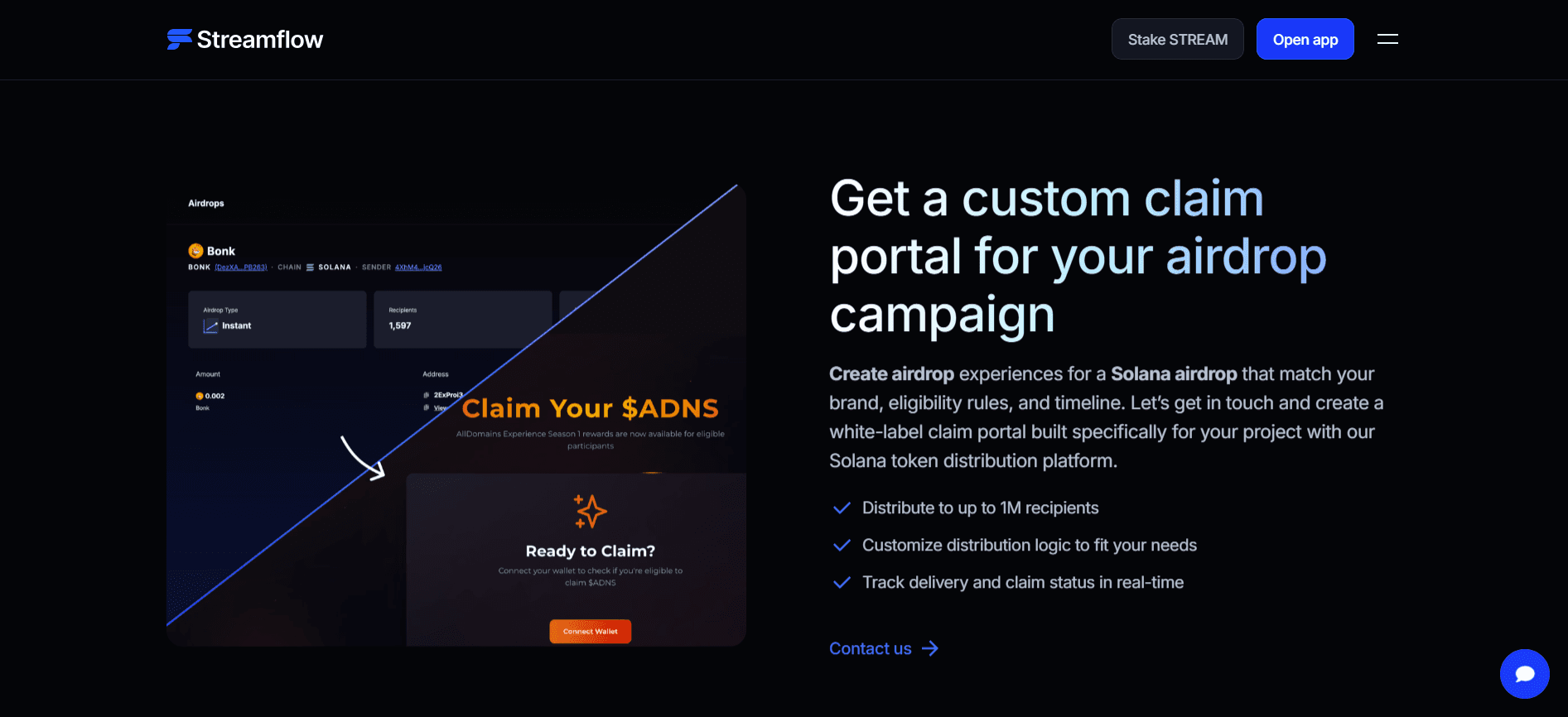
Teams that want full control over the claim experience can also deploy white-label claim portals with anti-phishing and official-link guidance baked in.
Case Study: How Bonk Paired a Mass Airdrop With On-Chain Vesting
Bonk, the Solana meme coin, is a useful model for distribution done with intent. The project allocated 55% of its supply to airdrops aimed at early Solana users, a deliberately broad, community-first launch rather than an insider distribution.
The discipline showed up in how the team treated its own allocation. As covered in the Bonk vesting case study on Streamflow, Bonk used Streamflow to vest its core team allocation: 20% of total supply across 22 early contributors on a 3-year linear vesting schedule.
That combination is the point. A wide community airdrop signaled fairness, while transparent, on-chain team vesting signaled long-term commitment, and both were verifiable rather than promised.
The outcome was the trust and transparency that a manipulated, dump-prone airdrop can never deliver.
What This Means for Web3 Founders and Token Issuers
For founders and token issuers, the strategic shift is to stop measuring an airdrop by how many wallets it reaches and start measuring it by how many real holders it retains. A distribution that looks huge on launch day but loses 79% of addresses in a month is a failure, regardless of the headline recipient count.
The practical move is to design defensively from the snapshot forward: tight eligibility, a Sybil filtering pass, vested release, and on-chain verification.
These are not optional add-ons in 2026, they are the baseline for a distribution that survives contact with professional farmers.
Founders thinking past the launch toward treasury and long-term operations can also lean on Streamflow's broader stack for token vesting, locks, and ongoing distribution.
Conclusion
Sybil attacks have turned token distribution into an adversarial design problem, where the projects that win are the ones that filter fake wallets, vest rewards, and verify everything on-chain.
Streamflow gives teams that full defensive toolkit, from a built-in Sybil checker to vested airdrops across 40,000+ projects, so a launch rewards real holders instead of farmers.
Book a demo to see how Streamflow handles a Sybil-resistant airdrop, from snapshot and filtering to vested, on-chain distribution.
Read Next:
FAQs
1. What is a Sybil attack in a crypto airdrop?
A Sybil attack in a crypto airdrop is when a single entity creates many wallets to impersonate distinct users and claim a disproportionate share of the distribution. Because creating wallets on a low-fee chain is nearly free, generic activity-based airdrops are especially vulnerable, with some campaigns flagging more than half of applicants as Sybil.
2. How does Streamflow help prevent airdrop Sybil attacks?
Streamflow helps prevent airdrop Sybil attacks with a built-in Sybil checker and a multi-wallet airdrop checker that filter coordinated wallet clusters before distribution. It also supports vested and price-based airdrops, snapshot and eligibility controls, and real-time claim tracking, so manipulation is filtered out early and dumping is reduced.
3. Do vested airdrops reduce Sybil farming and dumping?
Yes, vested airdrops reduce Sybil farming and dumping by releasing tokens over time instead of all at once. This removes the instant-flip incentive that farmers rely on and rewards recipients who continue participating, which is why Streamflow lets teams configure vested and price-based release on its airdrop platform.
4. How many recipients can a Streamflow airdrop handle?
A Streamflow airdrop can handle up to one million recipients in a single campaign, with imports of up to 100,000 recipients per CSV. That scale, combined with built-in filtering and claim tracking, lets teams run large, Sybil-resistant distributions without manual overhead.
5. Is a Streamflow airdrop verifiable on-chain?
Yes, a Streamflow airdrop is verifiable on-chain, with claim tracking and unlock schedules visible through its tokenomics dashboard. Public, real-time verification makes manipulation easier to spot and gives communities a transparent single source of truth for the distribution.