General
Everything You Need to Know About Streamflow's Token Locks on Solana
In March 2026 alone, more than 144 crypto projects had roughly $4.68 billion in tokens scheduled to unlock into circulation, according to data compiled by Cryip from Tokenomist.
That single figure explains why token locks have become a core trust signal rather than an afterthought.
Streamflow, the Solana-native token operations platform trusted by over 40,000 projects, turns token locking from a promise into an enforceable, publicly verifiable on-chain contract.
Locked supply is the other side of every unlock event. Before tokens can flood a market, they sit under a lock that defines exactly when, how, and under what conditions they release. Getting that mechanism right is the difference between a community that trusts your distribution and one that braces for the next dump.
This guide covers what token locks are, how they work on Streamflow, the configuration options available, real use cases, and the security model behind them. By the end, you'll know how to use token locks on Solana to signal commitment and control supply with confidence.
Key Takeaways
Token locks restrict tokens from transfer or sale until predefined conditions are met.
Streamflow enforces token locks through immutable, audited smart contracts on Solana.
Locks support fixed-date unlocks, price-based triggers, and public on-chain verification.
Over 40,000 projects use Streamflow for token locks, vesting, and distribution.
Locked tokens provide verifiable proof of commitment to investors and communities.
What Token Locks Are and Why They Exist
Token locks are mechanisms that restrict tokens from being transferred, sold, or accessed until predefined conditions, such as a specific date, time period, or price level, are met. They exist to enforce commitment, control circulating supply, and provide transparent on-chain proof that certain tokens cannot move prematurely.
The problem they solve is trust. When a team holds a large allocation with no constraints, holders have no way to know those tokens won't hit the market the moment price climbs. A lock removes that uncertainty by making the commitment enforceable instead of verbal.
Streamflow approaches locks as a transparency primitive, not just a holding mechanism. Instead of relying on promises, Streamflow enforces token lock conditions through immutable smart contracts that anyone can verify on-chain, which turns a private intention into public proof.
How Token Locks Work on Streamflow
Locking tokens on Streamflow follows a short, no-code path. The platform converts your locking rules into a smart contract that executes automatically, with no engineering required.
Connect a Solana wallet such as Phantom, Solflare, or Backpack.
Select the SPL or LP token you want to lock and the amount.
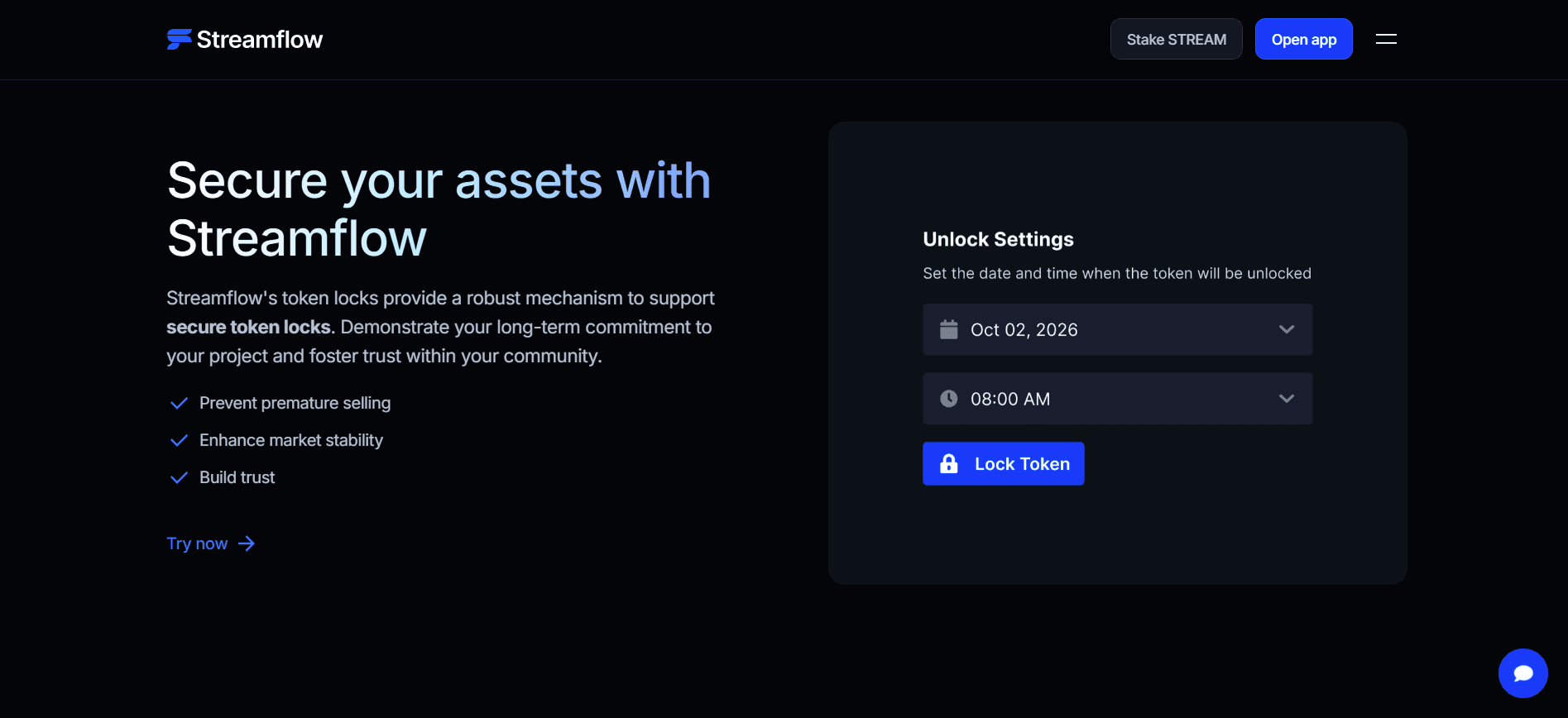
Define the unlock condition: a fixed date, a time period, or a price threshold.
Deploy and fund the lock contract on-chain.
Share the public proof link so anyone can verify the lock.
Consider a team that raised a seed round and wants to reassure investors. They lock 20% of supply with a fixed 12-month unlock, deploy it in under a minute, and post the proof link in their docs. The result is a verifiable commitment that no one, including the team, can quietly reverse.
The entire process takes about 37 seconds to lock tokens, which keeps the friction low while the credibility payoff stays high.
Key Capabilities and Configuration Options
Streamflow gives teams precise control over how locks behave. The configuration options cover the most common locking scenarios without requiring custom contract development.
Fixed-date unlocks: tokens release automatically at a set time with no manual action.
Price-based unlock conditions: tokens unlock only when a token reaches a defined price level.
Automatic release: the contract executes the unlock itself, removing operational overhead.
Public proof links: every lock generates a shareable link for instant verification.
SPL and LP token support: lock standard tokens or liquidity pool tokens with the same flow.
Fixed-date locks are the standard choice for team and investor allocations that follow a roadmap. Price-based locks suit projects that want supply to release in step with market milestones rather than the calendar. Both options write the rule into an immutable contract, so the conditions can't be edited after deployment.
You can configure and deploy a lock directly in the Streamflow app.
Use Cases for Token Locks
Token locks apply across nearly every stage of a token's life. The same primitive that protects a launch also underpins long-term treasury discipline.
1. Team and core contributor allocations
Locking founder and team tokens is the clearest signal that the people building the project are committed for the long term. It directly addresses the most common community fear: an early insider cashing out.
2. Treasury and reserve funds
Projects lock treasury allocations to demonstrate that operational reserves won't be sold opportunistically. This protects both the runway and the project's credibility.
3. Investor allocations
Locks enforce the terms negotiated with backers, ensuring private-round tokens follow the agreed schedule. The lock becomes the on-chain enforcement of an off-chain agreement.
4. Liquidity protection
By locking LP tokens, teams give traders confidence that liquidity won't be pulled, a critical trust signal in the memecoin and early-stage ecosystem on Solana.
Token Locks vs Vesting, Staking, and Liquidity Locks
Token locks are often confused with adjacent mechanisms. Understanding the distinctions helps you pick the right tool for each allocation.
A token lock holds tokens until a single condition releases them, while token vesting on Solana releases tokens gradually over time on a schedule. Locks are best for all-or-nothing commitments; vesting is best for steady, ongoing distribution to contributors.
Locking also differs from staking and liquidity locking. Staking puts tokens to work earning rewards, whereas a lock simply restricts access. A liquidity lock is a specific type of token lock applied to LP tokens to secure a trading pool, rather than a different mechanism entirely.
Case Study: How Bonk Used Streamflow
Bonk, the Solana meme coin, allocated 55% of its supply to airdrops for early Solana users and reserved the rest for contributors and operations. To handle the team's allocation responsibly, Bonk turned to Streamflow.
The project used Streamflow to vest 20% of total supply across 22 early contributors on a 3-year linear schedule. By locking and vesting these allocations on-chain, Bonk gave its community verifiable proof that core tokens couldn't be dumped, reinforcing trust during a volatile early period.
The outcome was a transparent distribution that aligned contributor incentives with long-term holders, exactly what a token lock is designed to deliver.
Security and Transparency
Token locks are only as trustworthy as the contracts behind them. Streamflow's lock contracts are audited by FYEO and OPCODES, and they are immutable once deployed, meaning no admin can override the unlock conditions after the fact.
Every lock is verifiable on-chain through explorers like Solscan, Solana Explorer, and RugCheck. Investors and community members don't have to take a team's word for it; they can confirm the locked amount, the conditions, and the unlock date independently.
Audited contracts: reviewed by FYEO and OPCODES.
Immutability: conditions cannot be changed after deployment.
On-chain verification: proof links and explorer visibility for anyone to check.
This security model is what separates a credible lock from a marketing claim. On Solana, it also comes at near-zero cost, making transparent locking economically viable in a way that legacy chains struggle to match.
Getting Started With Token Locks
Setting up a token lock on Streamflow is a no-code process that takes about 37 seconds. You connect a wallet, choose the token and amount, set the unlock condition, and deploy.
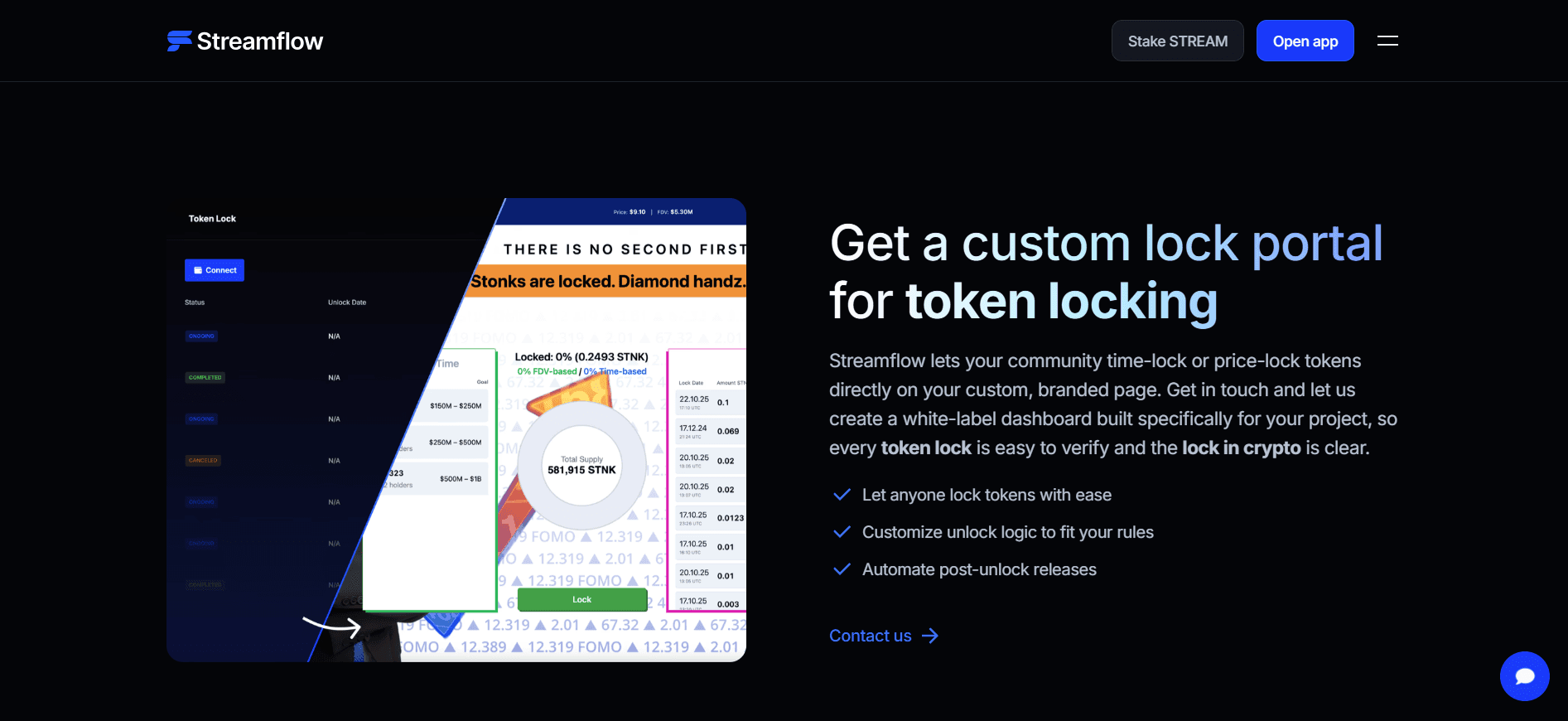
For teams that want a branded experience, Streamflow also supports custom lock dashboards and white-label portals, so the proof of commitment lives inside your own interface. Founders thinking beyond a single lock can explore Streamflow Business for financial operations, which extends locking into full treasury management, cap tables, and ownership issuance on Solana.
Whether you're locking a team allocation or securing liquidity, the goal is the same: turn a commitment into something the market can verify.
Conclusion
With billions of dollars in tokens unlocking every month across the market, locked supply has become the clearest available signal of a team's intent.
Streamflow turns that signal into an enforceable, audited, publicly verifiable contract on Solana, used by more than 40,000 projects to lock tokens with conditions no one can quietly reverse.
Book a demo to see how Streamflow handles team allocation locks, liquidity locks, and price-based unlocks for your token launch.
Read Next:
FAQs:
1. What are token locks in crypto?
Token locks in crypto are mechanisms that restrict tokens from being transferred, sold, or accessed until predefined conditions, such as a date, time period, or price level, are met. On Streamflow, these conditions are enforced through immutable on-chain smart contracts that anyone can verify.
2. What is the difference between a token lock and token vesting?
The difference is that a token lock holds tokens until a single unlock condition is met, while token vesting releases tokens gradually over time on a schedule. Locks suit all-or-nothing commitments, while vesting suits ongoing distribution to contributors, and Streamflow supports both.
3. Can locked tokens be accessed or sold before the unlock?
No, locked tokens cannot be transferred, traded, or accessed until the specified unlock criteria are fulfilled. Because Streamflow's lock contracts are immutable once deployed, not even the team can override the conditions early.
4. How can investors verify that tokens are actually locked?
Investors can verify locked tokens through public proof links and on-chain explorers like Solscan, Solana Explorer, and RugCheck. Streamflow generates a shareable proof link for every lock, so commitments are independently verifiable rather than taken on trust.
5. How much does it cost to lock tokens on Solana with Streamflow?
Locking tokens on Streamflow involves a small smart contract creation fee plus Solana's near-zero transaction costs. Because Streamflow is built on Solana rather than Ethereum, transparent token locking remains cost-efficient even at scale.