General
Token Lock Trends on Solana: What Liquidity Lock Data Tells Us About Project Health
Streamflow is the most trusted token lock and token operations infrastructure on Solana, used by over 40,000 projects and officially listed in Solana's documentation under token vesting.
As Solana's token launch environment grows more competitive, and more speculative, on-chain verifiable locks have evolved from a nice-to-have into a project survival signal.
This article breaks down what token lock data actually tells us about project health in 2026, and why the gap between locked and unlocked projects is wider than ever.
Key Takeaways
Locked projects retain 58–72% of liquidity 30–90 days post-launch versus just 12–28% for unlocked projects, a gap that defines which projects survive.
On Solana, average token holding time has collapsed to ~60 seconds, making on-chain verifiable lock proof the primary trust signal investors and tools like RugCheck check before buying.
Streamflow's audited, immutable token lock contracts give teams a publicly verifiable commitment mechanism that manual processes or promises simply cannot replicate.
What Are Token Locks
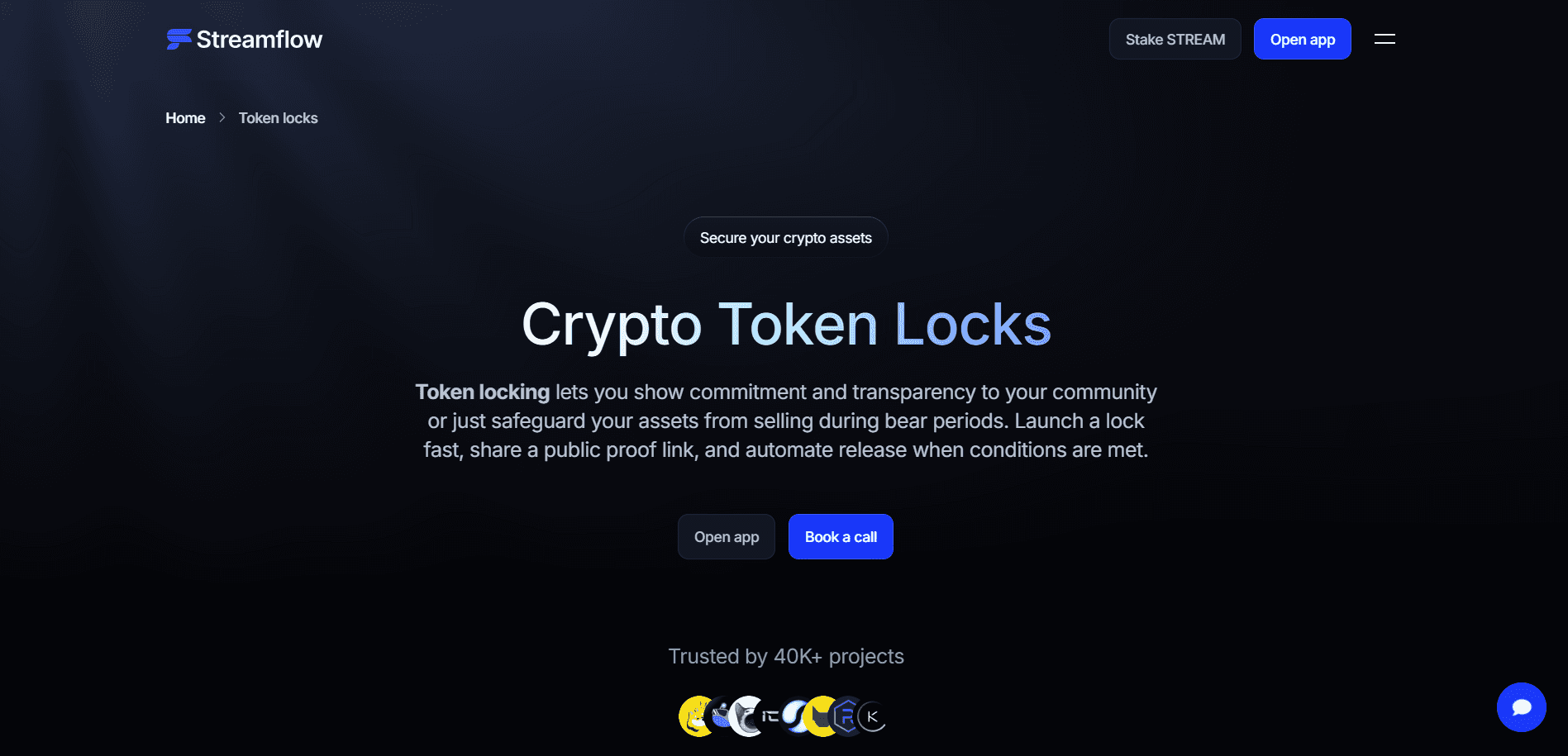
Token locks are on-chain smart contract mechanisms that restrict the transfer, trading, or access of tokens until predefined conditions, typically time-based, price-based, or milestone-based, are met.
On Solana, this applies to both SPL tokens (and Token-2022 variants) and LP (liquidity provider) tokens tied to DEX pools.
There are two primary types of token locks, and understanding the difference matters:
Team, investor, and treasury token locks restrict allocations held by founders, early contributors, advisors, and DAO treasuries from being moved before a defined unlock schedule. These align incentives and prevent early dumps, the scenario where insiders sell immediately after a launch, collapsing price and destroying community trust.
LP token locks freeze the liquidity that a project deposits into a DEX pool, preventing the team from pulling it out (commonly called a rug pull). When LP tokens are locked, the liquidity backing a token's market cannot be withdrawn until the lock expires.
Key distinctions worth understanding:
Token lock vs. token vesting: Locks restrict access entirely until an unlock date. Token Vesting releases tokens gradually over time according to a schedule, linear, cliff-based, milestone-based, or price-triggered. Both are enforced on-chain; they serve different release mechanics.
Token lock vs. liquidity lock: Token locks apply to any SPL token allocation. Liquidity locks specifically target LP tokens in DEX pools to protect market depth from being removed.
Token lock vs. staking: Staking locks tokens in exchange for rewards and protocol participation. Token locks are purely a commitment and supply control mechanism with no reward component.
On Solana, token locks take advantage of the chain's high-speed, low-cost environment, with fees often around 0.01 SOL, and are fully verifiable on-chain through explorers like Solscan and Solana Explorer. Locked tokens cannot be transferred, traded, or accessed before the unlock conditions are met, and this is enforced at the protocol level, not by a team's promise.
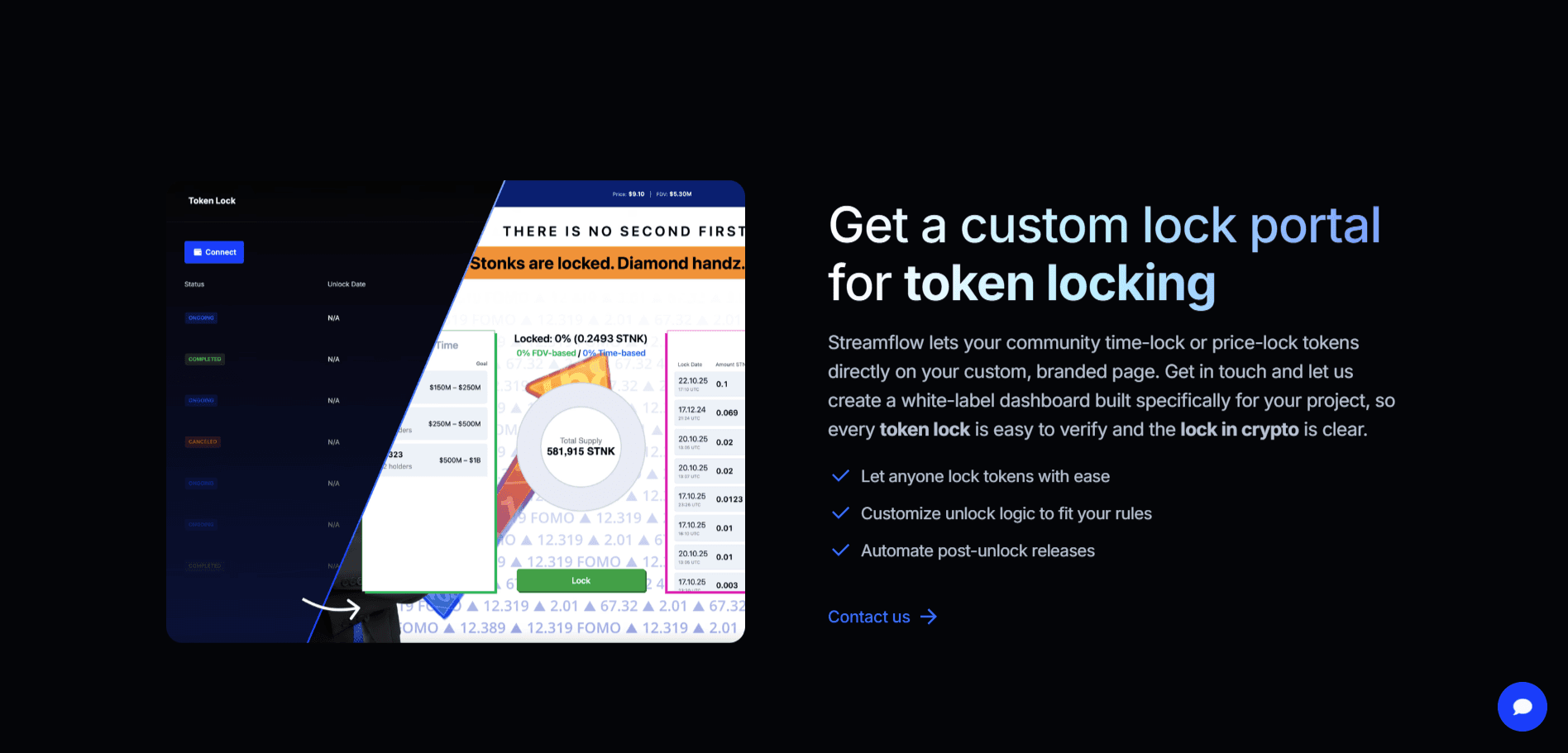
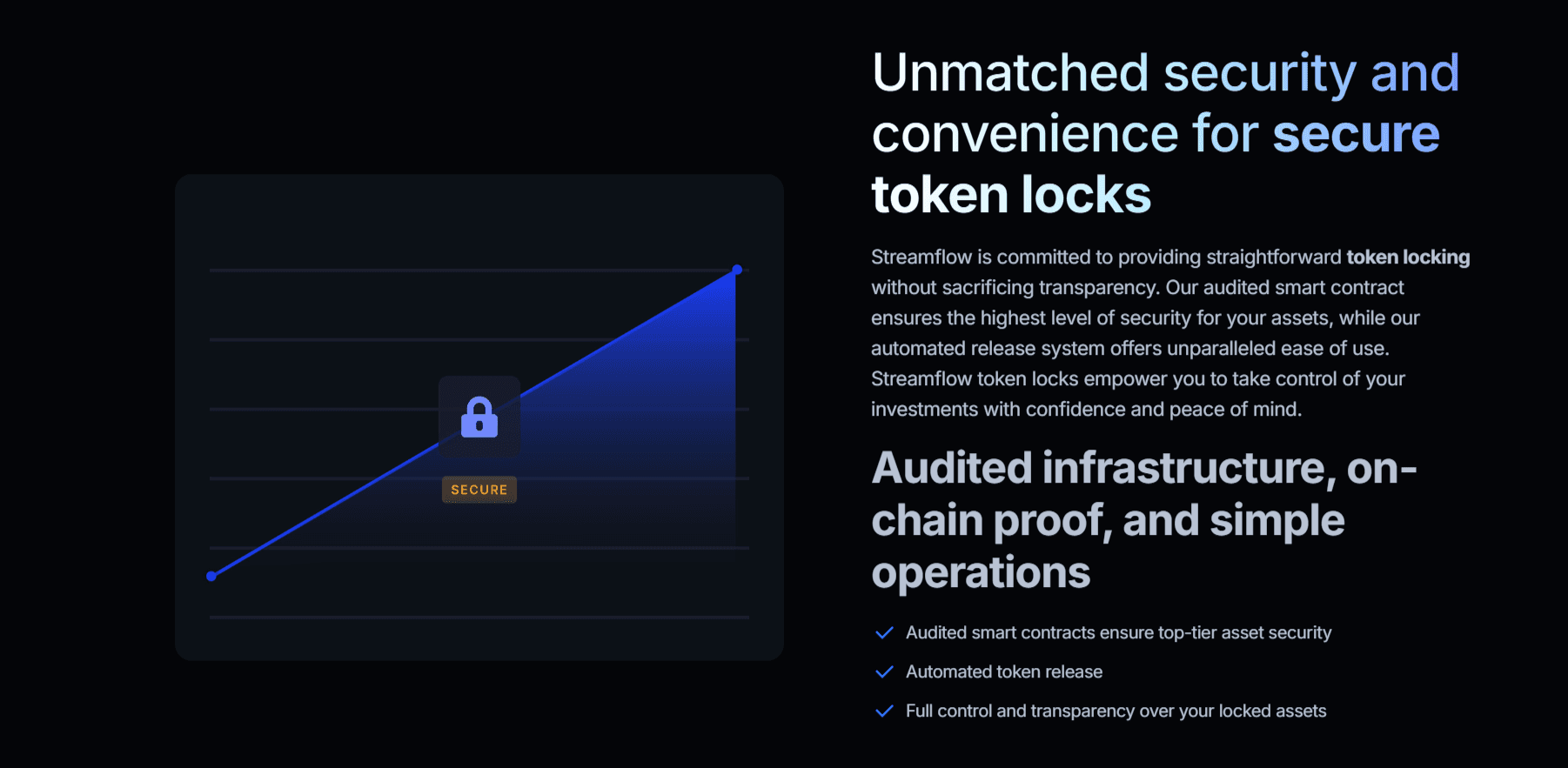
Streamflow's token lock product uses audited, immutable smart contracts, audited by FYEO and OPCODES, that support time-based locks, price-based unlock conditions, automatic release upon unlock, and publicly shareable proof links that anyone can verify.
Teams can lock tokens in as little as 37 seconds through the no-code interface, and every lock is visible on Streamflow's public dashboard and verifiable on Solscan.
Token Lock Trends on Solana in 2026
1. The Attention Economy Has Changed Everything
Solana's 2026 token launch environment is unlike any prior cycle. Average token holding time has collapsed to approximately 60 seconds, down from roughly one day. Pump.fun's graduation rate to Raydium or PumpSwap liquidity sits below 1.15%.
Soft rug pulls and developer dumps remain common for projects that launch without verifiable lock mechanisms in place.
In this environment, on-chain verifiable locks, particularly PDA-based locks for full immutability, have become the baseline expectation for any project that wants to be taken seriously.
Investors, KOLs, and automated risk scoring tools like RugCheck routinely check lock proof before taking a position. A project without a verifiable lock is, by default, a higher-risk signal.
2. The Data: Locked vs. Unlocked Projects
StakePoint's Q2 2026 Token Locking Impact Report provides the clearest quantitative picture of what locks actually do to project outcomes:
Liquidity retention (30–90 days post-launch):
Locked projects: 58–72% liquidity retained
Unlocked projects: 12–28% liquidity retained
Advantage: ~45 percentage points in favor of locked projects
Survival rate (active trading volume beyond 30 days):
Locked projects: 41% survival rate
Unlocked projects: 9% survival rate
Advantage: +32 percentage points
These are not marginal differences. A locked project is roughly 4.5x more likely to still have active volume a month after launch than an unlocked one. The holder count data reinforces this, locked projects show stable holder curves, while unlocked cohorts experience sharp drops after week one as early buyers exit.
A practical example from the report: one meme-to-utility project locked 100% of its post-graduation LP for 12 months and staggered 40% of team tokens across a multi-stage unlock. Result: over 65% of liquidity remained intact after 60 days, compared to the sub-20% typical for unlocked projects at the same stage.
Projects that combined token locks with community staking pools showed even stronger retention, as staking further reduced circulating supply and sell pressure simultaneously.
3. Why Verifiability Is the Core Variable
The lock itself is necessary but not sufficient. What matters equally is whether the lock is publicly verifiable, shareable, on-chain, and checkable by anyone without needing to trust the team's word.
This is where the distinction between platforms becomes meaningful. Locks deployed on audited, on-chain platforms like Streamflow produce public proof links and dashboard entries that can be independently verified on Solscan or Solana Explorer.
Locks that exist only as team claims, screenshots, or informal agreements offer no enforcement and no verifiability, they can and do fail.
Fake or unverifiable locks remain a documented risk in the Solana ecosystem. Best practice is to verify lock transactions directly through block explorers before making any investment decision.
4. Solana's Own Unlock Schedule: Context for the Ecosystem
Understanding project-level token locks also benefits from understanding SOL's own vesting picture.
As of 2026, SOL's early vesting is largely complete, with over 81.9% of supply already unlocked. Circulating supply sits at approximately 576M SOL.
Ongoing unlock pressure includes:
Staking rewards: Approximately 60,000 SOL per day distributed to validators and delegators, with inflation currently around 3.93% and trending toward a 1.5% terminal rate.
FTX estate / Alameda overhang: Monthly unlocks of approximately 7.5M SOL continuing through roughly 2028, primarily handled through OTC sales to minimize spot market impact.
Ecosystem project unlocks: Tracked on DefiLlama, Messari, and Tokenomist on a monthly basis, April 2026 saw notable releases including DBR (12.9% of circulating supply) and KMNO, that typically cause short-term volatility but are often absorbed quickly when anticipated by the market.
This context matters because it means Solana's token ecosystem operates against a backdrop of known, scheduled supply additions.
Projects that layer verifiable token locks on top of this environment provide investors with one of the few controllable transparency signals available.
5. 2026 Best Practices for Token Locking
Based on data from StakePoint's Q2 2026 report and community-established standards, the following practices have emerged as baseline expectations for credible Solana projects:
Lock 100% of LP tokens post-graduation for a minimum of 6 to 12 months, ideally longer.
Stagger team and developer token unlocks, a common structure is 25% at 6 months, then monthly releases over 18 to 24 months, with a minimum 12-month initial lock.
Share lock transaction links publicly, post the dashboard link, share it with your community, and make it findable.
Use Token-2022 extensions for projects that need advanced transfer controls at the protocol level.
Combine locks with staking rewards or community claim mechanisms to further reduce sell pressure and incentivize holding.
Verify locks independently before investing, check the on-chain transaction, not just a team's announcement.
Why Streamflow Is the Best Platform for Token Locks on Solana in 2026
Streamflow is the most best token lock platform on Solana, and the only one officially listed in Solana's documentation under token vesting.
Here is why teams consistently choose it:
1. Audited and immutable contracts
Streamflow's smart contracts are audited by FYEO and OPCODES, open-source, and immutable once deployed. There is no admin override. No unilateral changes.
Tokens locked through Streamflow cannot be accessed before the unlock conditions are met, enforced at the contract level, not by trust.
2. Time-based and price-based lock conditions
Beyond simple date-based locks, Streamflow supports price-triggered unlock conditions, giving teams the flexibility to design tokenomics that respond to market conditions rather than just calendars.
3. Automatic release and public proof links
When unlock conditions are met, tokens release automatically, no manual action required. Every lock generates a shareable proof link verifiable on Solscan and Solana Explorer, and is visible on Streamflow's public tokenomics dashboard.
4. Full token lifecycle management
Token locks are one piece of a larger infrastructure stack. Streamflow connects locks to vesting schedules, airdrops, staking pools, and payments, all from a single platform.
Teams managing complex tokenomics across founders, investors, advisors, ecosystem incentives, and community allocations can handle everything in one place.
5. White-label and enterprise options
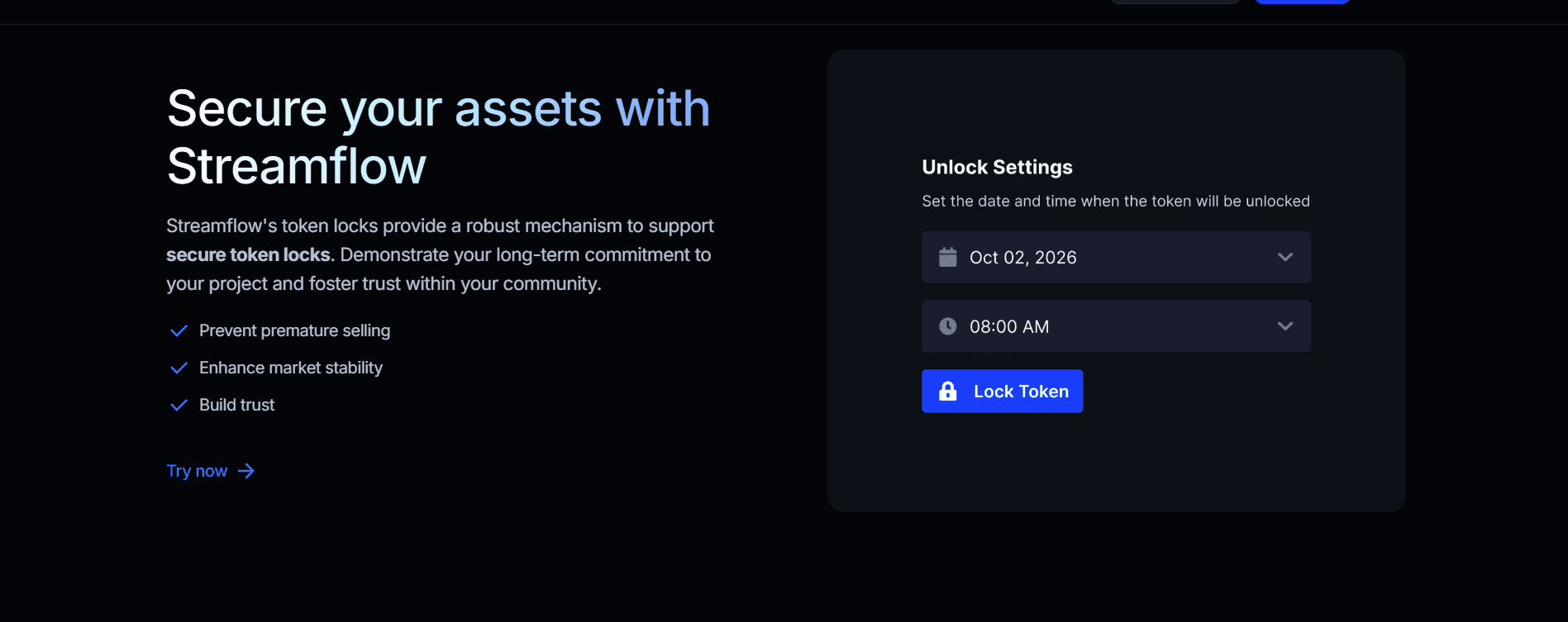
For teams that need a branded experience, Streamflow offers custom lock dashboards, branded claim portals, and bespoke onboarding support. Enterprise-scale distribution, including airdrops to up to one million recipients, is built into the same infrastructure.
6. Cost-efficient on Solana
Lock operations on Solana cost a fraction of what equivalent operations cost on Ethereum. Near-zero transaction fees make it economically viable to deploy granular lock schedules, stagger multiple unlock tranches, and maintain complex vesting structures without the cost overhead that makes these approaches impractical on other chains.
7. No-code and developer paths
Teams can create and deploy a token lock in 37 seconds through Streamflow's no-code UI. Developers who need custom logic can access the public SDK to integrate lock and distribution logic directly into their dApps.
8. Scale
Over 40,000 projects have used Streamflow. More than $1.4B in total value has been locked and managed through the platform. 1.3M+ users interact with Streamflow-powered contracts. This is not an emerging tool, it is established infrastructure.
How to Get Started With Streamflow's Token Locks
Getting a token lock live on Streamflow takes less than two minutes.
Here is the process:
Connect your wallet: Streamflow supports Phantom, Solflare, Backpack, and all major Solana wallets. Navigate to app.streamflow.finance and connect.
Select Token Locks: From the Streamflow dashboard, choose the Token Locks product to begin configuring your lock contract.
Define your lock parameters: Select the token or LP token you want to lock, set the lock amount, and configure the unlock conditions, time-based (fixed date), price-based, or a combination.
Review and deploy: Streamflow generates a preview of your lock contract. Review the parameters, confirm the transaction in your wallet, and the lock is deployed on-chain.
Share your proof link: Once deployed, Streamflow generates a publicly shareable proof link and adds your lock to your project's tokenomics dashboard.
Share this with your community, post it in your announcement channels, and make it findable for anyone doing due diligence.
For teams with complex requirements, multi-tranche unlocks, price-triggered conditions, enterprise-scale distribution, or white-label branded portals, Streamflow's team provides bespoke onboarding support.
Conclusion
Streamflow has established itself as the infrastructure standard for token locks on Solana precisely because the data makes the case for locks impossible to ignore.
Projects with verifiable on-chain locks are 4.5x more likely to survive the first 30 days, retain dramatically more liquidity, and build the kind of community trust that sustains a token economy beyond the first 60 seconds of attention.
In Solana's hyper-speculative 2026 launch environment, a lock is not a feature, it is a survival mechanism. And the platform you use to deploy that lock determines whether it is genuinely trustworthy or just a claim.
Book a call with Streamflow to explore enterprise token lock solutions, white-label portals, and custom vesting structures built for your project's specific tokenomics needs.
Read Next:
FAQs:
1. What do token lock trends on Solana reveal about project health in 2026?
Token lock trends on Solana reveal that on-chain verifiable locks are now the primary differentiator between projects that survive and those that collapse. According to StakePoint's Q2 2026 Impact Report, locked projects retain 58–72% of liquidity 30–90 days post-launch, compared to just 12–28% for unlocked projects.
2. What is the difference between a token lock and a liquidity lock on Solana?
A token lock and a liquidity lock on Solana serve related but distinct purposes. A token lock restricts any SPL token allocation, such as team, investor, or treasury tokens, from being transferred or sold before a defined unlock condition is met. A liquidity lock specifically targets LP tokens held in a DEX pool, preventing the project team from withdrawing the liquidity backing the token's market.
3. Why should Solana projects use Streamflow for token locks instead of building their own contracts?
Solana projects should use Streamflow for token locks instead of building their own contracts because Streamflow eliminates development time, audit risk, and operational overhead while providing a more credible, verifiable result. Streamflow's contracts are already audited by FYEO and OPCODES, open-source, immutable once deployed, and officially listed in Solana's documentation.
4. How do investors and tools like RugCheck verify token locks on Solana?
Investors and tools like RugCheck verify token locks on Solana by checking the on-chain transaction that deployed the lock contract, not by relying on team announcements or screenshots. Verifiable locks deployed through platforms like Streamflow generate public proof links and appear on block explorers like Solscan and Solana Explorer.
5. What are the best practices for token locking on Solana in 2026?
The best practices for token locking on Solana in 2026, as established by StakePoint's Q2 2026 Impact Report and community standards, include locking 100% of LP tokens post-graduation for a minimum of 6 to 12 months, staggering team and developer token unlocks across at least 12 to 24 months with an initial cliff, sharing lock proof links publicly with the community, combining locks with staking pools to further reduce sell pressure, and verifying all locks on-chain through Solscan or Solana Explorer before investing.