General
Streamflow vs Jupiter for Solana Token Distribution in 2026
Streamflow is the leading token operations infrastructure platform on Solana, trusted by over 1.3 million users and more than 40,000 projects with $1.4B+ in total value locked.
As Solana's Internet Capital Markets ecosystem matures in 2026, choosing the right platform for token distribution, vesting, and management has become a critical strategic decision.
This article compares Streamflow and Jupiter side by side so you can determine which platform is the right fit for your token economy.
Key Takeaways
Streamflow is a dedicated token operations infrastructure platform covering vesting, locks, airdrops, staking, and payments.
Jupiter is a decentralized exchange aggregator that excels at token swaps and liquidity routing, but does not offer native token vesting, structured distribution, or staking infrastructure.
For token distribution, vesting, and full tokenomics execution, Streamflow is the purpose-built solution.
What Is a Token Distribution Platform
A token distribution platform is infrastructure that automates how tokens are allocated, released, and delivered to different stakeholders: founders, teams, investors, community members, and the public, based on predefined rules and on-chain contracts.
Token distribution covers a broad operational surface: vesting schedules, token locks, airdrop campaigns, staking pools, and recurring payouts.
Without dedicated infrastructure, teams rely on spreadsheets, manual transfers, and fragmented tooling, all of which introduce human error, scaling limits, and a lack of verifiable transparency.
Streamflow was built to solve exactly this problem. As Solana's native token distribution platform, Streamflow allows teams to execute tokenomics automatically, transparently, and at scale, without writing a single line of smart contract code. Whether you are distributing to 50 contributors or one million airdrop recipients, Streamflow handles the full token lifecycle from a single interface.
What Is Streamflow

Streamflow is a Solana-native token operations infrastructure platform that automates token distribution, locks, vesting, staking, airdrops, and payments using on-chain smart contracts. It is backed by Jump Crypto, Solana Ventures, and John Lilic, and has raised over $5 million in funding.
With over $1.4B in total value locked, 1.3M+ users, and 40,000+ projects onboarded, Streamflow operates at infrastructure-level scale. It is listed in the official Solana documentation under token vesting, positioning it as a trusted, core tool in the Solana ecosystem.
Core products include:
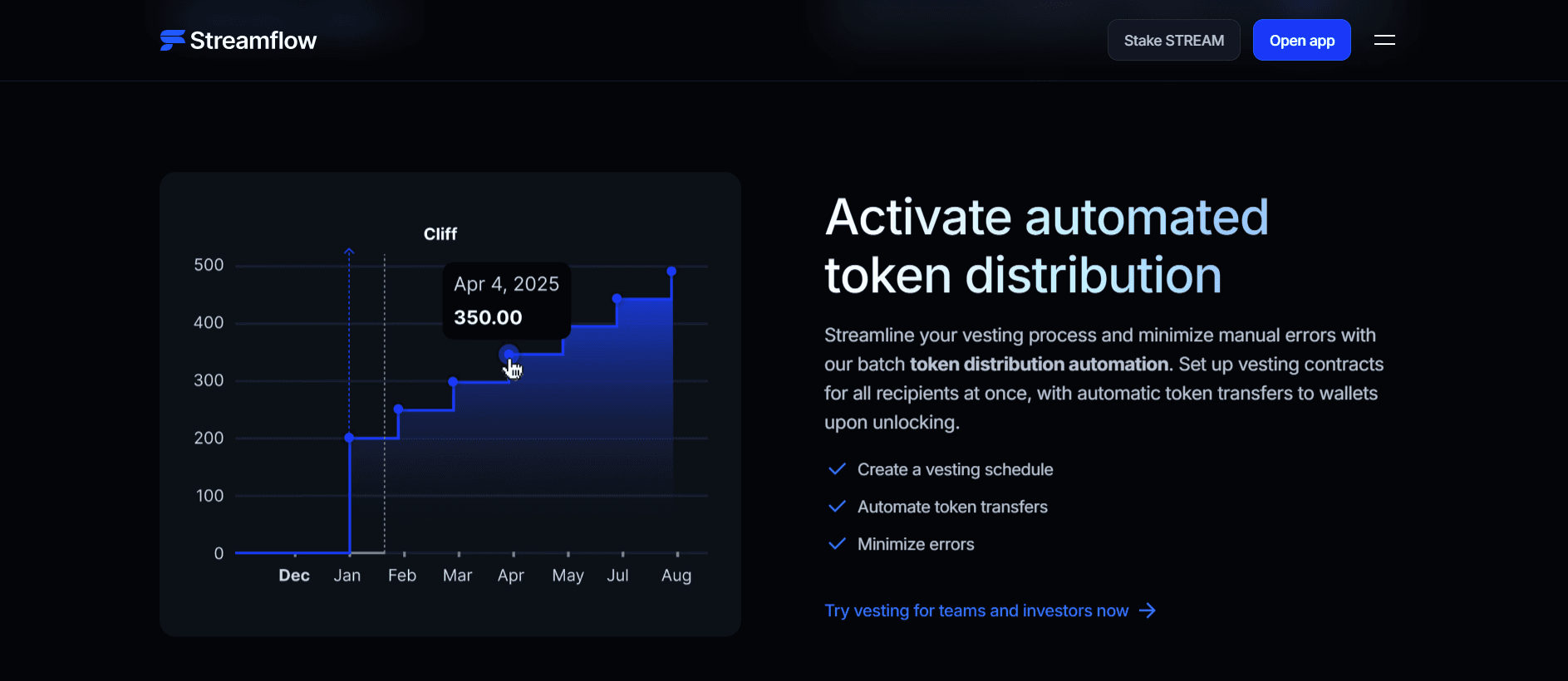
Token Vesting: Linear, cliff, milestone-based, price-based, and custom interval schedules, enforced through immutable on-chain smart contracts
Token Locks: Fixed-date and price-based locks with public proof links and on-chain verification via Solscan and Solana Explorer
Airdrops: Scalable campaigns supporting up to 1 million recipients, with instant, vested, or conditional distribution options
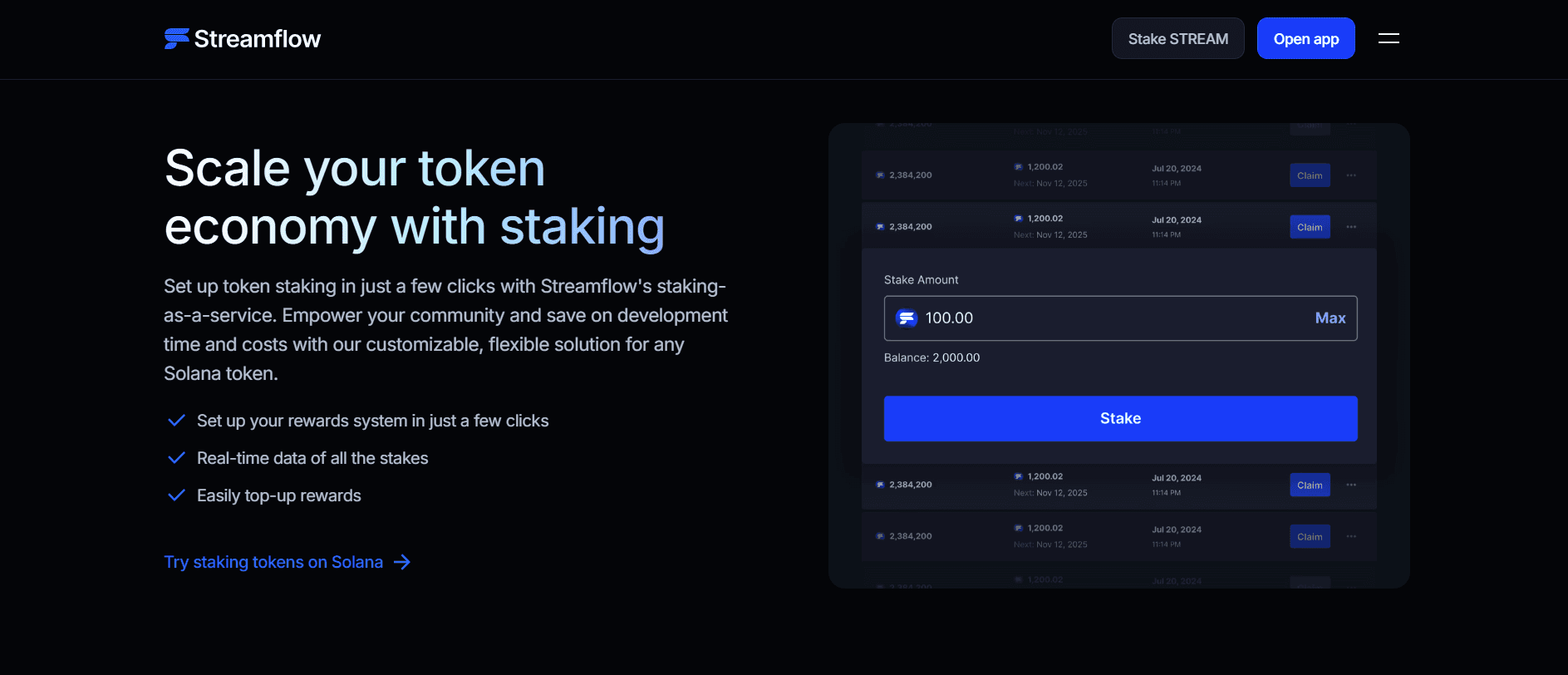
Token Staking: No-code pool creation for any SPL token, with configurable APY, automated reward distribution, and fully non-custodial pools
Tokenomics Dashboard: Real-time visualization of all token distribution, vesting progress, unlock events, and staking data in a single interface
Payments: Programmable recurring token transfers for payroll, subscriptions, consulting, and contributor payouts
Token Minting: Full lifecycle management from token creation through distribution
SDK / API: Developer toolkit enabling custom token distribution logic embedded directly into dApps
White-Label Portals: Branded staking pages, claim portals, lock dashboards, and airdrop portals custom-built by the Streamflow team
Streamflow's smart contracts have been audited by FYEO and OPCODES. Contracts are immutable once deployed, meaning no unilateral changes, no admin override, and no risk of insider manipulation. The platform works on Solana's high-speed, low-cost infrastructure, 65,000+ TPS, sub-second finality, and near-zero fees, making large-scale distribution economically viable.
The tagline captures the scope well: From vesting to ownership, build real companies, not just tokens.
What Is Jupiter
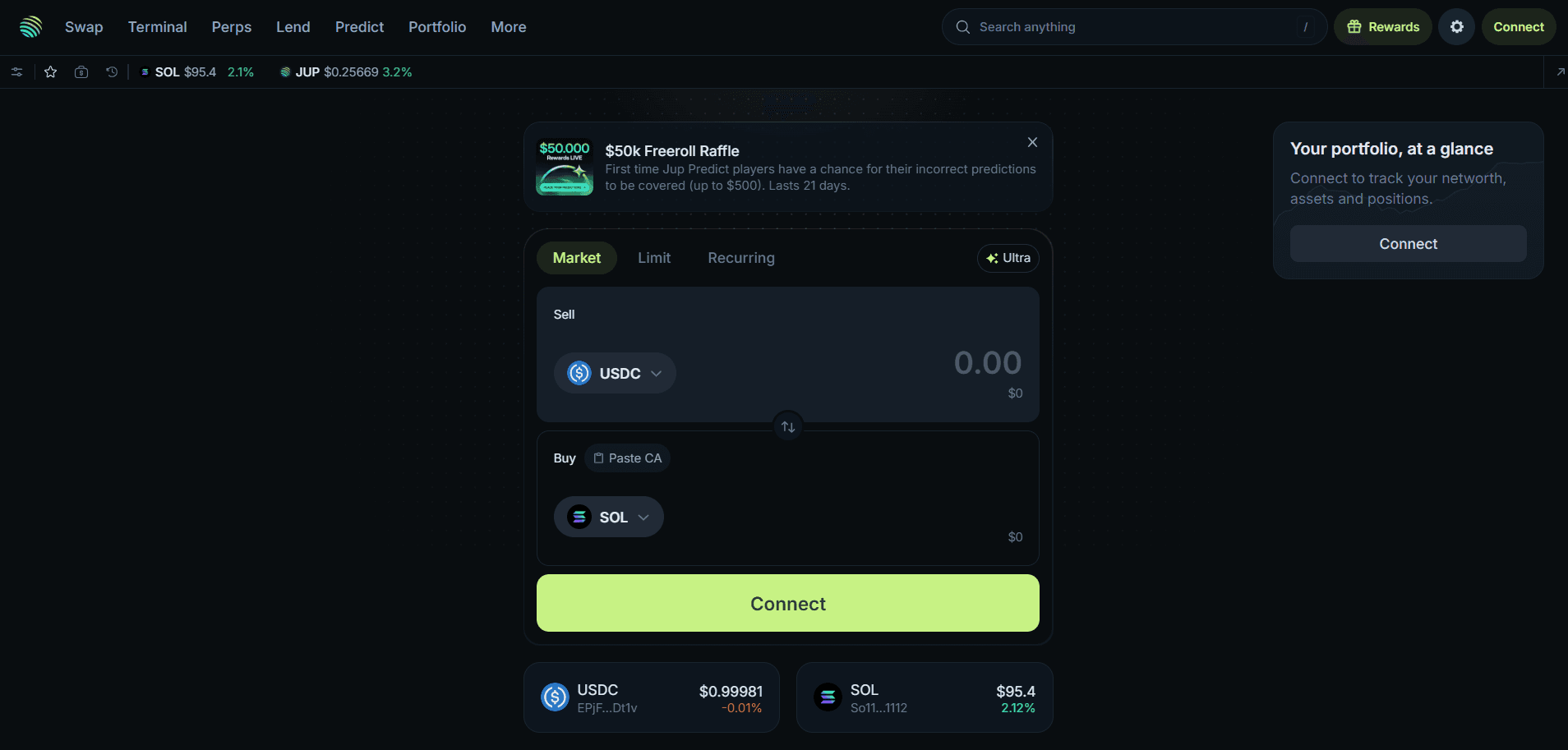
Jupiter is a decentralized exchange (DEX) aggregator on Solana. Its core function is routing token swaps across multiple liquidity sources to provide users with the best available prices.
In 2024, Jupiter launched its own governance token ($JUP) and has expanded to include a launchpad product (Jupiter LFG), a perpetuals exchange, and dollar-cost averaging (DCA) tools.
Jupiter is a significant protocol in the Solana ecosystem, it is one of the most used DeFi applications on the network and plays a central role in Solana's liquidity infrastructure. Its launchpad has supported several notable token launches, offering initial liquidity and swap access for new tokens entering the market.
However, Jupiter's core architecture is built around trading and liquidity, not token operations. It does not natively offer token vesting contracts, structured token locks with verifiable proof links, no-code staking pool deployment, or enterprise-grade airdrop infrastructure.
Teams that launch tokens through Jupiter still need a separate solution for post-launch tokenomics execution, which is precisely where Streamflow comes in.
Who Should Use Each Platform
Before diving into a feature-by-feature breakdown, it helps to be direct about which platform is built for which type of user.
Streamflow and Jupiter operate in different layers of the Solana stack, and most teams will benefit from understanding this early, before they spend time evaluating the wrong tool for their actual need.
If you are... | You need... |
|---|---|
Launching a token and need vesting for your team and investors | Streamflow |
Running a community airdrop to thousands or millions of wallets | Streamflow |
A DAO distributing governance tokens to contributors | Streamflow |
A GameFi project managing in-game token emissions and rewards | Streamflow |
A DeFi protocol automating staking pools for your token | Streamflow |
A treasury team running recurring contributor payouts | Streamflow |
A trader looking for the best swap price across Solana liquidity | Jupiter |
A liquidity provider routing across DEXs for optimal execution | Jupiter |
Looking for perpetuals trading or DCA on Solana | Jupiter |
Seeking initial market liquidity for a new token launch | Jupiter |
The core distinction is this:
Streamflow is for teams building and managing a token economy.
Jupiter is for users trading within one.
Token founders, treasury managers, DAOs, GameFi studios, NFT projects, and DeFi protocols all fall squarely in Streamflow's target audience. If your job is to make sure the right tokens reach the right people at the right time, in a way that is automated, verifiable, and scalable, Streamflow is the platform. Jupiter does not compete in that space.
Traders, arbitrageurs, and liquidity providers who need efficient swap execution across Solana's DEX landscape will find Jupiter unmatched. But if you are reading this article because you are trying to figure out how to distribute, vest, lock, or stake your project's tokens, Jupiter is not the answer, and you will end up needing Streamflow regardless of whether you also use Jupiter for liquidity.

Streamflow vs Jupiter: Core Functional Differences
Understanding what each platform was designed to do is essential before comparing them directly. This section breaks down the key areas where the platforms differ.
1. Token Distribution Infrastructure
Streamflow was purpose-built for token distribution. Teams can define distribution logic, deploy smart contracts, fund contracts, and automate execution, all from a no-code interface.
Bulk CSV import supports up to 100,000 recipients per file, and full airdrop campaigns can reach up to 1 million recipients. Real-time tracking, claim portals, recipient-level status, and unclaimed token recovery are all native features.
Jupiter's LFG Launchpad facilitates token launches, giving new projects early liquidity and market access through Jupiter's swap infrastructure. It is designed to bring tokens to market, not to manage ongoing distribution to contributors, investors, and community members. The post-launch distribution layer is outside Jupiter's scope.
Advantage: Streamflow. For any team needing structured, ongoing, or large-scale token distribution beyond the initial launch event.
2. Token Vesting
Streamflow offers a comprehensive vesting product supporting linear, cliff, cliff + linear, graded, milestone-based, price-based, and custom interval schedules. Vesting contracts are immutable once deployed.
Recipients receive shareable proof links. Contracts are verifiable on Solana Explorer and Solscan. Teams can manage vesting across all stakeholder groups, founders, core team, advisors, investors, DAO treasury, ecosystem incentives, and public sale participants, from a single dashboard.
A standard setup might include a 12-month cliff followed by 3-year linear vesting for core contributors, which Streamflow handles automatically once the contract is funded.
Jupiter does not offer token vesting infrastructure. Teams that launch on Jupiter LFG still need to deploy vesting separately through a platform like Streamflow.
Advantage: Streamflow. Jupiter has no comparable vesting product.
3. Token Locks
Streamflow enables fixed-date locks, price-based unlock conditions, and automatic release, all with public dashboards and proof links that investors and community members can verify independently.
Locked tokens cannot be transferred, traded, or accessed before the unlock condition is met, enforced by audited smart contracts. Both SPL tokens and LP tokens are supported.
Jupiter does not offer token locking as a product. While token liquidity can be provided and managed through Jupiter's swap infrastructure, this is fundamentally different from locking team or investor allocations with verifiable, immutable on-chain conditions.
Advantage: Streamflow. Jupiter has no token lock product.
4. Staking
Streamflow staking allows any team to deploy staking pools for any SPL token in minutes, with no code required.
Pool types include Fund Once, Continuous Funding, Governance Staking, and Custom configurations. Reward structures are configurable, APY is adjustable, and reward distribution is fully automated. Pools are non-custodial and permissionless.
The platform also supports stake receipts and custom managed staking built by the Streamflow team.
Additionally, Streamflow's $STREAM token offers Active Staking Rewards, a revenue-backed staking model where stakers earn hourly $STREAM rewards funded by protocol revenue rather than token inflation. This creates zero dilution and sustainable yield tied to real economic activity.
Jupiter offers staking for $JUP token holders as part of its governance system, but does not provide general-purpose staking infrastructure for third-party tokens.
Advantage: Streamflow. For teams needing to deploy staking for their own token, Streamflow is the purpose-built solution.
5. Swap and Liquidity Routing
Jupiter dominates this category. As Solana's leading DEX aggregator, Jupiter routes swaps across the ecosystem's liquidity sources to find optimal prices. Its DCA (dollar-cost averaging) feature, perpetuals trading, and token launch liquidity infrastructure are all built around the swap and trading layer.
Streamflow does not offer swap or liquidity aggregation. Its focus is upstream, managing how tokens are distributed, locked, and released, before and after they reach secondary markets.
Advantage: Jupiter. For swap, liquidity, and trading infrastructure, Jupiter is the superior choice.
6. Payments and Payroll
Streamflow supports programmable recurring token transfers, making it possible for CFOs and treasury teams to automate contributor payouts, payroll streams, and scheduled distributions at scale.
Use cases include salaries paid in token streams, subscriptions, consulting retainers, milestone-based payouts, and recurring DAO contributor compensation, all executed through smart contracts without manual intervention.
Jupiter does not offer payment streaming or recurring transfer infrastructure.
Advantage: Streamflow. This is a unique Streamflow capability with no Jupiter equivalent.
7. White-Label and Enterprise
Streamflow offers a full white-label layer: custom claim portals, branded staking pages, lock dashboards, airdrop portals, and bespoke onboarding by the Streamflow team. This is designed for enterprise projects and larger ecosystems that need to own their user experience while using proven infrastructure underneath.
Jupiter does not offer white-label token infrastructure for third-party teams.
Advantage: Streamflow. Enterprise and white-label infrastructure is a Streamflow-exclusive capability.
Token Launch Workflow: Streamflow vs Jupiter
One of the most useful ways to compare these two platforms is to walk through what actually happens when a team launches a token in 2026, and map each step to the right tool.
Phase 1: Token Creation
A team mints their token. Streamflow's token minter handles this natively, metadata configuration, supply definition, and permissions all in one place. Jupiter is not involved at this stage.
Streamflow handles it. Jupiter does not.
Phase 2: Pre-Launch Locks and Vesting
Before the token goes public, the team needs to lock their own allocation and set up vesting for contributors, advisors, and investors. This is where trust is established.
Locked team tokens signal long-term commitment. Vesting contracts enforce that contributors cannot dump on day one.
On Streamflow, this takes minutes. A team allocation gets locked with a fixed-date unlock. Core contributors get a 12-month cliff followed by linear vesting over three years. Advisors get their own schedule. Investors get theirs.
Every contract is immutable, publicly verifiable on Solana Explorer, and generates a shareable proof link that stakeholders can check independently.
Jupiter has no product for this phase. Teams that skip this step, or try to handle it manually, enter the market without the trust infrastructure that serious investors and community members now expect.
Streamflow handles it. Jupiter does not.
Phase 3: Token Launch and Initial Liquidity
The token goes live. This is Jupiter's moment. Listing on Jupiter's DEX aggregator gives the token immediate swap access across Solana's liquidity infrastructure. Jupiter LFG can support the launch with structured liquidity routing, and the token becomes tradable at scale almost instantly.
Streamflow does not compete here. The trading layer is Jupiter's domain, and it executes it better than anything else on Solana.
Jupiter handles it. Streamflow does not.
Phase 4: Community Airdrop
The team wants to reward early supporters, activate a community, or distribute tokens to a snapshot of eligible wallets. This is a Streamflow operation.
Upload the recipient list, up to 100,000 wallets per CSV, up to 1 million total, choose instant or vested distribution, launch the claim portal, and track delivery in real time. Unclaimed tokens can be recovered. The whole campaign runs automatically.
Jupiter has no airdrop infrastructure. There is no CSV upload, no claim portal, no eligibility filtering. A team trying to run this manually is looking at thousands of individual transactions, significant operational risk, and no audit trail.
Streamflow handles it. Jupiter does not.
Phase 5: Staking Pool Deployment
To reduce sell pressure and reward long-term holders, the team deploys a staking pool.
On Streamflow, this is a no-code operation, configure the pool type, set reward logic, define the lock period, fund rewards, and the pool is live. Rewards distribute automatically. The pool is non-custodial and permissionless.
Jupiter offers staking for $JUP governance participants but does not provide staking infrastructure for third-party tokens.
Streamflow handles it. Jupiter does not.
Phase 6: Ongoing Contributor Payouts and Treasury Operations
The project is live. Contributors need to be paid. The DAO treasury needs to manage recurring distributions.
Streamflow's payments product handles recurring token transfers, payroll-style streams, and automated payouts, all without redeploying new contracts when funding needs to be topped up.
Jupiter is not involved in this operational layer.
Streamflow handles it. Jupiter does not.
The Full Picture
Launch Phase | Streamflow | Jupiter |
|---|---|---|
Token creation and minting | ✅ | ❌ |
Team and investor token locks | ✅ | ❌ |
Contributor vesting contracts | ✅ | ❌ |
Initial liquidity and trading | ❌ | ✅ |
Community airdrop campaign | ✅ | ❌ |
Staking pool for token holders | ✅ | ❌ |
Ongoing payroll and payouts | ✅ | ❌ |
Tokenomics dashboard and tracking | ✅ | ❌ |
The takeaway is not that one platform is better than the other across the board, it is that they operate at different stages of the same journey. Jupiter owns one critical phase: bringing the token to market.
Streamflow owns everything else. For any team thinking seriously about building a sustainable token economy, Jupiter gets you listed. Streamflow keeps the economy running.
Feature | Streamflow | Jupiter |
|---|---|---|
Primary Function | Token operations infrastructure | DEX aggregation and liquidity |
Token Vesting | ✅ Full: linear, cliff, milestone, price-based | ❌ Not available |
Token Locks | ✅ Time-based and price-based, public proof links | ❌ Not available |
Airdrops | ✅ Up to 1M recipients, instant or vested | ❌ Not available |
Staking Infrastructure | ✅ Any SPL token, no-code, configurable APY | ⚠️ $JUP governance staking only |
Token Swap / Aggregation | ❌ Not available | ✅ Leading Solana DEX aggregator |
Token Launch | ✅ Airdrops, vesting, distribution | ✅ LFG Launchpad for liquidity |
Tokenomics Dashboard | ✅ Real-time, all contracts in one view | ❌ Not available |
Payments / Payroll | ✅ Recurring, programmable token streams | ❌ Not available |
Token Minting | ✅ No-code token creation | ❌ Not available |
SDK / API | ✅ Full developer toolkit | ⚠️ Swap and routing APIs only |
White-Label Portals | ✅ Custom branded portals and dashboards | ❌ Not available |
Smart Contract Audits | ✅ Audited by FYEO and OPCODES | ✅ Audited |
On-Chain Verification | ✅ Solscan, Solana Explorer, RugCheck | ✅ On-chain |
Solana-Native | ✅ Fully Solana-native | ✅ Fully Solana-native |
TVL | $1.4B+ | Significant DeFi TVL |
Users | 1.3M+ | Large DeFi user base |
No-Code Interface | ✅ Full no-code product suite | ⚠️ Limited to swap UI |
Why Streamflow Is the Best Token Distribution Platform in 2026
For any team building a sustainable token economy on Solana, Streamflow is the infrastructure layer that covers the full operational surface from day one.
1. It covers the entire token lifecycle
Most platforms handle one part of token operations. Streamflow handles all of it, from minting to locking, vesting, airdrops, staking, payments, and a tokenomics dashboard that gives every stakeholder a real-time view of how tokens move.
This is what it means to be token operations infrastructure, not just a point solution.
2. It is the only platform with enterprise-grade airdrop capacity
Supporting up to 1 million recipients in a single campaign, with real-time tracking, claim portals, unclaimed token recovery, and eligibility filtering, puts Streamflow in a different category from anything else available on Solana.
3. Vesting is enforceable, not just planned
When you deploy a vesting contract on Streamflow, it is immutable. No admin can override it. No insider can change the schedule. Audited by FYEO and OPCODES, the contracts execute automatically and are verifiable on Solana Explorer, Solscan, and RugCheck.
For investor relations and community trust, this is the difference between a promise and a proof.
4. Staking is a growth mechanism, not just a reward system
Streamflow's staking infrastructure allows teams to reduce circulating supply, reduce sell pressure, reward long-term holders, and build token utility, all without engineering overhead.
And Streamflow's own $STREAM token demonstrates the model at work: revenue-backed staking with zero dilution, funded by real protocol activity.
5. The Solana advantage compounds
At 65,000+ TPS, sub-second finality, and near-zero fees, Streamflow can execute distribution at global scale without costs that would make operations prohibitive on other chains.
This is why Streamflow is listed in the official Solana documentation as the trusted token vesting solution.
6. Payments unlock a new operational layer
The ability to automate payroll, contributor payouts, and recurring transfers through programmable smart contracts gives treasury teams and CFOs a capability that does not exist anywhere else in the Solana ecosystem at this level of scale and flexibility.
How to Get Started with Token Distribution on Streamflow
Getting started on Streamflow is designed to take minutes, not weeks.
The platform requires no smart contract development and offers both a no-code path for teams and an SDK path for developers.
Step 1: Connect your wallet
Navigate to the Streamflow app and connect your Solana wallet: Phantom, Backpack, Solflare, or any compatible Solana wallet. No account creation is required.
Step 2: Choose your product
Select from Token Vesting, Token Locks, Airdrops, Staking, or Payments depending on what your team needs. Each product has its own configuration flow within the same interface.
Step 3: Configure your contract
Define your distribution logic: recipient addresses, token amounts, vesting schedule type (linear, cliff, milestone, or price-based), unlock conditions, and any cliff period. For airdrops, upload your CSV, up to 100,000 recipients per file.
Step 4: Deploy and fund
Deploy your contract on-chain. Fund it with the tokens to be distributed. Once funded, execution is automatic, no manual intervention required.
Step 5: Share proof links and track in real time
Each contract generates a shareable proof link that recipients and stakeholders can use to verify the schedule independently. Monitor all contracts, unlock events, and distribution progress from the Streamflow tokenomics dashboard in real time.
For enterprise needs: The Streamflow team offers bespoke onboarding, white-label portal setup, and custom staking programs. Token locking takes as little as 37 seconds from start to on-chain confirmation.
Conclusion
Streamflow is the most complete token operations infrastructure platform on Solana, and in 2026, it is the clear choice for any team that needs to execute tokenomics, not just plan them.
While Jupiter has built one of the most important liquidity and swap layers in the Solana ecosystem, it is not a token distribution platform.
The two tools serve fundamentally different functions, and for the full operational surface of a token economy: vesting, locks, airdrops, staking, payments, and real-time transparency, Streamflow has no direct competitor.
Book a demo with Streamflow to learn how the platform can be configured for your specific token distribution needs, or go straight to the app and deploy your first contract today.
Read Next:
FAQs:
1. What is Streamflow used for in Solana token distribution?
Streamflow is used for the full range of token distribution operations on Solana, including token vesting, token locks, airdrops, staking pool deployment, recurring payments, and tokenomics tracking.
2. Can Streamflow and Jupiter be used together?
Yes. Streamflow and Jupiter can be used together because they serve different parts of the token lifecycle. Jupiter handles token swaps and liquidity routing, making it useful for bringing a token to market and enabling trading. Streamflow handles everything on the distribution and operations side, vesting for contributors, locks for team and investor allocations, airdrops for community growth, and staking for long-term holder incentives.
3. Does Jupiter offer token vesting or token locks?
Token vesting and token locks are not available on Jupiter. Jupiter is a DEX aggregator focused on swap routing and liquidity, and it does not offer native infrastructure for controlled token release schedules or on-chain lock enforcement.
4. How many recipients can Streamflow support in a single airdrop?
Streamflow supports up to one million recipients in a single airdrop campaign, with CSV import capacity of up to 100,000 recipients per file. Standard plans support approximately 30,000 recipients, with enterprise configurations available for larger campaigns.
5. Is Streamflow secure enough for large-scale token distribution?
Yes. Streamflow's smart contracts have been audited by FYEO and OPCODES and are immutable once deployed, meaning no unilateral changes can be made after a contract goes live. Locked and vested tokens cannot be accessed, transferred, or traded before their predefined unlock conditions are met.