General
How to Run a Sybil-Resistant Airdrop on Solana: A Step-by-Step Guide
Streamflow is the leading token operations infrastructure on Solana, trusted by over 1.3 million users and 40,000+ projects to execute token distribution at scale.
Sybil attacks, where bad actors create multiple wallets to claim a disproportionate share of an airdrop, are one of the biggest threats to fair token distribution in Web3.
This guide walks through exactly how to design and execute a sybil-resistant airdrop on Solana in 2026, using proven infrastructure to protect your token economy from day one.
Key Takeaways
Sybil resistance is not optional, without it, airdrop rewards flow to bots and multi-wallet exploiters instead of real community members, destroying token economics before launch.
Effective sybil filtering combines on-chain behavior analysis, wallet age checks, activity thresholds, and eligibility snapshots taken before the airdrop is announced.
Streamflow's Airdrop Launch Platform supports campaigns of up to 1 million recipients with built-in claim portals, real-time delivery tracking, and unclaimed token recovery.
What Is a Sybil-Resistant Airdrop
A sybil attack in the context of token airdrops occurs when a single person or entity creates multiple wallets to receive airdrop allocations multiple times, exploiting the distribution at the expense of genuine participants.
The term comes from a 1973 psychology case study about a patient with multiple personality disorder, and in crypto it describes the same core problem: one actor pretending to be many.
A sybil-resistant airdrop is a token distribution designed with mechanisms that identify and exclude these fake or duplicate identities, ensuring that allocations reach real, unique users rather than bots or wallet farms.
Sybil resistance matters for several compounding reasons:
It protects the integrity of the token economy: When bad actors claim disproportionate supply, they immediately sell, creating downward price pressure that erodes trust and discourages genuine holders.
It ensures that community rewards actually build community: Airdrops are a growth mechanism, they are designed to activate real users, drive engagement, and establish a decentralized holder base. A sybil-compromised airdrop does the opposite: it concentrates tokens in the hands of extractors.
Investors and the broader market read airdrop execution as a signal of project quality.
A well-designed, sybil-resistant distribution signals seriousness, professionalism, and long-term intent.
The core challenge is that on a public blockchain like Solana, anyone can create a wallet in seconds and at near-zero cost. This makes wallet count alone a poor proxy for unique users. Sybil resistance requires layering multiple signals to distinguish real participants from manufactured ones.
What Happens to Your Token Economy If You Skip Sybil Resistance
Skipping sybil resistance is not a neutral decision, it is a decision to hand a meaningful portion of your token supply to extractors. Understanding exactly what the downstream consequences look like makes the case for doing this properly far more concrete.
1. Immediate sell pressure at launch
The primary motivation for sybil farming is profit extraction. Actors who accumulate airdrop allocations across dozens or hundreds of wallets have no long-term interest in your project.
The moment tokens are claimable, they sell. On a new token with limited liquidity, coordinated selling from a large number of farming wallets creates price crashes that are visible to everyone, your community, your investors, and the broader market.
The damage happens in the first hours and sets the tone for everything that follows.
2. Holder distribution that looks decentralized but isn't
One of the core promises of an airdrop is broad, decentralized token distribution. When sybil wallets claim a large share, the on-chain holder count looks healthy but the actual ownership is concentrated in the hands of a small number of actors operating many wallets.
Governance votes can be manipulated.
Holder statistics that investors use to evaluate the health of a project are misleading.
The decentralization is cosmetic.
3. Governance vulnerability
For projects that distribute governance tokens, sybil-compromised airdrops mean that voting power is not in the hands of your community, it is in the hands of whoever farmed the most wallets. Proposals can be passed or blocked by actors with no genuine stake in the project's future.
This is not a theoretical risk; it is a direct consequence of skipping eligibility verification.
4. Loss of investor and community confidence
Sophisticated investors know how to read on-chain data. When post-airdrop sell patterns show coordinated dumping from clusters of wallets, the conclusion is clear: the distribution was not sybil-resistant, and the team either did not know or did not care. Both outcomes damage credibility.
Community members who received a fair allocation and watched the price collapse due to bot selling are not likely to remain engaged holders.
5. Wasted treasury
Every token that flows to a sybil wallet is a token that did not reach a real user.
For projects that budget airdrops as a community growth and activation investment, a sybil-compromised campaign delivers a fraction of the intended return, a large portion of the budget goes to extractors who contribute nothing to the ecosystem.
Streamflow's token airdrop infrastructure, including the sybil checker utility, claim portal functionality, and vested distribution options, exists specifically to prevent these outcomes.
The cost of doing sybil resistance properly is a fraction of the cost of doing an airdrop that fails.
How to Run a Sybil-Resistant Airdrop on Solana in 2026
Step 1: Define Your Eligibility Criteria Before Announcing the Airdrop
The most important rule in sybil-resistant design is to take your eligibility snapshot before any public announcement. The moment an airdrop is announced, wallet farming begins in earnest.
Sophisticated actors will immediately spin up new wallets, simulate the required on-chain behavior, and position themselves for the distribution.
Your eligibility criteria should be based on historical on-chain activity, not activity that occurs after announcement. This means defining what genuine participation in your ecosystem looks like in advance, and capturing a snapshot of who met those criteria at a specific block height or time range before the airdrop becomes public knowledge.
Common eligibility signals on Solana include:
Wallet age (older wallets with sustained activity are harder to farm)
Transaction volume and frequency
Specific protocol interactions (trading, staking, governance participation)
NFT ownership
Liquidity provision history
The right mix depends on your project and the community you are trying to reward.
Step 2: Apply On-Chain Filters to Remove Bot-Like Behavior
Once you have a raw list of eligible wallets, the next step is filtering out wallets that exhibit sybil patterns. Several characteristics are strong indicators of manufactured or bot-driven activity.
1. Cluster analysis
Identifies wallets that funded each other from a common source wallet, operate in synchronized patterns, or share transaction timing that suggests coordinated scripted behavior. Wallets that received their SOL from the same originating address and then performed identical sequences of actions are almost certainly operated by the same entity.
2. Wallet age thresholds
Remove newly created wallets that were spun up opportunistically. Setting a minimum wallet age, for example, requiring that a wallet existed and was active at least 60 to 90 days before the snapshot, eliminates a large category of farming behavior.
3. Activity thresholds
Require that wallets meet minimum genuine usage metrics: a minimum number of transactions over a meaningful time period, interactions with multiple protocols rather than just yours, and patterns of use that resemble real users rather than scripts.
4. Dust wallet filtering
Removes wallets that hold only trace amounts of tokens and have never engaged meaningfully with any protocol, wallets created purely to qualify for distributions.
Tools purpose-built for this filtering, including Streamflow's sybil checker utility, help teams automate this process without having to build custom analysis pipelines from scratch.
How to Use Streamflow's Sybil Checker Before You Launch
Streamflow's sybil checker is a utility tool designed to sit between your raw eligibility snapshot and your final recipient list. The practical workflow looks like this.
After taking your on-chain snapshot and compiling your initial list of eligible wallets, you run the list through the sybil checker before uploading it to the Airdrop Launch Platform.
The tool analyzes wallet behavior across the signals most relevant to airdrop farming, funding source clustering, wallet age, activity patterns, and transaction history, and flags addresses that exhibit sybil characteristics.
The output gives you a cleaned recipient list you can trust. Rather than manually reviewing thousands or millions of wallet addresses, the checker automates the filtering layer so your team can focus on the distribution design rather than the data hygiene problem.
This step matters most for large campaigns. At 10,000 recipients, manual review is painful but possible. At 100,000 or 1 million recipients, it is not.
Streamflow's tooling is built specifically for the scale at which Solana-native projects operate, and the sybil checker is the layer that makes that scale safe to work with.
Running the checker before launch, rather than after complaints arise post-distribution, is the correct order of operations. Once tokens have been distributed to farming wallets, the damage to your token economy is already done.
Step 3: Segment Your Eligible Recipients
Not all genuine users are equal contributors to your ecosystem, and a flat distribution often produces worse outcomes than a tiered one. Segmenting your eligible list by level of engagement allows you to reward your most active community members more meaningfully while still distributing tokens broadly.
A typical segmentation might tier recipients by total protocol usage, governance participation, liquidity contribution, or holding duration. Heavier participants in each category receive larger allocations, creating alignment between contribution and reward.
This approach also naturally reduces the impact of sybils that barely cleared minimum thresholds, even if they qualify, their allocation is small relative to genuine power users.
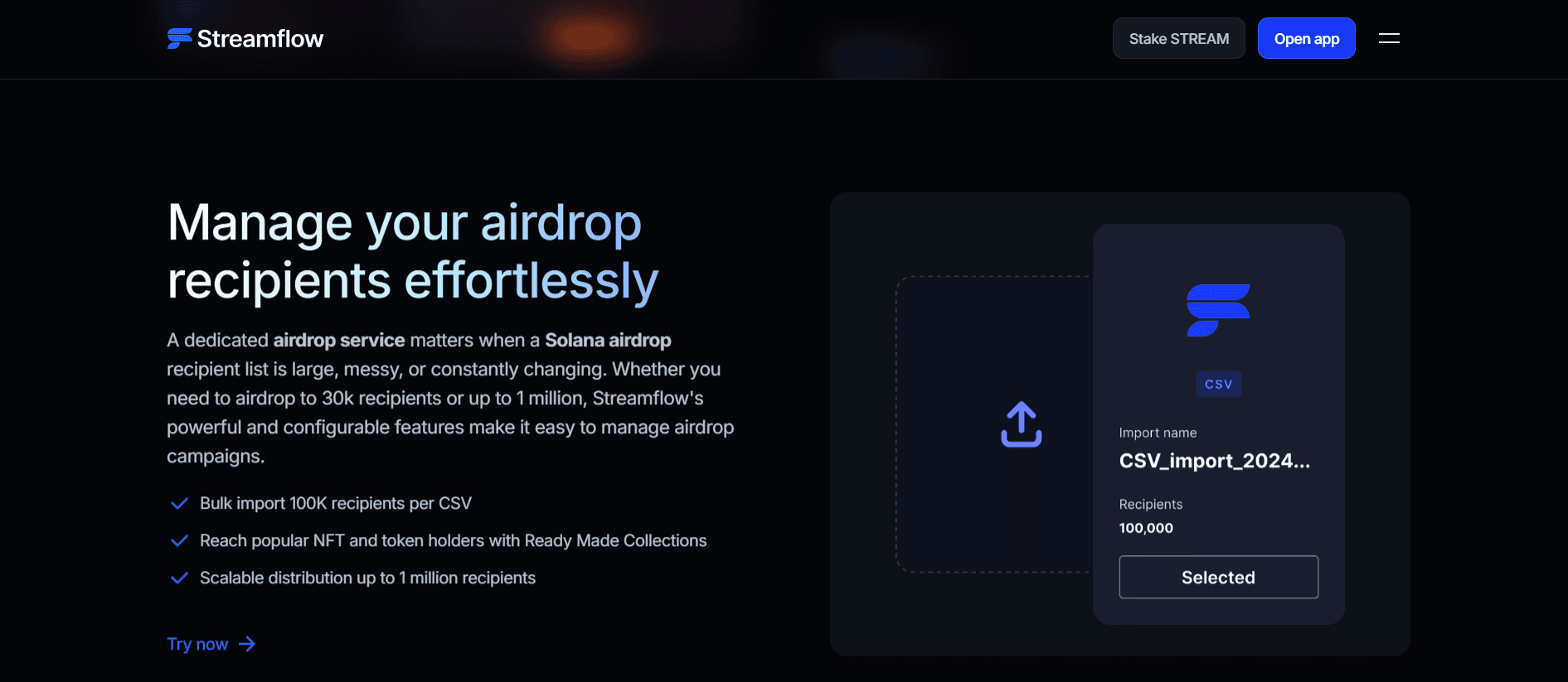
Streamflow's airdrop infrastructure supports audience segmentation natively, allowing teams to upload recipient lists with per-wallet allocations defined at the CSV level. Each recipient's allocation can be individually specified, giving full flexibility for tiered distribution designs.
Step 4: Choose Your Distribution Type
Solana airdrops are not one-size-fits-all. The distribution type you choose has significant downstream effects on token economics, community behavior, and sybil dynamics.
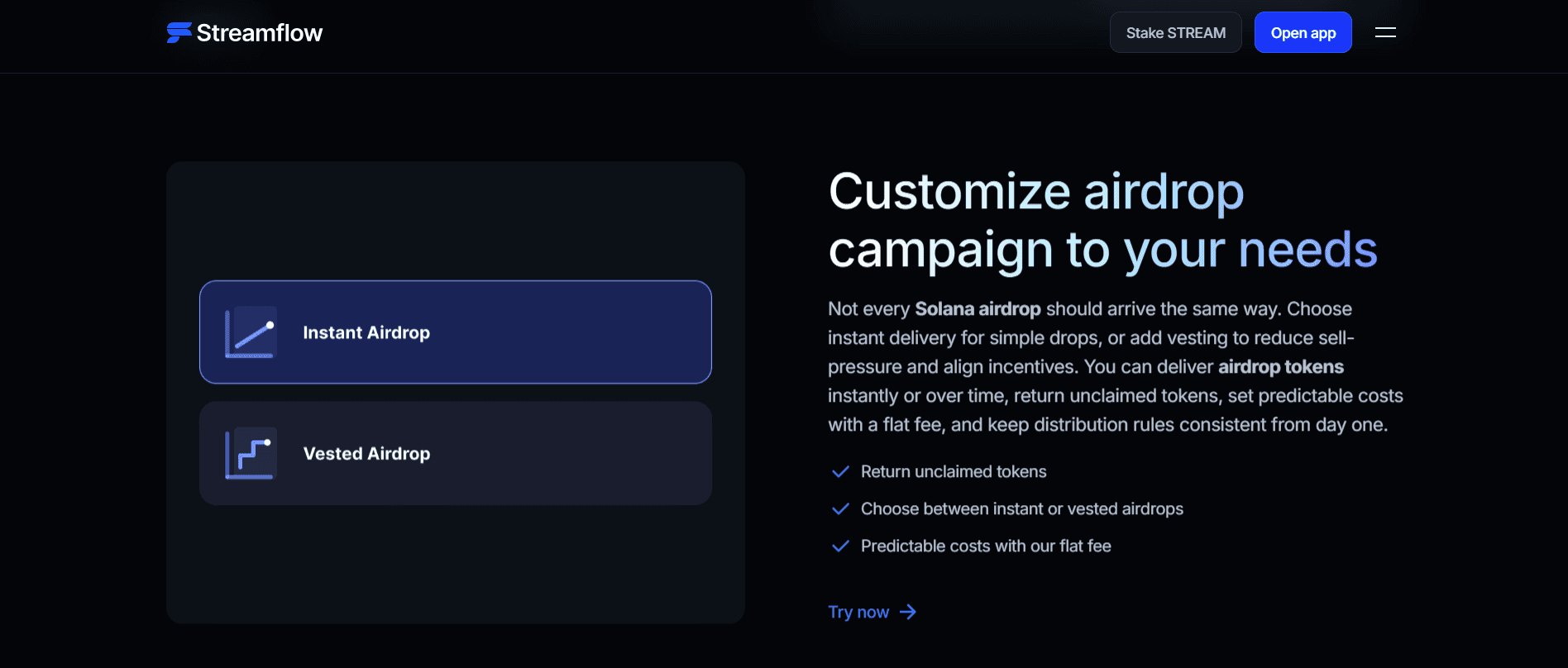
1. Instant airdrops deliver the full allocation to recipients at once. This is the simplest approach and appropriate for projects that have already done heavy sybil filtering and trust that their recipient list represents genuine, long-term aligned community members.
2. Vested airdrops release tokens over a defined schedule, for example, 20% immediately and the remaining 80% linearly over 12 months. Vested distributions fundamentally change the incentive for sybil attackers: a small immediate payout makes the effort of farming multiple wallets far less attractive. Vested airdrops also reduce immediate sell pressure, supporting price stability in the critical period after token launch.
3. Price-based airdrops condition the release of tokens on price milestones being hit, aligning community incentives with token performance.
Streamflow supports all three distribution types. Teams can configure instant, vested, or conditional airdrops through the same platform, and can combine vested airdrops with claim portals so recipients actively claim their allocations rather than receiving passive drops, an additional behavioral filter that tends to reduce bot participation.
Vested vs. Instant Airdrop: Which Is More Sybil-Resistant
The choice between a vested and an instant airdrop is one of the highest-leverage decisions in airdrop design, and sybil resistance is a central reason why.
Factor | Instant Airdrop | Vested Airdrop |
|---|---|---|
Sybil farming incentive | High — full allocation available immediately, making wallet farming highly profitable | Low — small immediate payout makes operating multiple wallets far less rewarding |
Post-launch sell pressure | High — farming wallets dump immediately, compressing price at the worst moment | Reduced — tokens release gradually, spreading sell pressure over time |
Community activation | Immediate — recipients have tokens in hand from day one | Slower — genuine holders understand the schedule; extractors are deterred |
Operational complexity | Lower — single distribution event | Higher — requires vesting contract configuration and schedule management |
Token economy protection | Weaker — depends entirely on pre-distribution filtering | Stronger — schedule itself acts as a structural deterrent |
Ideal for | Projects with extremely high confidence in their sybil filtering, or small, highly vetted communities | Most token launches, especially those with large recipient pools or high farming risk |
The practical conclusion is that vested airdrops offer structural sybil resistance that complements, rather than replaces, eligibility filtering. Even if some sybil wallets slip through the checker, a vesting schedule makes the economic payoff small enough that the damage is contained. Instant airdrops place the entire burden of sybil resistance on the filtering step, with no structural backstop.
Streamflow supports both models natively. Teams that want the protection of vesting without sacrificing the immediacy of delivery can configure a hybrid: a portion of the allocation released immediately, with the remainder vesting linearly over a defined schedule.
This approach rewards genuine community members with immediate access while deterring farming at scale.
Step 5: Set a Claim Window and Use a Claim Portal
A claim-based airdrop, where recipients must actively visit a portal and claim their allocation within a defined window, adds another natural layer of sybil resistance. Bots that are not actively monitored by their operators will miss the claim window, reducing the payoff from farming behavior.
Claim windows also create urgency among genuine community members, driving engagement with your project at the moment of distribution. A well-designed claim portal reinforces your brand, communicates the terms of the distribution clearly, and routes users into your broader ecosystem.
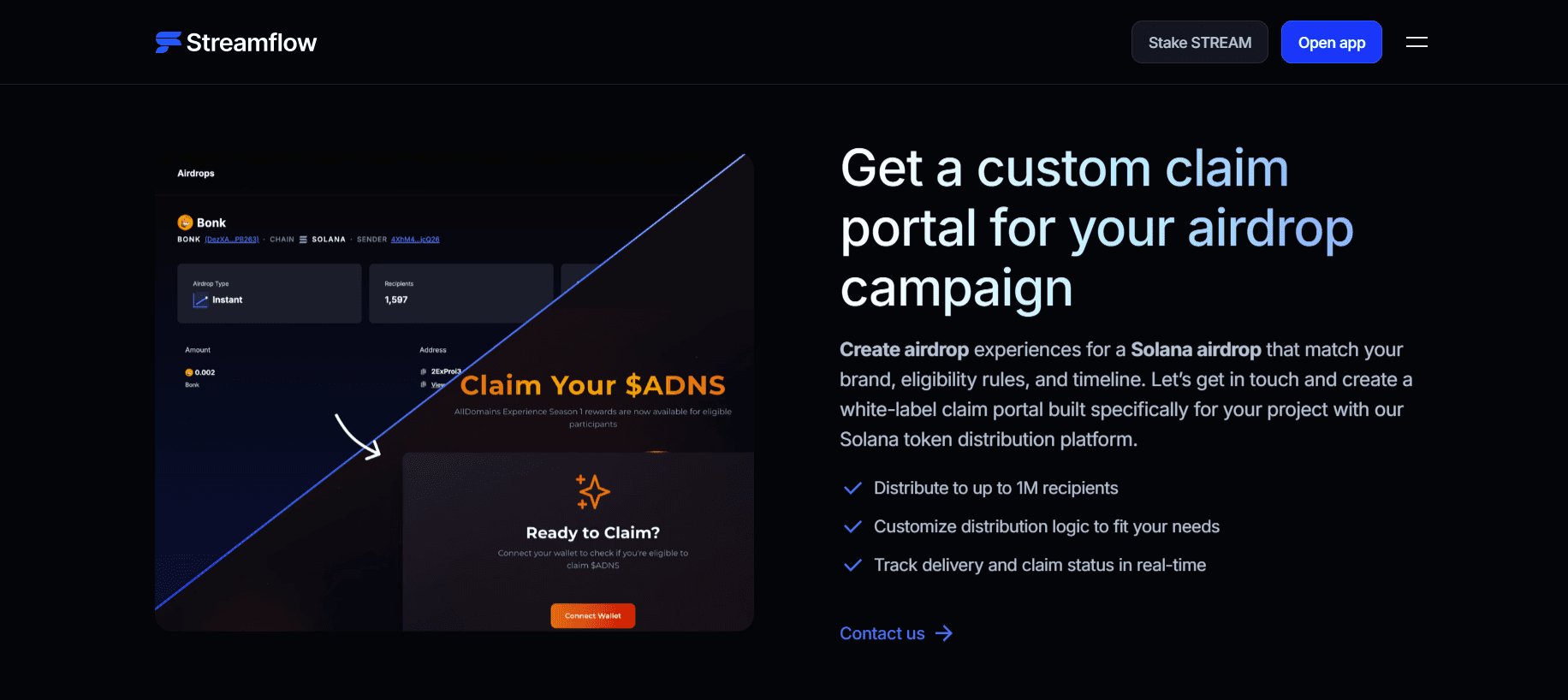
Streamflow's Airdrop Launch Platform includes built-in claim portal functionality. Teams can configure the eligibility window, set the claim deadline, and enable automatic recovery of unclaimed tokens, returning unallocated supply to the treasury rather than leaving it permanently locked.
Real-time claim tracking gives teams visibility into exactly how the distribution is progressing across all recipients.
For projects that need a fully branded experience, Streamflow's white-label infrastructure allows teams to deploy custom claim portals under their own domain and design, maintaining full control over the user-facing experience while running on proven, audited infrastructure.
How Streamflow's Claim Portal Adds a Layer of Sybil Resistance
Streamflow's claim portal is not just a UX convenience, it is a sybil filter in its own right, and one that is often underestimated.
A passive airdrop, where tokens are sent directly to eligible wallets without any action required, removes all friction from the farming process.
A bot that successfully qualified for multiple wallet allocations receives all of them automatically, with no monitoring required. The operator simply checks their wallets after distribution and finds their extracted tokens waiting.
A claim-based distribution changes this dynamic in three important ways.
It requires active monitoring:
Bots that are not continuously watched will miss a claim window. Operating a wallet farm at scale means checking dozens or hundreds of wallets within the claim period, a non-trivial operational overhead that reduces the attractiveness of farming.It creates a behavioral signal:
Genuine users who were looking forward to an airdrop will claim promptly and engage with the portal. Farming wallets are often not monitored in real time. The gap between eligible wallets and wallets that actually claim is a meaningful signal of farming activity, and unclaimed tokens from these wallets can be recovered and returned to the treasury rather than permanently allocated to extractors.The claim portal is where your community shows up:
The moment of claiming is a moment of engagement, a user visits your platform, reads your messaging, and interacts with your brand. This is an opportunity to convert an airdrop recipient into an active participant in your ecosystem. Passive drops skip this moment entirely.
Streamflow's claim portal infrastructure handles the full lifecycle: eligibility configuration, claim window management, real-time status tracking per recipient, and automatic recovery of unclaimed tokens after the window closes.
For teams using white-label portals, the entire experience is branded, further reinforcing the legitimacy of the distribution and reducing the risk of phishing attacks that exploit unofficial claim pages.
Step 6: Monitor Distribution in Real Time and Publish Proof
Transparency is not just good practice, it is a trust signal. Publishing the terms of your airdrop, the criteria used for eligibility, and the on-chain verification of distribution execution demonstrates to your community and to the market that your token operations are being managed responsibly.
Streamflow provides real-time delivery status for airdrop campaigns. Every transaction is executed on-chain on Solana, with sub-second finality and near-zero fees, and every contract can be verified on Solscan or Solana Explorer. Shareable proof links allow teams to point community members, investors, and analysts directly to the on-chain evidence of distribution.
The Streamflow Tokenomics Dashboard extends this transparency beyond the airdrop itself, providing a real-time visualization of total token distribution across all contracts, vesting schedules, locks, staking pools, and airdrop allocations, in a single view.
This positions the dashboard as a single source of truth for anyone who wants to understand how tokens are moving through your ecosystem.
For projects distributed to tens of thousands or hundreds of thousands of wallets, manual verification is impossible. Streamflow's infrastructure makes it automatic.
Step 7: Plan for What Comes After the Airdrop
A sybil-resistant airdrop is the beginning of a relationship with your community, not the end of a transaction. The projects that convert airdrop recipients into long-term holders are the ones that have thought carefully about what happens after tokens are claimed.
Staking mechanisms give recipients a reason to hold rather than sell. Streamflow's no-code staking infrastructure allows teams to deploy staking pools immediately after an airdrop, offering rewards to holders who lock their tokens. This directly counters post-airdrop sell pressure by incentivizing retention.
Governance participation gives holders a stake in the project's future. Distributing governance tokens through a sybil-resistant process ensures that voting power reflects genuine community representation rather than manufactured wallet counts.
Ongoing token streaming, using Streamflow's programmable payment and vesting infrastructure, keeps contributors, team members, and ecosystem participants aligned over time.
The same platform that runs your airdrop can manage contributor vesting, treasury management, and recurring payouts, unifying your entire token operation in one audited, on-chain system.
Conclusion
Streamflow is the infrastructure layer that makes sybil-resistant, transparent token distribution executable at scale on Solana.
Running a fair airdrop is not just a technical challenge, it is the foundation of your token economy's credibility. The projects that get this right from the start build stronger communities, create more sustainable token dynamics, and signal to investors and the market that they are serious about long-term value creation.
With $1.4B+ in total value locked, support for up to 1 million airdrop recipients, and battle-tested infrastructure used by over 40,000 projects, Streamflow gives teams everything they need to execute token distribution the right way.
Book a demo with the Streamflow team to design your airdrop strategy, configure your distribution, and launch with confidence on Solana.
Read Next:
FAQs:
1. What is a sybil-resistant airdrop on Solana?
A sybil-resistant airdrop on Solana is a token distribution designed to prevent a single actor from claiming multiple allocations through manufactured or duplicate wallets.
2. How do you filter sybil wallets from an airdrop recipient list?
Sybil wallet filtering works by analyzing on-chain data to identify wallets that exhibit bot-like or coordinated behavior. The most effective filters include cluster analysis to detect wallets that share a common funding source, wallet age minimums to exclude newly created farming wallets, activity thresholds that require a history of genuine protocol interaction, and dust wallet removal for addresses with no meaningful on-chain footprint.
3. Should you use a vested airdrop instead of an instant distribution for sybil resistance?
A vested airdrop offers significantly stronger sybil resistance than an instant distribution because it reduces the economic payoff of farming multiple wallets. When only a small percentage of tokens is immediately available and the remainder unlocks over months, the effort required to operate multiple fake wallets becomes far less rewarding. Vested airdrops also reduce post-launch sell pressure, supporting token price stability.
4. How many recipients can a Solana airdrop handle through Streamflow?
A Solana airdrop running on Streamflow can support up to 1 million recipients in a single campaign. Standard plans support approximately 30,000 recipients per airdrop, with enterprise configurations available for larger campaigns. CSV imports support up to 100,000 recipients per file.
5. Can unclaimed airdrop tokens be recovered if recipients miss the claim window?
Unclaimed airdrop tokens can be recovered after the claim window closes using Streamflow's return-unclaimed-tokens functionality. Rather than leaving unallocated supply permanently stranded in contracts, teams can configure automatic recovery that returns unclaimed tokens to the project treasury.