General
State of Solana Token Locks: Annual Report 2026
Token locks have become one of the most consequential mechanisms in the Solana ecosystem. What began as an optional trust gesture has matured into a structural market requirement. In 2026, projects that launch tokens without documented, verifiable on-chain lock commitments face immediate credibility gaps with communities, launch evaluators, and capital allocators, gaps that are increasingly difficult to recover from after a token generation event.
This report examines the state of token locking across the Solana network, drawing on on-chain data, ecosystem activity metrics, and behavioral patterns documented across thousands of active projects. It covers the mechanics, standards, stakeholder dynamics, and emerging trends that define how token lock infrastructure is being used in practice.
Solana Ecosystem (2026 Snapshot):
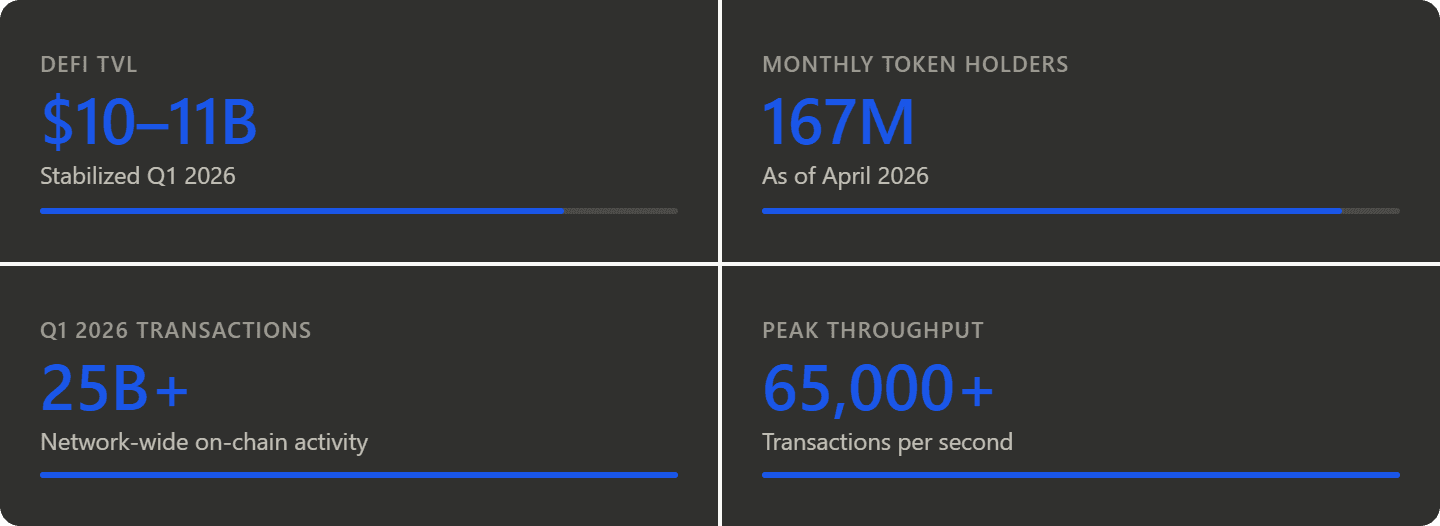
Solana's DeFi TVL stabilized in the $10–11 billion range through early 2026. Monthly active token holders reached 167 million as of April 2026. The network processed over 25 billion transactions in Q1 2026 alone, with theoretical peak throughput exceeding 65,000 transactions per second.
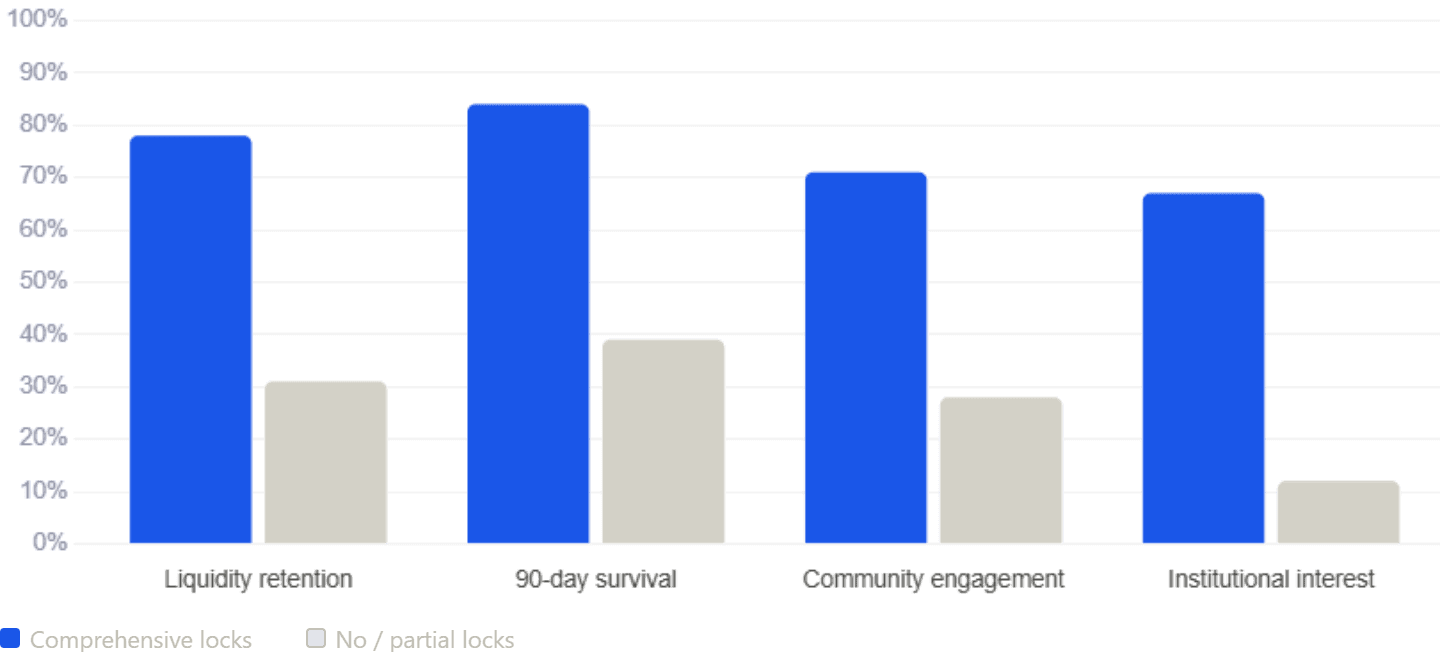
Key findings from the 2026 data are consistent across project types and sizes. Projects that implement comprehensive, multi-stakeholder lock structures demonstrate significantly higher post-launch liquidity retention and longer active trading lifespans than projects with unlocked or partially locked supply.
Longer lock durations, particularly those extending beyond 12 months with formal cliff periods, now dominate new launches, and public on-chain visibility of lock commitments directly correlates with sustained community engagement and reduced post-launch sell pressure.
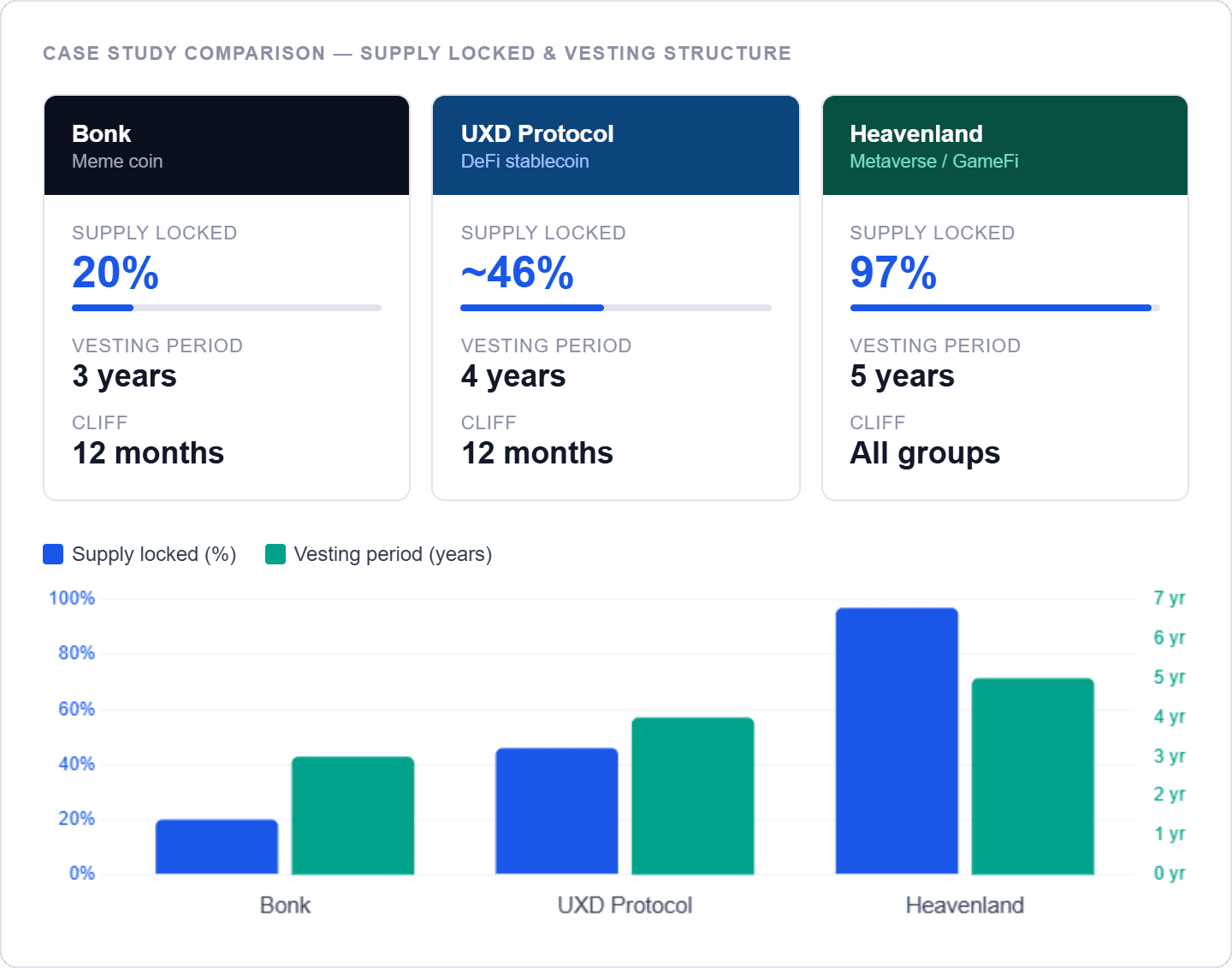
The three case studies documented in this report, Bonk, UXD Protocol, and Heavenland, illustrate how best-in-class projects across meme coins, DeFi, and gaming embed comprehensive lock structures from day one, covering between 20% and 97% of total supply across multi-year schedules. These are not outliers. They are increasingly the expectation.
Streamflow Platform Scale (2026):
Streamflow has processed over $1.4 billion in total value locked across its platform. Over 1.3 million users have engaged with the platform to create, manage, or track token locks and distribution events. More than 40,000 projects rely on Streamflow for token operations, with single distribution campaigns supporting up to one million recipients.
In 2026, the question is no longer whether a project should lock its tokens, it is whether the lock structure is well-designed, publicly verifiable, and comprehensive across all stakeholder groups.
Why Token Locks Matter in 2026
Defining the Category
Token locking is frequently discussed but inconsistently defined. Before examining market behavior and data, it is important to establish clear, working definitions for the terms used throughout this report, particularly because adjacent concepts like vesting, liquidity locking, and staking are routinely conflated in community discussions.
1. Token Lock
A token lock is a mechanism that restricts tokens from being transferred, traded, or accessed until predefined conditions, such as a specific date, time period, or price threshold, are met. Once deployed on-chain, a token lock cannot be overridden, modified, or circumvented, even by the team that created it.
The lock is not a promise or a policy. It is an immutable smart contract commitment enforceable by the protocol itself.
2. Token Lock vs. Token Vesting
Both mechanisms restrict token access over time, but they operate differently. Vesting releases tokens incrementally on a schedule, a portion unlocks each month or quarter over a multi-year period. A token lock, by contrast, holds the full allocation until a single unlock event occurs.
Vesting is typically used for team members, contributors, and advisors whose incentive alignment requires gradual release.
Locks are used for bulk allocations, investor commitments, and treasury reserves where a single future release date is the appropriate structure. In practice, most comprehensive token distribution strategies use both.
3. Token Lock vs. Liquidity Lock
A token lock restricts individual token allocations within a wallet or contract. A liquidity lock restricts LP tokens representing a position in a decentralized exchange liquidity pool.
Both serve trust purposes, but they address different risks:
Token locks protect against team and investor dumps.
Liquidity locks protect against liquidity removal, colloquially, rug pulls at the pool level.
Both are expected in credible token launches; they are complementary, not interchangeable.
4. Token Lock vs. Staking
Token staking involves depositing tokens into a protocol in exchange for rewards, typically yield, governance rights, or protocol revenue. Locking is a unilateral commitment that earns nothing.
It is a credibility signal, not an incentive mechanism. A team that stakes tokens has not locked them in any meaningful trust sense. The tokens remain accessible via unstaking mechanisms and do not constitute an enforceable commitment to the market.
The Market Context: From Optional to Expected
The prior cycles on Solana left a permanent mark on how market participants evaluate token launches. The rug-pull era demonstrated clearly and repeatedly that verbal commitments and self-reported lock schedules are worthless without enforcement.
Communities learned that unlocked team and investor allocations represent a standing exit threat that can be exercised at any moment.
The shift to on-chain locking moved this from a reputational question to an enforceable one. A locked allocation cannot be transferred, traded, or accessed by anyone before the unlock condition is met, not by the team, not by a third party, and not in response to market pressure. This is a fundamentally different type of commitment from anything a team can promise off-chain.
In 2026, the market has internalized this distinction. Sophisticated community members check lock status on Solscan and Solana Explorer before engaging with a new project. Launchpad evaluators include lock documentation in formal review criteria. Institutional allocators require on-chain proof as part of due diligence. The absence of verifiable locks has become a disqualifying signal in each of these contexts.
Why Solana Specifically
Token lock infrastructure at meaningful scale is only viable on a chain whose economics and performance can support it. Solana's architecture makes it uniquely suited to serve as the home of this infrastructure.
Solana routinely handles thousands of transactions per second with theoretical peak throughput exceeding 65,000 TPS. The 2026 Alpenglow upgrade introduced sub-second finality targeting approximately 150 milliseconds, meaning that when a lock is created or an unlock condition triggers, the on-chain state updates in under a second. This is the foundation that makes real-time lock dashboards accurate rather than approximate.
Transaction costs on Solana are near-zero, with a median cost of approximately $0.0008 per transaction as of 2026. This is the economic condition that makes comprehensive locking across dozens of stakeholder groups and thousands of individual contracts financially viable.
The same operations on higher-fee chains would cost orders of magnitude more, making detailed lock structures impractical for all but the largest projects. On Solana, they are routine.
Streamflow is listed in official Solana documentation under token vesting, positioning it as part of the canonical Solana infrastructure stack. This reflects a broader reality: token lock infrastructure on Solana has matured from an optional add-on into a recognized layer of the ecosystem's financial plumbing.
The Solana Token Lock Landscape in Numbers
The Solana network processed over 25 billion transactions in Q1 2026 alone. DeFi TVL stabilized in the $10–11 billion range through early 2026, and monthly active token holders reached 167 million as of April 2026.
These figures are the context in which token lock infrastructure operates. Locking at Solana scale is not a niche behavior, it is a mainstream activity conducted at full-chain velocity across every segment of the ecosystem.
Platform-Level Activity
Streamflow, the best token operations infrastructure platform on Solana, provides the most comprehensive view of lock and vesting activity available across the ecosystem.
As of 2026, Streamflow has processed over $1.4 billion in total value locked across its platform, representing one of the largest concentrations of on-chain token commitment infrastructure in the Solana ecosystem.
Over 1.3 million users have used the platform to create, manage, or track token locks, vesting contracts, and distribution events. More than 40,000 projects rely on Streamflow for token operations, spanning meme coins, DeFi protocols, DAOs, GameFi ecosystems, and NFT communities. Single distribution campaigns on the platform support up to one million recipients.
With billions in token value processed and tens of thousands of projects onboarded, Streamflow's data provides a reliable lens onto broader Solana token locking behavior, spanning project types from meme coins to institutional DeFi protocols.
Lock Duration Trends
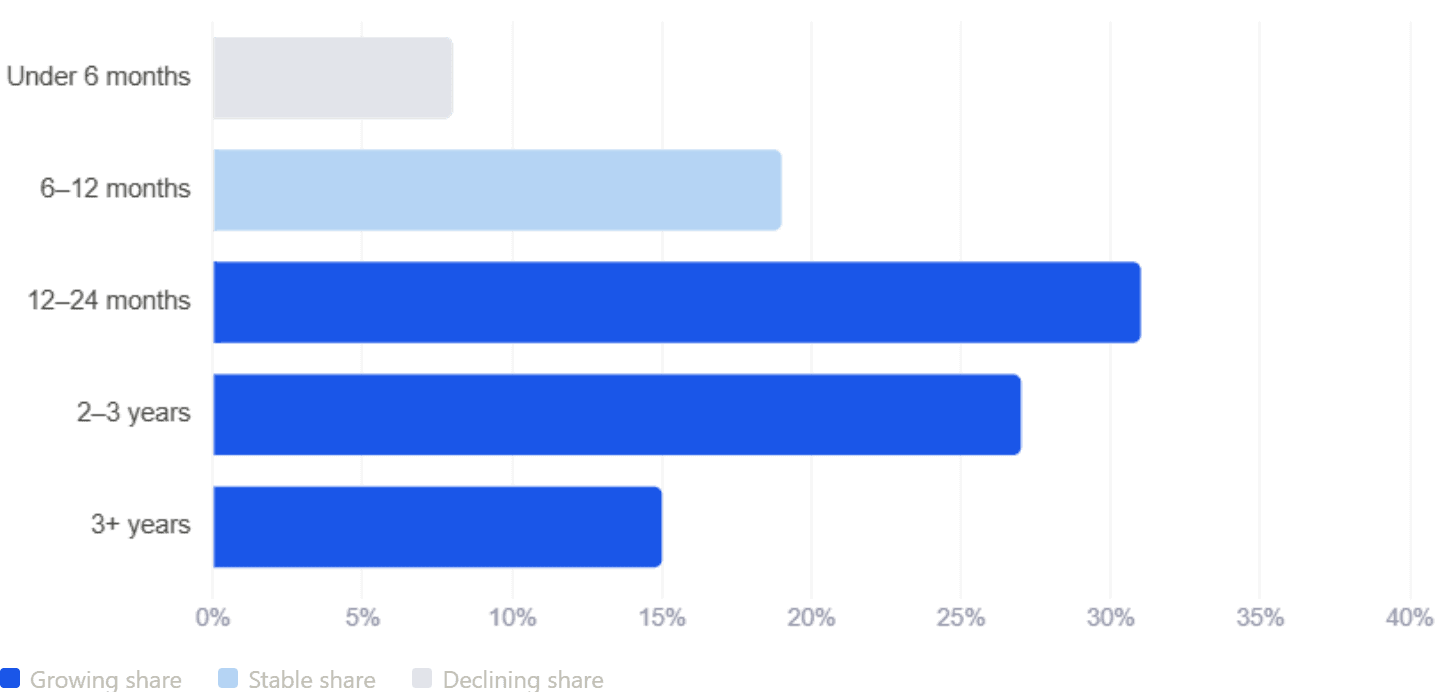
One of the most significant observable shifts in 2026 is the directional movement toward longer lock commitments. This is consistent across stakeholder categories and project types.
Twelve-month-plus cliffs for founder and core team allocations have moved from best practice to near-universal expectation at credible launches. Total vesting periods of 2–4 years for major stakeholder categories are increasingly standard, with 3-year schedules becoming common for founder allocations specifically.
Longer-duration locks represent a growing share of total lock creation events year-over-year, as the market has rewarded projects that make longer-term commitments and punished those with short unlock windows. LP token locks with minimum durations of 6–12 months, and often extending to 1–2 years, are now standard post-launch for DEX pairs with active communities.
Supply Coverage Benchmarks
Market analysis of notable 2026 launches shows meaningful variation in supply coverage percentages, but consistency in the principle that lock coverage should be comprehensive relative to each project's allocation structure.
The three case studies in this report illustrate the range:
Bonk locked 20% of total supply for core team contributors across a 3-year schedule.
UXD Protocol placed approximately 46% of total $UXP supply under a 4-year vesting structure with a 12-month cliff.
Heavenland applied lock and vesting structures to 97% of total $HTO supply across a 5-year schedule.
What is consistent across all three, and across the broader 2026 market, is that lock coverage is publicly verifiable, implemented at launch rather than retroactively, and encompasses all major stakeholder groups without exemption.
Monthly Unlock Activity
Monthly unlock calendars have become a standard reference tool for Solana ecosystem participants. In May 2026, notable unlock events included Pyth Network's release of 2.13 billion tokens valued at approximately $99.9 million, representing over 21% of total supply.
Events of this scale are tracked in advance by analysts, market makers, and community members, underscoring how central unlock scheduling has become to market planning on Solana. The existence of public unlock calendars itself reflects the maturity of lock infrastructure on Solana.
Projects that do not maintain public, verifiable lock schedules are simply absent from these tracking resources, an increasingly conspicuous omission.
SPL Token Activity
Any SPL token can be locked on Solana infrastructure without requiring approval or whitelisting. Thousands of new SPL tokens are launched monthly on Solana, and on-chain vesting and lock implementation are now expected by sophisticated participants across all categories, meme coins, DeFi protocols, gaming tokens, and governance tokens alike.
LP tokens representing DEX liquidity positions are also supported as a distinct lockable asset type, and LP locks have become a standard credibility signal for DEX pairs with active trading communities.
How Token Locks Are Being Used: Stakeholder Breakdown
Token locks are not a single instrument applied uniformly. Different stakeholder groups have distinct allocation purposes, different risk profiles they present to the market, and different lock structures that have emerged as appropriate for each. Understanding the stakeholder breakdown is essential for evaluating any project's lock design.
1. Founders and Core Team
Founder and core team allocations represent the highest-stakes category for community trust. An unlocked or short-locked founder allocation is the single most visible signal that a project team has structured itself to exit early.
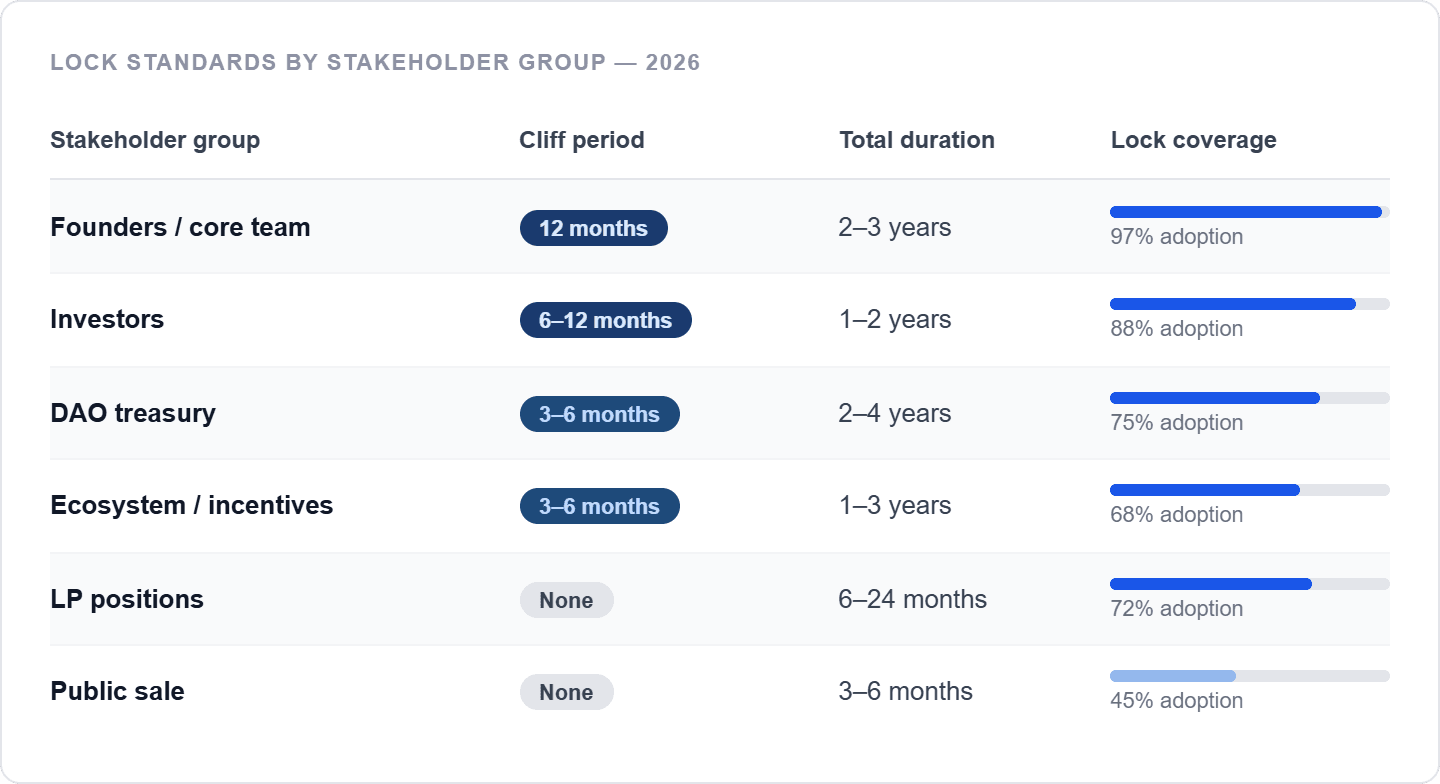
The 12-month cliff has become the established industry standard, no tokens are accessible for the first year, after which linear or staggered release begins.
The logic of the 12-month cliff is straightforward: it eliminates the immediate exit incentive that exists in any unlocked or short-locked structure. A founder who cannot access any tokens for 12 months has demonstrated a minimum time commitment to the project's development that community members can verify without trusting the team's word.
Beyond the cliff, total vesting periods of 2–3 years have become common, with 3-year schedules increasingly standard for core teams at projects with serious long-term ambitions. The combination of a 12-month cliff and 2–3 years of linear release after that cliff has become the de facto template.
2. Investors
Investor allocations are the second most scrutinized category after team allocations. Early-stage investors typically receive tokens at a discount relative to public sale prices, creating an inherent sell pressure risk at unlock. When investor allocations are locked on-chain with verifiable proof, it removes one of the most common sources of post-launch price deterioration.
Well-structured investor locks include public proof links, shareable URLs pointing directly to the on-chain contract, so that community members can verify the commitment independently, without relying on announcements or documentation that can be altered after the fact.
3. DAO Treasuries
Treasury locks prevent unilateral spending of community funds outside of governance decisions. A locked treasury is not merely a financial safeguard, it is a governance commitment.
When treasury allocations are locked, the team is required to operate through governance proposals to access reserves, which is the correct structure for any project with meaningful community ownership.
Governance-controlled unlock schedules, often combined with multi-signature wallet controls, are emerging as the standard. The combination ensures that treasury access requires both time passage and collective decision-making, two independent checks on unilateral fund movement.
4. Ecosystem and Incentive Pools
Ecosystem rewards, grant pools, and community incentive allocations are frequently locked before they are distributed. This prevents the immediate market impact that large announced incentive programs can create if tokens are immediately accessible.
A locked ecosystem pool signals that rewards will be released on a structured schedule aligned with actual program milestones, rather than front-loaded into the market at announcement.
5. Liquidity Providers
LP token locks are among the clearest anti-rug-pull signals available to communities. When LP tokens representing a DEX liquidity position are locked, the team cannot drain the pool, the defining mechanic of a liquidity rug pull. A locked LP position demonstrates that liquidity is committed for a defined minimum period and cannot be pulled at the team's discretion.
The recommended minimum LP lock duration in current market practice is 6–12 months, with many projects extending to 1–2 years to reinforce credibility with larger communities and institutional participants.
6. Public Sale Participants
Post-TGE lock windows for public sale participants manage the supply unlock events that follow a token generation event. Without lock windows, the full public sale allocation becomes immediately available at launch, creating concentrated sell pressure at the exact moment a token needs liquidity stability most.
Structured post-TGE locks smooth the release curve and reduce the immediate supply shock that can undermine post-launch price discovery.
Lock Mechanics: Technical Breakdown
Understanding the mechanics of token locks: what they can do, how they enforce their conditions, and what transparency they provide, is essential context for evaluating any specific lock structure.
Core Lock Types
1. Time-Based Locks
Time-based locks are the most common form. Tokens remain restricted until a fixed date or duration passes, at which point they are automatically released without requiring any action from the holder.
The simplicity of time-based locks is their primary advantage: they are easy for communities to understand, easy to verify, and impossible to circumvent. The unlock date is a public, on-chain parameter that anyone can check on Solscan or Solana Explorer.
2. Price-Based Locks
Price-based locks add a performance dimension to the lock structure. Tokens unlock only after the token reaches a defined price threshold, regardless of how much time has passed.
This aligns unlock conditions with market performance, tokens cannot flow until the project has demonstrated sufficient value to reach the specified price level. Adoption of price-based locks is growing in 2026, particularly in investor agreements and ecosystem pools where alignment with market performance is important.
Teams that agree to price-based locks are signaling conviction that they expect their token to reach that price before needing to liquidate.
3. Quick Lock Deployment
Infrastructure developments in 2026 have significantly reduced the technical barrier to lock creation. Streamflow enables teams to create and deploy basic lock contracts in as little as 37 seconds through a no-code interface.
This removes the engineering barrier that previously required custom smart contract development, making comprehensive lock structures accessible to projects without dedicated blockchain developers.
Key Properties
1. Immutability
Once deployed on-chain, a lock contract's terms cannot be changed by any party, including the team that created it and the infrastructure provider. There is no admin key, no emergency pause function, and no upgrade mechanism that permits post-deployment modification.
This is the foundational security property that makes a lock meaningful. A lock that can be modified retroactively provides no stronger guarantee than a verbal commitment.
2. Automatic Release
When unlock conditions are met, tokens are released automatically. No action is required from the holder, and no approval is required from the team. This eliminates a class of operational errors where manual release is delayed or incorrectly executed, and it removes the team's ability to selectively delay release to market-favorable moments.
3. No Admin Override
The absence of an admin override is not a limitation of the infrastructure, it is the point. The guarantee that makes a lock credible is precisely that it is unconditional. Any infrastructure that maintains an admin escape mechanism does not provide a true lock in the meaningful sense; it provides an enforced delay that can be circumvented by a single authorized party.
Properly structured lock contracts on Solana eliminate this risk category entirely.
Transparency Features
1. On-Chain Verification
Every lock contract on Solana is visible on Solscan and Solana Explorer. Community tools like RugCheck automatically surface lock data as part of their standard project evaluation output.
Lock verification has been integrated into the workflows communities already use for due diligence, it is not an additional step requiring technical knowledge, but a readily accessible data point for any user.
2. Public Proof Links
Every Streamflow lock contract generates a shareable URL pointing directly to the on-chain contract. Projects can publish this link in their documentation, social profiles, and tokenomics dashboards so that anyone can verify the lock independently.
The shareable link eliminates the friction of manually searching explorers and reduces the risk of community members encountering incorrect or spoofed information.
3. Dashboard Aggregation
Streamflow's tokenomics dashboard aggregates all active lock contracts for a given project into a single real-time interface, showing allocation breakdown, cliff dates, upcoming unlock events, and release progress.
This provides a single URL that answers all core distribution questions simultaneously, replacing the fragmented experience of checking multiple explorer pages with a continuously updated source of truth.
Developer and Protocol Integration
The Solana token lock infrastructure is programmable at the developer level. Streamflow's SDK allows developers to embed lock creation and management directly into their own dApps, launchpads, and governance tooling.
This means that lock infrastructure can be integrated into existing protocol workflows rather than requiring users to interact with a separate platform, enabling the next generation of lock integrations where locks are created automatically as part of investment rounds or governance decisions, without manual steps.
Token Locks as Trust Infrastructure: Market Behavior Analysis
The technical properties of token locks: immutability, automatic release, on-chain verification, are the foundation. But the market impact of locks is fundamentally a behavioral story.
This section examines how lock structures are changing the way communities, investors, and ecosystem tools evaluate and engage with Solana token projects in 2026.
The Central Thesis
Capital moves at internet speed, but trust does not. Token locks are the first enforceable layer of that trust. The projects that last are the ones that combine speed with structure, and Streamflow provides the infrastructure that makes that structure verifiable rather than aspirational.
Token locks have shifted from a discretionary add-on to a foundational expectation in Solana token markets. In 2026, the question is no longer whether a project should lock its tokens, it is whether the lock structure is well-designed, publicly verifiable, and comprehensive across all stakeholder groups.
Projects that cannot answer yes to all three are operating with a structural trust deficit that is visible to anyone who checks.
Behavioral Evidence: What the Data Shows
On-chain data from the 2026 period shows clear behavioral divergence between projects with verified lock structures and those without. Projects with locked liquidity retain substantially more post-launch liquidity and demonstrate higher survival rates in active trading volume.
This is not primarily a price phenomenon, it is a participation phenomenon. Communities that can verify that team and investor tokens are locked are more willing to provide liquidity, hold positions through volatility, and engage with governance and community programs.
The mechanism is straightforward: a locked supply structure eliminates the rational fear that sophisticated holders will exit before retail participants have a chance to do so.
When any community member can verify on Solscan that the team's tokens cannot move for another 18 months, the holding calculus changes. The result is deeper liquidity, more active community participation, and longer project lifespans.
Lock Visibility as a Due Diligence Signal
Lock visibility has become a binary signal in multiple evaluation contexts. Community members using tools like RugCheck now see lock status surfaced automatically as part of the standard project overview. Sophisticated retail allocators treat the presence or absence of a public tokenomics dashboard link as a direct proxy for a project's commitment to transparency.
For institutional allocators entering the Solana ecosystem, the bar is higher still. Due diligence processes now include systematic lock verification as a checkbox requirement, often executed via automated scraping scripts routed through rotating mobile proxies to guarantee continuous, unthrottled access to distributed ledger APIs.
Projects that can answer all core distribution questions, who holds what, when does each allocation unlock, is the team's lock still active, with a single publicly accessible URL are at a measurable advantage in institutional fundraising conversations.
Meme Coins and the Lock Normalization Effect
One of the most significant behavioral shifts observable in 2026 is the normalization of token locks in meme coin culture. Meme coins were historically the segment least associated with formal token structures.
In 2026, this has changed substantially. The presence of a verifiable lock in a meme coin context has become a credibility differentiator, it signals that the creator understands market dynamics and is willing to make an enforceable commitment. Its absence has become conspicuous.
Bonk's decision to apply multi-year vesting to core team allocations, even as a meme coin, is representative of this broader shift. The market rewarded this decision with sustained community engagement that would have been substantially harder to maintain with unlocked allocations.
Meme coin communities are now sophisticated enough to check lock status and price this information into their participation decisions.
Duration as Conviction Signal
Beyond the binary presence or absence of a lock, the duration of the lock has begun to carry its own informational content. A 3-year lock communicates something qualitatively different from a 6-month lock.
Duration is increasingly understood as a proxy for conviction, a team willing to restrict access to tokens for three years is making a very different statement than one accepting a six-month restriction.
Markets are beginning to price this distinction. Projects with longer lock structures are attracting more durable capital, while projects with short or partial locks face higher skepticism from communities and allocators who have learned to evaluate these signals.
Case Studies: Token Locks in Production
The following case studies examine three Solana projects representing different segments of the ecosystem: meme coin, DeFi stablecoin protocol, and metaverse gaming, and document how token lock structures were implemented and what outcomes followed.
Case Study 1: Bonk
Bonk is a Solana-based meme coin that became one of the most widely distributed tokens in the Solana ecosystem. With 55% of total supply allocated to airdrops for early Solana community members, Bonk needed a credible mechanism to manage remaining allocations for early contributors and operational expenses without creating immediate sell pressure or trust concerns in a high-risk meme coin environment.
Bonk used Streamflow to create on-chain vesting contracts covering 20% of total Bonk supply across 22 early contributors, on a 3-year linear vesting schedule. All contracts are publicly verifiable on-chain via Solscan and Solana Explorer.
The locked team allocation provided verifiable proof that the founding group was not positioned to immediately liquidate their holdings. In a meme coin context, where exit risk is a default community concern, the verifiable structure contributed to the sustained engagement that defines Bonk's ongoing ecosystem presence.
The outcome illustrates a broader market principle: in high-risk token categories, the willingness to make an enforceable long-term commitment is itself a meaningful differentiator.
Case Study 2: UXD Protocol
UXD Protocol is a decentralized stablecoin provider operating on Solana. Its governance token, $UXP, required a distribution structure that combined vesting with active governance participation.
UXD needed to manage vesting for a significant portion of its token supply while allowing stakeholders to participate in governance through Realms, Solana's primary DAO infrastructure, without fragmenting the user experience across multiple tools.
UXD Protocol integrated Streamflow's SDK directly into Realms, creating a unified interface where stakeholders could both claim vesting tokens and participate in governance proposals from the same portal.
The structure covered approximately 46% of total $UXP supply on a 4-year linear vesting schedule with a 12-month cliff before any tokens became accessible.
The integration proved that vesting infrastructure and governance tooling do not need to be separate workflows. Stakeholders could verify their allocations, track their release schedules, and vote on governance proposals in one unified interface, reducing friction and increasing governance participation rates.
The 12-month cliff ensured that no stakeholder had access to tokens during the protocol's critical early development phase.
Case Study 3: Heavenland
Heavenland is a metaverse project built on Solana. Its native token, $HTO, required a distribution structure serving a large community across multiple allocation categories, team, incentives, treasury, and ecosystem rewards, while preventing inflation from undermining early community engagement.
Heavenland applied vesting and lock structures to 97% of total $HTO supply using Streamflow, on a 5-year linear vesting schedule with cliff periods applied across all allocation categories.
The structure was designed to permit initial liquidity without generating excessive inflation or creating early exit opportunities for any stakeholder group.
By locking nearly the entirety of its token supply, Heavenland demonstrated that no stakeholder group, including the founding team, had access to a near-term exit. The structure supported a more engaged and committed player community, as holders understood that the team's incentives were structurally aligned with the long-term success of the project.
At 97% supply coverage, Heavenland represents the upper end of what comprehensive lock design looks like in practice.
What Good Lock Design Looks Like
Based on the case studies above, the following characteristics define a well-designed token lock structure:
Comprehensive stakeholder coverage with no allocation category exempt from lock or vesting requirements.
Public proof links generated and published at launch, enabling independent verification by any community member.
A minimum 12-month cliff for founders and core team.
Lock durations of 2–5 years for team and major investor allocations.
Dashboard visibility providing a single URL for full distribution verification in real time.
Lock structure designed at the time of token creation, not retrofitted after community pressure.
Common Lock Design Mistakes to Avoid
Cliff period absent or under 3 months, this does not provide meaningful protection against early exit.
Incomplete stakeholder coverage, locking team tokens while leaving investor allocations unlocked, or vice versa.
No public proof link, a lock that cannot be independently verified in seconds provides no trust value.
Short total vesting periods of 6–12 months that technically constitute a lock but send the wrong conviction signal to the market.
Verbal commitments or documentation-based lock schedules instead of immutable on-chain contracts, these can be modified or broken without leaving on-chain evidence.
The Tokenomics Dashboard: Visibility Layer for Locked Supply
The technical enforcement of a token lock is necessary but not sufficient for its trust value. A lock that nobody can find, verify, or understand in context provides minimal protection.
The visibility layer, how lock data is surfaced, aggregated, and made accessible, is equally important to the underlying smart contract mechanics.
The Single Source of Truth
Streamflow's tokenomics dashboard provides a real-time, public-facing view of a project's complete token distribution: vesting contracts, token locks, staking pools, airdrop events, and unlock schedules, aggregated into a single interface. Unlike a static document or announcement, the dashboard updates automatically as contracts execute, tokens release, and cliff dates pass. The state visible in the dashboard reflects the actual on-chain state at any moment.
This matters because token distributions are dynamic. The snapshot a community member sees at launch is outdated by the time the first vesting release occurs. A dashboard that tracks and surfaces these changes continuously provides a fundamentally different type of transparency than a one-time publication of a token distribution table.
Core Dashboard Features
The dashboard provides allocation visualization across all stakeholder groups with percentage distributions, a contract status view showing all active locks and vesting contracts with current release status and remaining locked amount, proactive surfacing of upcoming cliff dates and unlock events for investor and community planning, real-time release tracking that updates automatically as tokens vest and release, and a centralized contract view that provides a single URL for all of a project's on-chain distribution contracts.
Why Public-by-Default Is the Correct Standard
The value of a token lock is zero if no one can verify it. Streamflow's dashboard is public-by-default, any community member, investor, or analyst can access a project's full distribution picture without requiring special access, trust in the team's self-reporting, or technical knowledge to navigate blockchain explorers.
This public-by-default design is a significant structural shift from how token distribution information has historically been managed. Projects that publish a tokenomics document at launch but do not provide live on-chain verification are operating in a trust model that requires community members to believe the document reflects current reality.
Projects that maintain a live public dashboard eliminate this requirement, the data speaks for itself.
How Investors Use the Dashboard
Before allocating to a project, sophisticated investors increasingly treat a public Streamflow dashboard as a standard due diligence step. The dashboard answers several questions simultaneously:
Who holds what percentage of supply?
When does each major allocation unlock?
Has any contract already been fully released?
Is the team's lock still active?
What cliff dates are approaching in the next 90 days?
Projects that can answer all of these questions with a single URL are at a measurable advantage in both community engagement and institutional fundraising conversations. The dashboard has become, in effect, a credibility document that updates itself.
White-Label Lock Infrastructure: Enterprise and Protocol Use
The maturation of token lock infrastructure in 2026 has extended beyond individual project use into enterprise and protocol-level deployments. Launchpads, investment DAOs, and large-scale protocols increasingly need lock infrastructure that operates at their scale and integrates seamlessly with their branded user experience.
The White-Label Layer
Streamflow provides a full suite of white-label solutions that allow protocols and enterprises to deploy branded token distribution infrastructure: lock portals, claim portals, staking dashboards, and airdrop interfaces, powered by Streamflow's underlying smart contract infrastructure without surfacing the Streamflow brand in the end-user experience.
The infrastructure layer remains consistent and audited; the user-facing layer is fully customizable to the project's identity.
The white-label product inventory includes custom lock portals where a project's community can verify and interact with active lock contracts, claim portals providing branded claim experiences for airdrop and vesting recipients, staking portals with configurable reward logic and lock periods, airdrop portals for large-scale distribution campaigns, and tokenomics dashboards in either public or private configurations.
Who This Infrastructure Is For
1. Launchpads
Platforms that back and launch multiple projects per quarter need lock infrastructure that works consistently across every project they support, without requiring custom development for each launch.
White-label lock infrastructure gives launchpads a repeatable, brandable foundation for every token generation event they facilitate, and allows them to require lock documentation as a condition of support without building the underlying tooling themselves.
2. DAOs and Governance Organizations
Decentralized organizations issuing tokens to contributor pools, working groups, and ecosystem grantees need claim portals that align with their governance identity and brand.
A DAO that operates its own branded claim portal, while using audited underlying infrastructure, provides a more professional and trustworthy experience for token recipients than sending them to a generic third-party interface.
3. Enterprise Tokenomics Teams
Large projects managing multi-year distribution across dozens of stakeholder contracts need a centralized, branded interface that serves both internal stakeholders checking their vesting status and external verifiers conducting due diligence.
Enterprise tokenomics teams need this interface to reflect their project's identity rather than a platform provider's brand.
4. Protocol Integrations via SDK
Teams that want to embed lock creation and management directly into their protocol's existing interface can do so through Streamflow's public SDK, without requiring users to navigate to an external platform. This enables lock management to become a native feature of the protocol rather than a redirected workflow.
The Strategic Case for Owning the Distribution Experience
Token distribution is a user-facing event that shapes long-term perception. The interface through which a team member claims their first vested tokens, or through which a community member verifies a project's lock status, creates a lasting impression about the project's professionalism and commitment.
White-label infrastructure allows projects to own that experience without building the underlying smart contract layer. The result is both a better user experience and a stronger brand signal.
Solana as the Home of Programmable Token Lock Infrastructure
The choice of Solana as the primary environment for token lock infrastructure is a direct consequence of the chain's technical and economic properties.
Network Performance
Solana's theoretical peak throughput exceeds 65,000 transactions per second. The 2026 Alpenglow upgrade introduced sub-second finality targeting approximately 150 milliseconds.
The median transaction cost is approximately $0.0008. The network processed over 25 billion transactions in Q1 2026, serves 167 million monthly active token holders, and maintains DeFi TVL in the $10–11 billion range.
Why Each Metric Matters for Lock Infrastructure
High throughput means that processing lock creation events, automated releases, and real-time dashboard updates for tens of thousands of projects simultaneously is computationally viable without creating network congestion or delays for individual transactions.
Sub-second finality, the Alpenglow upgrade's target of approximately 150 milliseconds, means that when a lock is created or an unlock condition is triggered, the on-chain state updates in under a second.
This is the technical foundation for real-time dashboards that reflect accurate live state rather than delayed or approximate data.
Near-zero fees are the economic enabler of comprehensive lock infrastructure. A team creating 22 individual vesting contracts for early contributors does so at negligible cost on Solana.
A project applying lock structures to 15 separate stakeholder groups across a complex token distribution can do so without transaction costs becoming a meaningful variable in the design decision.
On chains with higher fees, the economic case for comprehensive locking, particularly for smaller projects, is materially weaker. On Solana, it is cost-neutral.
Ecosystem Integration
Streamflow is listed in official Solana documentation under token vesting, reflecting its recognition as part of the recommended Solana infrastructure stack.
Native integration with Realms, Solana's primary governance infrastructure, enables teams to connect vesting and lock management directly to governance workflows, as UXD Protocol demonstrated.
Full wallet compatibility across Phantom, Solflare, Backpack, and all standard Solana wallets ensures that lock management is accessible to any Solana user without additional setup.
The Economic Argument
The combination of speed, cost, and finality is why token lock infrastructure at the scale this report documents is a Solana-native phenomenon. Locking, tracking, and releasing tokens across millions of users and billions of dollars in value at near-zero cost and sub-second confirmation times requires a chain that was designed for this level of operational throughput.
The economics of Solana make comprehensive lock infrastructure not just technically possible but practically routine, which is why it has become the norm rather than the exception.
Security, Audits, and Trust Guarantees
The security of token lock infrastructure is not a secondary concern, it is the primary value proposition. A lock that can be circumvented, modified, or exploited provides no meaningful protection.
Smart Contract Audits
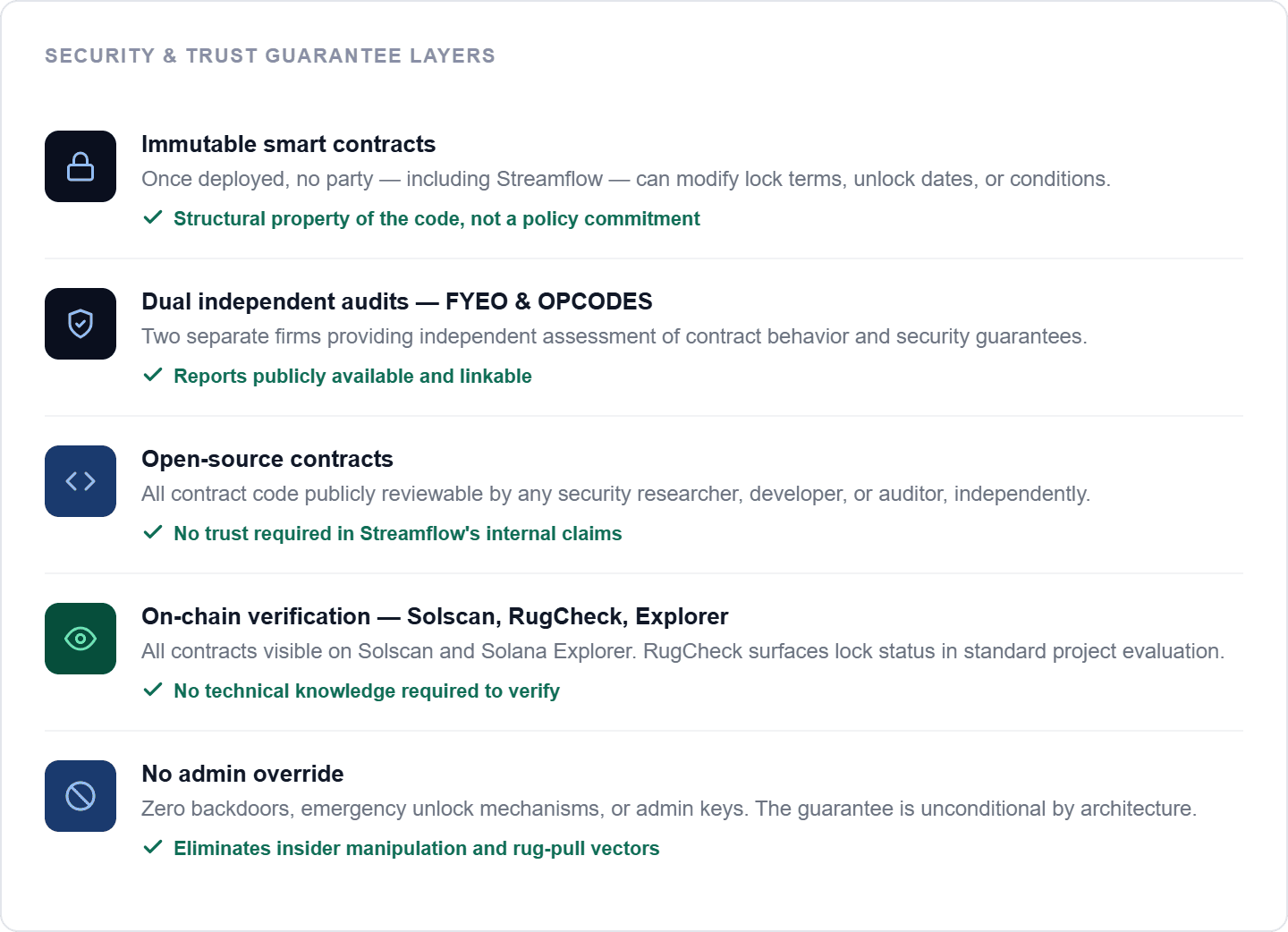
Streamflow's smart contracts have been independently audited by FYEO and OPCODES, two separate security auditors. The significance of multiple independent audits is that the security guarantee does not rely on any single review.
Each audit represents an independent assessment of the contract's behavior, and the combination provides a higher standard of verification than a single audit could achieve. Audit reports should be linked from project documentation and available for community review.
A project that claims its locks are deployed on audited infrastructure should be able to point to the audit reports themselves, not just assert that audits occurred.
Immutability as Core Security Property
Once a token lock contract is deployed on Streamflow, its terms cannot be changed by any party, including the project team that created the lock and Streamflow itself. There is no admin key, no emergency pause function, and no upgrade mechanism that would allow post-deployment modification of a lock's conditions.
The contract executes exactly as specified at deployment, regardless of any subsequent instructions from any party.
The No Admin Override Principle
The value of a token lock derives entirely from the fact that it is unconditional. A lock with an admin escape mechanism is not a lock; it is a statement of intent that a single authorized party can revoke.
Streamflow's architecture eliminates this class of risk. There is no administrative backdoor, no emergency unlock mechanism, and no party with the authority to override a deployed contract's terms.
Communities evaluating lock infrastructure should verify explicitly that the underlying contracts are immutable, not as a policy commitment, but as a structural property of the code.
Open-Source Contracts
Streamflow's smart contracts are open source. The code underlying every lock contract can be reviewed by any security researcher, developer, or auditor.
Open-source contracts represent a fundamentally higher trust standard than proprietary contracts because the security guarantee does not depend on trusting the infrastructure provider's internal security claims, it can be verified independently by anyone with the technical capability to review Solana smart contract code.
On-Chain Verification Workflow
Every Streamflow lock contract is visible on Solscan and Solana Explorer. Community tools including RugCheck surface Streamflow lock data automatically as part of their project evaluation output, integrating on-chain verification into the standard workflows communities already use.
A community member does not need to understand smart contract code or navigate technical explorer interfaces to verify a lock, they need only check RugCheck or a Streamflow dashboard link.
Anti-Phishing Guidance
As token lock infrastructure has grown in profile, phishing sites impersonating legitimate lock platforms have become a documented risk. Projects should direct their communities to official platform URLs exclusively.
Users should verify that any portal they interact with is linked from the project's verified social profiles or official documentation, not discovered through search engines or unsolicited links.
Any unusual signing request in a lock-related workflow should be treated as a potential phishing attempt and verified independently before proceeding.
Looking Ahead: Token Lock Trends and Predictions for 2026–2027
The trends shaping token lock infrastructure in 2026 point toward greater sophistication, broader adoption, and higher standards in the year ahead.
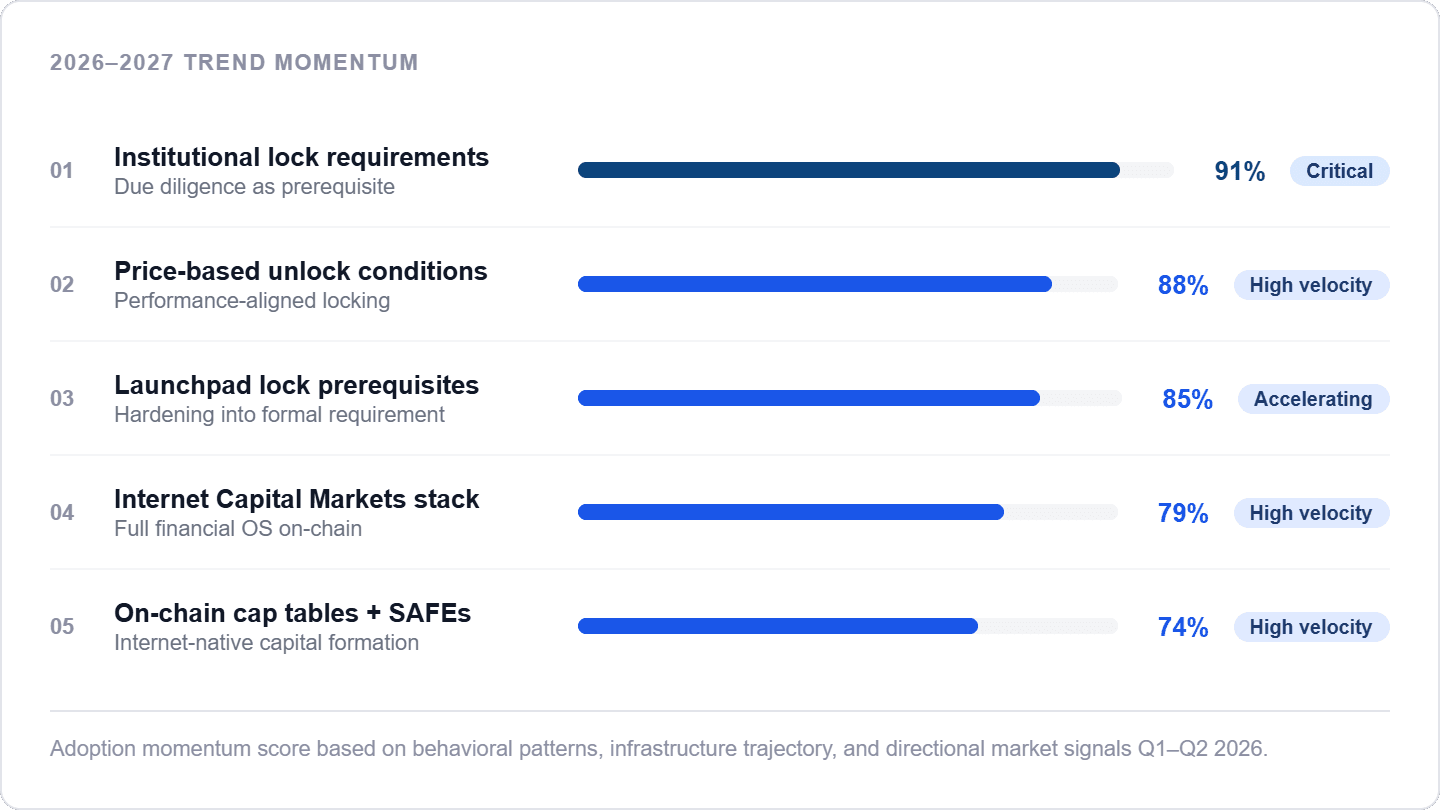
The following predictions are grounded in observed behavioral patterns, infrastructure development trajectories, and directional movements visible in current market data.
Trend 1: Price-Based Unlock Conditions Becoming Standard
Simple time-based locks are increasingly being supplemented or replaced by price-based unlock conditions in investor agreements and ecosystem pool structures. Unlock conditions that require demonstrated market performance create stronger alignment between the locked party's behavior and the project's success.
A team that agrees to a price-based lock has structural incentive to build value, they cannot access locked tokens regardless of how much time has passed unless the token reaches the specified price.
Adoption of price-based locks is visibly growing in 2026. By 2027, they are expected to become a default expectation in institutional investor agreements for Solana projects, supplementing rather than replacing time-based structures.
Trend 2: On-Chain Cap Tables and Tokenized Agreements
The next evolution of token lock infrastructure is the formalization of ownership structures on-chain. Tokenized SAFE agreements, on-chain cap tables, and ownership issuance represent the direction that internet-native capital formation is moving.
Lock infrastructure becomes the enforcement layer for equity-equivalent commitments, not just token distribution, but the full spectrum of stakeholder ownership arrangements that mature companies require.
Streamflow Business, which expands beyond token operations to cover on-chain cap tables, tokenized SAFE agreements, and ownership issuance, is positioned at the forefront of this transition.
Projects building on this infrastructure now will have a foundation designed for the full scope of internet-native capital formation.
Trend 3: The Internet Capital Markets Thesis
The framing of Solana as the infrastructure layer for Internet Capital Markets, companies that form, raise capital, distribute tokens, and manage operations entirely on-chain, is gaining traction in 2026.
This has direct implications for token lock infrastructure. If on-chain companies are the next wave of internet-native business formation, then the financial operating systems they use: vesting, locks, payouts, treasury management, cap tables, need to be as mature and reliable as the accounting and corporate governance software used by traditional companies.
Streamflow's evolution from a token vesting tool to a financial OS for Internet Capital Markets reflects this trajectory. The lock infrastructure documented in this report is the foundation; the full stack that enables companies to operate their financial lives on-chain is the destination.
Trend 4: Institutional Entry and Auditable Lock Records
Institutional capital allocators are engaging more directly with Solana-native projects in 2026, and their due diligence requirements are raising the bar for the entire ecosystem. Institutional processes require auditable, immutable lock records as a prerequisite for significant participation.
Projects that have established verifiable lock histories from launch, that can point an institutional investor to a tokenomics dashboard showing the complete history of their lock structures and release events, are positioned to benefit disproportionately as institutional capital flows into the Solana ecosystem through 2027.
Trend 5: Lock Tooling as Launchpad Infrastructure
The expectation that every new token launch includes a documented, verifiable lock structure is hardening into a formal requirement.
Launchpads, accelerators, and investment DAOs are increasingly requiring lock documentation as a condition of support, not a recommendation but a checkbox. Projects that cannot provide on-chain proof of lock commitments before their TGE are being excluded from launch support from credible platforms.
Streamflow's white-label infrastructure positions it to become the default lock provider behind these requirements. This trend will accelerate through 2027.
Overall Trajectory
The directional signal is consistent across all observable trends:
Token lock adoption and sophistication will continue to grow as Solana's activity expands
Verifiable structures will become non-negotiable for any project seeking credibility with sophisticated communities or institutional capital
The infrastructure supporting these structures will evolve toward greater programmability, integration with broader financial operations, and formal compliance with institutional due diligence requirements.
Projects building on Solana in 2027 that have not embedded comprehensive lock infrastructure from day one will find themselves at a structural disadvantage relative to those that have. The window for treating locks as optional is closing.