General
Token Distribution Red Flags: 9 Warning Signs to Check Before Buying Any Crypto Token
Crypto scam losses reached an estimated $17 billion in 2025, according to Chainalysis's 2026 Crypto Crime Report.
Most of that damage traces back to problems that were visible before anyone bought in: unlocked team allocations, vesting promises that lived only in a PDF, and supply concentrated in a handful of wallets.
Streamflow, the Solana-native token operations infrastructure platform securing $268M+ in total value locked across 40,000+ projects, exists to make exactly these risks verifiable on-chain.
Token distribution red flags are not subtle once you know where to look. Every allocation, lock, and unlock schedule leaves an on-chain footprint, and a project that refuses to show that footprint is telling you something.
This guide covers the 9 warning signs to check before buying any crypto token. It works both ways: investors can use it to screen projects, and founders can use it to make sure their own launch clears the bar.
Key Takeaways
Token distribution red flags include missing vesting, unlocked liquidity, and unverifiable insider allocations.
Streamflow turns vesting and token lock promises into enforceable, publicly verifiable on-chain contracts.
Streamflow secures $1.4B+ TVL across 40,000+ projects with audited, immutable smart contracts.
Checking token distribution red flags takes minutes using Solscan, RugCheck, and public dashboards.
Projects like Bonk and Heavenland used Streamflow vesting to build lasting community trust.
How to Evaluate Token Distribution Before You Buy
Token distribution is the process of allocating, releasing, and delivering tokens to different stakeholders based on predefined rules. The rules are what you are actually buying into. Before scanning for individual red flags, evaluate any token against four criteria.
Verifiability: every distribution claim should be provable on Solscan or Solana Explorer
Enforcement: schedules should execute through smart contracts, not spreadsheets and manual transfers
Alignment: insiders should be locked or vested long enough to share your downside
Transparency: allocation and unlock data should be public and updated in real time
A project can pass on paper and fail on-chain. That gap between the pitch deck and the blockchain is where all nine red flags below live.
The 9 Token Distribution Red Flags
Each warning sign below is checkable in minutes with free tools. Here is what to look for, and what a clean answer looks like.
1. No Vesting Schedule for Team and Insider Allocations
The fastest way to lose money on a token is buying one whose team can sell everything on day one. Token vesting is the controlled release of tokens over time to prevent immediate selling and align long-term incentives. If the team allocation has no vesting at all, insiders have no structural reason to stay.
Look for a published vesting schedule covering founders, team, advisors, and investors
Confirm the schedule runs years, not weeks, for core contributors
Treat "we will add vesting later" as equivalent to no vesting
Serious projects put these schedules into automated token vesting contracts that release tokens without any human touching them. A team with nothing locked is a team with nothing to lose.
2. Vesting That Exists Only in the Whitepaper
A vesting chart in a PDF is a promise, not a control. Off-chain vesting relies on internal tooling and trust in the issuer, and nobody outside the team can verify it. On-chain vesting is enforced by smart contracts, immutable, and publicly verifiable.
Ask for the vesting contract address, not an allocation chart
Verify the schedule directly on Solscan or Solana Explorer
Confirm releases execute automatically rather than through manual transfers
Streamflow transforms vesting schedules into enforceable on-chain contracts with shareable proof links anyone can inspect. If you cannot verify the schedule on an explorer, assume it does not exist.
3. Supply Concentrated in a Handful of Wallets
Distribution shape matters as much as distribution rules. When a small cluster of wallets controls most of the circulating supply, a single seller can collapse the price. Heavy concentration also suggests that "community distribution" claims are cosmetic.
Check top holder percentages on a block explorer before buying
Discount known exchange and protocol wallets, then reassess the picture
Compare stated allocations against actual on-chain holdings
Healthy launches spread supply deliberately across founders, team, investors, treasury, and community, with each group on its own schedule. If the holder list contradicts the tokenomics page, believe the holder list.
4. Unlocked or Unverifiable Liquidity
A liquidity lock restricts LP tokens to prevent rug pulls on DEX liquidity. If liquidity is unlocked, the team can drain the pool and leave holders with no exit. This is the classic rug pull mechanic, and it is entirely preventable.
Confirm LP tokens are locked and the lock is verifiable on-chain
Check the unlock date; a two-week lock is theater, not commitment
Verify lock status through RugCheck, Solscan, or Solana Explorer
Transparent token locks restrict tokens until predefined conditions are met and publish public proof links and dashboards. Locked liquidity does not guarantee a good project, but unlocked liquidity guarantees risk.
5. No Cliff on Founder and Team Tokens
A cliff is a period during which no tokens are released; after it ends, tokens begin vesting on schedule. The standard for founders and core team allocations is a 12-month cliff. When team tokens start unlocking at launch, sell pressure arrives before the product does.
Look for a 12-month cliff on founder and core team allocations
Check that advisors and early investors face cliffs too
Verify cliff dates on-chain, not just in the documentation
UXD Protocol set the benchmark here, putting roughly 46% of its $UXP supply on 4-year linear vesting with a 12-month cliff through Streamflow; the UXD vesting case study shows how it paired that schedule with governance via a Realms SDK integration. Cliffs are how a team proves it plans to still be here next year.
6. No Public Tokenomics Dashboard or Unlock Data
Transparent projects show holders exactly what unlocks and when. A tokenomics dashboard is a real-time visualization of token distribution, allocation, and unlock schedules. Projects that force you to reverse-engineer this from raw transactions are choosing opacity.
Look for real-time release progress, cliff dates, and unlock events in one view
Confirm the data is generated from contracts, not from a marketing deck
Be skeptical when allocation charts and on-chain reality disagree
Streamflow's real-time token tracking consolidates vesting contracts, token locks, and staking pools into a single public view. When a project makes its distribution easy to audit, that is a signal in itself.
7. A Massive Unlock Event on the Horizon
Even honest vesting creates risk when it is badly designed. A single unlock that releases a large share of supply at once invites coordinated selling. Buyers who ignore the unlock calendar often become exit liquidity for insiders whose lockups just ended.
Map the next 12 months of unlock events before you buy
Watch for single unlocks that dwarf typical daily trading volume
Prefer linear or graded schedules over one giant cliff unlock
Streamflow supports linear, graded, milestone-based, and price-based vesting, so supply can enter the market gradually or only under favorable conditions. The question is never whether tokens unlock, but whether the market can absorb them when they do.
8. Airdrop Numbers Inflated by Sybil Wallets
Big holder counts are a favorite vanity metric. Airdrops farmed by sybil wallets inflate "community size" while concentrating real ownership in professional farmers who dump on day one. Distribution breadth means nothing if the recipients were never real users.
Question airdrops that ran without eligibility filtering or anti-sybil protection
Watch for claim-and-dump patterns in the days after distribution
Favor vested airdrops that reward long-term participants over instant claims
Streamflow's airdrop platform pairs anti-sybil protection and eligibility filtering with vested and price-based distribution, and its sybil-resistant airdrop strategies guide shows what rigorous filtering looks like. An airdrop should build a community, not simulate one.
9. Admin Keys That Can Override the Distribution
The final red flag is the quietest: contracts the team can change after you buy. If an admin key can alter vesting, cancel locks, or redirect allocations, every other guarantee on this list is conditional. Immutability is what turns a distribution plan into a commitment.
Check whether distribution contracts are immutable once deployed
Confirm there is no admin override on locks and vesting
Prefer audited infrastructure over unaudited custom contract builds
Streamflow's contracts are audited by FYEO and OPCODES, immutable once deployed, and carry no admin override. The right answer to "can the team change this later?" is "no one can."
A Pre-Purchase Checklist You Can Run in Minutes
You do not need a research desk to screen for token distribution red flags. Run every token through six questions before committing capital.
Is team vesting enforced on-chain and verifiable on an explorer?
Do founders and insiders face a 12-month cliff?
Is liquidity locked, with public proof of the unlock conditions?
Does the unlock calendar avoid supply shocks over the next year?
Is distribution data public and updated in real time?
Are the contracts audited and immutable, with no admin override?
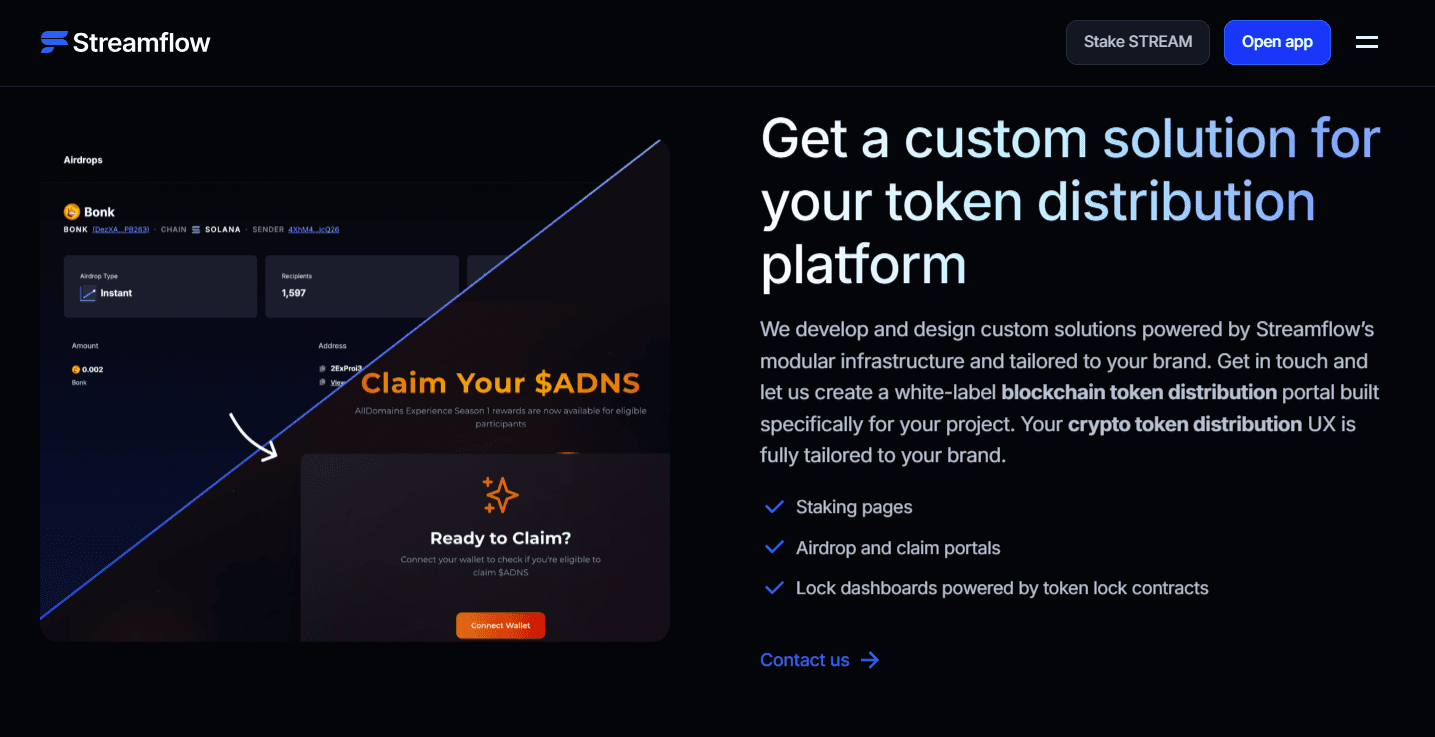
Founders can flip this checklist into a launch standard. Open the Streamflow app to set up locks and vesting from a no-code interface; locking tokens takes about 37 seconds. Clearing all nine red flags before launch costs far less than rebuilding trust after failing one.
What Healthy Token Distribution Looks Like
Bonk shows the pattern at meme coin speed. The project airdropped 55% of supply to early Solana users, then put 20% of total supply on a 3-year linear vesting schedule for 22 early contributors through Streamflow; the Bonk vesting case study details how that structure gave the community trust and transparency from day one.
Heavenland went further. The Solana metaverse project placed 97% of its $HTO supply on Streamflow with 5-year linear vesting and cliffs on every allocation, a structure designed to allow initial liquidity without excessive inflation. As the Heavenland case study shows, the result was a more engaged and dedicated player community.
Both projects treated distribution as a trust signal, not paperwork. That is the standard every token you buy should meet.
Conclusion
With crypto scam losses estimated at $17 billion in 2025 per Chainalysis, checking token distribution red flags before buying is the cheapest risk management available.
Every one of the nine warning signs above is detectable on-chain in minutes, and every one is preventable with the right infrastructure.
Streamflow makes healthy distribution the default, with audited, immutable contracts securing $268M+ in value across 40,000+ projects.
Book a demo to see how Streamflow handles transparent, fully on-chain token distribution that clears every red flag on this list.
Read Next:
Token Locks Explained: What They Are, How They Work, and Why Every Crypto Project Needs One in 2026
How to Build a Complete Token Vesting Strategy for Your Solana Token Launch
FAQs:
1. What are the most important token distribution red flags to check before buying a crypto token?
The most important token distribution red flags to check are missing team vesting, off-chain-only vesting promises, concentrated supply, unlocked liquidity, and admin-controlled contracts. Each one is verifiable on-chain in minutes using Solscan, Solana Explorer, or RugCheck. If a project fails even one of these checks, treat it as unproven.
2. How can I verify a token's vesting schedule on-chain?
You can verify a token's vesting schedule on-chain by looking up the vesting contract address on Solscan or Solana Explorer. Streamflow vesting contracts include shareable proof links and explorer verification, so anyone can confirm the schedule, cliff dates, and release progress. A schedule that only exists in documentation is not verifiable.
3. What is the difference between a token lock and a liquidity lock?
The difference between a token lock and a liquidity lock is what gets restricted: a token lock restricts native project tokens such as team or treasury allocations, while a liquidity lock restricts LP tokens to prevent rug pulls on DEX liquidity. A trustworthy project uses both. Streamflow supports SPL token locks and LP token locks with public proof links.
4. How does Streamflow help projects avoid token distribution red flags?
Streamflow helps projects avoid token distribution red flags by enforcing vesting, locks, and airdrops through audited, immutable smart contracts on Solana. Schedules execute automatically, distribution data is visible in real time, and there is no admin override. Over 40,000 projects use Streamflow to manage more than $268M in total value locked.
5. Are Streamflow's smart contracts audited?
Yes, Streamflow's smart contracts are audited by FYEO and OPCODES. Once deployed, contracts are immutable and cannot be unilaterally altered, and every distribution is verifiable on Solscan or Solana Explorer. This removes the admin-key risk that undermines many token launches.