General
Streamflow vs Smithii in 2026: Why Streamflow Is the Better Token Platform to Launch With
Only 4.55% of the 18.67 million tokens launched on Pump.fun between January 2024 and June 2026 were still trading there after 90 days, according to CoinGecko research published in June 2026.
Creating a token has never been easier, and keeping one alive has never been harder.
Streamflow, the Solana-native token operations platform with $800M+ in total value locked across 40,000+ projects, is built for what happens after the mint.
Smithii and Streamflow both offer no-code tools on Solana, but they solve different problems. Smithii is a broad toolkit for getting a token created, pooled, and visible. Streamflow is the infrastructure that proves commitment and executes tokenomics on-chain once the token exists.
This is a complete Streamflow vs Smithii comparison: ten categories head to head, a full feature table, pricing, use case fit, and the seven reasons Streamflow is the stronger platform to launch with.
Key Takeaways
Streamflow vs Smithii comes down to long-term token operations versus launch-day tooling.
Smithii offers a broad no-code toolkit across Solana, Sui, and many EVM networks.
Streamflow supports price-based locks, seven vesting models, and airdrops to one million recipients.
Over 40,000 projects and 1.3 million users rely on Streamflow's audited Solana contracts.
Bonk vested 20% of supply for 22 contributors over three years with Streamflow.

Quick Verdict: Streamflow vs Smithii
Smithii is a strong pick for creators who want a wide menu of launch-day tools across many chains. Streamflow is the better token platform to launch with when the goal is a token holders can trust and a distribution plan that runs itself.
Category | Better fit |
|---|---|
Multi-chain token creation | Smithii |
Launchpad bundlers and pool creation | Smithii |
Token locks | Streamflow |
Token vesting | Streamflow |
Large-scale airdrops | Streamflow |
Staking | Streamflow |
Public tokenomics transparency | Streamflow |
SDK and white-label | Streamflow |
Payments and treasury | Streamflow |
Track record at scale | Streamflow |
Smithii wins the first hour of a launch on chains Streamflow does not serve. Streamflow wins everything that determines whether the token still matters in month three.
What Smithii Does Well
Smithii earns its reputation on breadth. It is a no-code platform for creating and managing tokens, NFTs, and DeFi projects on Solana, Ethereum, BNB Chain, Base, Polygon, Arbitrum, Avalanche, Sui, and more. On Solana alone, the platform lists 64 tools.
The toolkit follows the order most creators work in:
Token creation: a no-code SPL creator priced at 0.5 SOL, with optional authority revokes.
Launch tooling: bundlers and volume bots for Pump.fun, Bonk, LaunchLab, Moonit, Bags, Jupiter Studio, and Printr.
Liquidity: Raydium pool creation across Standard AMM, CPMM, and CLMM pool types.
Distribution: a multisender, claim sites, and holder snapshots exported as CSV.
Lockups and staking: date-based locks with a public certificate, plus a no-code staking site builder.
Trust basics are covered too. Smithii states that its contracts are audited by Halborn and CoinFabrik, that users sign from their own wallets, and that all prices are shown before a transaction is confirmed. The company reports 12,000+ tokens launched and 9,000+ users served across chains.
For a creator who needs to go from idea to tradable token in an afternoon, on almost any network, that is a real strength. The comparison gets sharper once the token is live.
Streamflow vs Smithii: Head-to-Head by Category
Token Creation
Smithii's creator deploys a Solana token for 0.5 SOL and includes a Token-2022 tax token option, and the same form covers multiple networks. Streamflow's token mint handles token creation, metadata configuration, supply definition, and permissions on Solana.
Verdict: Smithii for multi-chain and tax tokens. On a standard SPL launch, both get the job done.
Token Locks
Smithii locks SPL tokens until a single unlock date or across multiple dated cliff releases, and a lock cannot be undone. Streamflow supports fixed-date and price-based unlock conditions, SPL and LP tokens, quick locks, and public proof links.
Verdict: Streamflow, because price-based conditions and LP token support cover more real launch scenarios.
Token Vesting
Smithii's vesting uses single unlocks or cliff releases, and recipients claim manually through a generated claim page. Streamflow supports linear, cliff, cliff plus linear, graded, milestone-based, price-based, and custom-interval token vesting schedules, with bulk CSV creation and auto transfers.
Verdict: Streamflow, by a wide margin for anything beyond a simple team lock.
Airdrops and Distribution
Smithii's multisender sends a token to 5,000 wallets in batched transactions, and its claim site lets holders claim an airdrop themselves. Streamflow supports up to 1M recipients per airdrop, 100K recipients per CSV, instant, vested, and price-based formats, and recovery of unclaimed tokens.
Verdict: Streamflow for campaigns at scale or with vesting. Smithii works for direct sends to a small holder list.
Staking
Smithii's Staking Builder creates a hosted staking site at a custom URL, with a staking token, a reward pool, and a minimum stake amount. Streamflow offers no-code pools for any SPL token with configurable APY, lock periods, reward top-ups, and four pool types: Fund Once, Continuous Funding, Governance Staking, and Custom.
Verdict: Streamflow, for deeper reward logic, governance staking, and a public SDK.
Transparency and Dashboards
Smithii generates a public certificate page for each lock. Streamflow's tokenomics dashboard shows vesting contracts, token locks, and staking pools together in real time, including cliff dates and unlock events.
Verdict: Streamflow, because holders see the whole token economy, not one contract at a time.
Developer Tools and White-Label
Smithii is built around its no-code web interface, and its staking sites can be branded with a custom logo and colors. Streamflow offers a public SDK and API, plus white-label claim, staking, and lock portals with bespoke onboarding from the Streamflow team.
Verdict: Streamflow, for teams that want token logic inside their own product.
Payments and Treasury
Smithii's listed Solana toolset centers on launch, liquidity, and distribution. Streamflow adds programmable payments, recurring payout contracts for payroll-style transfers, and treasury management through USD+.
Verdict: Streamflow, since contributor payouts and treasury are part of the same system.
Chain Coverage and Launch Trading Tools
Smithii supports 15 networks, including Ethereum, Base, BNB Chain, TRON, Sui, and NEAR, and offers bundlers and volume bots. Streamflow is Solana-native and focuses on token operations rather than launch-day trading tools.
Verdict: Smithii. Teams launching outside Solana, or needing a launchpad bundler, should use it.
Security and Track Record
Both platforms use audited contracts: Halborn and CoinFabrik for Smithii, FYEO and OPCODES for Streamflow. Streamflow's contracts are immutable once deployed and are listed in the official Solana Docs under token vesting.
Verdict: Even on audits. Streamflow leads on proven scale, with $800M+ in TVL and 1.3M+ users.
Across ten categories, Smithii takes the launch-day and multi-chain rows, and Streamflow takes the rows that govern the token's next several years.

Side-by-Side Feature Comparison
Feature | Streamflow | Smithii |
|---|---|---|
Token creation | No-code token mint on Solana | No-code creator, 0.5 SOL |
Token vesting | Linear, cliff, graded, milestone, price-based | Single unlock or cliff releases |
Vesting delivery | Claim or auto transfers | Manual claim page |
Token locks | Date-based and price-based | Date-based, non-cancelable |
LP token locks | Supported | Not stated on lock page |
Airdrops | Up to 1M recipients | Multisender and claim sites |
Vested airdrops | Supported, plus price-based | Not stated on tool pages |
Staking | Four pool types, any SPL token | Hosted staking site builder |
Tokenomics dashboard | Real-time, public dashboard | Certificate page per lock |
SDK | Public SDK and API | No-code interface focus |
White-label | Branded claim, staking, lock portals | Branded staking sites, claim pages |
Payments and payouts | Recurring payout contracts | Not in listed Solana toolset |
Launch trading tools | Outside core product scope | Bundlers, volume bots, pool creator |
Chain support | Solana-native | 15 networks |
Pricing model | Contract creation plus network fees | Flat per-tool fees in SOL |
Security audits | FYEO, OPCODES | Halborn, CoinFabrik |
Reported scale | $800M+ TVL, 1.3M+ users, 40K+ projects | 12,000+ tokens, 9,000+ users |
Case studies | Three published, including Bonk | Usage stats published |
The table makes the pattern clear. The next section explains why that pattern matters for a launch.
Why Streamflow Is the Better Token Platform to Launch With
A launch is not the moment a token is minted. It is the first 90 days in which holders decide whether the team is serious. Streamflow is built for that window, and for every stage after it.
1. It Turns Launch Promises Into On-Chain Proof
Communities no longer accept "team tokens are locked" as a sentence in a thread. Streamflow token locks take 37 seconds to create and produce a public proof link the moment they are live.
Locked tokens cannot be transferred, traded, or accessed before unlock
Anyone can verify the lock on Solscan, Solana Explorer, or RugCheck
Lock conditions are enforced by immutable smart contracts, not promises
A Pump.fun creator can launch, lock the team allocation, and post the proof link before the first holders finish asking. That is the standard user flow: launch token, lock tokens, use Streamflow.
2. It Covers the Entire Token Lifecycle in One System
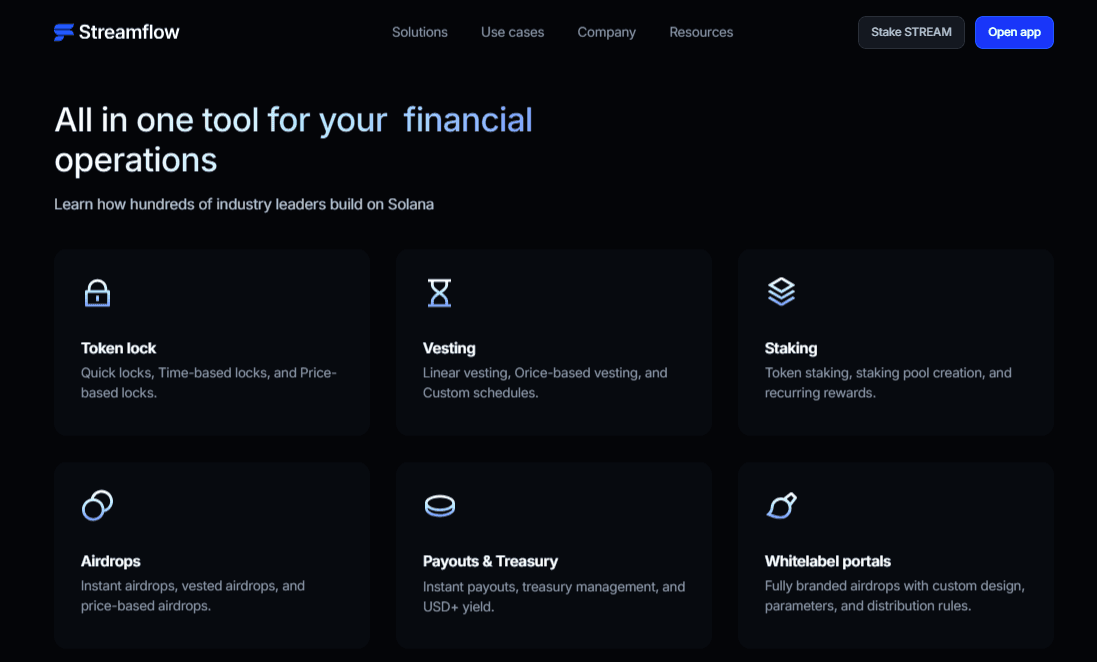
Most launches stitch together a creator, a locker, a multisender, and a staking site. Streamflow replaces fragmented tools with one platform that manages the full lifecycle, from creation to distribution to ongoing incentives.
Token mint for creation and supply definition
Locks and vesting for team, investor, and treasury allocations
Airdrops for community distribution
Staking for holder incentives
Payouts for contributors
One system means one dashboard, one set of audited contracts, and one place for holders to check. Unlike single-purpose tools, Streamflow provides a complete token lifecycle solution.
3. Its Release Logic Goes Beyond Dates
Date-based unlocks are the baseline. Streamflow adds conditions that tie token releases to performance, which changes what a lock or vesting contract communicates.
Price-based locks that open only at a defined price level
Price-based and milestone-based token vesting
Price-based airdrops that adjust to market conditions
Graded schedules and custom intervals for complex allocations
A team that locks its allocation until the token reaches a set price is making a different statement than a team with a calendar date. The incentive is visible on-chain, and holders can read it.
4. It Scales From One Lock to a Million Recipients
Tools that work for 500 wallets often break at 50,000. Streamflow token airdrops are designed for that jump from day one.
Up to 1M recipients in a single airdrop
100K recipients per CSV import
Standard plans up to 30,000 recipients, with enterprise for larger campaigns
Real-time claim tracking and return of unclaimed tokens
The same project that locked tokens in 37 seconds at launch can run a vested airdrop to its entire community a year later. It never has to migrate platforms as it grows.
5. It Removes Manual Work After Launch
Manual claims, spreadsheet tracking, and one-off transfers are where token operations fail. Streamflow automates execution so tokenomics run exactly as designed.
Auto transfers deliver vested tokens without recipient action
Staking rewards are distributed automatically
Recurring payout contracts keep running without redeploying
Bulk creation handles many recipients in one upload
A founder who sets up vesting for a 12-month cliff should not have to think about it again in month thirteen. With Streamflow, the contract does the work and the dashboard shows the result.
6. It Is Proven at Infrastructure Scale
Trust in a token platform comes from what has already run on it. Streamflow's numbers reflect infrastructure, not an experiment.
$800M+ in total value locked
1.3M+ users and 40,000+ projects
Smart contracts audited by FYEO and OPCODES
Listed in official Solana Docs under token vesting
Backed by Jump Crypto, Solana Ventures, and John Lilic
When a holder sees a Streamflow proof link, they are looking at the same contracts used by tens of thousands of other projects. That familiarity is itself a trust signal.
7. It Grows With the Project Into a Real Company
Launch tooling stops being useful once the token is live. Streamflow keeps going, from the tokenomics dashboard to white-label portals and the SDK.
For teams building long-term value, Streamflow Business adds a full financial layer:
Treasury management through USD+
On-chain cap tables and ownership issuance
Tokenized SAFE agreements
Structured payouts for teams and contributors
The projects that last combine speed with structure. Open the Streamflow app to see how the first lock, the first vesting contract, and the first airdrop live in one interface.
Pricing and Cost Considerations
Smithii publishes flat fees per tool, which makes one-off actions easy to budget. Its listed prices include 0.5 SOL for the token creator, 0.3 SOL for the bundler, 0.001 SOL per wallet for the multisender, and 0.1 SOL for the liquidity pool creator. Locking tokens costs 0.3 SOL.
Streamflow's cost model is smart contract creation fees plus Solana transaction fees, which stay near zero. Current numbers are published in the Streamflow fees documentation.
The sticker price is rarely the real cost. Three variables matter more:
Recipient count: per-wallet fees scale linearly, so 100,000 wallets at 0.001 SOL is 100 SOL.
Tool sprawl: separate fees for each launch step add up across a full lifecycle.
Operations time: manual claims and tracking cost hours at every unlock.
A team with one allocation to lock will find both platforms affordable. A team managing many stakeholders and a large airdrop should model the full lifecycle, where automated execution on Streamflow lowers operational overhead.
Use Case Fit
When Smithii Is the Better Choice
Smithii fits best when the priority is getting live quickly across more than one network.
The token launches on an EVM chain, Sui, TRON, or NEAR
The launch needs a launchpad bundler or Raydium pool creation
The project wants a presale page with its own caps
The task is a one-off utility, such as a snapshot or tax token
Streamflow is Solana-native, so teams deploying elsewhere need a different tool. That constraint is worth stating plainly.
When Streamflow Is the Better Choice
Streamflow fits best when the token has stakeholders who need proof, not promises.
Team and investor allocations need linear, graded, milestone, or price-based release
The airdrop runs to tens of thousands of recipients or more
Holders should verify everything through public dashboards and proof links
The roadmap includes staking, payouts, or branded portals
The project is building a company with treasury and ownership needs
The two platforms are not mutually exclusive. Streamflow is permissionless and works with any SPL token, so a token created elsewhere can be locked, vested, and distributed on Streamflow the same day.
Case Study: How Bonk and Heavenland Used Streamflow
Bonk is a Solana meme coin that allocated 55% of its supply to airdrops for early Solana users. The remaining supply was reserved for early contributors and operating expenses, which raised the obvious community question: when can insiders sell?
Bonk answered it on-chain. The team used Streamflow for core team vesting, placing 20% of total supply for 22 early contributors on a 3-year linear vesting schedule. The outcome was trust and transparency, as documented in the Bonk case study.
Heavenland, a metaverse on Solana, went further with its $HTO token. It placed 97% of token supply on 5-year linear vesting with cliffs on every allocation, a structure designed to allow initial liquidity without excessive inflation. The Heavenland case study reports a more engaged and dedicated player community as the result.
A memecoin and a metaverse project had different tokenomics and the same need: commitments that anyone could verify. Both used Streamflow to make that verifiable from launch.

Conclusion
With fewer than 5% of Pump.fun tokens still trading after 90 days, creating a token is no longer the hard part.
Smithii gets a token created and visible quickly across many chains, while Streamflow gives it locks, vesting, airdrops, staking, and payouts that holders can verify on-chain, at a scale of 40,000+ projects.
For teams launching on Solana with long-term intent, Streamflow is the better token platform to launch with.
Book a demo to see how Streamflow handles locks, vesting, and distribution for your token launch.
Read Next:
Best Crypto Staking Platforms in 2026: APY, Fees, and Lockups Compared
Token Staking Report 2026: Average APY, Staked Supply, and Real Yields Across 20 Blockchains
FAQs:
1. What is the difference between Streamflow and Smithii?
The difference between Streamflow and Smithii is focus. Smithii is a multi-chain, no-code toolkit for creating and launching tokens, while Streamflow is Solana-native token operations infrastructure for locks, vesting, airdrops, staking, and payments. Streamflow manages the token lifecycle after creation, with $800M+ in TVL and 1.3M+ users.
2. Why is Streamflow the better token platform to launch with?
Streamflow is the better token platform to launch with because it turns launch commitments into on-chain proof. Teams can lock tokens in 37 seconds, share public proof links, and add vesting, airdrops, and staking in the same system. That covers the full lifecycle instead of only launch day.
3. Is Streamflow or Smithii better for token locks and vesting on Solana?
Streamflow is better for token locks and vesting on Solana when allocations need more than a date. It supports price-based locks, LP token locks, seven vesting models, bulk CSV creation, and auto transfers. Smithii offers date-based locks and cliff releases, which suit simpler setups.
4. Can Streamflow and Smithii be used together?
Yes, Streamflow and Smithii can be used together. Streamflow is permissionless and works with any SPL token, so a token created with another tool can be locked, vested, and distributed on Streamflow. Many teams separate launch tooling from long-term token operations this way.
5. How much does Streamflow cost compared to Smithii?
Streamflow costs smart contract creation fees plus Solana's near-zero transaction fees, while Smithii charges flat per-tool fees in SOL. Smithii's flat fees are easy to budget for single actions. Teams with many recipients or stakeholders should compare total lifecycle cost, including operations time.
