General
How to Create Investor Token Vesting Schedules on Solana: Complete Guide
The crypto market released $97.43 billion in scheduled token unlocks during 2025, one of the largest emission years on record, according to Tokenomist's 2025 Token Unlocks Review.
A meaningful share of that flow traced back to investor and team allocations on multi-year vesting schedules, which means the way a project structures those schedules now directly shapes its price stability later.
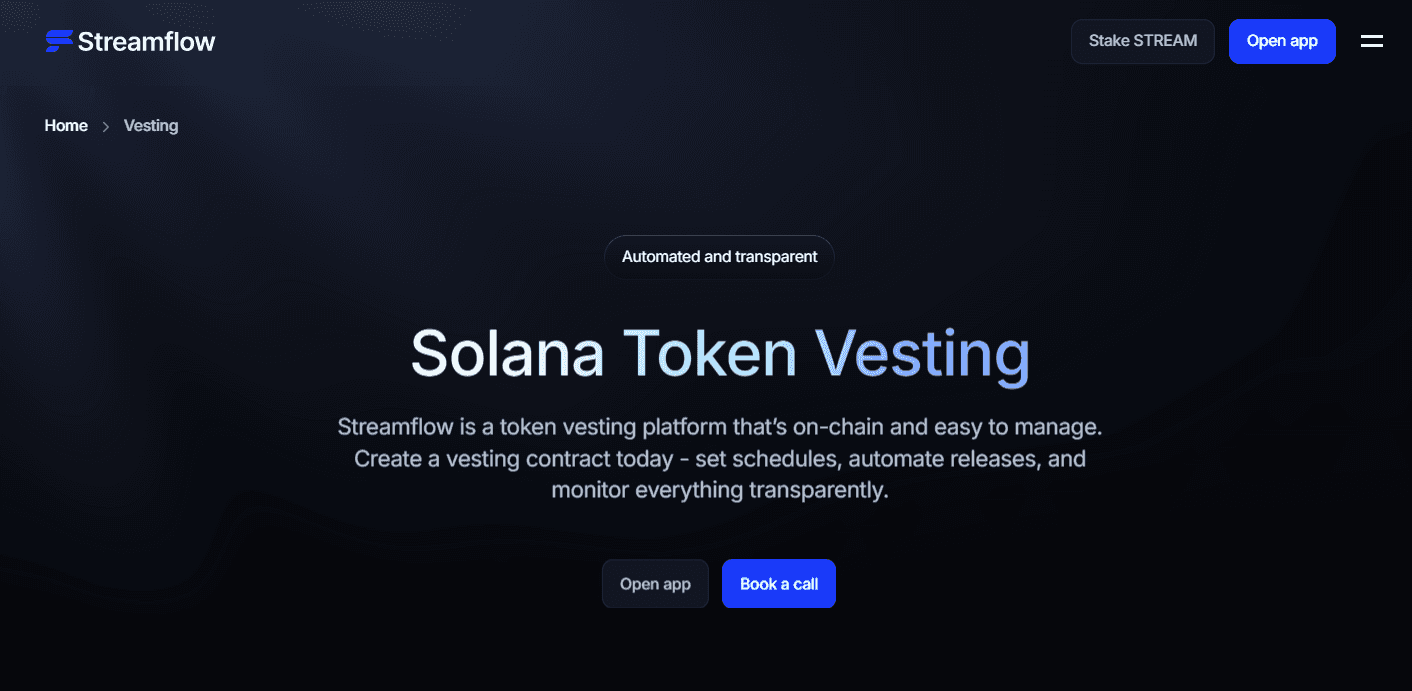
Streamflow sits at the center of this problem on Solana, where over 40,000 projects use its on-chain smart contracts to enforce vesting that cannot be altered after deployment.
Investor vesting is where most tokenomics plans quietly succeed or fail. A schedule that releases too fast signals weak conviction and invites sell pressure, while a schedule that is opaque or manually managed erodes the trust it was meant to build.
Investor vesting on Solana solves both by making the release rules public, automated, and verifiable from the moment the contract goes live.
This guide walks through how to design and deploy investor vesting schedules that protect your cap table, satisfy your backers, and hold up under market scrutiny.
Key Takeaways
Investor token vesting on Solana works best with a cliff plus multi-year linear release.
Streamflow enforces vesting through immutable, audited smart contracts with public on-chain proof.
Over 40,000 projects use Streamflow for token vesting, locks, and distribution.
Investor schedules differ structurally from team vesting and need deliberate per-group design.
On-chain verification via Solscan removes the trust gap manual vesting always leaves open.
Why Investor Vesting Is Not the Same as Team Vesting
Most teams treat vesting as a single setting applied uniformly across the cap table. That is the first mistake. Investor allocations carry different expectations, different lockup norms, and different downstream supply effects than founder or contributor allocations.
Investors negotiated their terms during a fundraising round, so their schedule is part of a deal, not an internal policy. A seed investor who accepted a discount expects a defined cliff and a predictable linear unlock, and any deviation reads as a red flag. Treating their tokens the same as an ecosystem incentive pool ignores the contractual weight behind the allocation.
The supply impact is also concentrated. Investor unlocks tend to hit the market faster than team or treasury tokens, because funds have mandates and liquidity needs. Designing the investor schedule deliberately, with the right cliff and release curve, is what separates a smooth unlock from a structural sell-off.
What Investor Vesting Actually Does
A well-built investor vesting schedule does three jobs at once, and a weak one does none of them.
It manages circulating supply by metering tokens into the market gradually.
It signals long-term alignment to the broader community and future investors.
It enforces the terms agreed during the round without relying on anyone's good faith.
The third job is the one manual processes cannot do. A spreadsheet and a multisig require humans to execute transfers on schedule, which introduces error, delay, and the theoretical ability to change the rules midstream. On-chain token vesting removes that discretion entirely.
This is why on-chain vesting has become the default expectation for credible raises on Solana.
When the schedule lives in an immutable smart contract, investors and community members can both verify it independently. The schedule stops being a promise and becomes an enforceable system.
The Framework for Designing Investor Vesting Schedules
Strong investor vesting comes down to five deliberate decisions. Work through each one before deploying anything.
Match Schedule Length to the Round
The duration of an investor schedule should reflect how early and how cheap the capital was. Earlier rounds at lower valuations typically carry longer schedules, because the upside justifies the lockup.
Seed and strategic rounds: commonly 3 to 4 years of total vesting.
Later or public rounds: shorter schedules, often 12 to 24 months.
Always confirm the agreed terms from the round documents before building.
For example, a strategic investor who entered at a steep discount on a $5M raise should expect a multi-year schedule, not a one-year unlock. Matching length to round type keeps the cap table coherent and defensible.
Use the Cliff as a Conviction Signal
A cliff is a period during which no tokens release at all, after which the first tranche unlocks in a single event. A 12-month cliff is the standard floor for core stakeholders, and it works equally well as an investor signal.
The cliff prevents day-one liquidity and demonstrates that backers are committed through at least the first year. After the cliff, linear release smooths the rest of the schedule.
Choose the Right Release Model
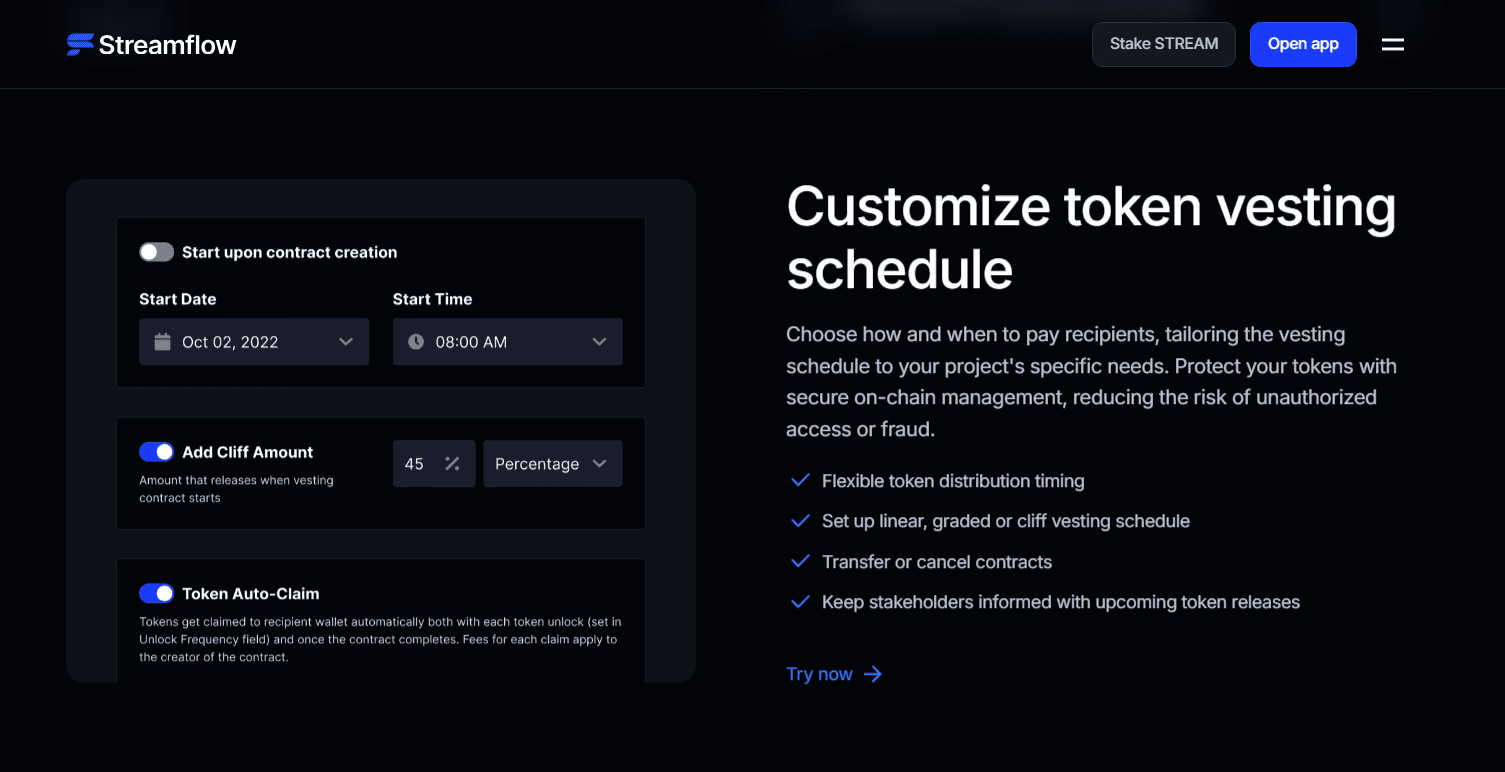
Streamflow supports every major release model, so the choice should be driven by strategy rather than tooling limits. The options are linear, cliff, cliff plus linear, graded, milestone-based, price-based, and custom intervals.
Cliff plus linear: the most common investor structure, a lockup followed by smooth release.
Milestone-based: ties unlocks to delivery, useful for strategic partners.
Price-based: releases tokens only when price thresholds are met, protecting against unlocks into weakness.
For example, a project worried about unlocking into a down market can use price-based vesting to gate investor releases behind sustained price levels. That single design choice can prevent the slow bleed that scheduled unlocks often cause.
Make It Immutable and Verifiable
A vesting schedule only builds trust if no one can quietly change it. Streamflow contracts are immutable once deployed, with no unilateral changes and no admin override over the release logic.
Every contract generates a shareable proof link.
Allocations are verifiable on Solscan and Solana Explorer.
Investors can confirm their own terms without contacting the team.
This verifiability is the entire point. Streamflow is listed in the official Solana Docs as a token vesting reference, which reflects its position as trusted core infrastructure in the ecosystem.
Map Every Investor Group Before Deploying
Investors are not a monolith. Seed, strategic, private, and public sale participants often have distinct terms, and bundling them into one schedule destroys that nuance.
Build separate schedules per investor group with their agreed terms.
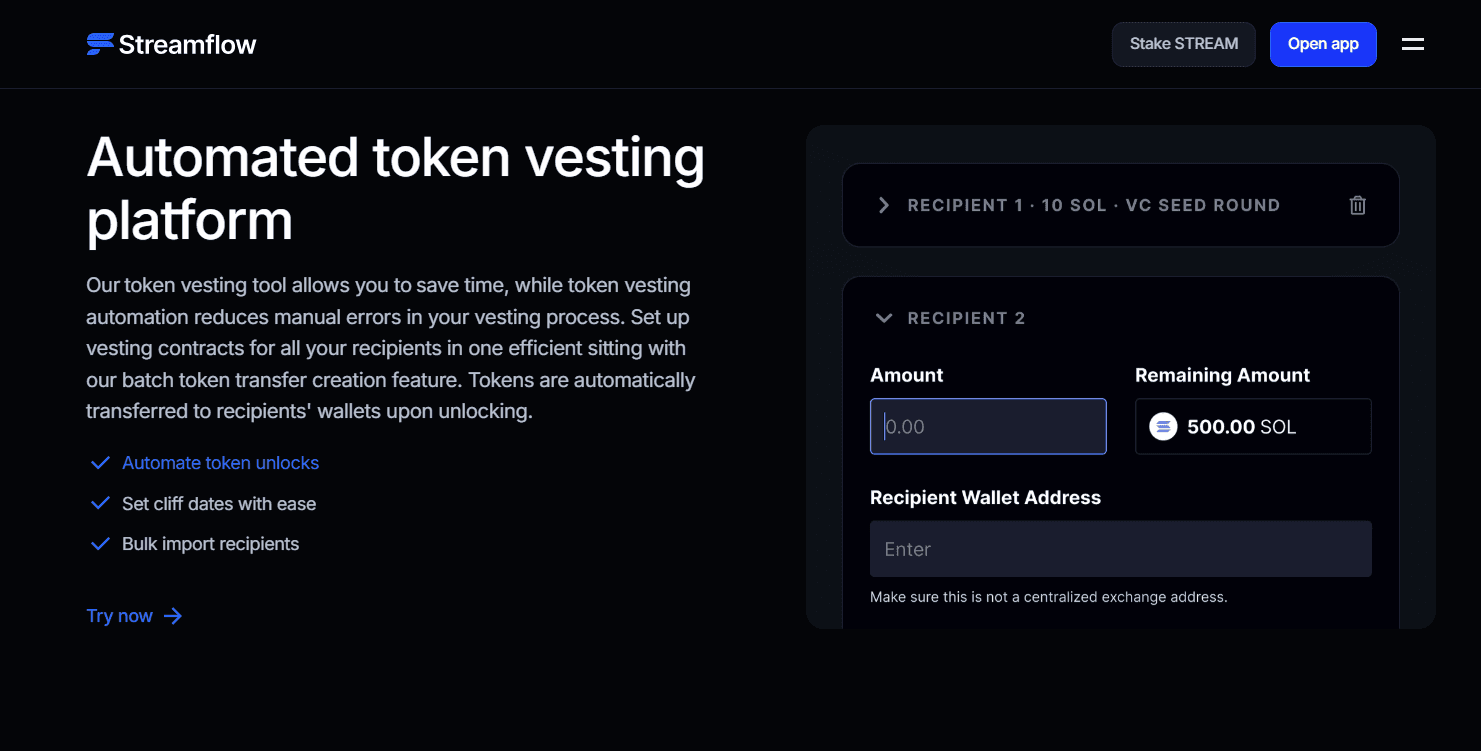
Use bulk import or CSV creation to deploy many recipients at once.
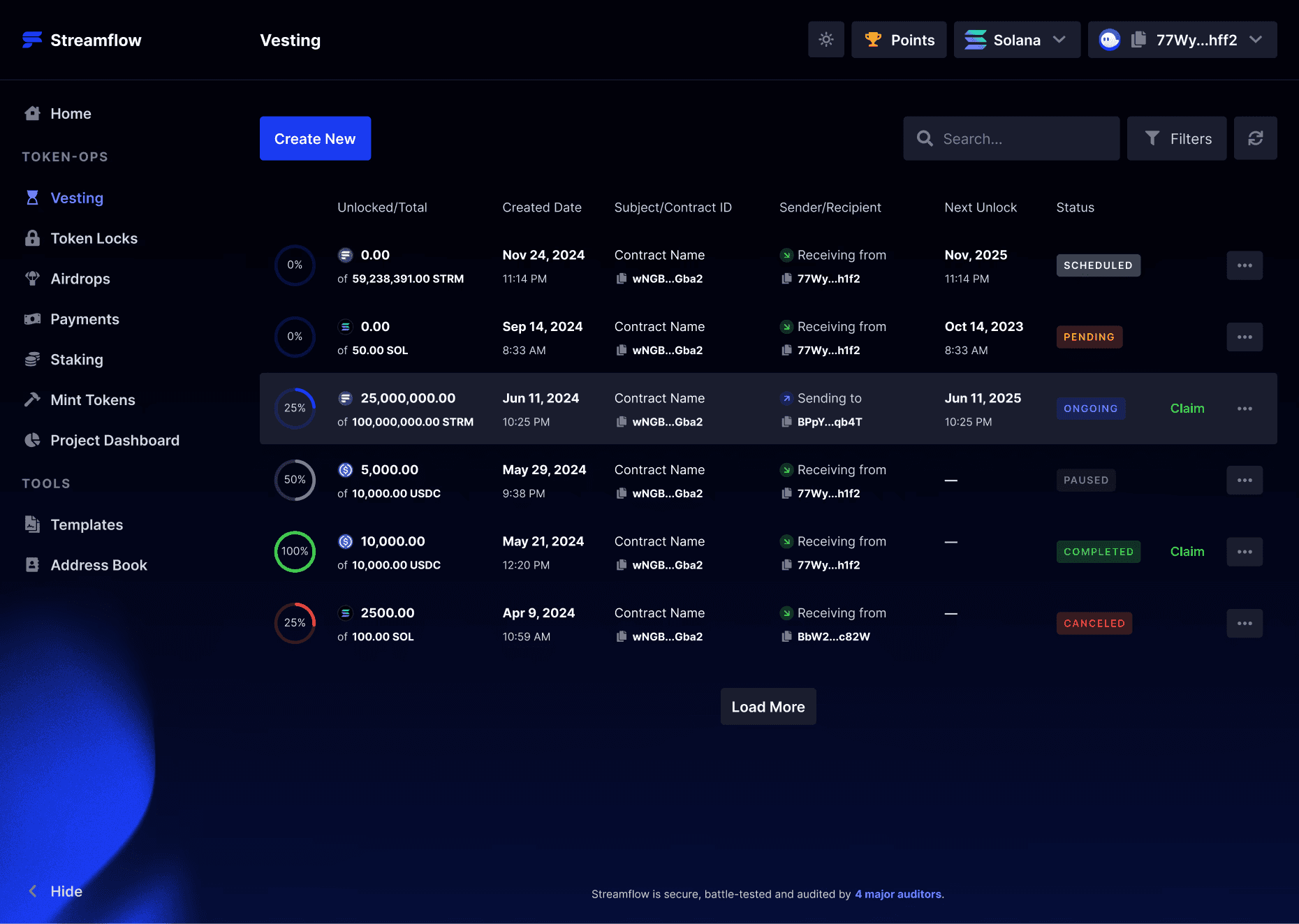
Track all of them from a single dashboard after launch.
Mapping each group cleanly up front prevents the reconciliation headaches that surface at the first unlock event.
How Streamflow Executes Investor Vesting
Streamflow turns the framework above into deployed contracts without requiring any smart contract development. Teams create vesting schedules through the interface, upload recipients, define the schedule, fund the contract, and tokens then release automatically on the agreed terms.
The configuration covers everything an investor schedule needs. You can set the cliff, the linear curve, the release model, and per-recipient amounts, then verify the result on-chain before sharing proof links with backers.
The tokenomics dashboard gives every stakeholder a real-time view of allocations, cliff dates, and unlock progress in one place.
For projects that also want to lock team or treasury tokens alongside investor schedules, transparent token locks on Solana provide the same verifiable proof of commitment.
You can create a vesting schedule on Streamflow directly and have an investor contract live in minutes.
For founders building toward full financial operations, Streamflow Business extends this into cap tables, tokenized SAFEs, and ownership issuance.
Case Study: How UXD Protocol Structured Investor Vesting
UXD Protocol, a decentralized stablecoin provider on Solana, needed investor vesting and governance in a single interface for its $UXP governance token. The team integrated the Streamflow SDK directly into Realms and ran a claim portal for stakeholders.
The numbers show how a serious investor schedule looks in practice. Roughly 46% of $UXP supply moved onto a 4-year linear vesting schedule with a 12-month cliff, with token claiming and governance participation handled in the same interface.
The result was a structure that aligned long-term holders while keeping the entire process transparent and on-chain.
For a different shape of the same discipline, how Bonk used Streamflow put 20% of total supply across 22 core contributors on a 3-year linear schedule. Both projects show that credible vesting is a design decision backed by enforceable contracts.
What This Means for Web3 Founders
For a founder running a raise, investor vesting is one of the few tokenomics decisions that is effectively permanent once tokens go live. Getting the cliff, the duration, and the release model right protects both your price and your relationship with backers.
The practical path is straightforward: Confirm the terms from each round, design per-group schedules, deploy them as immutable on-chain contracts, and share the proof links.
Doing this on infrastructure used by more than 40,000 projects means the execution layer is already solved, leaving you to focus on the strategy.
Conclusion
Investor token vesting on Solana is where tokenomics plans become enforceable reality, and 2025's $97.43 billion in unlocks proved how much schedule design matters to price stability.
Streamflow turns investor schedules into immutable, audited, on-chain contracts that backers and communities can verify independently, the same infrastructure UXD Protocol used to vest 46% of $UXP across four years.
Book a demo to see how Streamflow handles investor vesting schedules with cliffs, linear release, and on-chain proof.
Read Next:
FAQs:
1. How do you create an investor token vesting schedule on Solana?
You create an investor token vesting schedule on Solana by defining the cliff, duration, and release model, then deploying it as an on-chain smart contract. With Streamflow, you configure the schedule through the interface, upload recipients via CSV, fund the contract, and tokens release automatically on the agreed terms. The contract is immutable once deployed and verifiable on Solscan.
2. What is the standard cliff for investor vesting?
The standard cliff for investor and core stakeholder vesting is 12 months, meaning no tokens release during the first year. After the cliff, the first tranche unlocks and the remainder typically follows a multi-year linear schedule. This structure prevents day-one liquidity and signals long-term alignment to the community.
3. How is investor vesting different from team vesting?
Investor vesting is different from team vesting because investor terms are negotiated during a fundraising round and carry contractual weight rather than internal policy. Investor unlocks also tend to reach the market faster, so the schedule needs deliberate per-group design. Streamflow lets you build separate schedules for seed, strategic, private, and public sale participants.
4. Can investors verify their vesting schedule on Streamflow?
Yes, investors can verify their vesting schedule on Streamflow independently. Every contract generates a shareable proof link, and allocations are verifiable on Solscan and Solana Explorer without contacting the team. Because the contracts are immutable, the verified terms cannot be changed after deployment.
5. Is Streamflow's vesting smart contract code audited?
Yes, Streamflow's smart contracts are audited by FYEO and OPCODES, and the vesting contracts execute on-chain with no admin override over the release logic. Streamflow is also listed in the official Solana Docs as a token vesting reference. Over 40,000 projects rely on this infrastructure for vesting, locks, and distribution.