General
Token Vesting Explained: How Vesting Schedules Work in Crypto (2026 Guide)
Token vesting is the controlled release of tokens over time, used to prevent immediate selling and align long-term incentives between a project and its stakeholders.
Streamflow is the Solana-native token operations platform that turns vesting schedules into enforceable on-chain contracts, trusted by 40,000+ projects with over $1.4B in total value locked.
Vesting is no longer optional in 2026; investors, communities, and exchanges expect verifiable proof that team and investor tokens cannot hit the market early.
This guide explains what token vesting actually means, the schedule types used in crypto, how cliffs work, and how to set up automated on-chain vesting without writing code.
Key Takeaways
Token vesting releases tokens gradually to prevent dumps and align incentives.
On-chain vesting is enforced by immutable smart contracts, not promises.
Streamflow automates vesting for 40K+ projects with $1.4B+ TVL.
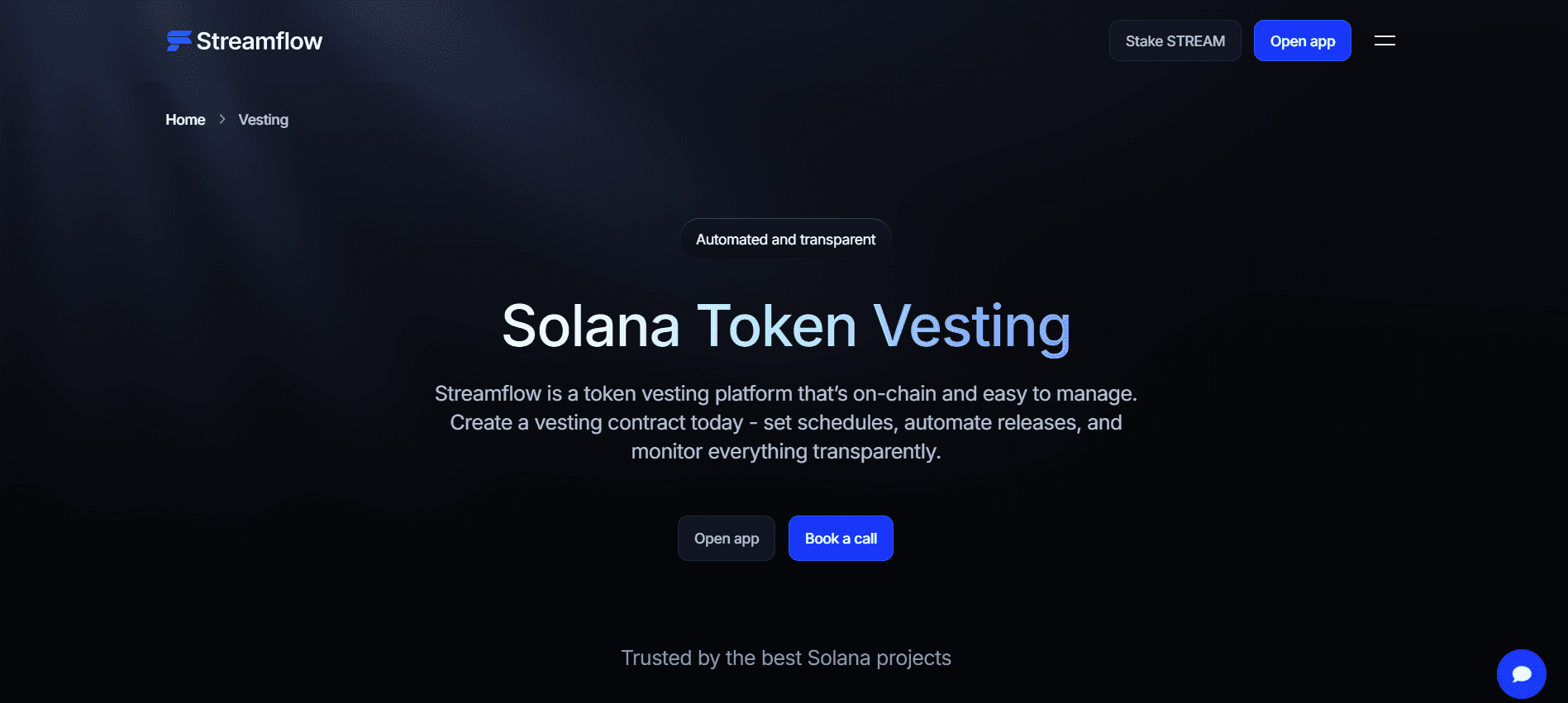
What Token Vesting Actually Means (and What It Doesn't)
Token vesting is the gradual, rule-based release of tokens to a recipient over a defined period. Until tokens vest, the recipient cannot sell, transfer, or otherwise access them.
What vesting is not:
It is not a token lock: A lock restricts an entire allocation until a condition is met; vesting releases tokens progressively over time.
It is not staking: Stablecoin staking is voluntary locking in exchange for rewards; vesting is a distribution rule attached to an allocation.
It is not a promise: A vesting schedule written in a whitepaper or spreadsheet is a plan. Only on-chain vesting makes it enforceable.
That last distinction is the one most teams get wrong. Streamflow's position is that vesting is not just planned, it is automatically executed, with every release verifiable on Solscan or Solana Explorer.
Why Token Vesting Matters in Crypto
Vesting exists to solve one structural problem: misaligned time horizons. Founders, investors, and contributors receive large allocations at launch, but the project needs years to deliver value.
Without vesting, projects face predictable risks:
Early recipients selling tokens too early (paper hands) and crashing the price
Loss of investor and community trust
Incorrect or manual distributions that create disputes
Supply shocks that make the token economy impossible to model
Vesting controls circulating supply, signals long-term commitment, and gives holders confidence to participate.
It is the difference between tokenomics as a slide and tokenomics as an enforceable system.
How Vesting Schedules Work: The Core Mechanics
A token vesting schedule defines three things: how much, to whom, and on what timeline. Once deployed on-chain, a smart contract executes those rules automatically.
1. The Cliff
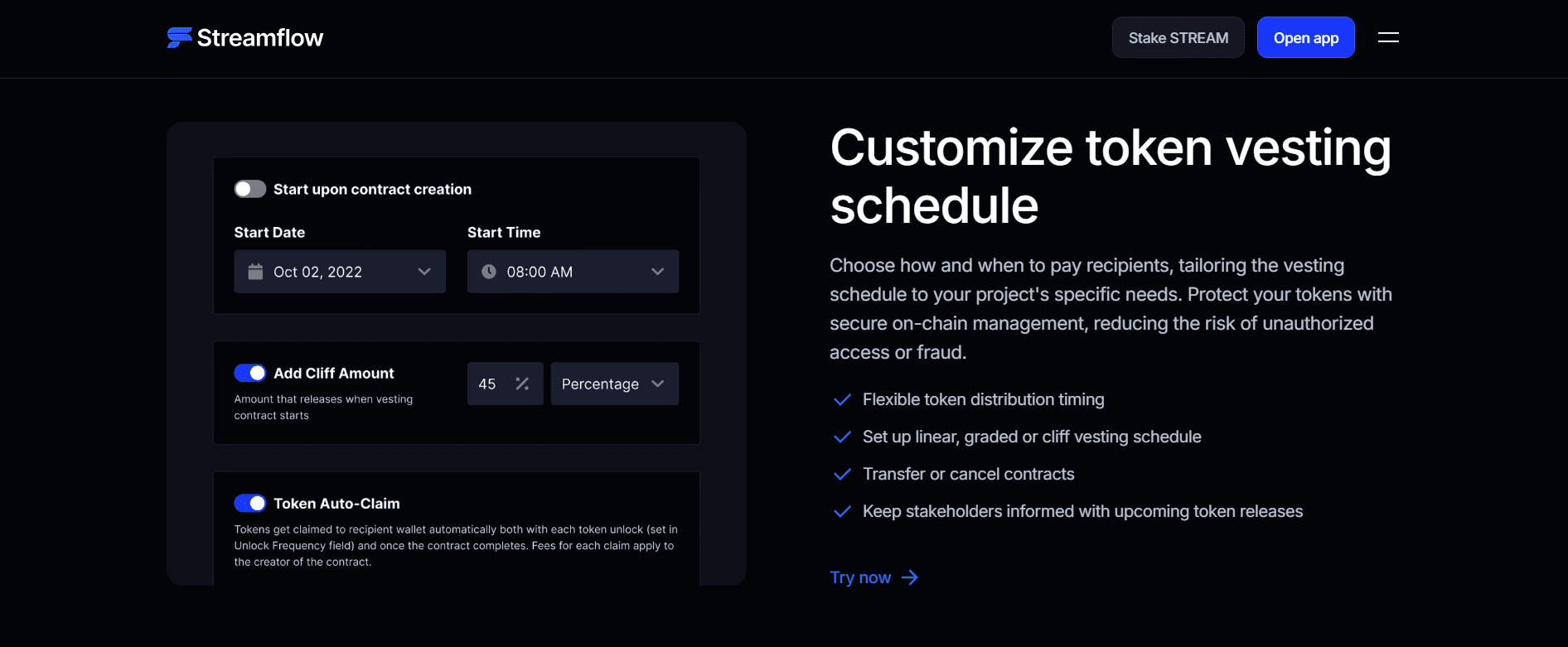
A cliff is an initial period during which no tokens are released at all. When the cliff ends, a first chunk unlocks, and the remaining tokens begin vesting on schedule.
The industry standard for founders and core teams is a 12-month cliff. It guarantees that insiders earn nothing tradeable in year one, which is one of the strongest trust signals a project can send.
2. Linear Vesting
Linear vesting releases tokens continuously and evenly across the schedule. A 3-year linear schedule releases the same fraction every interval until the allocation is fully vested.
3. Cliff + Linear
The most common structure in crypto combines both: a cliff (often 12 months) followed by linear vesting for the remainder. This is the default shape for team and investor allocations.
4. Graded Vesting
Graded vesting releases tokens in defined steps, for example 25% per year over four years. It is useful when allocations should map to milestones in time rather than a continuous stream.
5. Milestone-Based and Price-Based Vesting
More advanced models tie unlocks to conditions rather than dates:
Milestone-based vesting releases tokens when a project goal is reached.
Price-based vesting releases tokens when the token hits a defined price threshold.
Custom intervals let teams define any release rhythm their tokenomics require.
Streamflow supports all of these models, including linear, cliff, cliff + linear, graded, milestone-based, price-based, and custom intervals, configurable without writing a single line of code.
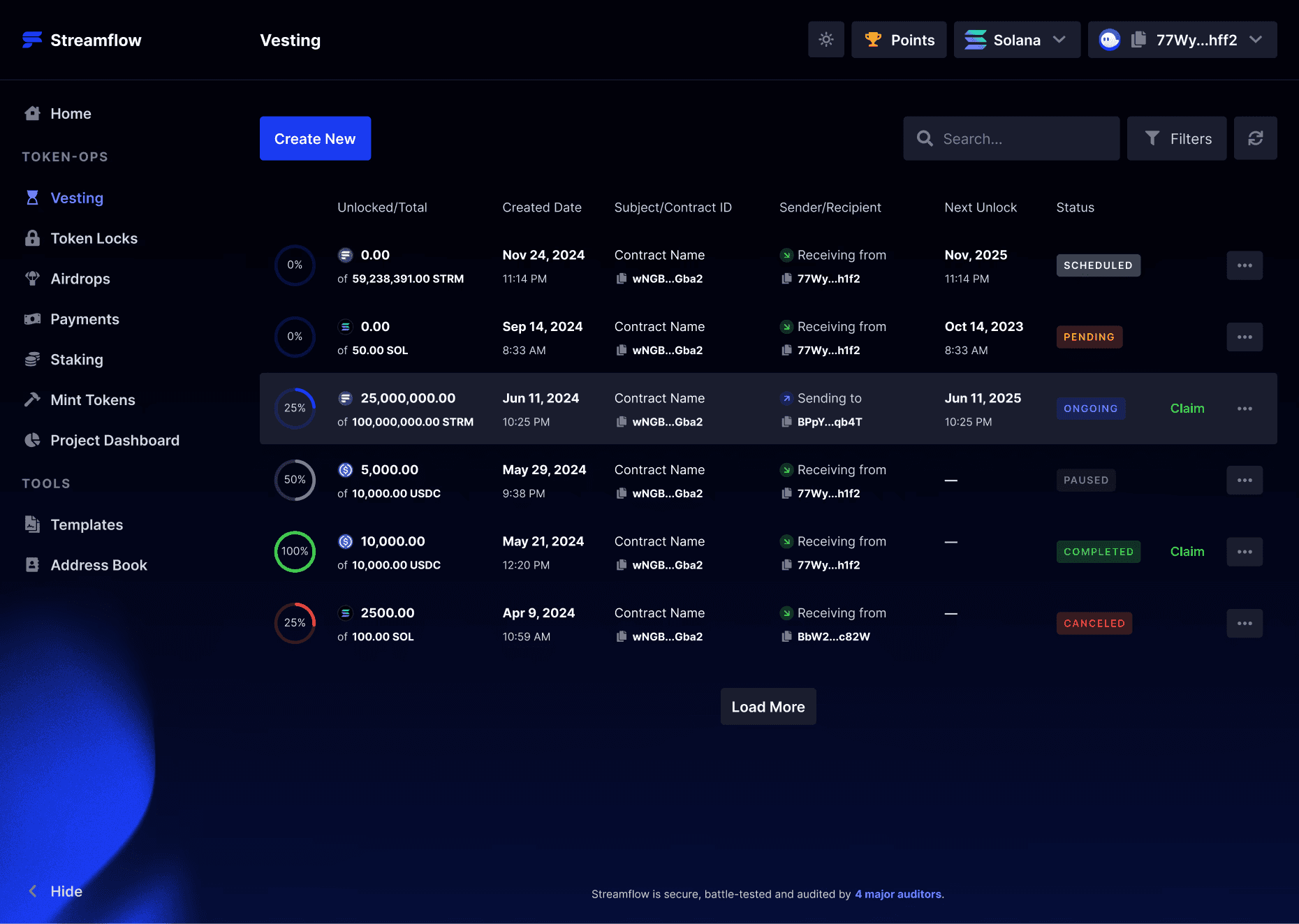
On-Chain vs Off-Chain Vesting
Off-chain vesting means the schedule lives in a spreadsheet, a legal agreement, or an internal tool, and someone manually sends tokens on each unlock date. On-chain vesting means a smart contract holds the tokens and releases them automatically.
The differences are decisive:
Enforcement: off-chain vesting depends on human discipline; on-chain vesting is immutable once deployed, with no unilateral changes and no admin override.
Transparency: on-chain schedules are verifiable by anyone via explorer links and shareable proof links.
Error rate: manual transfers introduce human error; automated contracts execute exactly as designed.
Trust: investors can verify rather than believe.
This is why Streamflow enforces vesting on-chain through audited smart contracts, eliminating the risk of manual errors or manipulation.
How to Set Up a Token Vesting Schedule in 2026
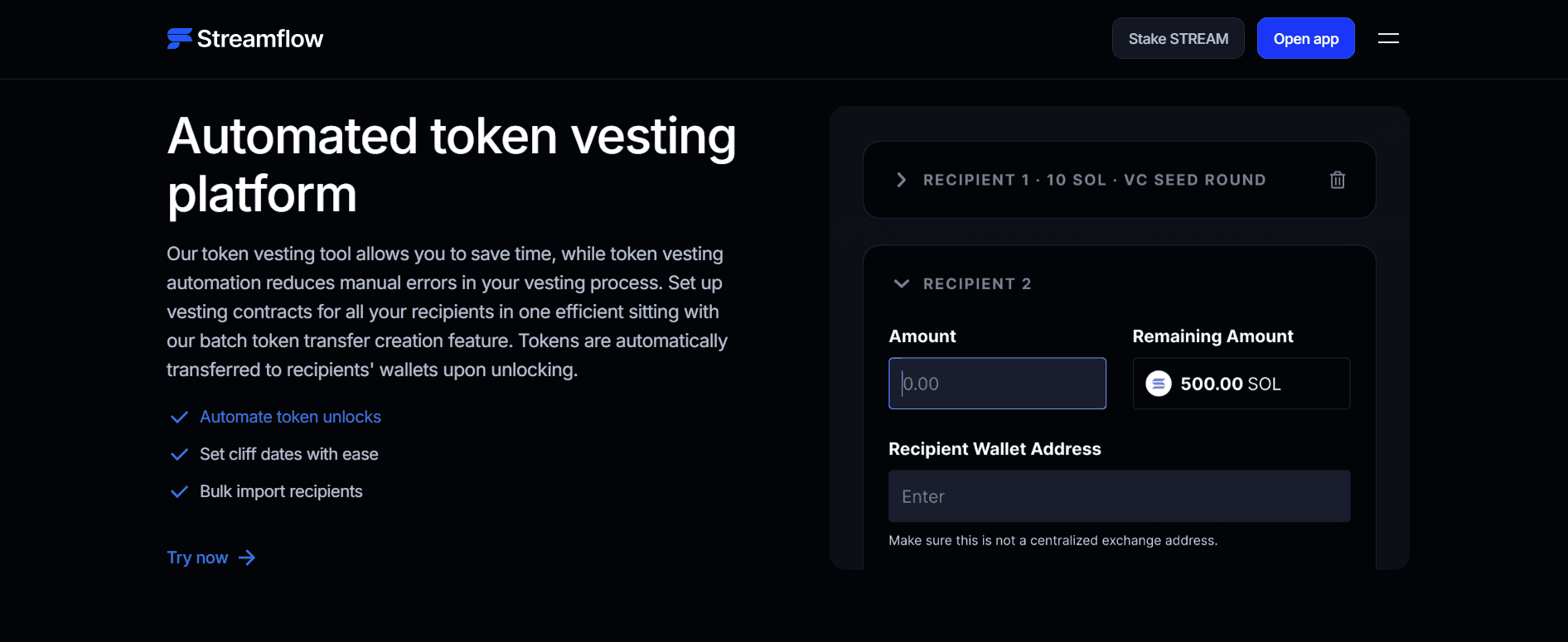
The modern workflow takes minutes, not engineering sprints. On Streamflow, the no-code path looks like this:
Create the vesting contract in the dashboard.
Upload recipients, individually or in bulk via CSV import.
Define the schedule: cliff, duration, release model, and intervals.
Fund the contract with the allocated tokens.
Tokens release automatically, with real-time tracking, shareable proof links, and explorer verification.
Adjacent capabilities round out the workflow: a tokenomics dashboard acts as a single source of truth showing release progress, cliff dates, and unlock events in real time, while the SDK lets developers embed vesting logic directly into their own applications.
Vesting Strategy by Stakeholder Group
A good vesting design treats different stakeholders differently. The standard framework:
Founders and core team: longest schedules, typically with a 12-month cliff, to signal maximum commitment.
Advisors: shorter schedules tied to their engagement period.
Investors: cliffs plus linear vesting matched to round terms.
DAO treasury: programmatic release to prevent governance abuse.
Ecosystem incentives: gradual emissions to avoid inflation shocks.
Public sale participants: lighter or no vesting, depending on sale structure.
The principle is simple: the closer a group sits to inside information and large allocations, the longer and stricter its vesting should be.
Real Projects, Real Vesting Schedules
The strongest proof that vesting works comes from how major Solana projects use it.
Bonk, the Solana meme coin that allocated 55% of supply to airdrops for early Solana users, used Streamflow to vest its core team allocation: 20% of total supply across 22 early contributors on a 3-year linear schedule.
The result was verifiable transparency around insider tokens at a moment when meme coin teams were assumed to be exit liquidity.
UXD Protocol, a decentralized stablecoin provider on Solana, put approximately 46% of $UXP supply on a 4-year linear vesting schedule with a 12-month cliff, integrating the Streamflow SDK into Realms so stakeholders could claim tokens and participate in governance in the same interface.
"Programmable token transfers and an easy SDK made it possible to combine governance participation and token claiming in one place."
— Kento Inami, UXD Protocol (paraphrased from the UXD case study)
Heavenland, a metaverse on Solana, went further still: 97% of $HTO token supply on 5-year linear vesting, with all allocations subject to cliffs, designed to allow initial liquidity without excessive inflation. The outcome was a more engaged, dedicated player community.
Token Vesting Security: What to Verify Before You Trust a Schedule
A vesting schedule is only as trustworthy as the contract enforcing it. Before relying on any project's vesting claims, check for:
Audited contracts: Streamflow's smart contracts are audited by FYEO and OPCODES.
Immutability: Once deployed, schedules cannot be unilaterally changed, and there is no admin override.
On-chain verification: Every contract should be checkable on Solscan or Solana Explorer.
Public proof links: Anyone, not just insiders, should be able to confirm the schedule.
Security here is not a feature; it is the product. Properly enforced vesting reduces manipulation, insider misuse, rug-pull risk, and governance abuse.
Why Streamflow Is the Best Way to Run Token Vesting in 2026
Several structural advantages separate Streamflow from manual processes and DIY contracts:
Proven scale: Over $1.4B in total value locked, 1.3M+ users, and 40K+ projects rely on the platform.
Ecosystem trust: Streamflow is listed in the official Solana Docs under token vesting as a core ecosystem tool.
Every vesting model supported: Linear, cliff, graded, milestone-based, price-based, and fully custom intervals.
No-code and developer paths: Bulk CSV creation through the UI, or SDK integration for custom flows.
Solana economics: With sub-second finality and near-zero fees, large vesting operations remain cost-efficient at any scale.
Backed and audited: Backed by Jump Crypto, Solana Ventures, John Lilic and more, with contracts audited by FYEO and OPCODES.
Compared to building custom contracts, Streamflow is faster, safer, and requires no maintenance. Compared to manual transfers, it removes human error entirely.
Conclusion
Token vesting is the mechanism that turns tokenomics from a plan into an enforceable system, and in 2026 the market expects that system to live on-chain.
Projects like Bonk, UXD Protocol, and Heavenland have shown that transparent, automated vesting builds the trust that manual processes never can.
Streamflow makes that standard accessible to any team: audited, immutable vesting contracts deployed in minutes, verifiable by anyone.
Start vesting on Streamflow and put your token schedule on-chain where your community can verify it.
Read Next:
FAQs:
1. What is token vesting in crypto?
Token vesting in crypto is the controlled, gradual release of tokens over time, used to prevent immediate selling and align long-term incentives between projects and stakeholders.
2. How does Streamflow enforce vesting schedules?
Streamflow enforces vesting schedules through immutable, audited on-chain smart contracts that release tokens automatically, with public proof links and explorer verification on Solscan and Solana Explorer.
3. What is the difference between token vesting and a token lock?
The difference between token vesting and a token lock is that vesting releases tokens gradually over a schedule, while a lock restricts an entire allocation until predefined conditions are met.
4. Can I create a vesting schedule without writing code?
Yes, you can create a vesting schedule without writing code. Streamflow's no-code interface lets teams upload recipients via CSV, define the schedule, fund the contract, and automate releases.
5. What is a standard vesting schedule for founders in 2026?
A standard vesting schedule for founders in 2026 is a 12-month cliff followed by linear vesting, often over a total of 3 to 4 years.