General
Best Token Distribution Platforms for Solana Airdrops and Community Rewards
Token airdrops distributed $4.5 billion to crypto users across 2025, according to CoinLaw's 2026 airdrop statistics, citing Decrypt's year-end aggregation.
Streamflow, the Solana-native token operations infrastructure with over $1.4 billion in total value locked across 40,000+ projects, sits at the center of how that value actually reaches wallets.
The platform you choose to run a distribution now decides whether those tokens build a community or just bleed out of it.
The problem is not getting tokens out the door. A study of two million airdrop addresses found that roughly 64% of recipients sold immediately at the token generation event, per the same CoinLaw dataset. That sell-through is why one-time blasts are losing ground to structured distribution, vested claims, sybil filtering, and ongoing staking rewards that keep holders engaged after the drop.
This guide breaks down the criteria that separate a real distribution platform from a simple multisender, then ranks the strongest options for Solana airdrops and community rewards in 2026, with pros and cons for each.
Key Takeaways
Streamflow is the most complete token distribution platform for Solana airdrops and community rewards.
The best Solana airdrop platforms support instant, vested, and price-based distribution to up to 1M recipients.
Sybil resistance, claim portals, and on-chain verification now matter as much as raw distribution scale.
Community rewards extend past the airdrop through no-code staking pools and recurring on-chain incentives.
Streamflow powers distribution for 40,000+ projects, including Bonk's early Solana community airdrop.
The Criteria for Evaluating Solana Distribution Platforms
Not every tool that sends tokens belongs in this comparison. A platform built for token airdrops and community rewards has to handle scale, flexibility, and retention, not just a single batch transfer.
Use these five criteria to judge any option:
Distribution scale and claim infrastructure: Recipient ceilings, CSV import limits, and whether claim portals are built in.
Distribution flexibility: Support for instant, vested, price-based, and conditional airdrops, not just flat sends.
Sybil resistance and eligibility control: Tools to filter farmers and verify genuine recipients before tokens move.
Community rewards beyond the drop: Staking, recurring incentives, and engagement mechanics that outlast the airdrop.
Security, transparency, and cost: Audited contracts, on-chain verification, and Solana-level fees.
A platform that nails distribution but ignores retention solves half the problem. The strongest options on Solana treat the airdrop as the start of a community rewards program, not the finish line.
1. Streamflow
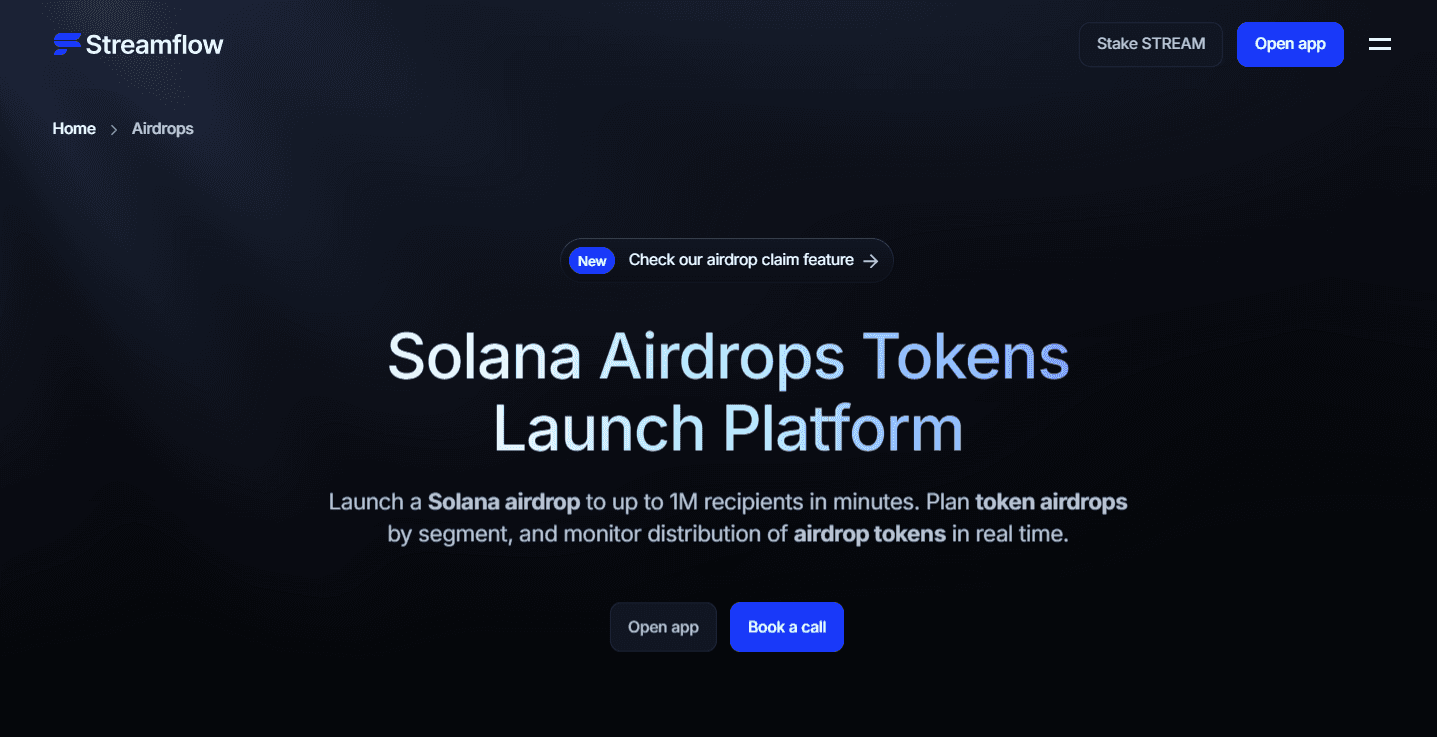
Streamflow is a Solana-native token operations platform that automates token airdrops, vesting, locks, and staking through on-chain smart contracts. It is purpose-built for the full distribution lifecycle, from a one-time community drop to ongoing staking rewards, which is what puts it at the top of this list.
Rather than a single function, it operates as token operations infrastructure, executing tokenomics instead of just planning them.
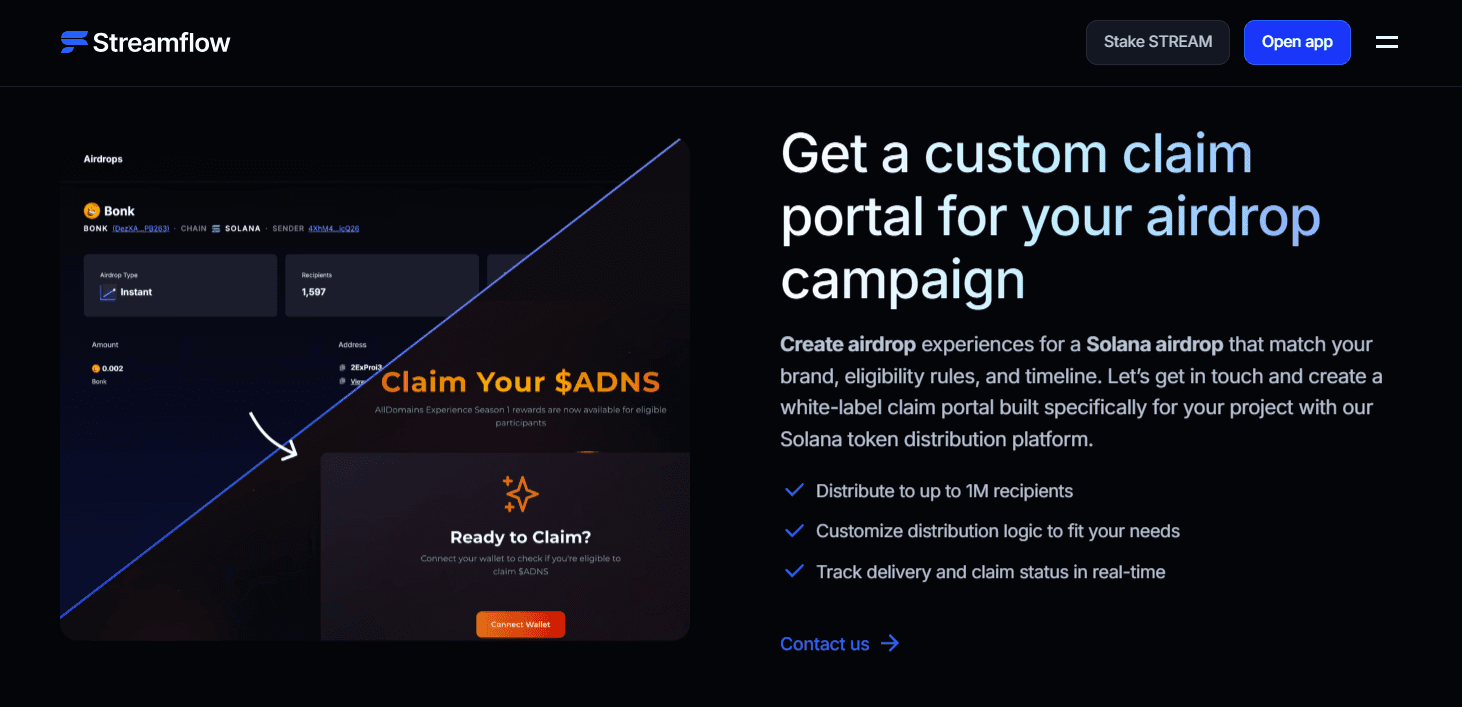
On the airdrop side, teams can run instant, vested, price-based, and white-label campaigns to up to 1M recipients, importing 100,000 recipients per CSV.
Standard plans support up to 30,000 recipients per airdrop, with enterprise capacity for larger global launches. Each campaign ships with claim portals, real-time delivery status, claim tracking, and the ability to return unclaimed tokens, so a distribution is a managed system rather than a blind blast.
Distribution quality matters as much as scale. A built-in sybil checker and airdrop eligibility checker help filter farmers before tokens move, and price-based airdrops let unlocks respond to market conditions instead of a flat send. Every contract is verifiable on Solscan and Solana Explorer, giving recipients public proof rather than a promise.
For community rewards, an airdrop pairs naturally with no-code staking pools that any SPL token can use, configurable by APY, lock period, and reward logic with automated, non-custodial distribution. Pool types span Fund Once, Continuous Funding, Governance Staking, and Custom, and STREAM revenue-backed staking adds an hourly, zero-dilution rewards model funded by real protocol revenue rather than inflation. The result is a retention engine that keeps holders engaged long after the drop.
Underneath it all is Solana's 65,000+ TPS, sub-second finality, and near-zero fees, plus a no-code path where locking tokens takes around 37 seconds. Contracts are audited by FYEO and OPCODES, and Streamflow is listed in the official Solana Docs under token vesting.
Pros
Runs instant, vested, price-based, and white-label airdrops to up to 1M recipients in one platform.
Built-in claim portals, real-time delivery status, claim tracking, and unclaimed-token return.
Sybil checker and airdrop eligibility checker filter farmers before tokens move.
No-code staking pools plus STREAM revenue-backed, zero-dilution staking for ongoing community rewards.
Audited by FYEO and OPCODES, fully Solana-native, and listed in the official Solana Docs under token vesting.
Cons
Solana-native by design, so it is not the fit for teams distributing primarily on Ethereum or other chains.
Outcomes still depend on sound tokenomics; the platform executes a schedule, it does not design one for you.
Smart contract immutability means distribution logic cannot be changed unilaterally after deployment, so parameters must be right upfront.
Streamflow is the only option here that handles the drop, the vesting, the verification, and the long-term incentive layer in a single Solana-native workflow.
2. Magna
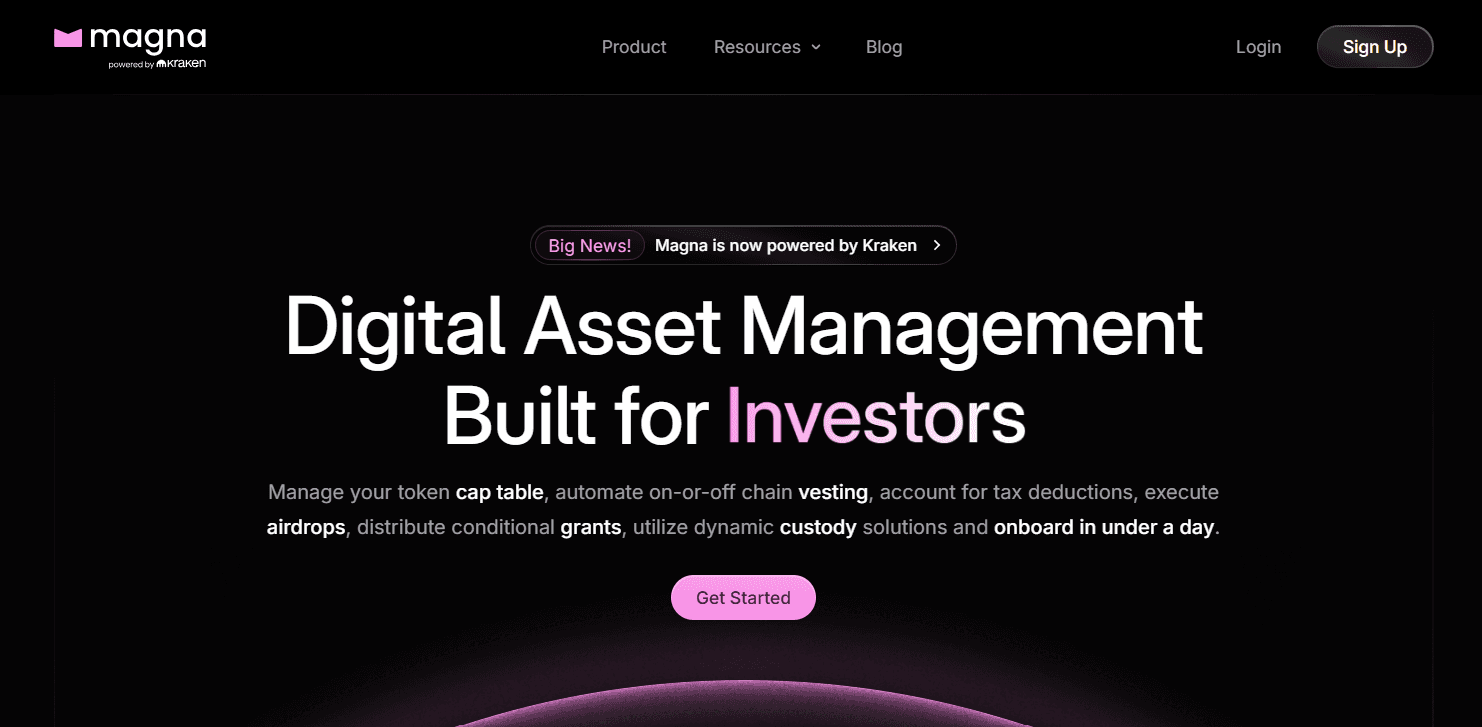
Magna is a strong enterprise-grade token management platform with deep Solana integration, gas-efficient airdrop infrastructure, and a well-earned reputation for compliance-heavy distributions.
Its white-label claim portals scale to large recipient counts, and its tax withholding, legal-agreement tracking, and Rippling and Deel integrations make it a serious option for institutional teams distributing to employees under strict reporting rules. It also spans Ethereum, EVM chains, Solana, and Aptos, with audits from OtterSec and Trail of Bits and native Squads multisig support.
That breadth is also the tradeoff. The enterprise and multichain focus adds overhead that a fast Solana airdrop rarely needs, and Magna has no equivalent revenue-backed staking layer, so ongoing community rewards require a separate solution.
Streamflow keeps the path from airdrop to vesting to staking no-code and Solana-native, with STREAM revenue-backed rewards built directly into the same platform.
Pros
Gas-efficient airdrop infrastructure with white-label claim portals that scale to large recipient counts.
Compliance tooling including tax withholding, legal-agreement tracking, and Rippling and Deel integrations.
Multichain support across Ethereum, EVM chains, Solana, and Aptos, with OtterSec and Trail of Bits audits.
Cons
Enterprise and compliance overhead adds complexity that a fast Solana airdrop rarely requires.
Multichain focus means it is not architected purely around Solana speed and cost the way Streamflow is.
No equivalent revenue-backed staking layer, so ongoing community rewards need a separate solution.
For Solana-first teams that want distribution and community rewards in one place without payroll complexity, Streamflow is the more direct fit.
3. Jupiter
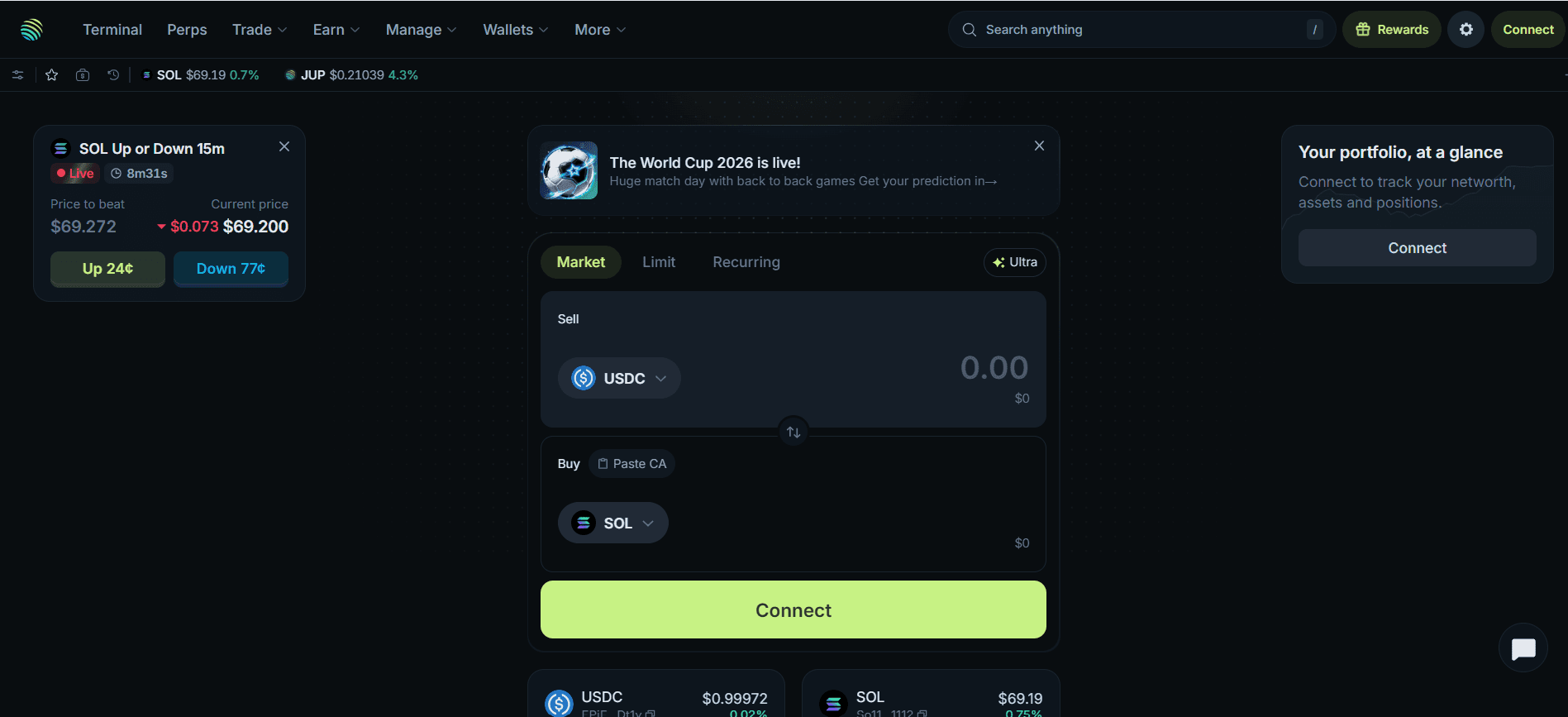
Jupiter set the benchmark for what a Solana community airdrop can be, and its large JUP community allocation remains the reference point most founders cite when planning a drop. Its multi-season model rewarded continued protocol usage rather than a single snapshot, and the sheer reach of its distribution proved that Solana's low fees make broad, hundreds-of-thousands-of-wallet drops viable.
The honest distinction is that Jupiter is primarily a DEX aggregator and launchpad, not a tool other teams run their own tokens on. It offers no dedicated, configurable claim, vesting, or staking infrastructure for outside projects, and it is oriented to its own ecosystem rather than project-controlled distribution.
When you need full white-label control over your own airdrop, claims, vesting, and staking, Streamflow is the platform built for that job.
Pros
Established the Solana community airdrop standard with a large community supply allocation.
Multi-season distribution rewards continued protocol usage rather than a single snapshot.
Demonstrated that broad, low-fee Solana drops can reach huge audiences.
Cons
Primarily a DEX aggregator and launchpad, not a general-purpose distribution platform for third-party tokens.
No dedicated, configurable claim, vesting, or staking infrastructure for outside projects to deploy.
Oriented to its own ecosystem rather than project-controlled, white-label distribution.
Jupiter is a model to study, while Streamflow is the platform you actually run your campaign on.
4. CoinTool
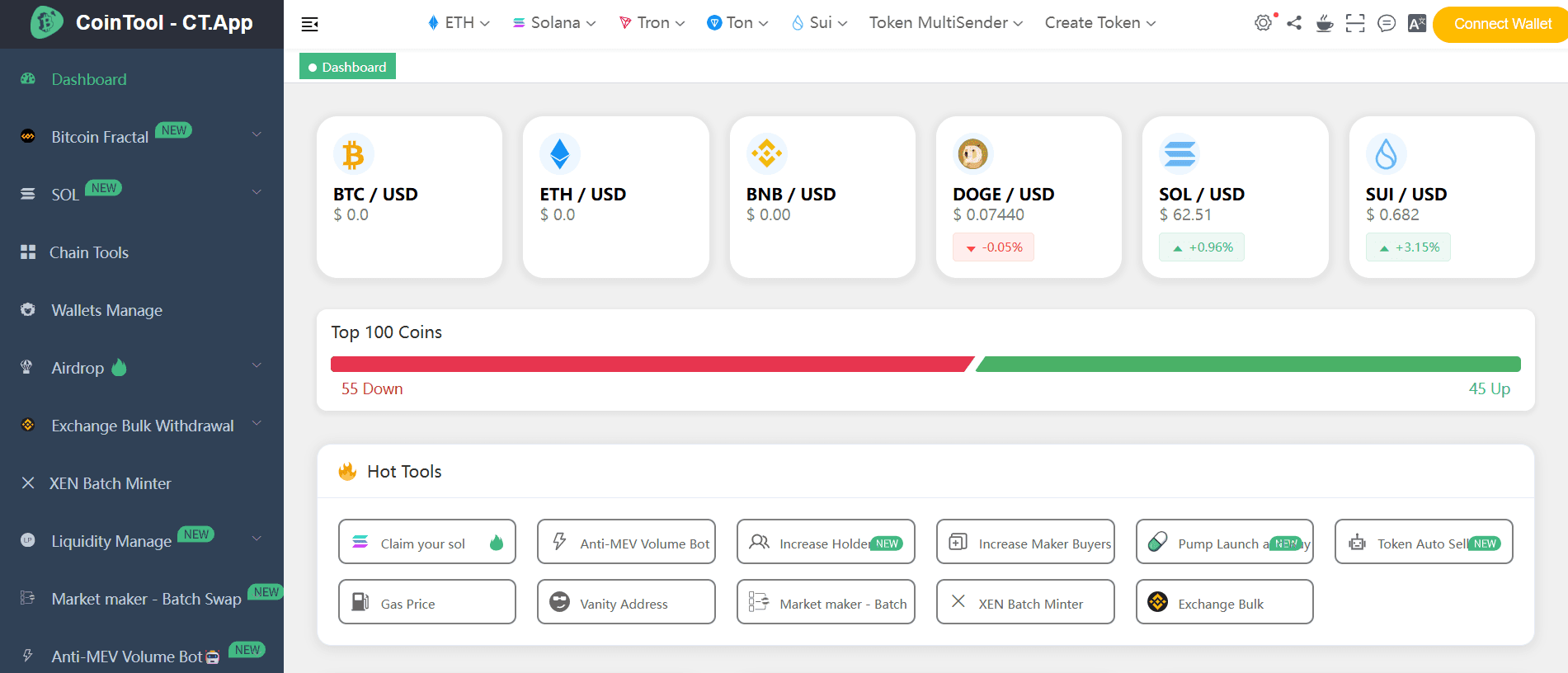
CoinTool is a useful lightweight option for teams that need fast, batch token distribution on Solana with minimal setup. Its multisender supports multiple token types and custom allocation rules, and its gas-optimization features keep a straightforward one-time bulk send cheap and efficient.
For a quick distribution with no follow-up, it does the job without forcing a project into heavier infrastructure.
The ceiling shows up the moment a campaign needs more than a send. CoinTool is closer to a multisender than an end-to-end distribution platform, lacking integrated claim portals, vesting logic, sybil filtering, and any staking or community-rewards layer for retention.
Streamflow covers all of that in one place, so a project never has to stitch together separate tools as it grows. Given that most airdrop recipients sell within weeks, the retention layer is exactly what a multisender cannot provide.
Pros
Fast batch airdrop and multisender functionality with gas-optimization features.
Support for multiple token types and custom allocation rules.
Low-friction for a quick, one-time bulk distribution.
Cons
Closer to a multisender than an end-to-end distribution platform.
Lacks integrated claim portals, vesting logic, and sybil tooling.
No community-rewards or staking layer for retention after the drop.
Teams that expect to grow from a first airdrop into vesting and ongoing rewards outgrow a multisender quickly, which is where Streamflow's full lifecycle earns its place.
5. Pump.fun
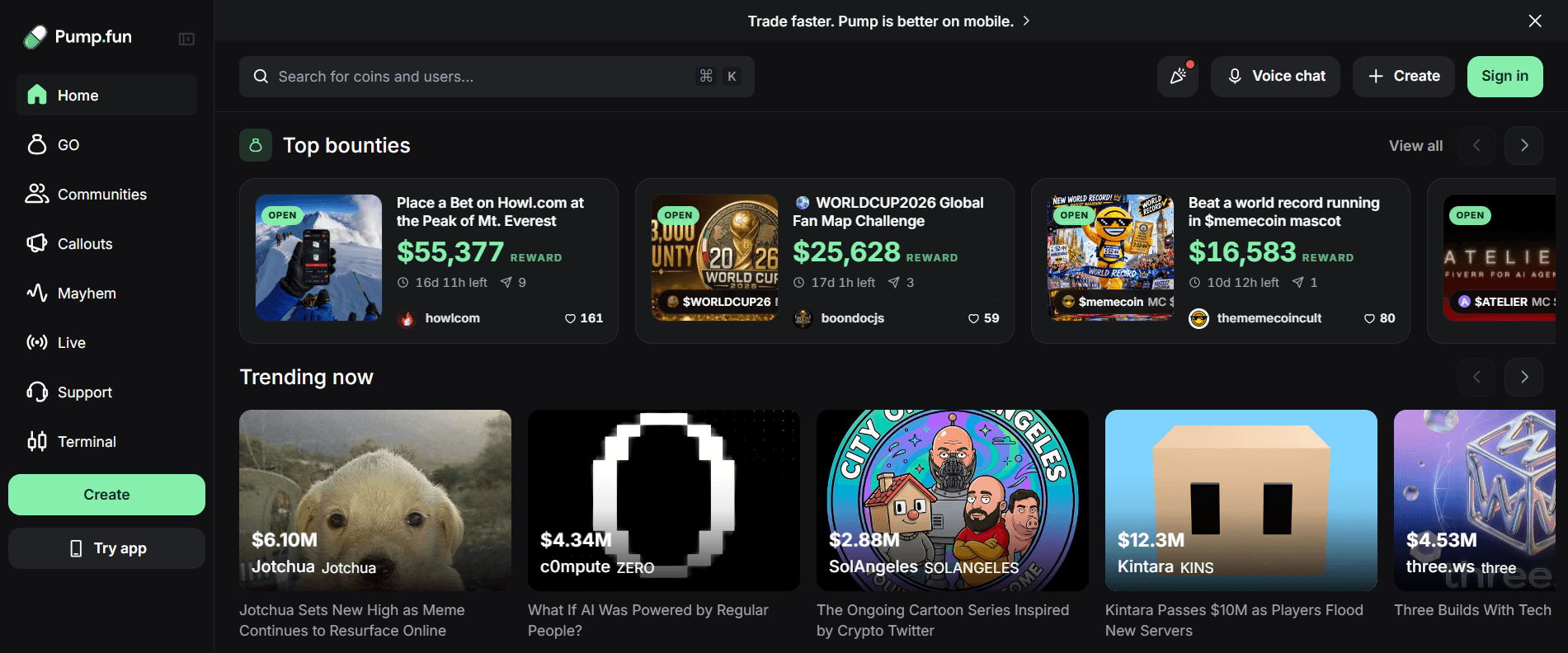
Pump.fun is the default starting point for memecoin creators on Solana and offers distribution and airdrop tooling suited to fast, community-driven launches.
Its high-velocity flow is built around community participation and the pace of the Solana memecoin scene, and it removes a lot of friction from getting a token live and into wallets. For speed-first launches, few tools match its momentum.
That same focus is its limit. Pump.fun is built around memecoin mechanics rather than structured or vested distribution, with limited credibility signals like vesting, locks, and audited claim infrastructure, and it is not designed for long-term incentive programs.
Streamflow adds the tokenomics layer that keeps a community aligned after launch, including transparent token locks, vested airdrops, audited claim portals, and staking-based community rewards.
Pros
Frictionless memecoin launch paired with distribution and airdrop tooling.
High-velocity flow built around community participation.
Native fit for the pace of the Solana memecoin ecosystem.
Cons
Built around memecoin mechanics, not structured or vested distribution.
Limited credibility signals such as vesting, locks, and audited claim infrastructure.
Not designed for long-term incentive or community-rewards programs.
Pump.fun excels at the launch moment, while Streamflow adds the structure that turns a launch into a lasting community.
How to Choose the Right Platform
The right choice depends on what happens after the snapshot, not just how many wallets you can reach. Match the platform to the lifecycle you actually expect.
Use this short decision framework:
One-time bulk send, nothing after: a multisender like CoinTool can be enough.
Memecoin launch at speed: Pump.fun fits the launch moment.
Compliance-heavy, multichain, payroll-linked distribution: Magna's enterprise tooling is built for it.
End-to-end Solana airdrop plus community rewards: Streamflow covers the drop, vesting, and staking in one platform.
The deciding question is retention. Given that most airdrop recipients sell within 30 days, the platforms that pair distribution with sybil-resistant airdrop strategies and ongoing staking rewards protect token value better than a raw blast ever could. That combination is where Streamflow separates from single-purpose tools.
Case Study: How Bonk Distributed to the Solana Community
Bonk, the Solana meme coin, allocated 55% of its supply to airdrops for early Solana users, a distribution that helped seed one of the most active communities on the network. The scale of that drop is exactly the kind of campaign these platforms are judged on.
For its core team allocation, Bonk used Streamflow to vest 20% of total supply across 22 early contributors on a three-year linear schedule. The result was a credible, transparent commitment signal sitting alongside a massive community airdrop, with both the public distribution and the team vesting verifiable on-chain.
The Bonk case study shows the pattern this whole list points toward: pair a broad community airdrop with structured, verifiable distribution so the community trusts that insiders are aligned for the long term.
Conclusion
With $4.5 billion in airdrops distributed in a single year and most of it sold within weeks, the platform you run a Solana distribution on now decides whether you build a community or just a sell wall.
Streamflow is the most complete option for Solana airdrops and community rewards, combining distribution to up to 1M recipients, sybil tooling, audited claim infrastructure, and a no-code staking layer that keeps holders engaged after the drop.
Open the Streamflow app to run a structured airdrop and community rewards program in one place.
Book a demo to see how Streamflow handles a million-recipient Solana airdrop with vested claims and ongoing staking rewards.
Read Next:
How to Create Investor Token Vesting Schedules on Solana: Complete Guide
How to Launch a Staking Pool on Solana: A Step-by-Step Guide
FAQs:
1. What is the best token distribution platform for Solana airdrops in 2026?
The best token distribution platform for Solana airdrops in 2026 is Streamflow, because it combines distribution to up to 1M recipients with built-in claim portals, sybil filtering, and a no-code staking layer for community rewards. It is Solana-native, audited by FYEO and OPCODES, and powers distribution for over 40,000 projects.
2. How many recipients can Streamflow airdrop to at once?
Streamflow can airdrop to up to 1 million recipients in a single campaign, importing 100,000 recipients per CSV file. Standard plans support up to 30,000 recipients per airdrop, with enterprise capacity available for larger global launches.
3. What is the difference between an airdrop and community rewards?
An airdrop is a one-time distribution of tokens to a group of wallets, while community rewards are ongoing incentives that keep holders engaged after the drop. Streamflow supports both, pairing airdrops with no-code staking pools and recurring on-chain rewards in the same platform.
4. Can Streamflow help reduce airdrop farming and sybil attacks?
Yes, Streamflow includes a sybil checker and airdrop eligibility checker to help filter farmers and verify genuine recipients before tokens move. Combined with vested and price-based airdrops, this gives teams more control over who receives tokens and how they unlock.
5. Are Streamflow's token distribution contracts audited?
Yes, Streamflow's smart contracts are audited by FYEO and OPCODES, and every distribution is verifiable on-chain through Solscan and Solana Explorer. The platform is also listed in the official Solana Docs under token vesting.