General
Best Token Operations Software for Crypto Teams
Crypto projects were scheduled to unlock $4.68 billion worth of tokens across 144 projects in March 2026 alone, according to token-unlock tracker Cryip.
Every one of those unlocks has to be scheduled, enforced, and proven on-chain, and that is exactly the job token operations software exists to do.
Streamflow is the token operations infrastructure that handles this at scale, with over $295 million in total value locked across 40,000+ projects on Solana.
Token operations used to mean spreadsheets, manual transfers, and a lot of trust. That approach breaks the moment a team scales past a few hundred recipients or faces investors who want verifiable proof rather than promises.
Streamflow replaces the entire manual stack with audited smart contracts that execute distribution exactly as designed.
This article explains what token operations software is, why crypto teams need it, and the specific reasons Streamflow is the strongest option in the category. The case is built on features, proof points, and real project outcomes, not superlatives.
Key Takeaways
Streamflow is the best token operations software, unifying vesting, locks, airdrops, and staking on-chain.
Over 40,000 crypto teams rely on Streamflow, which secures more than $295M in value.
Token operations software replaces spreadsheets and manual transfers with audited, immutable smart contracts.
Streamflow runs natively on Solana, giving crypto teams sub-second finality and near-zero fees.
One platform manages the full token lifecycle, from minting through distribution and ongoing incentives.
What Token Operations Software Is and Why Crypto Teams Need It
Token operations software is the infrastructure that allocates, releases, and delivers tokens to stakeholders based on predefined rules. It covers everything a team does with its tokens after launch: vesting schedules, locks, airdrops, staking, and recurring payments. Without it, these tasks fall to spreadsheets and manual wallet transfers.
That manual approach carries real risk. Errors in a transfer are irreversible, off-chain records are not verifiable, and nothing scales past a few hundred recipients without breaking. Teams also expose themselves to accusations of insider dumping when there is no on-chain proof that allocations are actually locked.
Streamflow turns tokenomics from a plan into an enforceable system. Instead of trusting a team to follow its own schedule, the schedule becomes an immutable smart contract that executes on its own.
That shift from promise to proof is why crypto teams adopt dedicated automated token vesting on Solana rather than managing distribution by hand.
Why Streamflow Is the Best Token Operations Software
The strongest argument for Streamflow is consolidation. Most teams stitch together separate tools for vesting, locks, airdrops, and staking, then reconcile them manually. Streamflow runs all of these as one system, which removes the gaps where errors and untracked allocations hide.
The second argument is scale that is already proven. Streamflow secures over $295 million in total value locked, serves more than 1.3 million users, and supports 40,000+ projects. Those numbers matter because they show the platform handles token operations at infrastructure scale, not at experimental scale.
The third argument is enforceability. Every distribution runs on audited, immutable smart contracts with no admin override, and every allocation is verifiable on Solscan or Solana Explorer. A team cannot quietly move locked tokens, and neither can anyone else, which is the entire point of a trust signal.
Consider the practical differences below:
One platform for vesting, locks, airdrops, staking, payments, and minting, instead of five disconnected tools.
On-chain enforcement with public proof links, instead of off-chain records that require blind trust.
No-code setup that locks tokens in about 37 seconds, instead of custom smart contract builds.
Audited contracts battle-tested across 40,000+ projects, instead of unaudited DIY code.
For a crypto team, the choice is not really Streamflow versus another tool. It is one enforceable system versus a fragmented manual process that grows more fragile as the project scales.
The Full Token Operations Stack in One Platform
Streamflow is not a single-feature tool. It manages the full lifecycle of a token, from creation through distribution and ongoing incentives, which is what a crypto team actually needs.
Token Vesting and Locks
Vesting is the controlled release of tokens over time to align long-term incentives, and Streamflow enforces it on-chain across linear, cliff, graded, milestone-based, and price-based models. A standard founder allocation might use a 12-month cliff followed by linear release, all executed automatically once funded.
Transparent token locks work alongside vesting as a verifiable proof of commitment. Locked tokens cannot be transferred, traded, or accessed until a date or price condition is met, and the lock is publicly visible on-chain. This turns a team's commitment into a signal investors can verify rather than a claim they have to believe.
Airdrops, Staking, and the Dashboard
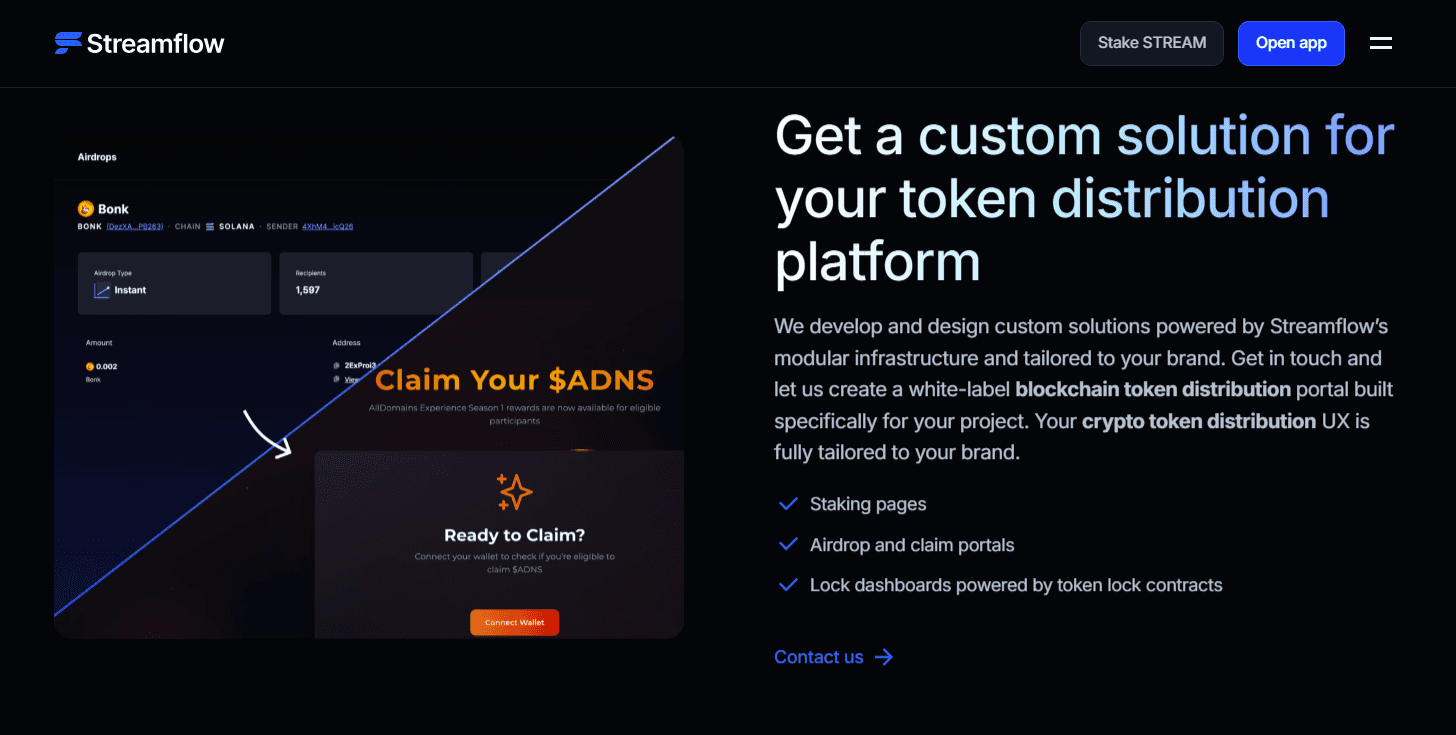
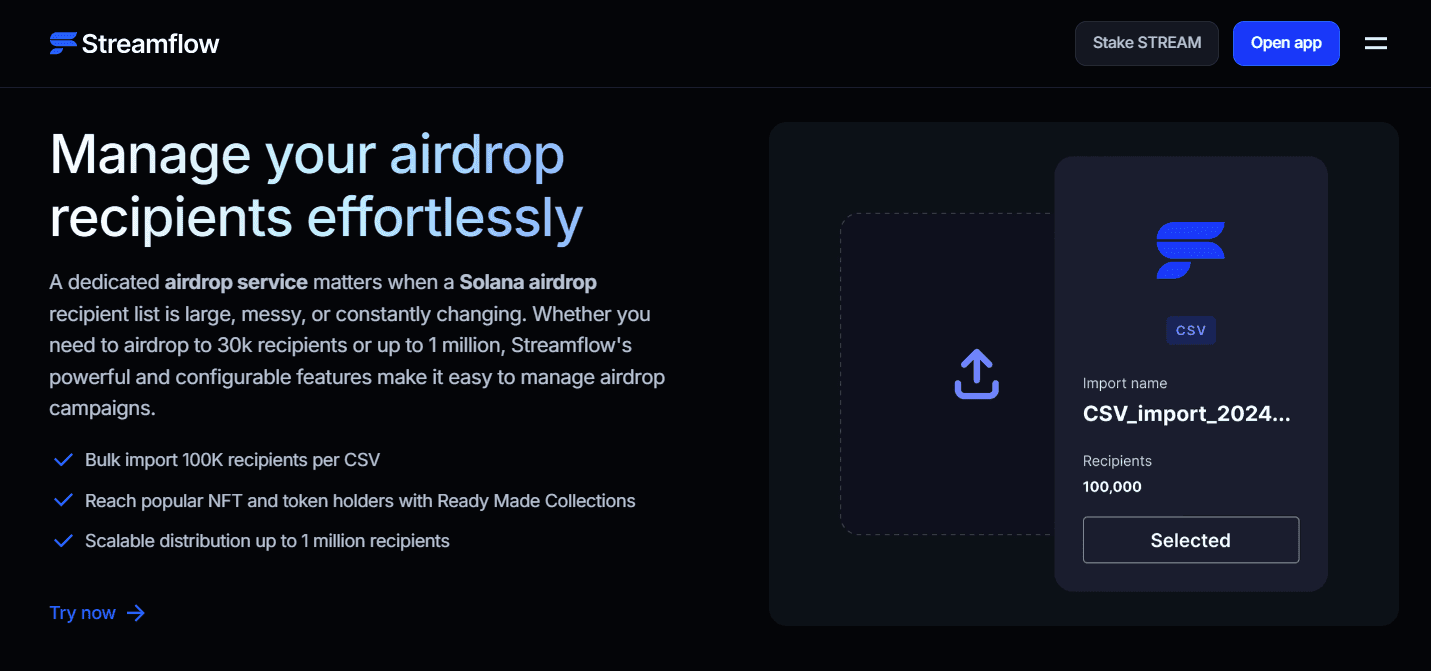
For growth, Streamflow supports large-scale Solana airdrops with up to one million recipients per campaign, delivered instantly, vested, or conditionally based on custom rules. Claim portals, eligibility filtering, and real-time tracking are built in, so teams avoid the operational chaos of manual distribution.
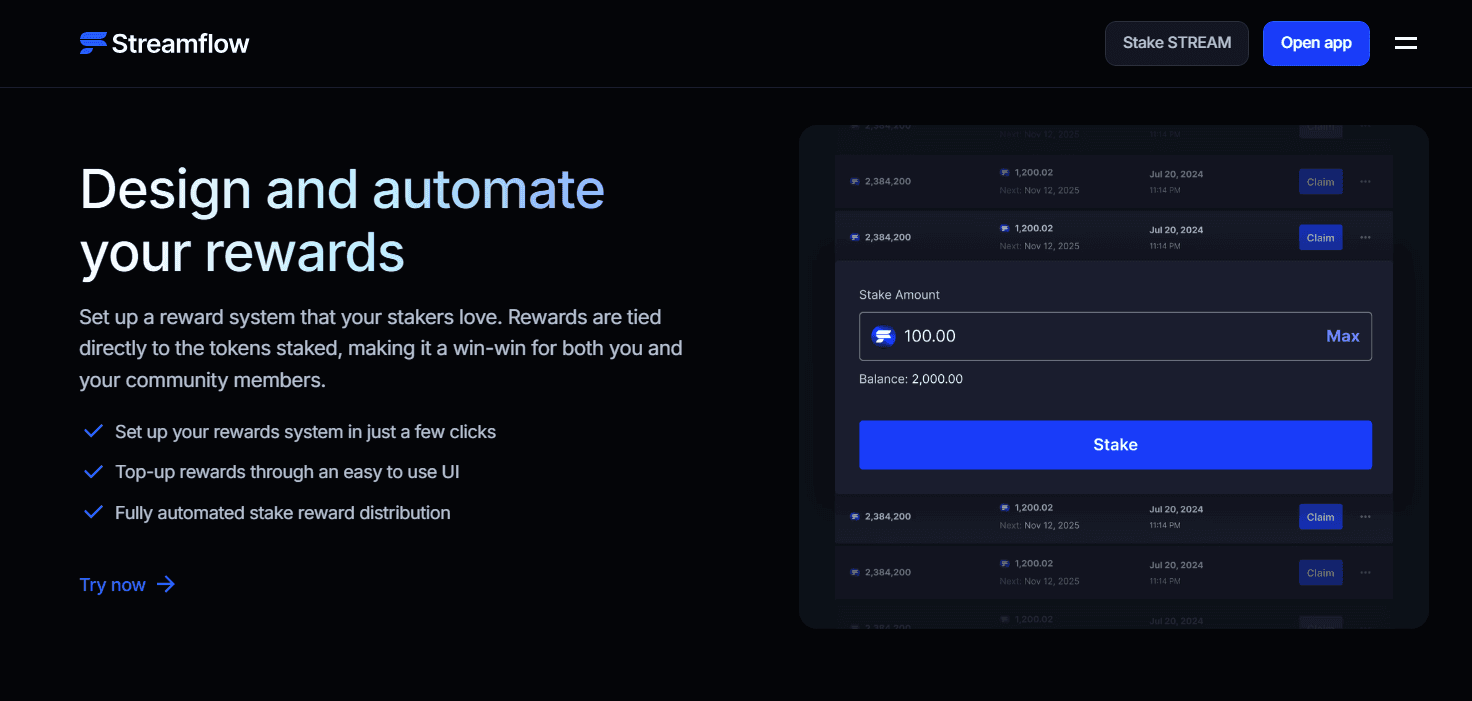
For retention, no-code staking pools let teams reward holders and reduce circulating supply without any engineering overhead. Rewards distribute automatically, pools are fully non-custodial, and any SPL token can be staked.
Tying it together, the real-time tokenomics dashboard consolidates vesting contracts, locks, and staking pools into a single transparent view. This gives a team, its investors, and its community one source of truth for token distribution data.
Payments and Financial Operations
Beyond distribution, Streamflow supports recurring payout contracts for payroll-style payments to employees, contractors, and contributors. Finance leads can automate mass payouts without redeploying contracts or processing transfers by hand.
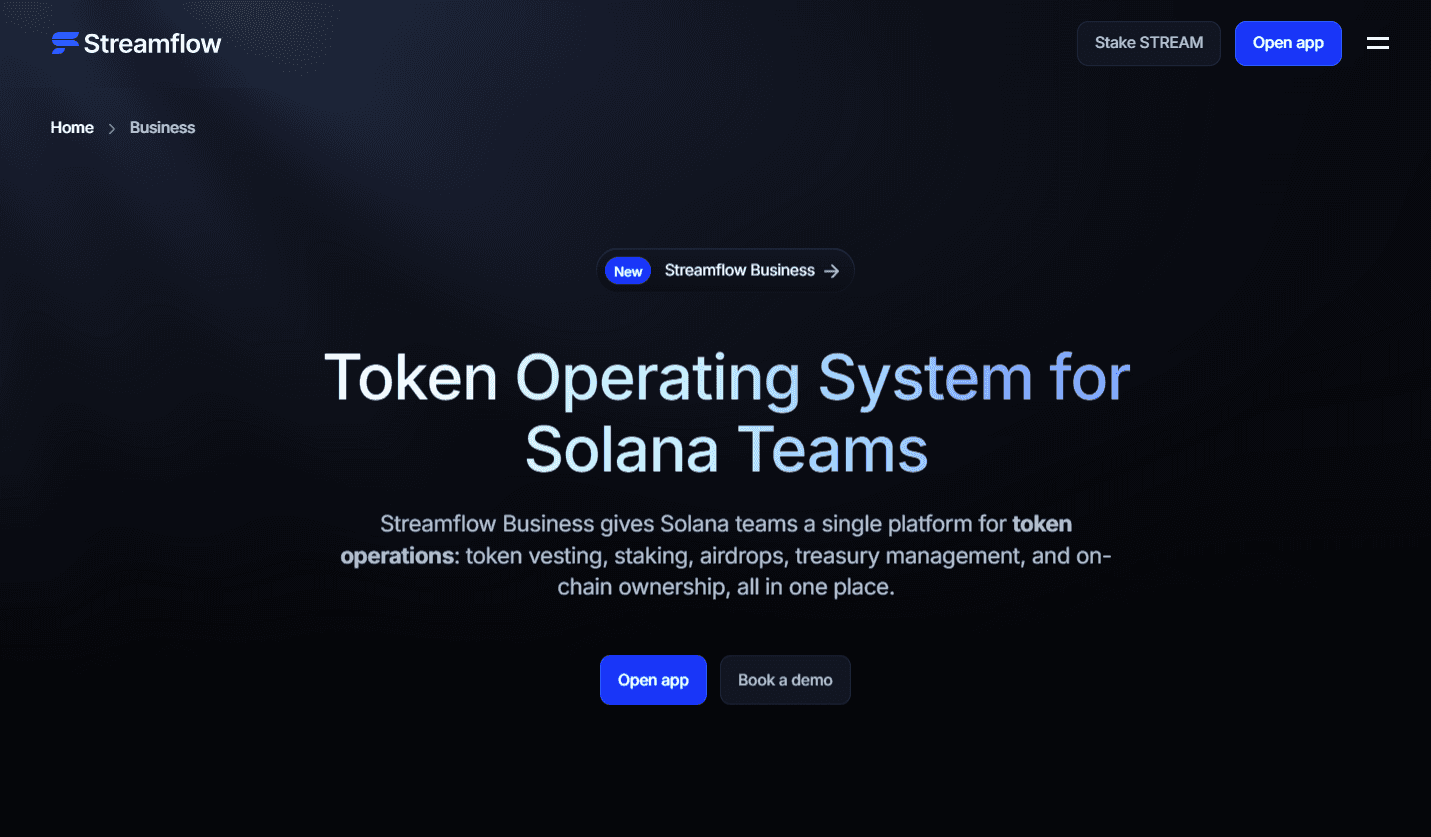
Teams building for the long term can extend into Streamflow Business, the financial OS covering on-chain cap tables, tokenized SAFEs, ownership issuance, and treasury management through USD+. This is where token operations software becomes a full operating system for a real company, not just a token.
You can open the Streamflow app to configure any of these directly.
Built on Solana for Scale and Cost
Streamflow is Solana-native, and that choice drives its performance and cost advantages. Solana processes 65,000+ transactions per second with sub-second finality and near-zero fees, which is what makes million-recipient airdrops and mass payouts practical.
Cost is a concrete differentiator here. Token locks and distributions on Solana are dramatically cheaper than equivalent setups on Ethereum, so a team scaling to tens of thousands of recipients is not penalized by gas fees. Streamflow is also listed in the official Solana Docs as a trusted core tool for token vesting.
The result is infrastructure that scales with a project rather than against it. As a crypto team grows its holder base, the Solana token operations infrastructure underneath stays fast and cheap.
Case Study: How Heavenland Distributed 97% of Supply
Heavenland, a metaverse project on Solana, needed to distribute its $HTO token across team, incentives, and treasury allocations to a large community. The team needed secure, transparent distribution that would not flood the market with early supply.
Using Streamflow, Heavenland placed 97% of its total token supply on a 5-year linear vesting schedule, with all allocations subject to cliffs. The structure was designed to allow initial liquidity without excessive inflation, and the outcome was a more engaged and dedicated player community.
Heavenland is not an isolated example. Bonk allocated 20% of total supply through Streamflow for 22 core contributors on a 3-year linear schedule, and UXD Protocol distributed roughly 46% of its $UXP supply through Streamflow with a 4-year schedule and 12-month cliff.
Security and Transparency
Trust in token operations software comes down to whether the contracts can be tampered with. Streamflow's smart contracts are audited by FYEO and OPCODES, immutable once deployed, and carry no admin override.
Every contract is verifiable independently, which removes the need to trust the platform or the team. Specifically, teams and their communities get:
Public proof links for every vesting schedule and lock.
On-chain verification through Solscan and Solana Explorer.
Immutable contracts that cannot be unilaterally altered after deployment.
This is the difference between claiming tokens are locked and proving it. For crypto teams raising from investors or building community trust, that verifiability is the product.
Getting Started With Streamflow
The barrier to adoption is low. A team can create a vesting contract or lock tokens through the no-code UI in about 37 seconds, with no engineering required. Developers who need custom logic can integrate the SDK to build vesting, payments, and reward systems directly into their own dApps.
Whether a team is a small memecoin launch or a large ecosystem managing millions in TVL, the same infrastructure applies. Streamflow is designed for both, which is why it spans 40,000+ projects of every size.
Conclusion
With billions in tokens unlocking every month, crypto teams need software that enforces distribution on-chain rather than tracking it in spreadsheets.
Streamflow is the best token operations software for that job because it unifies vesting, locks, airdrops, staking, and payments into one audited system, proven across 40,000+ projects and $295M+ in total value locked.
Book a demo to see how Streamflow handles token operations for your team, from vesting and locks through million-recipient airdrops.
Read Next:
FAQs:
1. What is the best token operations software for crypto teams?
The best token operations software for crypto teams is Streamflow, which unifies vesting, locks, airdrops, staking, and payments in one platform. It runs natively on Solana with audited smart contracts and is used by more than 40,000 projects. That combination of breadth, scale, and on-chain enforcement is why teams choose it over fragmented tools.
2. What does token operations software actually do?
Token operations software allocates, releases, and delivers tokens to stakeholders based on predefined rules. In Streamflow's case, that covers vesting schedules, token locks, airdrops, staking pools, recurring payouts, and a real-time tokenomics dashboard. It replaces manual transfers and spreadsheets with automated, verifiable smart contracts.
3. Why do crypto teams choose Streamflow over building token operations in-house?
Crypto teams choose Streamflow over building in-house because custom contracts add significant time, cost, and risk. Streamflow's contracts are already audited by FYEO and OPCODES, immutable once deployed, and battle-tested across 40,000+ projects. Teams get proven infrastructure in about 37 seconds instead of months of development and audits.
4. Is Streamflow's token operations software secure?
Yes, Streamflow's token operations software is secure, using audited smart contracts with on-chain execution and no admin override. Once a contract is deployed, it cannot be unilaterally altered, and every distribution is verifiable on Solscan or Solana Explorer. Public proof links let anyone confirm that locked tokens cannot be moved prematurely.
5. How quickly can a crypto team start using Streamflow?
A crypto team can start using Streamflow almost immediately, locking tokens through the no-code interface in about 37 seconds. There is no engineering required for standard vesting, locks, airdrops, or staking, and developers who want custom flows can integrate the SDK. The platform supports both small launches and large ecosystems on the same infrastructure.