General
How to Check if a Token's Liquidity Is Locked: 5-Step Verification Guide (2026)
A May 2026 arXiv study from Sun Yat-sen University screened 100,063 tokens newly issued on Orca, Raydium, and Meteora during the first half of 2025 and flagged 76,469 of them as rug pulls, with 15,606 executed specifically through liquidity withdrawal.
The same study traced at least $151 million in direct, verifiable losses across 7,322 profiting addresses.
Streamflow sits on the other side of that ledger as the Solana-native token operations infrastructure behind $243M+ in total value locked and 40,000+ projects, where every lock is an immutable on-chain contract rather than a claim in a Telegram post.
The problem is that most liquidity checks stop at a badge. A green "LP locked" indicator on a screener tells you a lock exists somewhere, at some size, for some duration, controlled by someone. It does not tell you whether that lock actually prevents the pool from being drained tomorrow.
This guide breaks the check into five steps that are verifiable entirely on-chain, using tools anyone can open right now. It also covers what founders need to publish so their own locks survive this level of scrutiny.
Key Takeaways
A green LP locked badge is not verification; only on-chain lock contracts prove commitment.
Check if liquidity is locked by verifying LP custody, percentage, duration, and unlock authority.
Streamflow token locks are immutable, audited contracts with public proof links anyone can verify.
Most Solana rug pulls exploit liquidity withdrawal, making proper lock verification a mandatory pre-investment step.
Over 40,000 projects use Streamflow to lock tokens and publish verifiable proof on Solana.
The "LP Locked" Badge Is Not Verification
Screeners and risk scanners aggregate signals. They surface whether LP tokens sit in a known locker program, and they render that as a binary. Binary output on a multi-variable question is where the misread happens.
The Sun Yat-sen study is blunt about this in its own mitigation section: users should not rely only on token names, symbols, locked liquidity, or renounced authority as risk signals. That recommendation comes from a dataset where liquidity withdrawal was the second most common execution pattern, behind pump-and-dump.
The lock existed in plenty of those cases. It just did not constrain what mattered.
Four failure modes recur:
A lock covering 20% of the pool while the deployer holds the rest
A lock with a seven-day expiry on a token marketed as long-term
A lock in a custom program with an admin key that can cancel or modify it
A locked pool paired with an unlocked team allocation that dumps into it
None of those trigger a red badge. All of them defeat the purpose. Verification means reading the contract, not reading the indicator.
What a Liquidity Lock Actually Is on Solana
Tokens created through the SPL Token program have no native liquidity. To make a token tradable, the issuer creates a pair on a DEX and deposits both assets into a pool, receiving LP tokens that represent proportional ownership of that pool.
Whoever holds those LP tokens can redeem them for the underlying assets at any time. That is the entire mechanism. A liquidity lock restricts the LP tokens so they cannot be redeemed until a predefined condition is met, which is a specific case of the broader token lock platform category.
The distinction matters for your check:
A token lock restricts native project tokens such as team, treasury, and investor allocations.
A liquidity lock restricts LP tokens to prevent the pool itself from being drained.
A project can have one without the other, and both need verifying before you draw conclusions about supply risk.
The 5-Step Liquidity Lock Verification Process
Each step below produces a factual answer, not an impression. Run them in order. If a step cannot be completed because the data is not public, treat that as the answer.
Step 1: Locate the Token Mint and the Actual Liquidity Pool
Start from the token mint address, never the ticker. Impersonation is the most common on-chain deception pattern in the Solana rug pull dataset, with 3,203 tokens deliberately using symbols resembling mainstream assets and 1,030 using look-alike names.
Pull the mint address from the project's own documentation, then find its pools on a block explorer.
Copy the mint address into Solscan or Solana Explorer
Identify every pool the token trades in, not just the largest
Note the pool address and the quote asset for each
Check whether liquidity is split across multiple venues
A project can lock the Raydium pool and leave a Meteora pool untouched. If you verify one and assume the rest, you have verified nothing.
Step 2: Identify Who Holds the LP Tokens
Once you have the pool address, look at where its LP tokens sit. This is the question the badge is trying to answer, and it has a precise on-chain answer.
Three custody outcomes are possible:
LP tokens held in a lock program, which is what you want to see
LP tokens held by the deployer or an associated wallet, which is unrestricted
LP tokens burned, which is permanent but also irreversible for the team
Trace the holder address back through its transaction history. In the study's syndicate analysis, 78 large-scale groups were identified with a median of 36 addresses each, so a "third-party" holder that first funded the deployer wallet is not a third party.
Step 3: Read the Lock Contract Itself
A lock address is not a lock. Open the contract and read what it enforces. On Solana this is fast and free, which is one reason Solana token operations infrastructure makes public verification practical at scale rather than aspirational.
What to extract from the contract:
The exact quantity of LP tokens under lock
The unlock condition, whether a fixed date or a price threshold
Whether the contract is immutable or carries an admin override
Whether the recipient or unlock terms can be transferred
Contracts created on Streamflow cannot be unilaterally altered once deployed, and there is no admin override. That is a property you confirm by reading the contract, not a property you take on faith because a logo appeared on a landing page.
Step 4: Calculate the Percentage and the Duration
Now do the arithmetic the badge skips. Divide locked LP tokens by total LP supply for that pool, and check the unlock date against the project's stated roadmap.
Benchmarks worth applying:
Below roughly 80% of LP locked, the unlocked remainder is the real risk figure
Locks expiring inside 90 days signal a launch tactic, not a commitment
Unlock dates clustered before a major listing or emission event deserve scrutiny
Multiple partial locks with staggered expiries need to be summed, not read individually
A pool with 95% of LP locked for 24 months and a pool with 55% locked for 30 days both show as locked. They describe completely different projects.
Step 5: Cross-Check Token Authorities and Team Allocations
Liquidity is one attack surface. Supply is the other, and a locked pool offers no protection against an unlocked team allocation being sold into it.
Complete the picture by checking:
Whether mint authority has been renounced, so supply cannot be inflated
Whether freeze authority has been renounced, since retained freeze authority enables account-level abuse
Whether team, advisor, and investor allocations sit under on-chain vesting contracts
Whether unlock schedules are published where holders can track them
Projects using a real-time token distribution dashboard make this step trivial, because allocations, vesting contracts, locks, and unlock events all resolve to a single verifiable view. Projects that make this step difficult are telling you something.
How Streamflow Changes the Verification Equation
Every step above is adversarial by default. The reader is trying to extract facts from a project that may not want to provide them, using public data as the only reliable source.
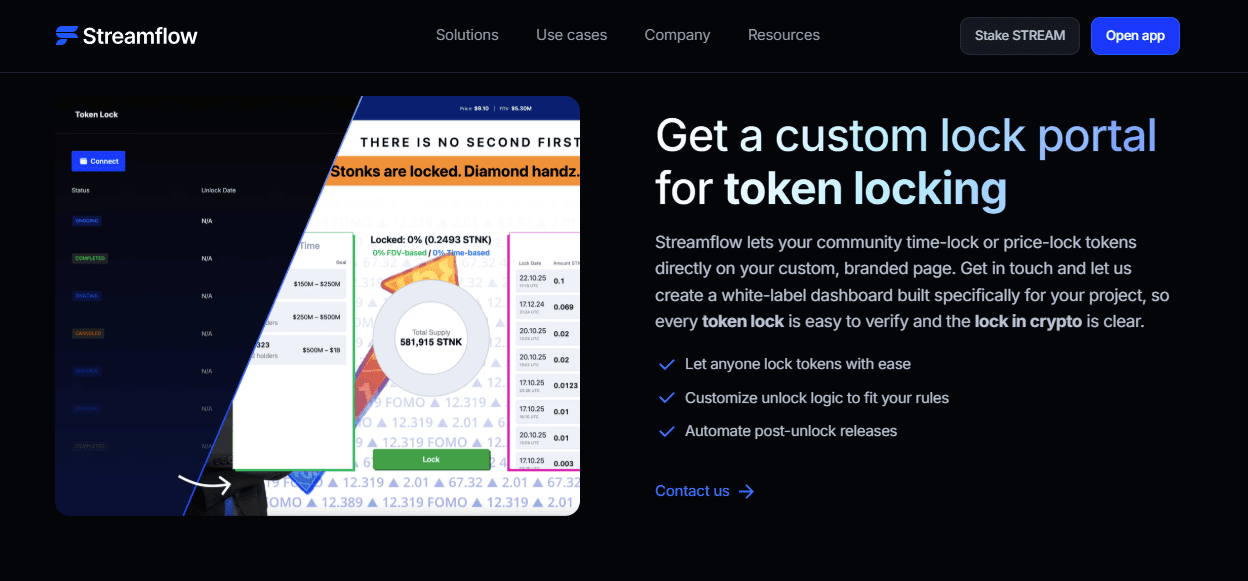
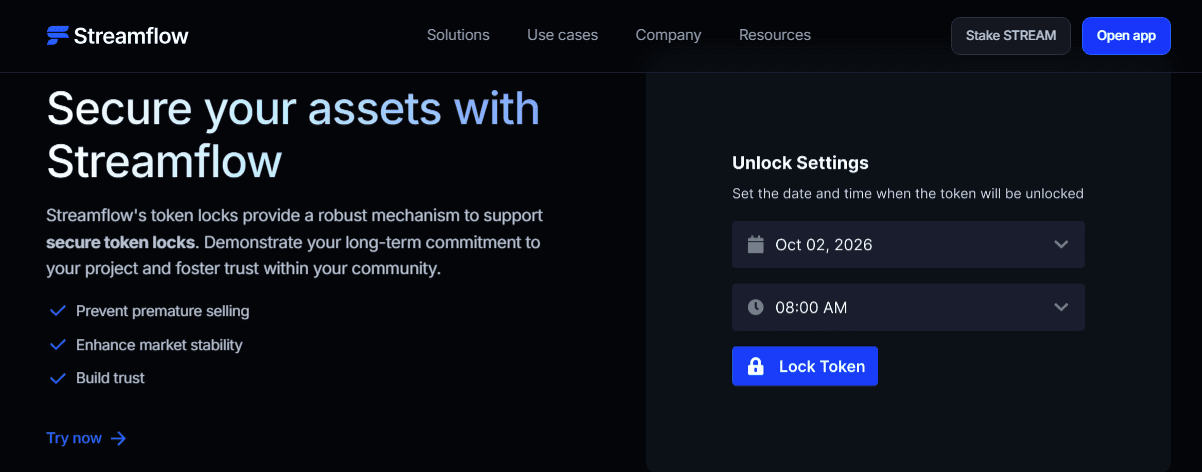
Streamflow inverts that dynamic by making the proof a product of the lock itself. Locks created on the platform generate public proof links and dashboard visibility, are verifiable on Solscan, Solana Explorer, and RugCheck, and support both SPL tokens and LP tokens. Time-based and price-based unlock conditions are both enforced by the contract rather than by the team's discretion.
The contracts are audited by FYEO and OPCODES, immutable once deployed, and carry no admin override, which removes the two questions Step 3 exists to answer. Setup takes roughly 37 seconds through the no-code interface, so there is no operational excuse for a project to skip it.
Teams can open the Streamflow app and produce a verifiable lock before their pool goes live.
Case Study: How Bonk Made Its Distribution Verifiable
Bonk launched as a Solana meme coin with 55% of supply allocated to airdrops for early Solana users, a distribution profile that invites exactly the skepticism this guide describes. Community trust was the constraint on the project, not technical capability.
Bonk used Streamflow for core team vesting, placing 20% of total supply across 22 early contributors on a 3-year linear vesting schedule. The schedule is enforced on-chain and independently verifiable, which converted the team's commitment from a stated intention into a checkable fact.
The lesson generalizes past meme coins. A verifiable contract answers a holder's question in seconds; a blog post starts a debate.
What This Means for Founders and Token Issuers
If you are launching on Solana in 2026, assume every serious buyer runs some version of the five steps above, and assume the sophisticated ones run all five. Your job is to make each step return a clean answer in under a minute.
That means locking a meaningful percentage of LP for a duration that matches your roadmap, renouncing mint and freeze authority, putting team and investor allocations under published vesting contracts, and linking the proof from your own site. It also means locking before you market, not after someone asks.
Median rug pull lifecycles in the Sun Yat-sen dataset were measured in hours, which has trained the market to treat unverified new tokens as guilty until proven otherwise. Verifiable locks are how legitimate projects exit that default assumption, and they cost near-nothing to produce on Solana.
Conclusion
Checking whether a token's liquidity is locked is a five-variable question, not a badge: which pools, who holds the LP, what the contract enforces, how much and for how long, and whether supply-side authorities and allocations are constrained.
Streamflow turns each of those variables into a public, immutable, on-chain answer, which is why 40,000+ projects and $243M+ in total value locked run through the platform. Verification is only adversarial when the project makes it so.
Book a demo to see how Streamflow handles LP and team token locks with public proof links your community can verify independently.
Read Next:
Do Token Locks Prevent Rug Pulls? What Locked Liquidity Actually Protects Against
How to Distribute SPL Tokens on Solana: Airdrops, Vesting, and Bulk Distribution Tools
How to Verify a Token Lock On-Chain: Step-by-Step Checklist for Solscan and Etherscan
FAQs:
1. How do you check if a token's liquidity is locked on Solana?
You check if a token's liquidity is locked on Solana by locating the token mint and all of its pools on Solscan or Solana Explorer, identifying which address holds the LP tokens, opening the lock contract to read its terms, calculating the locked percentage and unlock date, then confirming that mint and freeze authorities are renounced. A screener badge is a starting point, not a verification. Any step that cannot be completed with public on-chain data should be treated as a negative result.
2. What is the difference between a token lock and a liquidity lock?
The difference between a token lock and a liquidity lock is what gets restricted. A token lock restricts native project tokens such as team, treasury, and investor allocations, while a liquidity lock restricts LP tokens so the pool itself cannot be drained. Streamflow supports both, with time-based and price-based unlock conditions enforced by immutable smart contracts.
3. Can locked liquidity still be rug pulled?
Locked liquidity can still be rug pulled when the lock covers only part of the pool, expires shortly after launch, sits in a program with an admin override, or exists alongside an unlocked team allocation that gets sold into the pool. This is why percentage, duration, and contract immutability all need checking rather than lock existence alone. Locks built on Streamflow are immutable once deployed and carry no admin override.
4. Does Streamflow support locking LP tokens?
Yes, Streamflow supports locking LP tokens as well as any SPL token, with fixed-date and price-based unlock conditions. Every lock generates public proof links and dashboard visibility, and is verifiable on Solscan, Solana Explorer, and RugCheck. Locked tokens cannot be transferred, traded, or accessed before the unlock criteria are met.
5. How long does it take to lock tokens on Streamflow?
It takes roughly 37 seconds to lock tokens on Streamflow through the no-code interface, with no smart contract development required. Solana's near-zero transaction fees make the cost negligible compared with equivalent setups on Ethereum. Teams that need custom logic can build the same flows through the Streamflow SDK.
