General
Top 10 Benefits of Using the Streamflow App for Solana Teams
Solana recorded approximately 167 million monthly SPL token-holder addresses in April 2026, an all-time high according to the Solana Foundation's ecosystem roundup.
At that scale, managing token distribution with spreadsheets and manual transfers is no longer an option for serious teams.
Streamflow, the Solana-native token operations platform with over $302M in total value locked, 1.3M+ users, and 40,000+ projects, exists precisely to solve that problem.
The Streamflow app consolidates token locks, vesting, airdrops, staking, payments, and tokenomics tracking into a single on-chain system.
Instead of stitching together fragmented tools or building custom smart contracts, teams execute their entire token economy from one interface.
This article covers the market conditions pushing Solana teams toward automated token operations, the ten benefits that matter most, and how to get started.
Key Takeaways
Streamflow automates the full token lifecycle for Solana teams in one single platform.
No-code setup lets Solana teams lock tokens in as little as 37 seconds.
Streamflow contracts are audited by FYEO and OPCODES and immutable once deployed.
Airdrops on Streamflow scale to one million recipients with real-time claim tracking.
Over 40,000 projects trust Streamflow for vesting, locks, staking, and distribution.
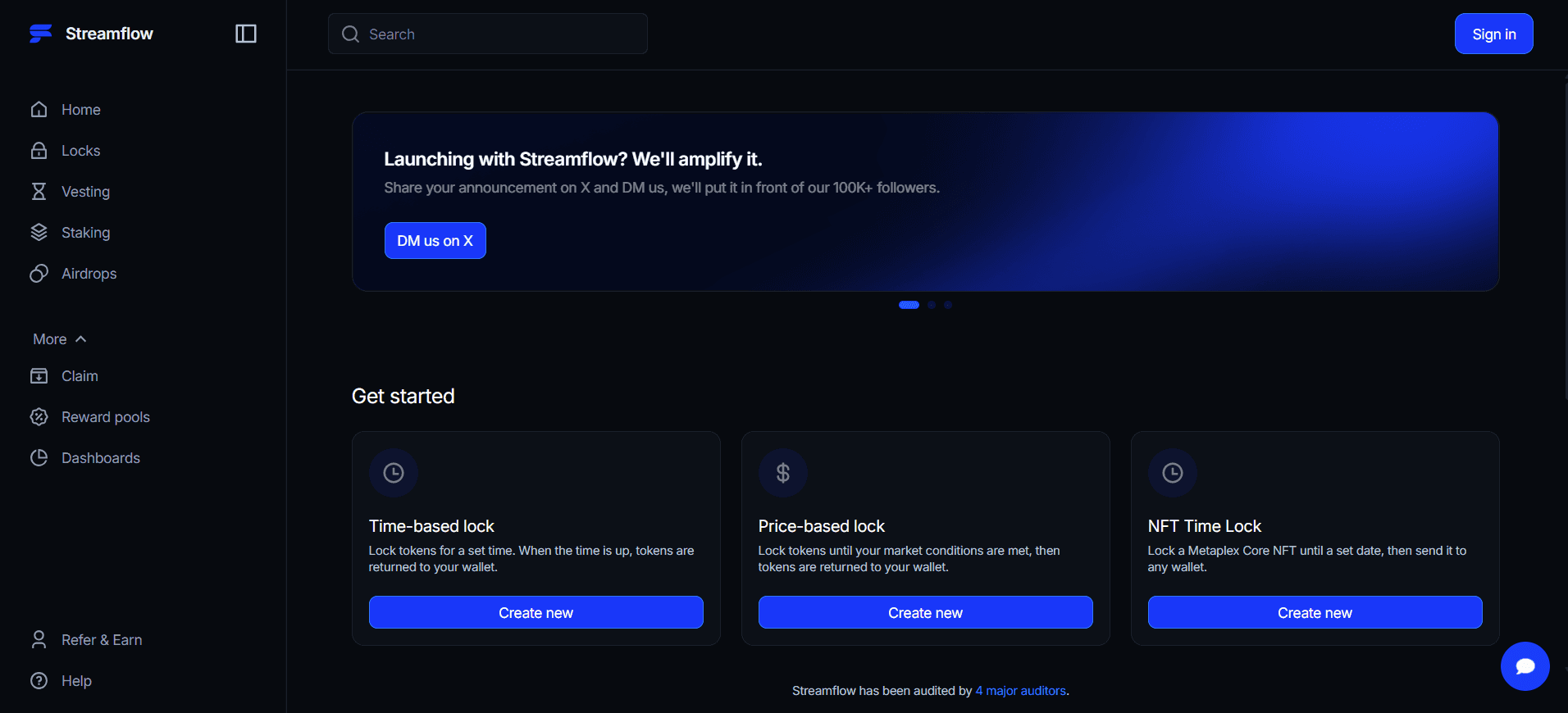
Why Token Operations on Solana Have Outgrown Manual Processes
Solana's growth has changed what token management demands. Beyond the record 167 million monthly SPL token-holder addresses, more than $1 billion in token unlocks were scheduled across crypto projects in June 2026 alone, per Crypto Briefing. Every one of those unlocks is a distribution event that must execute correctly, on time, and in public view.
Manual processes cannot keep up with that volume. Spreadsheet-tracked vesting introduces human error, off-chain promises cannot be verified, and hand-sent transfers do not scale past a few hundred wallets.
Manual errors compound as recipient counts grow into the thousands
Off-chain schedules offer no proof to investors or communities
Fragmented point tools force teams to reconcile data across systems
The market has effectively set a new baseline: token operations must be automated, on-chain, and verifiable. That baseline is exactly what Streamflow was built for.
What Solana Teams Should Expect From a Token Operations Platform
Before evaluating any platform's benefits, it helps to define the criteria. Solana teams typically judge token infrastructure against five dimensions.
Automation depth: does the platform execute distribution, or just plan it?
Security: are contracts audited, immutable, and verifiable on-chain?
Scale: can it handle thousands or millions of recipients without breaking?
Flexibility: does it support every schedule type your stakeholders need?
Operational cost: does it reduce engineering and admin overhead, not add to it?
Streamflow performs across all five, which is why over 40,000 projects use it for Solana token operations. The ten benefits below map directly to these criteria.
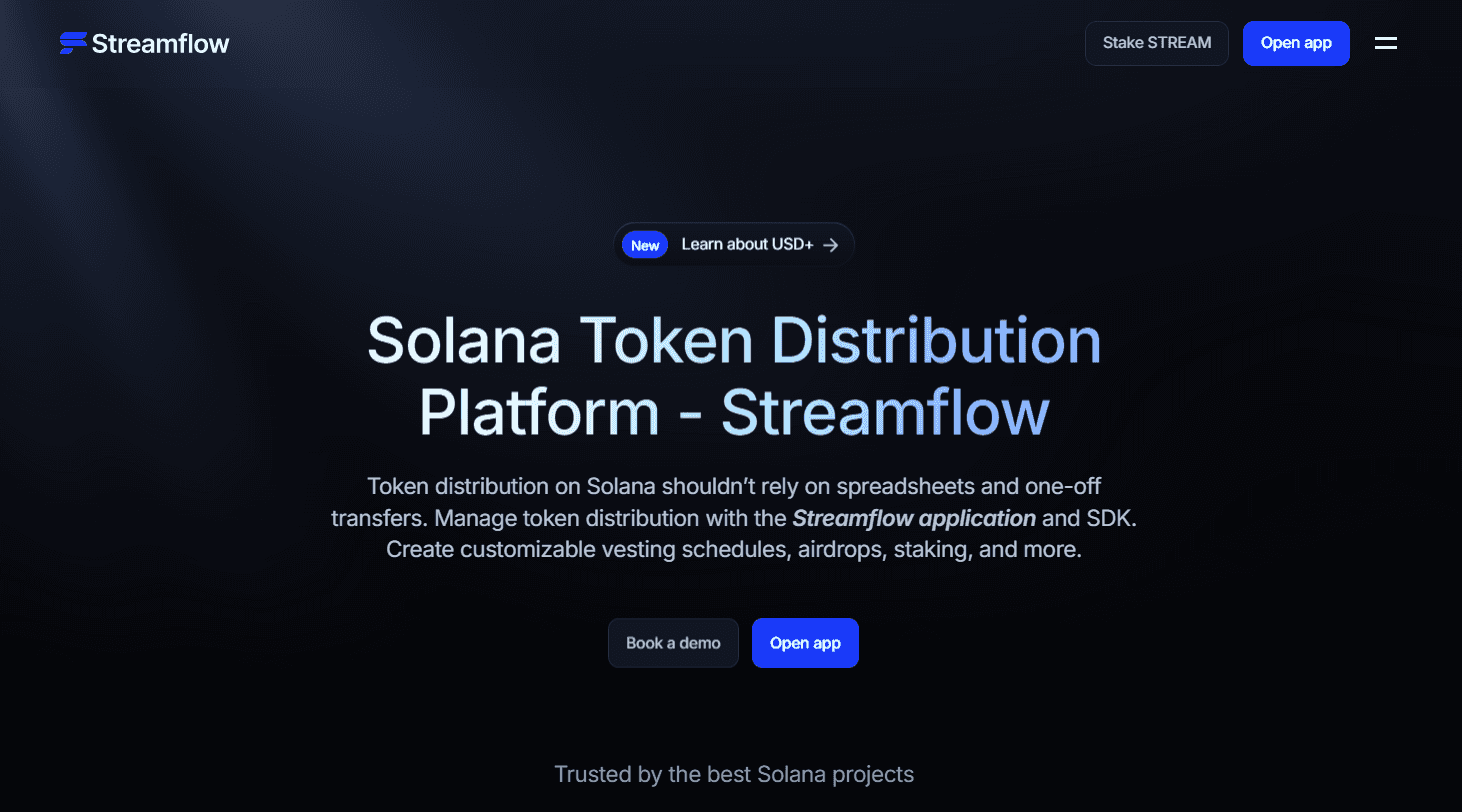
The Top 10 Benefits of Using the Streamflow App
1. One Platform for the Entire Token Lifecycle
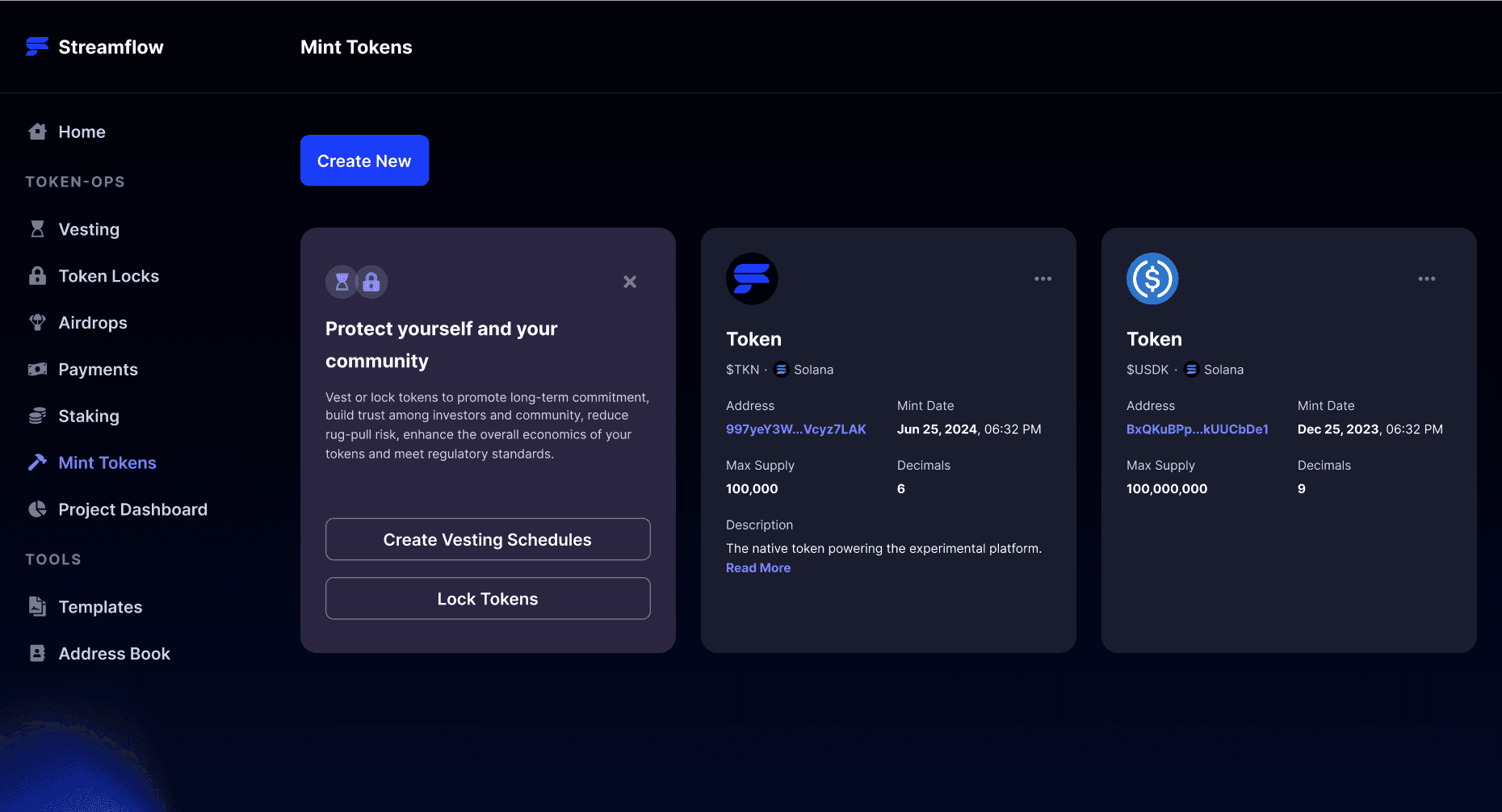
Most Web3 tools solve a single function. Streamflow operates as token operations infrastructure, covering the full lifecycle from token minting to distribution to ongoing incentives.
Token minting with metadata, supply, and permission configuration
Token locks with publicly verifiable unlock conditions
Vesting, airdrops, staking, payments, and a tokenomics dashboard in one place
A team launching a token can mint it, lock team allocations, run a community airdrop, and deploy staking without ever leaving the platform. That consolidation eliminates the integration risk that fragmented tooling creates.
2. No-Code Deployment Measured in Seconds
Speed matters for Solana teams, especially during launch windows. The Streamflow app turns contract deployment into a UI flow: create the contract, configure parameters, and deploy instantly.
Locking tokens takes as little as 37 seconds
Vesting contracts are created through bulk CSV import, no Rust required
Staking pools launch with no-code reward configuration
For a founder racing a launch date, tokenomics execution stops being an engineering ticket. It becomes a task any operator on the team can complete in minutes.
3. Audited, Immutable Smart Contracts
Security is non-negotiable when contracts hold team and investor allocations. Streamflow's smart contracts are audited by FYEO and OPCODES, and once deployed they cannot be unilaterally altered.
No admin override on vesting contracts
Immutability prevents insider manipulation and rug-pull risk
Every contract executes exactly as configured, every time
This is the difference between a promise and a guarantee. A token vesting schedule on Streamflow is enforced by code, not by trust in whoever holds the multisig.
4. Public, On-Chain Transparency by Default
Communities and investors no longer accept "trust us" as a distribution policy. Streamflow makes every contract verifiable on Solscan and Solana Explorer, with shareable proof links teams can post publicly.
Proof links show exactly what is locked and when it unlocks
Locked tokens cannot be transferred, traded, or accessed before unlock
Third-party verification works through explorers and tools like RugCheck
A project can answer a skeptical community member with a link instead of a statement. That transparency compounds into credibility over time.
5. Flexible Vesting for Every Stakeholder Group
Founders, advisors, investors, and DAO treasuries all need different release logic. Streamflow supports every major on-chain vesting model so one platform covers the whole cap table.
Linear, cliff, and cliff-plus-linear schedules
Milestone-based and price-based vesting
Graded schedules and fully custom intervals
A standard setup might put founders on a 12-month cliff with linear release, while ecosystem incentives unlock against milestones. Bulk CSV creation and automatic transfers mean a 200-recipient vesting plan deploys as easily as a single contract.
6. Airdrops That Scale to One Million Recipients
Manual airdrop execution collapses past a few hundred wallets. The Streamflow airdrop launch platform is built for campaigns at ecosystem scale.
Up to 1M recipients per airdrop, with 100K recipients per CSV import
Instant, vested, or price-based distribution types
Claim portals, real-time delivery status, and unclaimed token recovery
Vested airdrops deserve special attention. Instead of dumping tokens on recipients who sell immediately, teams release airdropped tokens over time, converting a one-time event into a retention mechanism.
7. No-Code Staking With Custom Reward Logic
Building staking infrastructure from scratch typically costs months of engineering. Streamflow lets teams deploy staking pools on Solana in minutes, for any SPL token.
Configurable APY, lock periods, and reward logic
Fund Once, Continuous Funding, Governance, and Custom pool types
Fully non-custodial pools with automated reward distribution
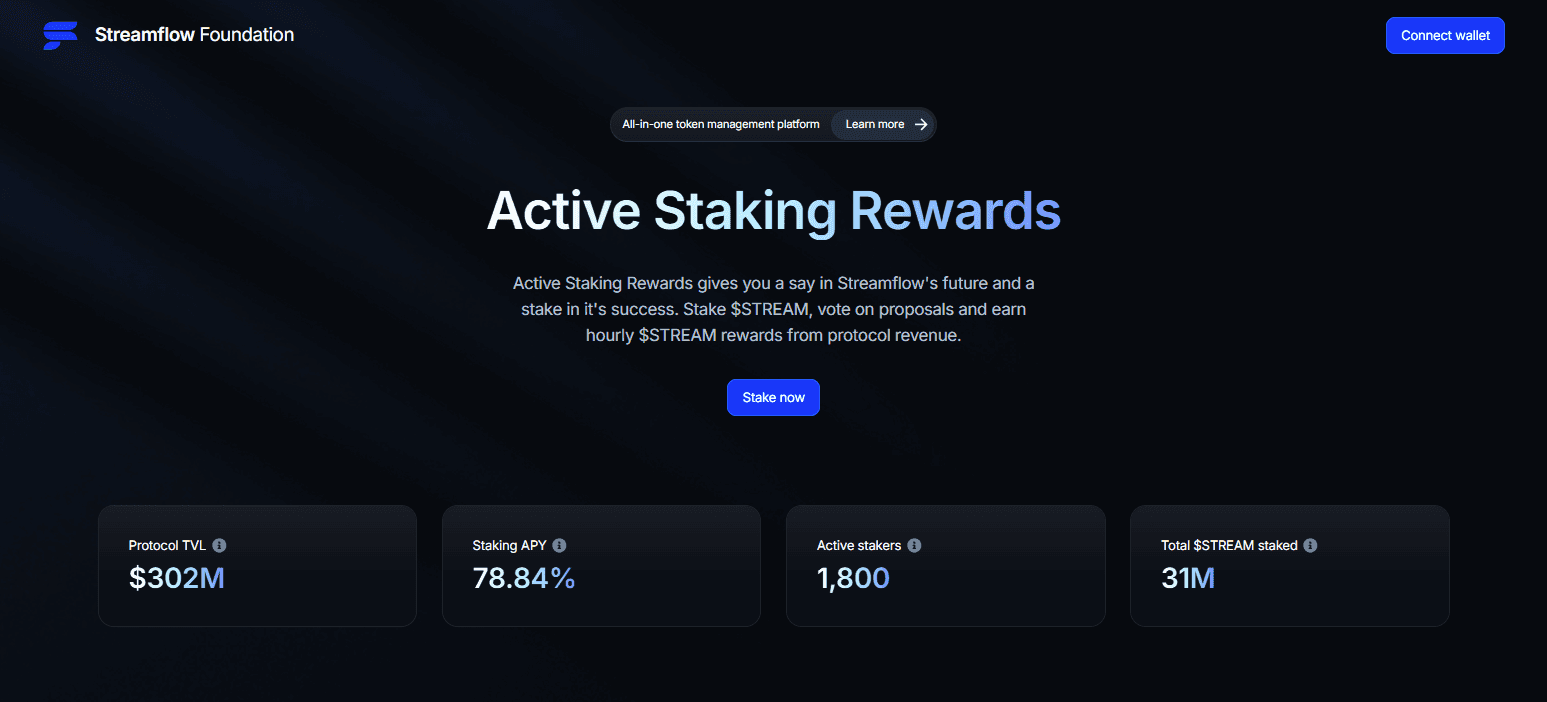
Teams use staking to reduce circulating supply, reward holders, and drive governance participation. Streamflow's own STREAM staking goes further with a revenue-backed model, where rewards come from protocol revenue and hourly buybacks rather than inflationary emissions.
8. A Real-Time Tokenomics Dashboard
Token distribution data is usually scattered across contracts, spreadsheets, and explorer tabs. The Streamflow tokenomics dashboard consolidates it into a single source of truth.
Real-time release progress across vesting contracts, locks, and staking pools
Cliff dates and unlock events visualized in one view
Public by default, so communities see the same data teams do
For a tokenomics designer or investor, this replaces hours of manual reconciliation. Every allocation and unlock schedule is visible, current, and verifiable.
9. Programmable Payments and On-Chain Payroll
Token operations do not end at launch. Streamflow supports recurring payout contracts for payroll-style payments to employees, contractors, and DAO contributors.
Salaries streamed in real time rather than fixed monthly batches
Recurring transfers that keep funding without redeploying contracts
Metadata for processed transfers accessible for accounting
This is where a Web3 CFO's workflow changes materially, since mass contributor payouts become a configured contract instead of a monthly manual process. Teams building full financial operations on Solana can extend into Streamflow Business, the Financial OS for Internet Capital Markets.
10. SDK and White-Label Infrastructure for Teams That Outgrow the UI
The no-code app is the starting point, not the ceiling. Streamflow's SDK lets developers embed token distribution logic directly into their own products.
Custom vesting, payment, and reward flows built on audited infrastructure
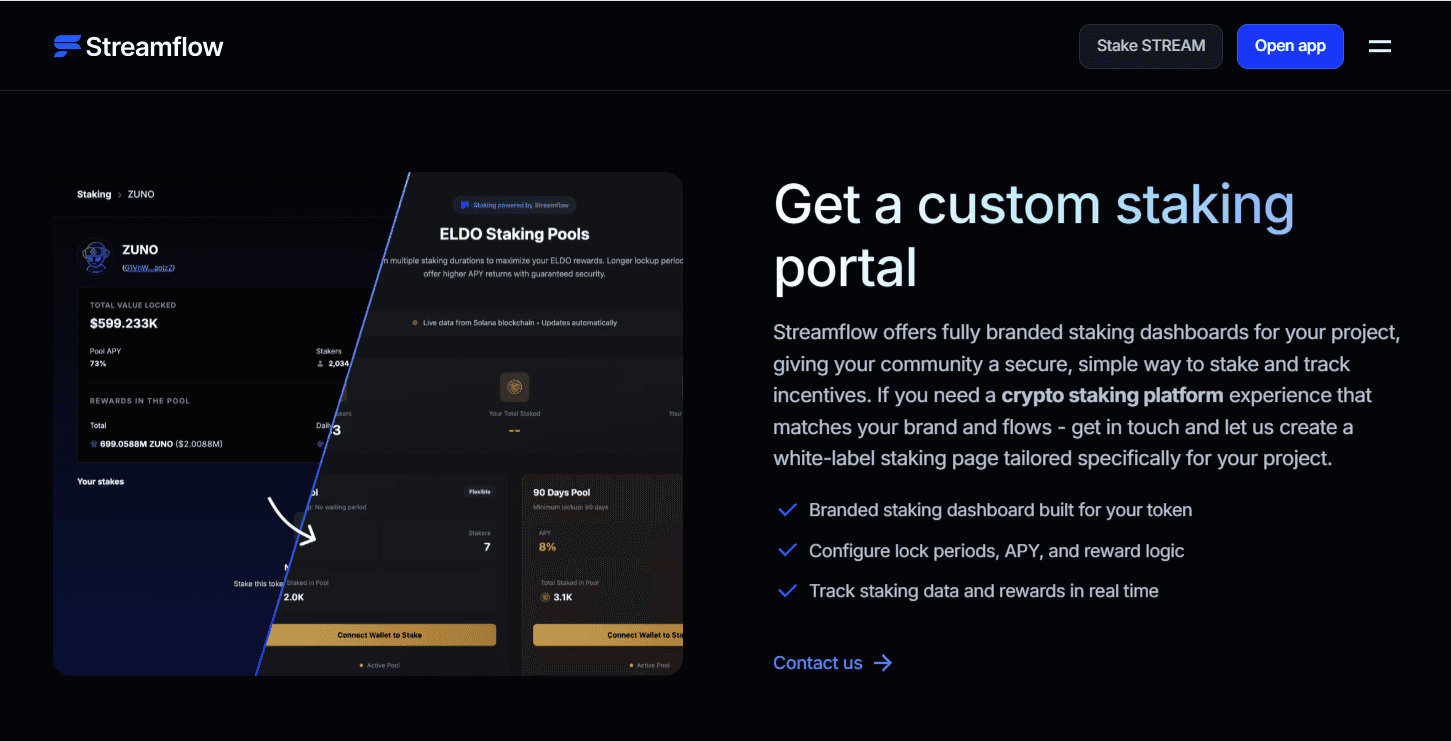
White-label claim portals, staking dashboards, and lock pages under your own brand
Bespoke onboarding and custom-built staking programs from the Streamflow team
UXD Protocol demonstrates the pattern: the team integrated the Streamflow SDK into Realms so stakeholders could claim vested $UXP and participate in governance from the same interface. Roughly 46% of $UXP supply runs on a 4-year linear vesting schedule with a 12-month cliff through that integration.
Proof at Scale: How Bonk Used Streamflow for Core Team Vesting
These benefits are not theoretical. Bonk, the Solana meme coin that allocated 55% of its supply to airdrops for early Solana users, needed a credible way to handle its core team allocation and turned to Streamflow for on-chain vesting.
20% of total supply placed under vesting
22 early contributors covered
A 3-year linear vesting schedule enforced by immutable contracts
The outcome was trust. Because the schedule was on-chain and publicly verifiable, the community could confirm that contributors could not dump their allocation, which mattered enormously for a meme coin fighting skepticism.
Which Benefits Matter Most at Each Stage
Not every team needs all ten benefits on day one. A simple sequencing framework works for most Solana projects.
Pre-launch: mint the token, then lock or vest team and investor allocations.
Launch: run the airdrop with claim portals and vested distribution.
Post-launch: deploy staking, turn on the tokenomics dashboard, automate contributor payouts.
The advantage of a unified platform is that each step builds on the last without new tooling. The same interface that locks your team tokens will run your million-recipient airdrop later.
How to Get Started With the Streamflow App
Getting started requires nothing more than a Solana wallet. Streamflow is permissionless and works with any SPL token, so there is no application or approval process for the core products.
Connect a supported wallet such as Phantom, Solflare, or Backpack
Pick your first operation: lock, vesting contract, airdrop, or staking pool
Configure parameters through the UI, or bulk import recipients via CSV
Fund the contract and deploy; execution runs automatically from there
Open the Streamflow app to run your first lock or vesting contract in under a minute. Teams with larger or custom requirements, such as white-label portals or bespoke staking programs, can work directly with the Streamflow team.
Conclusion
At 167 million monthly SPL token-holder addresses, Solana's scale has made manual token operations obsolete, and the ten benefits above show why over 40,000 projects have moved to automated infrastructure instead.
Streamflow gives Solana teams one audited, no-code platform for locks, vesting, airdrops, staking, payments, and real-time tokenomics tracking.
The result is token distribution that executes exactly as designed, at any scale, with proof anyone can verify on-chain.
Book a demo to see how Streamflow handles your token launch, vesting schedules, and community airdrop from a single platform.
Read Next:
FAQs:
1. What are the main benefits of using Streamflow for Solana teams?
The main benefits of using Streamflow for Solana teams are full token lifecycle automation, no-code deployment, audited immutable contracts, and on-chain transparency. The platform covers locks, vesting, airdrops, staking, payments, and a real-time tokenomics dashboard in one system. Over 40,000 projects and 1.3M+ users already rely on it.
2. How fast can a team set up token locks on Streamflow?
A team can set up token locks on Streamflow in as little as 37 seconds. The entire flow is no-code: create the contract, configure the unlock conditions, and deploy. Locked tokens cannot be transferred, traded, or accessed until the unlock criteria are met.
3. Can Streamflow scale to a million-recipient airdrop?
Yes, Streamflow can scale to airdrops with up to one million recipients. Teams import up to 100,000 recipients per CSV, launch claim portals, and track delivery status in real time. Airdrops can be instant, vested, or price-based depending on the campaign design.
4. Is the Streamflow app's smart contract code audited?
Yes, Streamflow's smart contracts are audited by FYEO and OPCODES. Contracts are immutable once deployed, with no admin override, and every distribution is verifiable on Solscan and Solana Explorer. This eliminates the manipulation and rug-pull risks associated with unaudited custom contracts.
5. Does Streamflow support payroll and recurring payments for Solana teams?
Yes, Streamflow supports recurring payout contracts that work for payroll-style payments to employees, contractors, and contributors. Teams can automate payouts and keep funding contracts over time without redeploying. This makes it practical for CFOs to run mass contributor payouts on-chain.